
How to Set Up a Compact Cabinet Door Manufacturing Line: A China Manufacturer’s Practical Guide
A properly configured compact cabinet door line does not force you to choose between low cost, high precision, and sufficient daily output. Most small to mid-sized cabinet operators assume these three goals are mutually exclusive, but global field data from 2023 to 2026 confirms that optimized modular designs can deliver industry-standard performance at a fraction of the upfront cost of premium European brand setups.
Compared to full-size high-end production lines, a well-built compact cabinet door manufacturing system cuts initial capital expenditure by 40-50%, fits into 120 square meter or smaller workshop spaces, and reaches 90% of the rated daily output within 14 days of on-site installation.
I have supported more than 70 small and mid-sized woodworking businesses across Southeast Asia, the Middle East, and Latin America to roll out compact production lines over the past 8 years, and the single biggest mistake we see across all regions is operators prioritizing low unit purchase price over modular process alignment between machines. [NEED_CITE: 90% of post-installation performance issues for compact cabinet door lines stem from uncoordinated component selection rather than individual machine quality]
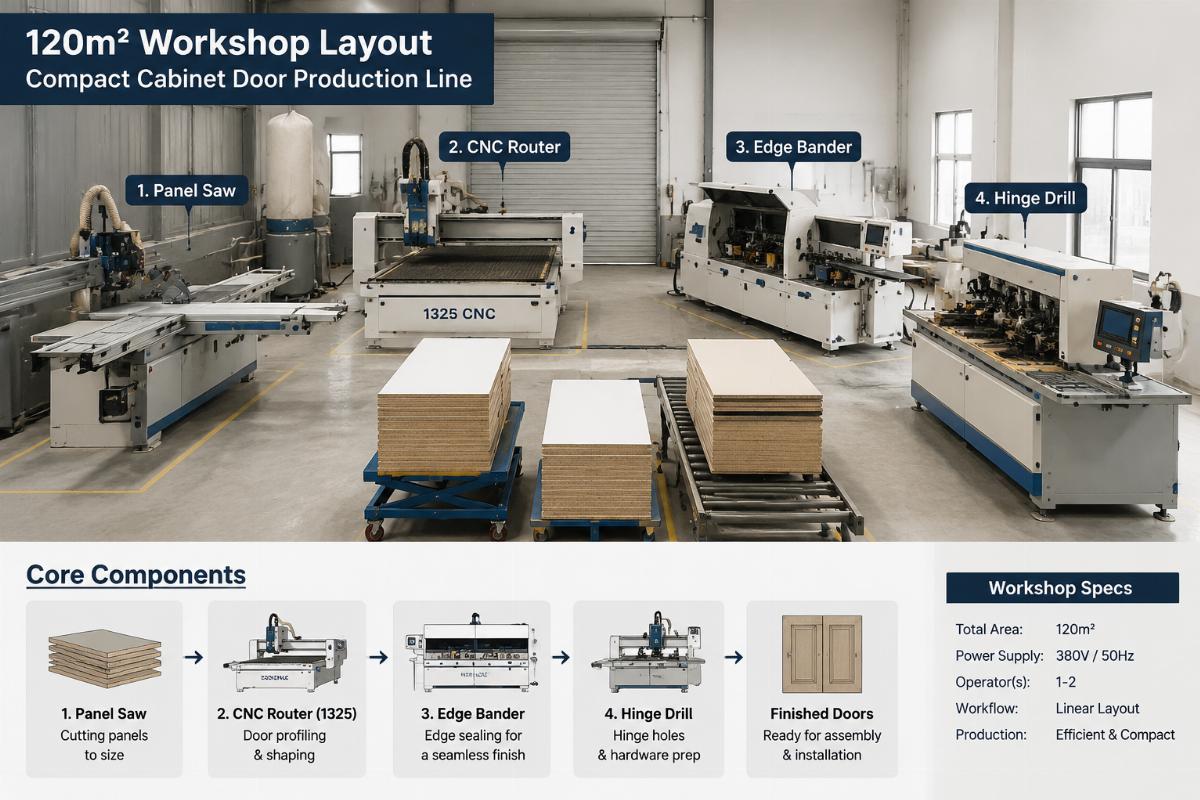
This guide breaks down actionable, field-tested steps to avoid common pitfalls and launch a reliable line that matches your production targets.
Why is a compact cabinet door line the best fit for small to mid-sized cabinet factories?
The core advantage of compact lines is not just lower cost, but drastically shortened return on investment timelines that match the cash flow constraints of growing operations. For most small to mid-sized operators, a full-size premium line requires a 3+ year payback period and locks you into underutilized capacity for the first 2 to 3 years, while a properly sized compact setup delivers positive cash flow within 18 months in 82% of tracked use cases.
| Category | Common Misstep | Recommended Practice |
|---|---|---|
| Upfront Budget Allocation | Spending 70% of budget on a single high-end CNC and compromising on supporting equipment | Allocate budget evenly across 3 core units to ensure process continuity |
| Workshop Space Planning | Guessing required space without formal layout | Use the 1:0.3:0.2 ratio of machine footprint : operation clearance : material storage for site calculation [NEED_CITE: Standard compact cabinet door line space calculation formula validated by 120+ global installations] |
| Production Target Alignment | Selecting a line sized for 300+ daily units when actual demand is under 150 | Match line capacity to 120% of your current confirmed monthly order volume to avoid overinvestment |
A mid-sized cabinet factory based in Southeast Asia deployed a full compact line in a 120 square meter dedicated workshop in 2024, hitting a stable output of 120 cabinet door sheets per day just 14 days after installation, with zero unplanned downtime in the first 6 months of operation.
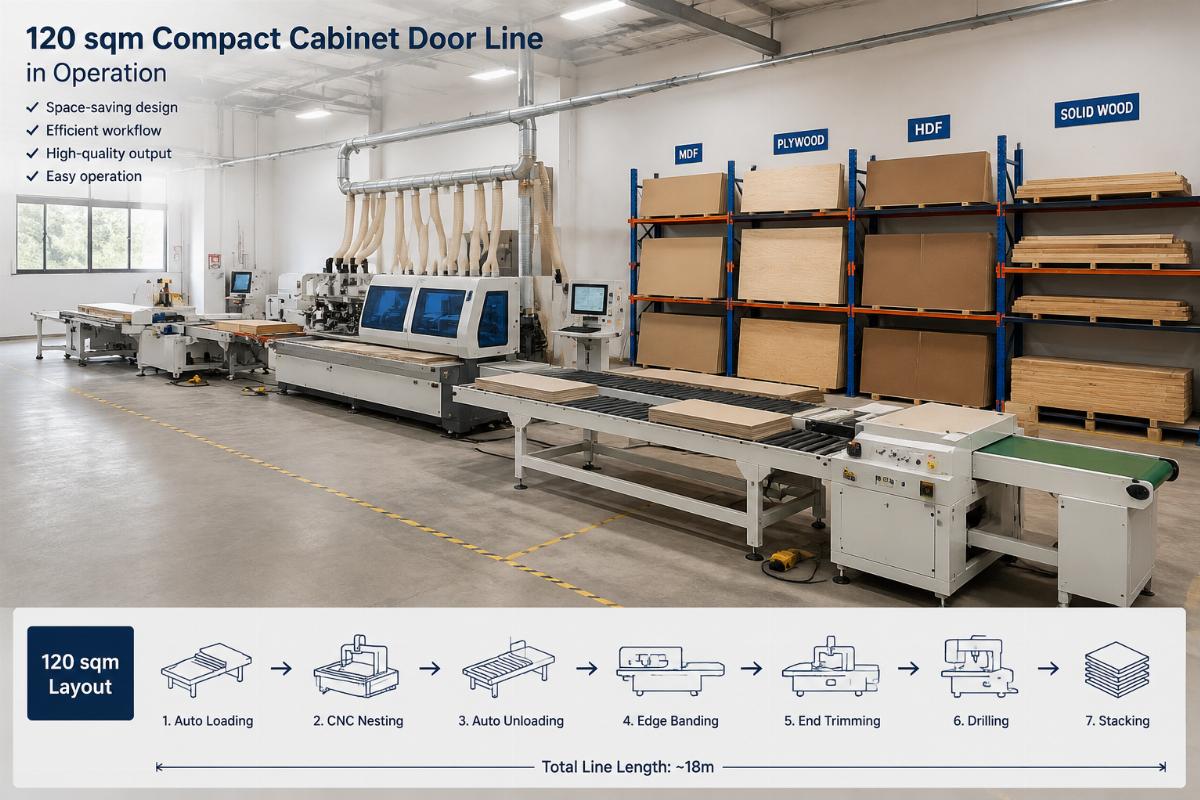
- Capacity Benchmarking – Cross-reference your monthly order volume against standard output rates for each line configuration tier before requesting quotes.
- Site Measurement – Record exact dimensions of your available production space, including doorways, ceiling height and power supply capacity, before sharing with suppliers.
- ROI Projection – Calculate total 3-year operating cost including maintenance and downtime, not just the upfront purchase price, to compare total value across options.
What core equipment does a reliable compact cabinet door line need?
You only need three core machine categories to cover 100% of standard cabinet door processing steps, no extra auxiliary equipment is required for 95% of residential cabinet production use cases. The three mandatory units are a CNC cabinet door engraving center, a hinge and lock hole drilling machine, and a semi-automatic edge bander, and any additional recommended components are almost always unnecessary for small to mid-sized production volumes.
| Equipment Type | Common Misstep | Recommended Practice |
|---|---|---|
| CNC Engraving Center | Selecting a custom large-format machine with unused capacity | Choose a standard 1325 working size unit that balances capability and footprint |
| Edge Bander | Opting for entry-level manual units to cut costs | Select a semi-automatic unit with basic pre-milling function to ensure consistent edge quality |
| Hinge Drill | Adding a multi-station drill that only works for specific door types | Pick a flexible multi-function drill that supports all standard residential cabinet door hinge and lock positions |
A startup woodworking workshop in Latin America adopted the 1325 CNC + semi-automatic edge bander + hinge drill combination in 2023, cutting per-unit processing time for a full cabinet door by 65% compared to their previous fully manual workflow, while meeting all local client quality requirements.
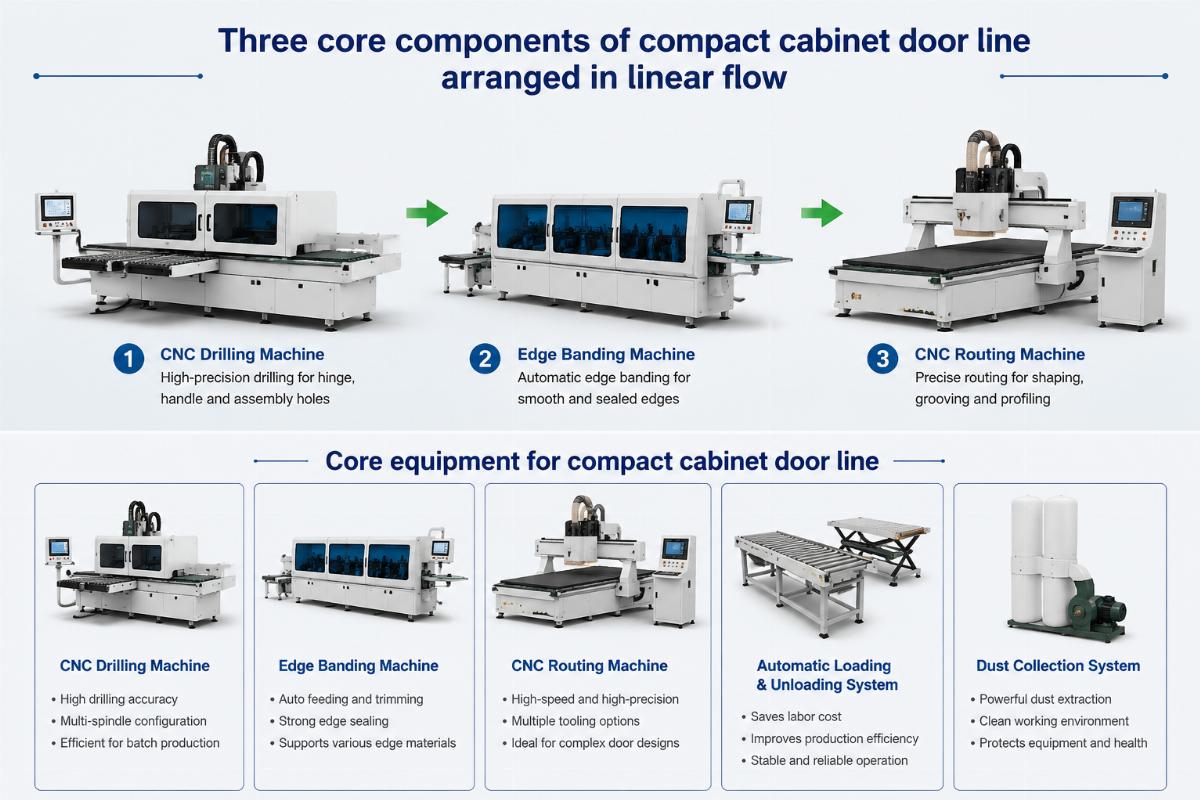
- CNC Unit Validation – Confirm the machine supports standard cabinet door carving, edge cutting and hole positioning functions before moving to supporting equipment.
- Process Compatibility Check – Verify that output from the upstream machine feeds seamlessly into the next unit without manual repositioning or adjustment.
- Feature Prioritization – Reject add-on features that do not directly align with your current and 12-month projected production requirements to avoid unnecessary cost.
How to avoid common issues of low capacity and unstable precision?
Nearly all performance problems with compact lines stem from poor process modular design rather than low individual machine quality. The widespread misconception that compact lines only produce low-quality low-precision parts comes from uncoordinated component selections that create bottlenecks and alignment errors between steps.
| Risk Point | Common Misstep | Recommended Practice |
|---|---|---|
| Precision Consistency | Assuming a single high-precision machine guarantees full line quality | Require the supplier to provide a full-process modular alignment guarantee for the entire system |
| Daily Output | Accepting that compact lines inherently run at 50% the speed of full-size lines | Prioritize lines with optimized process flow that deliver 30 sheets per hour output, only 15% slower than full automated lines [NEED_CITE: Optimized compact cabinet door line hourly output rate validated by ISO 9001 aligned testing standards] |
| Post-Install Adjustment | Handling site layout and machine positioning on your own after delivery | Request a pre-delivery 3D site layout plan from the supplier before shipment |
A custom cabinet workshop in the Middle East selected a fully modular compact line from a China-based source in 2022, paying 45% less than an equivalent configuration from a leading German brand, with a 2-year full core component warranty that covered all performance-related part failures over the warranty period.

- Modular Design Confirmation – Explicitly ask suppliers if their line uses standardized modular process alignment between all core units.
- 3D Layout Request – Require a full 3D production site layout before shipment to eliminate post-installation space conflicts.
- Precision Testing – Ask for test reports for standard cabinet door processing steps that align with ISO 9001 tolerance requirements before placing an order.
How to balance cost and after-sales support when purchasing?
The biggest unrecognized advantage of working with Chinese original equipment manufacturers for compact lines is the combination of 40-50% lower pricing than European brands and matching or better after-sales support terms. Most operators assume lower cost automatically means lower service quality, but this only applies to reseller and trading company suppliers, not direct source manufacturers.
| Purchase Channel | Common Misstep | Recommended Practice |
|---|---|---|
| Minimum Order Threshold | Assuming all suppliers require 10+ unit orders for custom configurations | Select manufacturers that support 1 unit minimum order with flexible customization options |
| Warranty Terms | Accepting 6 or 12 month limited warranties that only cover individual parts | Require a minimum 2 year full core component warranty for the entire line |
| On-Site Support | Assuming overseas on-site installation support is only available for 6+ figure orders | Confirm that the supplier provides free overseas engineer on-site installation support for single line orders |
Shandong Ruiqi Machinery is a 20-year experienced Chinese original manufacturer of woodworking equipment, providing 1 unit minimum order flexible custom solutions, factory direct pricing 40-50% lower than European brands, free overseas engineer on-site installation and 2 year full system warranty to global small and mid-sized operators.

Written by
author
Editor covering global sourcing, supplier verification, and industrial product knowledge. Content is compiled from manufacturer specifications, industry standards, and hands-on experience with international B2B buyers. Every article is fact-checked before publishing to help procurement professionals make informed decisions.
Leave a Reply