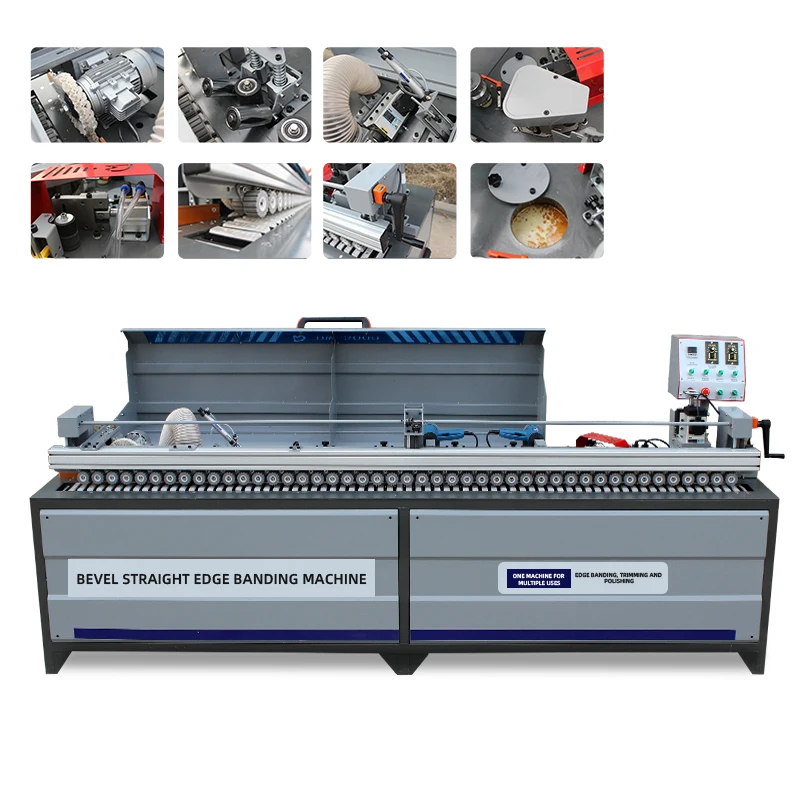
Edge banding machine
Click to enlarge
ISO 9001
CE Certified
OEM / ODM
12-Mo Warranty
Edge banding machine
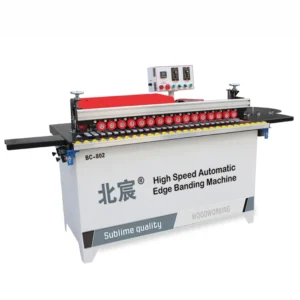
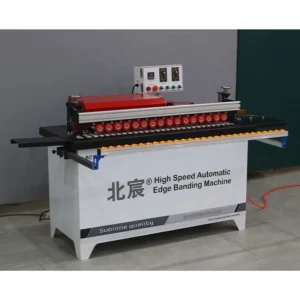
45 Degree Bevel and Straight Edge Banding Machine with Pre-Milling – Industrial Application
<p><strong>DW3000 45 Degree Bevel and Straight Edge Banding Machine, 11KW, 0-12M/min Feed Speed, 0.3-3MM Edge Thickness</strong> — addresses glue-line inconsistency across MDF, plywood and particleboard substrates.</p> <ul> <li>Pre-milling station squares the panel edge before gluing for uniform bond quality</li> <li>Dual heat gun and 8 oblique pressure wheel groups handle straight and bevel edges in one pass</li> <li>Three spindle trimming motors deliver finish-ready edges without secondary hand work</li> </ul> <p>Verified pre-shipment testing on your specific panel material and edge banding thickness, with multilingual manuals and control panels matched to your operators.</p>
100+
Countries
MOQ 1
Unit
15-25 Days
Lead Time
== Gate == identifier: FX-20 → 通过 Edge Banding Machine
11KW Motor
45 Degree Bevel
Dual Heat Gun
DW3000
Furniture Factory
MDF Panel
Pre-milling
Process And Application
- Full OEM/ODM support -- custom logo, voltage (110V-440V), multilingual panels
- ISO 9001 & CE certified, 5 national patents, 60 professional engineers
- 12-month warranty, remote technical support & spare parts service
- Professional export packaging, customs clearance support, on-time delivery
Four-Stage QC with Pre-Shipment Verification — Every DW3000 undergoes incoming, in-process, finished, and pre-shipment inspection covering both straight and 45° bevel runs with your specified edge banding material before it leaves the factory.
Technical Specifications
| Parameter | Value |
|---|---|
| Model | DW3000 |
| Product Type | 45 Degree Bevel and Straight Edge Banding Machine with Pre-Milling |
| Total Power | 11 kW |
| Voltage | 380V / 415V (configurable from 110V to 440V) |
| Pre-Milling Motor | 2.2 kW |
| Heating Power | 2.2 kW × 2 (dual heat gun) |
| Trimming Power | 2.2 kW × 2 + 800 W silent trimming motor |
| Polishing Power | 0.4 kW × 2 |
| Vacuum Power | 550 W |
| Feed Speed | 0–12 m/min |
| Edge Banding Height | 0–50 mm |
| Edge Banding Thickness | 0.3–3 mm |
| Bevel Angle Range | 30°–90° (8 groups of oblique pressure wheels) |
| Minimum Sheet Length | 30 cm |
| Minimum Sheet Width | 15 cm |
| Glue Pot Capacity | 4000 ml |
| Air Source Pressure | 0.5–0.7 MPa |
| Overall Dimensions (L×W×H) | 299 × 65 × 130 cm |
| Net Weight | 430 kg |
| Control Panel Language | Chinese and English (customizable to Spanish or other languages) |
| Plug Options | EU, USA, AU, UK |
| Key Features | Plate milling, 30°–90° edge banding, trimming, scraping, polishing, high-power vacuuming, edge band slotting device, spindle trimming motors |
Application Suitability
| Application | Material or Output |
|---|---|
| Custom cabinet door edge banding | MDF panels with PVC edge banding, straight and 45° bevel profiles |
| Wardrobe and shelving visible panel finishing | Particleboard carcasses with 0.3–3 mm veneer or PVC banding |
| Plywood furniture component sealing | Plywood panels requiring pre-milled edge cleaning before gluing |
| Mixed-substrate workshop production | MDF, particleboard, plywood, and solid wood panels on one machine |
| Bevel-edge decorative furniture parts | Solid wood panels with 30°–90° beveled edge banding |
Why Glue Lines Appear on Some Substrates But Not Others
The edge surface your adhesive bonds to is only as good as the cut that created it.
The edge banding machine process and application reality is that MDF, particleboard, and plywood each present a different edge texture after sizing. Particleboard tears at the surface, leaving voids. MDF edges compress unevenly. Plywood grain direction changes mid-panel. When the saw blade finishes the cut, none of these surfaces are ready for a clean glue bond [NEED_CITE: panel substrate edge quality standards for furniture manufacturing]. A pre-milling station solves this by removing the damaged outer layer and producing a flat, square reference edge before the glue is ever applied. I remember a cabinet factory that ran PVC banding on particleboard without pre-milling — every third panel showed a visible glue seam under fluorescent showroom lighting. After switching to a pre-milled workflow, the rejects dropped and the client stopped blaming the operator.
How Pre-Milling Changes the Bond on Particleboard and MDF
The 2.2 kW pre-milling motor on this edge banding machine removes a thin layer from the panel edge before the gluing station. On particleboard, this eliminates the tear-out left by the panel saw and exposes a denser, more uniform substrate. On MDF, it flattens the compressed fibers that the saw blade pushes outward. The result is a consistent glue spread across the entire edge height, which is exactly what the edge banding machine process and application demands when you switch between substrate types during a single production run.
Dual Heat Guns and the Problem of Uneven Band Conforming
The DW3000 uses two 2.2 kW heat elements rather than a single source. This matters when you run thicker PVC or real wood veneer banding on curved or wide panels. A single heat gun often leaves the top or bottom edge of a 50 mm band cooler than the center, causing incomplete bonding at the margins [NEED_CITE: thermal bonding requirements for PVC and veneer edge banding materials]. The dual configuration heats the band across its full width, so it conforms to the panel edge without lifting — particularly on bevel cuts where the contact geometry is already less forgiving than a straight edge.
Reading the Specs That Actually Affect Your Output
The feed speed range of 0–12 m/min gives operators room to slow down for veneer banding, which demands more careful heat and pressure management, and speed up for PVC on standard carcass panels. The 8 groups of oblique pressure wheels, adjustable from 30° to 90°, press the band into the panel edge during the critical seconds while the adhesive is still open. On straight edges, all eight groups apply perpendicular force. On bevel cuts, the oblique angle means fewer contact points — which is why eight groups exist, to distribute that force across the band length and prevent air pockets. The 4000 ml glue pot capacity supports continuous runs without frequent refills, and the 0.3–3 mm thickness range covers everything from thin PVC to thicker solid wood strips [NEED_CITE: edge banding thickness compatibility with hot melt adhesive systems]. Three spindle trimming motors — two at 2.2 kW plus an 800 W silent unit — handle rough and finish trimming in a single pass, which directly affects whether downstream assembly sees a clean edge or one that needs hand-sanding.
What Happens When Voltage and Language Are an Afterthought
Machines quoted without confirming local supply arrive and refuse to start, or worse, run at incorrect speeds that burn through trimming motors. A 380V machine plugged into a 440V supply without verification will overheat the heating elements and fail within weeks [NEED_CITE: voltage and frequency mismatch effects on industrial edge banding equipment]. The control panel language is another common failure point. When the operator cannot read the display, they guess at parameters — and glue temperature is not something you guess at. The DW3000 ships with customizable control panel languages and configurable voltage from 110V to 440V, but only if those details are confirmed before production begins.
Why Procurement Through This Channel Works
The four-stage QC process covers incoming material, in-process assembly, finished product, and pre-shipment verification with a test run on your actual panel material and banding thickness. An engineer-led configuration recommendation arrives as a formal quotation within 24 hours of your inquiry. Patented cutting mechanisms achieve verified tolerances rather than claimed ones, and the test record ships with the machine. Factory visits are welcomed, so you can see the DW3000 run your substrate before it is crated. Voltage, plug type, and control panel language customization is treated as standard configuration, not a special request.
Documentation & Verification
- CE declaration of conformity covering machinery and electrical safety directives
- ISO 9001 certificate for the manufacturing quality management system
- Factory test record on your specified panel thickness and banding material before dispatch
- Electrical schematic and voltage confirmation matched to your workshop supply
- Operation and maintenance manual in your operators’ chosen language
- Spare parts list with part numbers matching the as-built configuration
Installation, Commissioning & Support
- 299 × 65 × 130 cm footprint requires a level concrete floor with clearance for panel infeed and outfeed
- 11 kW total power demands a dedicated 380V/415V circuit with correct phase and frequency verification
- 430 kg net weight allows standard forklift handling; machine ships assembled with minimal on-site setup
- First-run commissioning includes glue temperature calibration for your specific banding material and thickness
- Control panel language set before shipment; operator training covers bevel angle adjustment and pressure wheel tuning
- Edge band slotting device and trimming motor spindles require scheduled inspection per the maintenance manual
Before You Request a Quote
Send the panel materials you actually run — MDF, particleboard, plywood, or solid wood — along with typical thickness and the edge banding type and width. Confirm your workshop voltage, frequency, and plug standard. Let us know if you need straight-only, bevel-only, or both, and what your daily throughput target is. If you have upstream panel saws or downstream boring machines already in place, share their feed speeds so we can match the line.
Frequently Asked Questions
Q: How does pre-milling affect edge quality on MDF versus particleboard versus plywood?
A: Pre-milling removes the saw-damaged outer layer from each substrate. On particleboard it eliminates tear-out voids. On MDF it flattens compressed fibers. On plywood it evens out grain-direction irregularities. The 2.2 kW pre-milling motor produces a consistent reference surface, so adhesive bonds uniformly regardless of which material is running through the machine at that moment.
Q: Which edge banding materials work with the dual heat gun system?
A: PVC, ABS, and natural wood veneer all work within the 0.3–3 mm thickness range. The dual 2.2 kW heat guns warm the band evenly across its full width, which is particularly important for veneer and thicker PVC where uneven heat causes lifting at the top or bottom margin. Glue type and temperature should be matched to the specific banding material.
Q: What is the practical difference between straight-only and bevel-capable edge banding?
A: A straight-only machine cannot process 45° bevel edges, which limits you when customers request angled decorative panels or miter-fold cabinet components. The DW3000 handles 30° to 90° bevel angles with eight oblique pressure wheel groups, so one machine covers both straight and angled production without requiring a second dedicated unit on the floor.
Q: How do the oblique pressure wheels influence bond quality on beveled edges?
A: On a bevel cut, the band meets the panel at an angle, reducing the contact area compared to a straight edge. Eight groups of adjustable oblique pressure wheels distribute force along the entire band length at that angle, closing air gaps that a perpendicular-only pressure system would leave open. This maintains consistent bond strength across both straight and beveled runs.
Q: Can the DW3000 integrate into an existing panel sizing and boring line?
A: Yes, provided feed speeds are matched. The 0–12 m/min feed range allows the machine to synchronize with most panel saws and CNC boring machines. Share your upstream and downstream equipment specifications during the inquiry so the engineer configuration proposal accounts for throughput matching and material flow between stations.
Technical Specifications
| Parameter | Value |
|---|---|
| Product Name | 45 Degree Bevel and Straight Edge Banding Machine with Pre-Milling – Industrial Application |
| Category | Edge banding machine |
| Voltage Options | 110V / 220V / 380V / 440V (customizable) |
| Frequency | 50Hz / 60Hz (customizable) |
| Certification | ISO 9001, CE |
| MOQ | 1 Unit |
| Lead Time | 15-25 Working Days |
| Warranty | 12 Months |
| OEM / ODM | Available -- logo, color, panel language |
* Detailed technical specifications vary by model. Please contact us with your specific requirements for a complete datasheet.
Shipping & Export
-
Export Packaging
Heavy-duty wooden crate with foam padding and moisture protection
-
Shipping Methods
Sea freight (FCL/LCL), air freight, express -- we support all methods
-
Customs Support
Full documentation: CO, commercial invoice, packing list, HS code assistance
-
Port of Loading
Tianjin / Qingdao port, China -- 20 years export experience
OEM / ODM Services
-
Logo & Branding
Custom logo printing, color scheme, and nameplate engraving
-
Voltage Configuration
110V / 220V / 380V / 440V, 50Hz / 60Hz -- any region supported
-
Multilingual Panels
Control panels in English, Spanish, French, Arabic and more
-
Custom Specifications
Modified dimensions, accessories, or feature sets on request
Get a Quote
Request Product Inquiry
Fill in your details and we'll respond within 24 hours with pricing and availability.
Direct Contact
How It Works
-
1
Confirm requirements & budget
Tell us your factory scale and processing needs
-
2
Receive recommendation & quote
We match the right machine with full specs
-
3
Negotiate & place order
OEM terms, voltage, payment and delivery
-
4
Production & QC inspection
Multi-stage quality control by 60 engineers
-
5
Export packaging & shipment
Professional packing, customs clearance
-
6
After-sales support
12-month warranty, remote tech support
You May Also Like