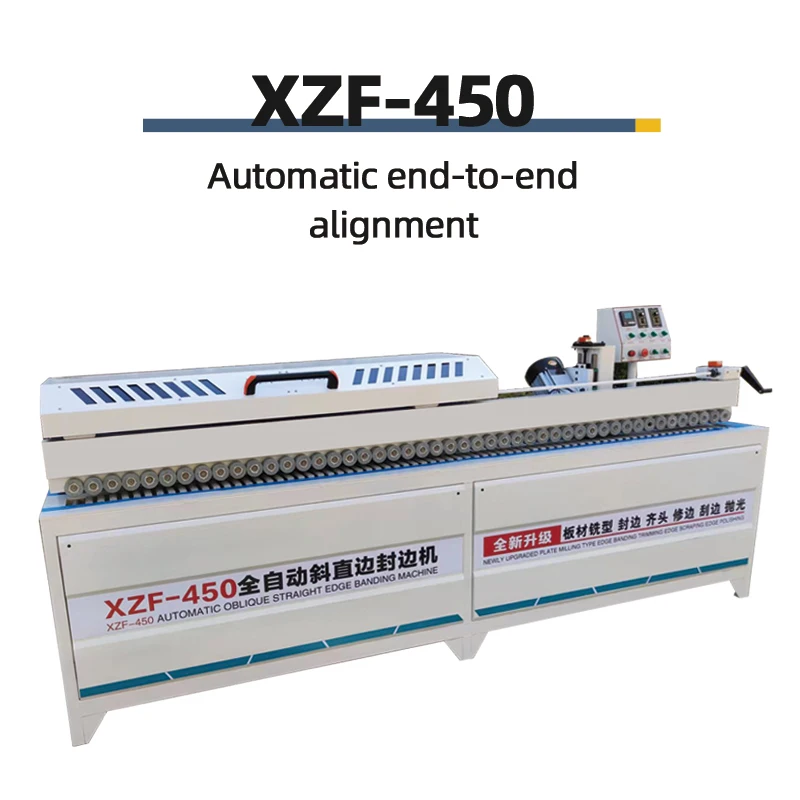
Edge banding machine
Click to enlarge
ISO 9001
CE Certified
OEM / ODM
12-Mo Warranty
Edge banding machine
45 Degree Edge Banding Machine for MDF Plywood – Industrial Application
<p><strong>XZF-450 45 Degree Edge Banding Machine, 9.5 kW, 0–12 m/min feed, 0.3–3 mm banding thickness</strong> — built for MDF, plywood and particleboard processing with pre-milling, dual trimming and polishing stations.</p> <ul> <li>4 kW pre-milling removes saw marks before gluing, improving adhesion on rough-cut substrates</li> <li>4000 ml glue pot sustains continuous runs across 30°/45°/60° angles and 0–50 mm edge heights</li> <li>Scraping and polishing stages deliver sealed edges ready for assembly</li> </ul> <p>Voltage confirmation, agreed-language manual and pre-shipment test record provided with every order — verify your local supply and panel specs before dispatch.</p>
100+
Countries
MOQ 1
Unit
15-25 Days
Lead Time
380V
45 Degree Edge Banding
Edge Banding Machine
MDF Plywood
Pre-milling Motor
Process And Application
XZF-450
- Full OEM/ODM support -- custom logo, voltage (110V-440V), multilingual panels
- ISO 9001 & CE certified, 5 national patents, 60 professional engineers
- 12-month warranty, remote technical support & spare parts service
- Professional export packaging, customs clearance support, on-time delivery
Four-stage QC with pre-shipment verification — every XZF-450 undergoes incoming material checks, in-process assembly inspection, finished-product functional tests, and a documented dispatch audit before it leaves the factory floor.
Technical Specifications
| Parameter | Value |
|---|---|
| Model | XZF-450 |
| Product Type | 45 Degree Full-Automatic Edge Banding Machine |
| Total Power | 9.5 kW |
| Voltage | 380V / 415V (verify 50 Hz or 60 Hz requirement before order) |
| Pre-milling Motor | 4 kW |
| Edge Banding Power / Speed | 0.16 kW / 0–12 m/min |
| Trimming Motors | 2.2 kW × 2 |
| Polishing Motors | 0.4 kW × 2 |
| Vacuum Power | 550 W |
| Transmission Power / Speed | 180 W / 0–12 m/min |
| Glue Pot Capacity | 4000 ml |
| Edge Banding Height | 0–50 mm |
| Edge Banding Thickness | 0.3–3 mm |
| Minimum Sheet Length | 30 cm |
| Minimum Sheet Width | 15 cm |
| Air Source Pressure | 0.5–0.7 MPa |
| Product Size | 300 × 65 × 135 cm |
| Product Weight | 430 kg |
| Language Options | Chinese, English; customizable to Spanish or other languages |
| Plug Options | EU, USA, AU, UK |
| Key Features | Plate milling, 30°/45°/60° edge banding, trimming, scraping, polishing, high-power vacuuming |
Application Suitability
| Application | Material or Output |
|---|---|
| Cabinet mitre joints | 45° edge banding on melamine-faced particleboard |
| Custom furniture panel finishing | 90° edge banding on MDF and plywood |
| Solid wood door frame edging | Edge sealing on blockboard and solid wood panels |
| Medium-volume batch production | PVC, veneer, and ABS banding on polymer doors |
Why Voltage Must Be Locked Before the Quotation on Every 45 Degree Edge Banding Machine Woodworking Process
Confirm local supply voltage and frequency before the first line item is written.
I learned this the hard way. A customer in Vietnam received an edge bander wired for domestic 380V/50Hz while their workshop ran 220V/60Hz. The machine sat dead on the floor for three weeks while they sourced and installed a step-up transformer, and the export containers they were finishing that month missed their shipping window entirely — penalty clauses kicked in and wiped out the margin on the whole batch. When buyers evaluate a 45 degree edge banding machine woodworking process, the electrical specification is not a footnote; it is the first constraint that determines whether the machine will ever run. [NEED_CITE: voltage and frequency standards by export market]
Substrate Behaviour Across MDF, Plywood and Particleboard
Different board materials respond differently to the pre-milling, gluing, and trimming stages. MDF cuts cleanly under the 4 kW pre-milling cutter, leaving a flat surface that accepts hot-melt adhesive evenly. Plywood, with its alternating grain layers, tends to tear out on the cross-grain plies if the feed speed is pushed too fast or the trimming cutters are dull — the XZF-450’s variable 0–12 m/min feed control lets operators dial back for these sections. Particleboard, especially the lower-density grades used in budget cabinet carcasses, produces a rougher milled edge and absorbs more glue, so the 4000 ml glue pot and adjustable glue gap need to be set with care to avoid squeeze-out that shows as a visible glue line after trimming.
Trimming and Finishing for 45° Mitre Joints
A 45 degree edge banding machine woodworking process is only as good as its trimming and scraping output. The dual 2.2 kW trimming motors on this machine handle both flush end trimming and radius edge trimming across 30°, 45°, and 60° angles. After trimming, the scraping station removes the thin adhesive ridge that trimming leaves behind, and the twin 0.4 kW polishing wheels bring the edge to a smooth finish ready for assembly. On mitre joints where two banded edges meet at a corner, any residual ridge or uneven scrape shows immediately as a gap or shadow line — which is why the scraping and polishing stages matter as much as the gluing stage itself. [NEED_CITE: CE machinery directive requirements for edge banding equipment]
What the Specs Mean on the Workshop Floor
Spec Interpretation: Feed Speed, Glue Pot and Pre-mill Power in Practice
The 4 kW pre-milling motor is sized to remove saw marks and minor panel sizing errors in a single pass. On a panel that has been cut on a sliding table saw with a slightly worn blade, pre-milling restores a straight, clean reference surface — the difference is visible when you run a fingernail across the edge before and after. The 0–12 m/min variable feed speed is managed by the 180 W transmission motor; slower feed gives the glue more open time on porous substrates like particleboard, while faster feed suits dense MDF runs where adhesion is easier. The 4000 ml glue pot holds enough EVA hot-melt for sustained production without constant refills, and the 550 W vacuum system at the trimming station captures the banding offcuts and dust before they can fall onto the conveyor track and mark the next panel’s face. Air supply at 0.5–0.7 MPa drives the pneumatic cylinders that control trimming, scraping, and pressure roller engagement — undersized compressors cause intermittent cylinder lag that shows up as uneven trimming passes.
The Cost of Skipping Configuration Checks
When a workshop orders a single machine without thinking about how it fits the rest of the line, mismatches surface quickly. A feed height that doesn’t align with the panel saw’s output table forces operators to lift boards manually, introducing feed-angle errors that the trimming motors then have to correct — and they can only correct so much. Control panels left in a default language that the operator cannot read lead to incorrect glue temperature settings, which in turn cause either cold glue lines that peel off in winter or overheated adhesive that carbonises inside the pot. These are not warranty claims; they are configuration oversights, and they cost production days to resolve. [NEED_CITE: industrial equipment commissioning best practices for export markets]
Why Source This Machine Here
Every XZF-450 ships with a documented four-stage inspection record — incoming material, in-process, finished product, and pre-shipment — so the buyer can review test data against their own panel thickness and angle requirements before the crate is sealed. Voltage and plug type are confirmed line-by-line in the quotation, covering 380V and 415V options with EU, USA, AU, or UK plugs as standard. The control panel language is agreed before production starts, and the operation manual is supplied in the same language. For workshops scaling from a single machine to a full line, the product family covers entry-level through full-function pre-milling configurations, so the supplier relationship carries forward without re-qualification. Factory test runs on the buyer’s own sample panels can be arranged before dispatch.
Documentation & Verification
- CE declaration of conformity covering the XZF-450’s electrical and mechanical safety requirements
- Machine specification sheet confirming all power ratings, banding range, and dimensional data
- Electrical schematic with voltage and frequency locked to the buyer’s confirmed supply standard
- Factory test record showing processed sample panels at the buyer’s target thickness and angle
- Operation and maintenance manual written in the agreed language before production begins
- Spare parts list covering trimming cutters, scraper blades, polishing wheels, and glue pot components
Installation, Commissioning & Support
- The 300 × 65 × 135 cm footprint requires a level concrete floor with clearance on both infeed and outfeed sides
- 9.5 kW total draw needs a dedicated circuit breaker; confirm amperage rating matches the 380V/415V supply
- Machine ships fully assembled at 430 kg; plan forklift access and rigging for positioning on the shop floor
- First-power commissioning includes glue pot temperature calibration, feed speed verification, and trimming alignment checks
- Compressed air line at 0.5–0.7 MPa must be dry and filtered to protect the pneumatic cylinders
- Trimming cutters and scraper blades are the primary consumables; keep a first reorder set on hand from day one
Preparing Your Enquiry
To move from initial interest to a configuration that fits your workshop, share the substrate types you run most often, the edge banding materials you use, and whether your production involves 45° mitres, 90° edges, or both. Confirm your local voltage and frequency so the electrical build matches your supply, and specify the control panel language your operators will need. If you have existing upstream saws or downstream drilling stations, note their feed height and throughput so the line can be matched without bottlenecks.
Frequently Asked Questions
Q: How does pre-milling affect edge quality on MDF versus particleboard?
A: The 4 kW pre-milling cutter removes saw marks and minor sizing errors before gluing. On MDF, it produces a smooth, dense surface that bonds evenly. On particleboard, which is more porous, pre-milling exposes a cleaner cross-section, but operators should reduce feed speed slightly so the glue penetrates adequately without squeeze-out.
Q: What glue type and temperature work best for 45° banding on melamine board?
A: EVA hot-melt is the standard choice. Temperature depends on the specific adhesive brand and the ambient workshop conditions — typically within the range printed on the glue packaging. The 4000 ml glue pot maintains stable temperature across sustained runs, and the operator should verify bond strength on a test piece before starting the batch.
Q: How do I confirm the voltage and control panel language before ordering?
A: Provide your workshop’s supply voltage, frequency, and plug type in the initial enquiry. The quotation will list the confirmed electrical specification line by line. The control panel language and the operation manual language are agreed and documented before production begins, so there is no ambiguity at commissioning.
Q: Which edge banding materials fit the 0.3–3 mm thickness range?
A: PVC, ABS, veneer, and melamine edge banding within the 0.3–3 mm thickness specification are all compatible. The pressure roller and trimming stations adjust to cover this range. For materials at the thicker end, feed speed may need to be reduced to allow adequate glue coverage and clean trimming.
Q: How does feed speed influence the finish on solid wood panels?
A: Solid wood has variable density along and across the grain. Running at the higher end of the 0–12 m/min range works on straight-grain sections, but cross-grain areas benefit from slower feed to prevent tear-out during trimming. Operators typically adjust speed per panel type rather than running a single setting all day.
Technical Specifications
| Parameter | Value |
|---|---|
| Product Name | 45 Degree Edge Banding Machine for MDF Plywood – Industrial Application |
| Category | Edge banding machine |
| Voltage Options | 110V / 220V / 380V / 440V (customizable) |
| Frequency | 50Hz / 60Hz (customizable) |
| Certification | ISO 9001, CE |
| MOQ | 1 Unit |
| Lead Time | 15-25 Working Days |
| Warranty | 12 Months |
| OEM / ODM | Available -- logo, color, panel language |
* Detailed technical specifications vary by model. Please contact us with your specific requirements for a complete datasheet.
Shipping & Export
-
Export Packaging
Heavy-duty wooden crate with foam padding and moisture protection
-
Shipping Methods
Sea freight (FCL/LCL), air freight, express -- we support all methods
-
Customs Support
Full documentation: CO, commercial invoice, packing list, HS code assistance
-
Port of Loading
Tianjin / Qingdao port, China -- 20 years export experience
OEM / ODM Services
-
Logo & Branding
Custom logo printing, color scheme, and nameplate engraving
-
Voltage Configuration
110V / 220V / 380V / 440V, 50Hz / 60Hz -- any region supported
-
Multilingual Panels
Control panels in English, Spanish, French, Arabic and more
-
Custom Specifications
Modified dimensions, accessories, or feature sets on request
Get a Quote
Request Product Inquiry
Fill in your details and we'll respond within 24 hours with pricing and availability.
Direct Contact
How It Works
-
1
Confirm requirements & budget
Tell us your factory scale and processing needs
-
2
Receive recommendation & quote
We match the right machine with full specs
-
3
Negotiate & place order
OEM terms, voltage, payment and delivery
-
4
Production & QC inspection
Multi-stage quality control by 60 engineers
-
5
Export packaging & shipment
Professional packing, customs clearance
-
6
After-sales support
12-month warranty, remote tech support
You May Also Like