Edge banding machine
Click to enlarge
ISO 9001
CE Certified
OEM / ODM
12-Mo Warranty
Edge banding machine
90-degree Beveled Edge Banding Machine – Industrial Application
<p>Request a factory test record with your specific substrate to verify edge finish and trimming accuracy before shipment, backed by four-stage QC and engineer-led configuration support.</p>
100+
Countries
MOQ 1
Unit
15-25 Days
Lead Time
220V 380V
Automatic Edge Banding
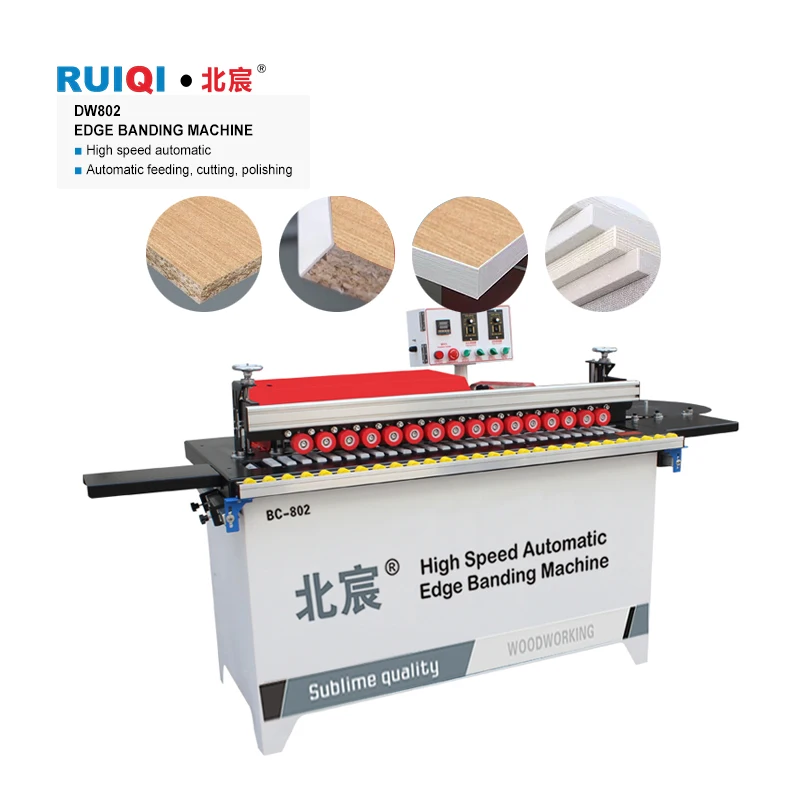
DW802
Edge Banding Machine
Furniture Factory
MDF Panel
Process Application
- Full OEM/ODM support -- custom logo, voltage (110V-440V), multilingual panels
- ISO 9001 & CE certified, 5 national patents, 60 professional engineers
- 12-month warranty, remote technical support & spare parts service
- Professional export packaging, customs clearance support, on-time delivery
Integrated Multi-Station Trimming — Glue pot, dual 800W trimming cutters, and vacuum dust extraction sequenced in a single pass for consistent edge quality on MDF and plywood substrates.
Technical Specifications
| Parameter | Value |
|---|---|
| Product Type | Automatic Edge Banding Machine |
| Model | DW802 |
| Total Power | 4200W |
| Voltage | 220V/380V/customization |
| Edge Banding Thickness | 0.3-3MM |
| Edge Banding Height | 0-50MM |
| Minimum Sheet Length | 25CM |
| Minimum Sheet Width | 10CM |
| Glue Pot Capacity | 4000ml |
| Trimming Power | 800W x 2 |
| Polishing Power | 180W x 2 |
| Vacuum Power | 1200W |
| Edge Feed Power | 140W |
| Transmission Power | 140W |
| Air Source Pressure | 0.4-0.8Mpa |
| Product Size | 1306095CM |
| Product Weight | 135KG |
| Language Options | Chinese and English (customizable to Spanish or other languages) |
| Key Features | Edge banding, trimming, polishing, automatic head and tail cutting, integrated vacuum |
Application Suitability
| Application | Material or Output |
|---|---|
| Cabinet and wardrobe panel edge sealing | MDF, particleboard |
| Custom furniture workshop production | Ecological board, plywood |
| Joinery transitioning from manual to automated finishing | Solid wood board |
| Home decoration panel processing | PVC and veneer edge banding on wood substrates |
Why Visible Glue Lines Appear on Some Substrates and How to Prevent Them
Glue line visibility is a substrate-temperature mismatch, not a machine defect.
When a production manager reviews sample panels, MDF edges may look flawless while particleboard shows a faint glue seam under the same settings. The DW802 addresses this by maintaining a 4000ml glue pot that holds thermal mass across continuous runs, reducing temperature fluctuation between panels. However, the edge banding machine process and application demands that operators match glue temperature to the specific board density and banding material before the first sheet enters the feed. [NEED_CITE: adhesive temperature ranges for wood-based panel substrates]
Glue Behavior Across Substrate Types
MDF absorbs heat differently from particleboard, and plywood grain direction affects how adhesive spreads along the edge. The DW802’s 4000ml glue pot provides sufficient thermal reserve so that sequential panels do not cool the adhesive below its effective bonding window. When switching from MDF to plywood within the same batch, operators typically need to adjust feed speed and pot temperature to maintain a uniform bond line without squeeze-out or starvation.
Trimming Sequence and Edge Finish Consistency
The dual 800W trimming stations handle flush cuts on varying substrate densities. A softer particleboard core requires less cutter aggression than a dense MDF panel, and the trimming power is sized to prevent chatter marks on the finished edge. After trimming, the dual 180W polishing wheels remove micro-scratches left by the cutters, producing a surface that accepts subsequent hardware mounting without additional hand-finishing. The edge banding machine process and application sequence ensures that trimming and polishing occur while the adhesive is still at working temperature. [NEED_CITE: trimming cutter geometry for wood composite edge finishing]
How Banding Thickness and Board Dimensions Interact
The 0.3-3MM edge banding thickness range covers PVC, melamine, and thin wood veneer. Thinner banding at 0.3MM conforms easily to minor edge irregularities but demands precise trimming to avoid cutting through the material. Thicker 3MM PVC requires the full trimming power of both 800W stations and benefits from the integrated 1200W vacuum system, which removes trimming dust before it can embed in the fresh adhesive. The minimum sheet dimensions of 25CM length and 10CM width mean that small drawer fronts and narrow cabinet dividers can run through the machine without manual holding fixtures.
The Cost of Skipping the Substrate Test
Panels that look acceptable at the machine may show glue line separation after the adhesive fully cures and the board acclimates to workshop humidity. A batch processed without substrate-specific temperature adjustment can pass initial visual inspection yet fail during downstream assembly when hinge screws apply lateral stress to the edge. This type of failure is not caught by the machine’s own stations and only surfaces at the installation site. [NEED_CITE: wood panel adhesive cure behavior under humidity variation]
Why Purchase Configuration Matters Here
In-house manufacturing allows the DW802 to ship with voltage matched to the destination grid, whether 220V single-phase for a small workshop or 380V three-phase for a production facility. The control panel language is set before dispatch so the operator reads instructions in a familiar script from the first power-on. A four-stage quality check verifies glue pot temperature stability, trimming alignment, and vacuum suction before the machine leaves the factory. Each unit arrives fully assembled at 1306095CM, reducing commissioning time on the shop floor. Engineer-led configuration recommendations are provided within 24 hours of receiving the buyer’s material and throughput requirements.
Documentation & Verification
- Factory test record on buyer’s specific substrate and banding material
- Electrical schematic confirming voltage and frequency before dispatch
- Operation and maintenance manual in the agreed operator language
- Spare parts list covering trimming cutters, polishing wheels, and glue pot seals
- CE declaration of conformity for machinery directive compliance
- Packing photographs showing assembly state and protective measures
Installation, Commissioning & Support
- 1306095CM footprint requires a level concrete floor with clearance on feed and exit sides
- 4200W total draw requires a dedicated circuit matching the confirmed 220V or 380V supply
- Machine ships fully assembled; only air hose and power connection needed at arrival
- First-run parameter setting covers glue temperature, feed speed, and trimming depth for the buyer’s material
- Trimming cutters and polishing wheels included in initial spare parts kit for early replacement cycles
- 0.4-0.8Mpa air source must be clean and dry to protect pneumatic cylinders in the head and tail cutting station
Before You Send the Inquiry
Provide the substrate type and thickness you process most frequently, along with the edge banding material and thickness range. Specify your local voltage and frequency so the electrical system is configured before production begins. If your workshop runs multiple panel materials in a single shift, note the changeover frequency so the glue pot and trimming settings can be evaluated for quick-adjust capability.
Frequently Asked Questions
Q: How does substrate type affect glue temperature and feed speed settings?
A: MDF typically requires a higher glue temperature than particleboard due to its denser fiber structure, while plywood may need a slower feed speed to allow adhesive penetration along the grain. The 4000ml glue pot on the DW802 maintains thermal stability across these adjustments, but operators should run test pieces on each substrate before committing a full batch.
Q: What edge banding materials work within the 0.3-3MM thickness range?
A: PVC, melamine, and thin wood veneer all fall within this range. Thinner 0.3MM veneer requires careful trimming to avoid cutter breakthrough, while 3MM PVC benefits from the full dual-station trimming power. The operator adjusts trimming depth and polishing pressure according to the specific banding material loaded.
Q: How does the integrated vacuum system affect edge finish quality?
A: The 1200W vacuum extracts trimming dust at the cutting point before it can settle on the fresh adhesive or polishing surface. This prevents embedded particles that would otherwise appear as blemishes on the finished edge and reduces airborne dust levels in the immediate workshop area around the machine.
Q: What glue type is recommended for different panel materials?
A: Standard EVA hot-melt adhesive covers most MDF, particleboard, and plywood applications within the DW802’s temperature range. For moisture-resistant requirements or specific veneer materials, PUR adhesive may be specified, though this requires confirmation of glue pot compatibility before ordering. Always request a factory test record using your intended adhesive and substrate combination.
Q: How do trimming and polishing stations affect downstream assembly tolerance?
A: Flush trimming ensures the banded edge does not protrude beyond the panel face, which is critical when panels stack against each other in cabinet carcase assembly. The dual 800W trimming stations remove excess banding to within the substrate plane, and polishing eliminates burrs that could interfere with hinge plate mounting or drawer slide alignment.
Technical Specifications
| Parameter | Value |
|---|---|
| Product Name | 90-degree Beveled Edge Banding Machine – Industrial Application |
| Category | Edge banding machine |
| Voltage Options | 110V / 220V / 380V / 440V (customizable) |
| Frequency | 50Hz / 60Hz (customizable) |
| Certification | ISO 9001, CE |
| MOQ | 1 Unit |
| Lead Time | 15-25 Working Days |
| Warranty | 12 Months |
| OEM / ODM | Available -- logo, color, panel language |
* Detailed technical specifications vary by model. Please contact us with your specific requirements for a complete datasheet.
Shipping & Export
-
Export Packaging
Heavy-duty wooden crate with foam padding and moisture protection
-
Shipping Methods
Sea freight (FCL/LCL), air freight, express -- we support all methods
-
Customs Support
Full documentation: CO, commercial invoice, packing list, HS code assistance
-
Port of Loading
Tianjin / Qingdao port, China -- 20 years export experience
OEM / ODM Services
-
Logo & Branding
Custom logo printing, color scheme, and nameplate engraving
-
Voltage Configuration
110V / 220V / 380V / 440V, 50Hz / 60Hz -- any region supported
-
Multilingual Panels
Control panels in English, Spanish, French, Arabic and more
-
Custom Specifications
Modified dimensions, accessories, or feature sets on request
Get a Quote
Request Product Inquiry
Fill in your details and we'll respond within 24 hours with pricing and availability.
Direct Contact
How It Works
-
1
Confirm requirements & budget
Tell us your factory scale and processing needs
-
2
Receive recommendation & quote
We match the right machine with full specs
-
3
Negotiate & place order
OEM terms, voltage, payment and delivery
-
4
Production & QC inspection
Multi-stage quality control by 60 engineers
-
5
Export packaging & shipment
Professional packing, customs clearance
-
6
After-sales support
12-month warranty, remote tech support
You May Also Like