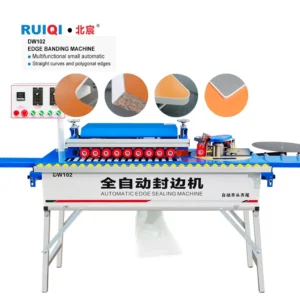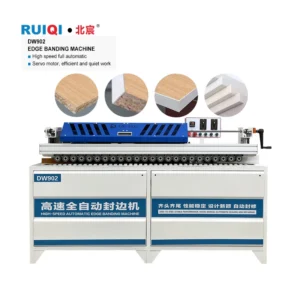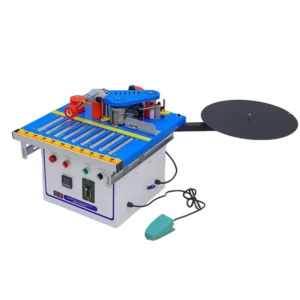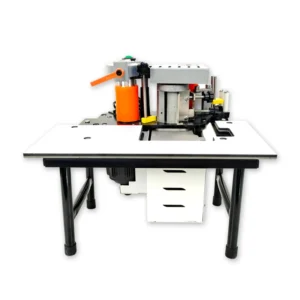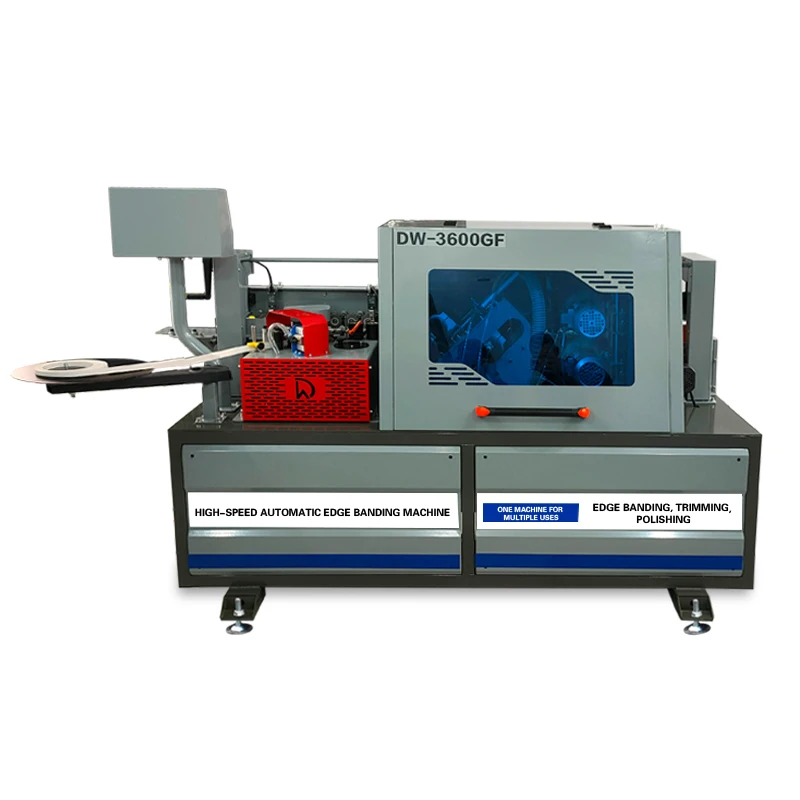
Edge banding machine
Click to enlarge
ISO 9001
CE Certified
OEM / ODM
12-Mo Warranty
Edge banding machine
Automatic Edge Banding Machine for Furniture – Industrial Application
<p><strong>DW-3600GF Automatic Edge Banding Machine, 380V, 0–14 m/min Feed Speed, 0.3–3 mm Band Thickness</strong> — designed for straight-edge finishing on MDF, particleboard and plywood panels in furniture production.</p> <ul> <li>Dual 800W trimming heads at 24000 r/min deliver flush cuts across varying board densities</li> <li>Sequential gluing, scraping and polishing stations produce clean glue lines in one pass</li> <li>Edge band height 0–50 mm with PVC and veneer compatibility for cabinet and joinery applications</li> </ul> <p>Supported by in-house manufacturing with patented cutting mechanisms, four-stage QC with pre-shipment verification, and engineer-led configuration confirmed within 24 hours.</p>
100+
Countries
MOQ 1
Unit
15-25 Days
Lead Time
380V Three-phase
Automatic Edge Banding Machine
Dual Trimming Heads
DW-3600GF
Furniture Factory
MDF Panel
Plywood Edge Banding
Process Application
- Full OEM/ODM support -- custom logo, voltage (110V-440V), multilingual panels
- ISO 9001 & CE certified, 5 national patents, 60 professional engineers
- 12-month warranty, remote technical support & spare parts service
- Professional export packaging, customs clearance support, on-time delivery
Voltage-locked configuration — Every DW-3600GF order confirms local three-phase supply and frequency before production starts, preventing the dead-machine scenario I witnessed early in my career when a unit sat idle for weeks waiting on a transformer.
Technical Specifications
| Parameter | Value |
|---|---|
| Model | DW-3600GF |
| Product Type | Automatic Edge Banding Machine |
| Rated Power | 4.9 kW |
| Voltage & Frequency | 380V Three-Phase Four-Wire (frequency to be confirmed: 50Hz or 60Hz) |
| Feed Speed | 0–14 m/min (basis not stated in source — confirm with standard panel format) |
| Edge Band Height Range | 0–50 mm |
| Edge Band Thickness Range | 0.3–3 mm |
| Minimum Panel Length | 200 mm |
| Trimming Stations | Dual heads, 800W × 2 at 24000 r/min |
| Polishing Stations | Dual heads, 400W × 2 |
| Air Supply Requirement | 0.4–0.6 MPa |
| Standard Functions | Gluing, trimming, scraping, polishing, vacuuming |
| Edge Banding Type | Straight edge |
| Overall Dimensions (L×W×H) | 2200 × 650 × 1250 mm |
| Net Weight | 320 kg |
| Control System | Chinese/English panel, multilingual customization supported |
| Standards | CE, ISO 9001 |
Application Suitability
| Application | Material or Output |
|---|---|
| Cabinet carcass edge finishing | MDF panels with 0.4–2 mm PVC banding |
| Shelving and partition edging | Particleboard with PVC or melamine strips |
| Custom furniture visible edges | Plywood panels with veneer banding up to 3 mm |
| Small-to-medium batch panel production | Mixed substrate runs in workshop environments |
Why Glue Lines Show Up on Some Boards and Not Others
The automatic edge banding machine process application depends on matching feed speed, glue temperature, and pressure to substrate porosity — not just running the same settings across every board.
I have watched the same edge bander produce invisible seams on MDF and then leave visible glue lines on plywood, with no mechanical fault on the machine at all. The difference sits in how each substrate absorbs adhesive during the open-time window [NEED_CITE: substrate porosity and hot-melt adhesive open time interaction]. MDF pulls glue into its fibres quickly, which helps bonding but demands a slightly faster feed rate. Plywood, with its sealed laminations, lets the adhesive sit on the surface longer, requiring different pressure timing. When a production manager runs mixed materials on a single pass without adjusting parameters, one of those substrates will always show a defect. Understanding this relationship before the machine arrives on the shop floor is what separates a smooth commissioning from weeks of rework.
Glue Application and the Open-Time Window
The gluing station on this automatic edge banding machine applies hot-melt adhesive to the panel edge as the board passes through the feed zone. The 0–14 m/min feed speed range gives operators room to slow the feed for dense substrates that need longer contact time or speed it up for porous boards like MDF. Getting this parameter right is the single biggest factor in whether the finished edge shows a clean bond line or a visible ridge of excess adhesive.
How Dual Trimming Heads Shape the Finished Edge
The dual trimming stations, each rated at 800W and spinning at 24000 r/min, handle front and rear flush trimming in a single pass. On particleboard, the high rotational speed shears through the relatively brittle core without tearing the decorative surface. On plywood, where alternating grain directions create varying resistance, those same heads maintain a consistent cut profile because the power rating prevents bogging down under load [NEED_CITE: trimming head power and rotational speed effect on edge finish across wood composites].
Reading Specifications Against Real Workshop Conditions
The 0.3–3 mm edge band thickness range covers thin PVC foils for cabinet interiors and thicker veneer strips for visible furniture faces. The 200 mm minimum panel length means smaller offcuts from nesting operations can still be processed, reducing waste in custom furniture production. Air supply at 0.4–0.6 MPa must be stable — pressure drops from shared compressor lines in crowded workshops will affect pneumatic pressure rollers and cause intermittent bonding failures that operators often mistake for glue problems. Panel thickness range and glue pot temperature should be confirmed with the manufacturer against your specific board stock before order placement.
What Happens When Voltage Is Treated as an Afterthought
I once configured an edge bander for a Middle East customer and quoted the machine without locking in whether the workshop ran 50Hz or 60Hz. The unit arrived, the main motor would not start, and the customer waited three weeks for a step-down transformer before production could begin. That machine sat under plastic wrap in a hot warehouse while installation crews stood around. With the DW-3600GF specified at 380V three-phase four-wire, frequency confirmation must happen before the order is placed — not after the crate is opened [NEED_CITE: three-phase voltage and frequency standards by export market].
Sourcing Decisions Backed by Process Evidence
Every DW-3600GF leaves the factory with a pre-shipment test record showing edge banding results on actual panel material, so buyers see output quality before the machine ships rather than discovering issues after installation. Configuration recommendations are engineer-led, based on your workshop’s substrate mix and production volume, with a formal quotation typically issued within 24 hours. The four-stage quality control sequence — incoming material, in-process, finished product, and pre-shipment — means station alignment and trimming accuracy are verified at multiple points. Voltage, control panel language, and specification adjustments are treated as standard configuration options, not custom engineering requests. Factory visits are open to buyers who want to witness assembly and testing first-hand.
Documentation & Verification
- CE declaration of conformity covering the DW-3600GF mechanical and electrical safety requirements
- Factory test record showing edge banding output on your specified panel thickness and banding material
- Electrical schematic with confirmed 380V three-phase wiring and frequency match for your facility
- Operation and maintenance manual supplied in your agreed language, not default Chinese
- Spare parts list with trimming head and polishing wheel replacement intervals identified
Installation, Commissioning & Support
- 2200 × 650 mm footprint requires level concrete flooring with clearance for infeed and outfeed tables
- Dedicated 380V three-phase circuit with confirmed frequency, separate from shared workshop compressor lines
- Machine ships fully assembled; positioning and air connection at 0.4–0.6 MPa are the primary site tasks
- First-run commissioning includes feed speed calibration across your panel stock range
- Operator training covers glue pot temperature adjustment for PVC versus veneer banding materials
- Dual trimming heads and polishing wheels listed as consumables with reorder specifications provided
What to Prepare Before Requesting a Quote
To configure the DW-3600GF for your production line, share the substrate types and panel thicknesses you run most frequently, along with the edge banding materials and thicknesses in your current inventory. Confirm your facility’s three-phase voltage and frequency so the motor and control system are matched before manufacturing begins. If you run mixed batches across MDF, particleboard, and plywood in a single shift, note that pattern so the engineer can recommend feed speed and glue settings accordingly.
Frequently Asked Questions
Q: How does edge banding quality differ between MDF, particleboard and plywood, and which parameters should be adjusted?
A: MDF’s porous surface absorbs adhesive quickly, often requiring a slightly faster feed speed. Particleboard holds glue on the surface longer due to its sealed resin content, and plywood’s alternating grain layers create variable trimming resistance. Feed speed and glue temperature are the primary adjustments between substrates on the DW-3600GF.
Q: What glue type and temperature does the DW-3600GF support for PVC versus veneer banding?
A: The machine uses hot-melt adhesive applied through the gluing station. Temperature requirements differ between PVC foil and natural veneer, as veneer demands higher heat for proper wetting. Specific glue pot temperature range should be confirmed with the factory based on your banding material selection before order confirmation.
Q: How is feed speed calibrated to prevent delamination or visible glue lines?
A: Feed speed on the DW-3600GF is adjustable from 0 to 14 m/min and should be matched to panel thickness, banding material, and substrate density. Slower speeds increase adhesive contact time for dense boards, while faster speeds prevent over-application on porous substrates. Factory test records verify the calibration before shipment.
Q: Can I run a sample test using my own panel material before confirming the order?
A: Yes. Sample processing tests using your specific substrate and edge banding stock can be arranged before order placement. The factory test record documents trim finish, glue line visibility, and adhesion quality so you can evaluate output against your assembly standards before committing to production.
Q: What assembly tolerances depend on edge banding accuracy, and how is trim finish verified?
A: Flush trimming directly affects panel fit in cabinet assemblies, where overhanging banding material prevents square joints and visible gaps. The DW-3600GF dual trimming heads at 24000 r/min produce a flush cut verified during pre-shipment testing. Downstream assembly fit should be checked against sample panels from the factory test run.
Technical Specifications
| Parameter | Value |
|---|---|
| Product Name | Automatic Edge Banding Machine for Furniture – Industrial Application |
| Category | Edge banding machine |
| Voltage Options | 110V / 220V / 380V / 440V (customizable) |
| Frequency | 50Hz / 60Hz (customizable) |
| Certification | ISO 9001, CE |
| MOQ | 1 Unit |
| Lead Time | 15-25 Working Days |
| Warranty | 12 Months |
| OEM / ODM | Available -- logo, color, panel language |
* Detailed technical specifications vary by model. Please contact us with your specific requirements for a complete datasheet.
Shipping & Export
-
Export Packaging
Heavy-duty wooden crate with foam padding and moisture protection
-
Shipping Methods
Sea freight (FCL/LCL), air freight, express -- we support all methods
-
Customs Support
Full documentation: CO, commercial invoice, packing list, HS code assistance
-
Port of Loading
Tianjin / Qingdao port, China -- 20 years export experience
OEM / ODM Services
-
Logo & Branding
Custom logo printing, color scheme, and nameplate engraving
-
Voltage Configuration
110V / 220V / 380V / 440V, 50Hz / 60Hz -- any region supported
-
Multilingual Panels
Control panels in English, Spanish, French, Arabic and more
-
Custom Specifications
Modified dimensions, accessories, or feature sets on request
Get a Quote
Request Product Inquiry
Fill in your details and we'll respond within 24 hours with pricing and availability.
Direct Contact
How It Works
-
1
Confirm requirements & budget
Tell us your factory scale and processing needs
-
2
Receive recommendation & quote
We match the right machine with full specs
-
3
Negotiate & place order
OEM terms, voltage, payment and delivery
-
4
Production & QC inspection
Multi-stage quality control by 60 engineers
-
5
Export packaging & shipment
Professional packing, customs clearance
-
6
After-sales support
12-month warranty, remote tech support
You May Also Like