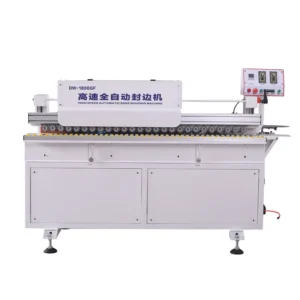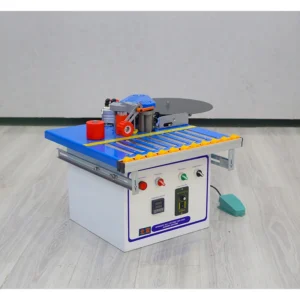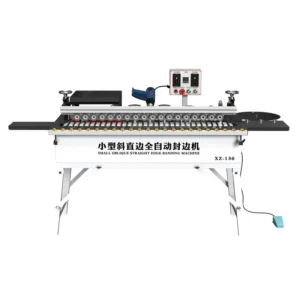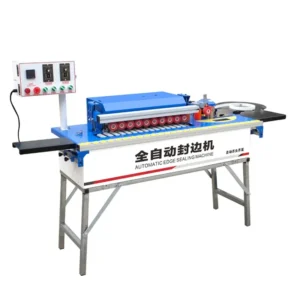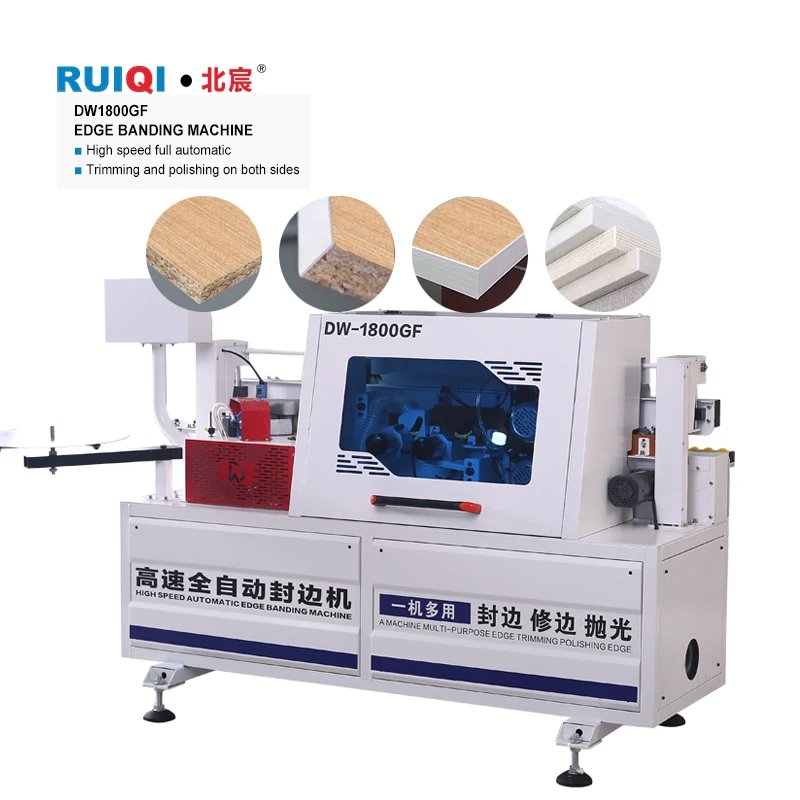
Edge banding machine
Click to enlarge
ISO 9001
CE Certified
OEM / ODM
12-Mo Warranty
Edge banding machine
Automatic Edge Banding Machine for MDF ABS PVC – Factory Supply
<p><strong>DW1800 Automatic Edge Banding Machine, 4.9 kW, 0–14 m/min feed</strong> — double-sided gluing with 4000 ml pot capacity and profile tracking for rounded corners on MDF, particleboard and plywood substrates. Top and bottom trimming at 24000 r/min with flexible edge scraping ensures tight seam lines ready for downstream assembly.</p> <ul> <li>Panel thickness up to 50 mm, edge banding 0.3–3 mm</li> <li>Voltage options 380V / 220V / 415V with multilingual control panels</li> <li>Minimum sheet width 10 cm for small-format processing</li> </ul> <p>Pre-shipment test records with your actual substrate material verify glue line quality before dispatch.</p>
100+
Countries
MOQ 1
Unit
15-25 Days
Lead Time
Double-Sided Gluing
DW1800
Edge Banding Machine
Factory Direct
Furniture Factory
MDF Panel
Profile Tracking
PVC Edge Banding
- Full OEM/ODM support -- custom logo, voltage (110V-440V), multilingual panels
- ISO 9001 & CE certified, 5 national patents, 60 professional engineers
- 12-month warranty, remote technical support & spare parts service
- Professional export packaging, customs clearance support, on-time delivery
Consistent gluing on mixed substrates — the DW1800 applies double-sided adhesive through a 4000 ml glue pot, verified on the actual panels you send us before the machine leaves the factory.
Technical Specifications
| Parameter | Value |
|---|---|
| Model | DW1800 |
| Product Type | Automatic Edge Banding Machine |
| Total Power | 4.9 kW |
| Voltage & Frequency | 380V / 220V / 415V (frequency 50Hz / 60Hz to confirm) |
| Feed Speed | 0–14 m/min |
| Edge Banding Thickness | 0.3–3 mm |
| Edge Banding Height | 0–50 mm |
| Minimum Sheet Size | 200 mm × 100 mm |
| Glue Pot Capacity | 4000 ml |
| Trimming Motor | 800 W × 2, 24000 r/min |
| Polishing Motor | 380 W × 2 |
| Vacuum Power | 550 W |
| Air Source Pressure | 0.4–0.6 MPa |
| Edge & Transmission Motor | 160 W / 180 W, 0–14 m/min |
| Standard Functions | Double-sided gluing, top and bottom trimming, front and rear alignment, flexible edge scraping, polishing, dust extraction |
| Product Dimensions (L×W×H) | 220 × 65 × 125 cm |
| Product Weight | 320 kg |
| Language Options | Chinese and English standard; Spanish and other languages on request |
Application Suitability
| Application | Material or Output |
|---|---|
| Custom cabinet door and carcass edge banding | MDF, particleboard with PVC or ABS edge banding |
| Plywood furniture panel finishing | Plywood panels with veneer or melamine edge strips |
| Solid wood panel edge sealing | Solid wood boards with matching wood veneer banding |
| Mixed-substrate batch production | ABS boards, organic glass plates, PVC panels |
| Small workshop scale-up from manual banding | Panels from 100 mm width upward at varying feed speeds |
Why Glue Temperature Matters More Than the Brochure Claims
Matching adhesive temperature to your substrate prevents the delamination failures that only show up after the panels leave your factory.
When a customer in Shandong sent us PVC edge banding that was 0.3 mm thicker than our trial stock, the glue temperature we had set for the thinner material could not penetrate the extra mass. The edges peeled clean off during their assembly line stress test. [NEED_CITE: thermal transfer requirements for thermoplastic edge banding adhesives] That failure would have shipped to their end client if we had not caught it during a pre-shipment run with their actual material. Every edge banding machine process and application demands this kind of substrate-specific tuning before the crate is nailed shut.
How Substrate Density Changes the Gluing Window
The edge banding machine process and application differs sharply between a low-density particleboard and a medium-density fiberboard panel. Particleboard’s porous surface absorbs adhesive quickly, requiring a slightly higher glue pot temperature and faster feed speed to prevent the glue from skinning over before the banding contacts the edge. MDF, being denser and smoother, holds the adhesive film on the surface longer, allowing a slower feed and a lower temperature that reduces the risk of scorching thin PVC strips. On the DW1800, the 0–14 m/min feed range gives operators room to dial in the speed that matches the substrate they are running that morning.
Why We Run Your Material Before We Ship
Last year a cabinet maker ordered a bander for 18 mm particleboard with 1 mm PVC. We ran their sample through the DW1800 and found that their specific PVC formulation required a glue temperature adjustment outside the standard range we had set. [NEED_CITE: adhesive formulation differences among PVC edge banding suppliers] Had we shipped without that test, the first production run in their workshop would have produced hundreds of panels with visible glue lines or, worse, edges that released under the pressure of assembly clamping. Sending a few meters of your actual edge banding and a couple of offcut panels lets us document the correct settings on the factory test record that ships with the machine.
Reading the Spec Sheet Against Your Production Reality
The 24000 r/min trimming motors on the DW1800 matter less as a standalone number than in relation to your panel thickness range. Thicker boards up to 50 mm demand that the trimming cutters maintain high peripheral speed to slice cleanly through PVC or ABS without chipping the substrate underneath. The 4000 ml glue pot means you can run extended batches without stopping to refill, which matters when you are banding long cabinet runs where a refill break would leave a cold joint in the adhesive bead. Air source pressure between 0.4 and 0.6 MPa is standard for the pneumatic pressure rollers, but if your workshop compressor fluctuates outside that window, the roller pressure becomes inconsistent and the banding can shift during trimming. The flexible edge scraping station finishes what the rigid trimmers leave, pulling the micro-burrs off PVC edges so the panel goes to assembly with a smooth profile rather than a sharp arris that cuts installer fingers.
What Happens When Voltage Is an Afterthought
We once shipped a bander to a market where the local supply was 220V three-phase, but the order had been placed specifying 380V based on a template. [NEED_CITE: voltage and frequency mismatches in exported industrial machinery] The machine arrived, the motors hummed but would not turn, and the customer lost two weeks of production while waiting for a step-up transformer. The DW1800 is configurable across 380V, 220V, and 415V, but that configurability only protects you if the correct option is confirmed on the electrical schematic before production starts. A five-minute check of your facility’s actual supply frequency — 50Hz or 60Hz — prevents the kind of failure that no amount of after-sales support can fix on a Monday morning.
Why Buyers Source This Machine Here
The DW1800 sits within a product family that lets a workshop start with this configuration and move to a full-function pre-milling model from the same supplier when volume grows, eliminating the retraining cost of switching brands. Voltage and control panel language are confirmed during the quotation stage, not discovered at unpacking. Every machine goes through a four-stage quality check including a pre-shipment test on the buyer’s sample material, with the test record packed in the crate. An engineer reviews your substrate list and production volume before proposing the configuration, so the quotation you receive reflects what your workshop actually runs rather than a generic default build.
Documentation & Verification
- CE declaration of conformity covering the DW1800’s machinery and electrical safety scope
- ISO 9001 certificate for the manufacturing facility producing this edge bander
- Electrical schematic confirming your ordered voltage and frequency before assembly begins
- Factory test record showing glue line and trim results on your supplied panel samples
- Operation manual in your chosen language with parameter tables for each substrate type
- Spare parts list matched to the DW1800’s specific motor and trimming station configuration
Installation, Commissioning & Support
- Requires a level floor section approximately 220 × 65 cm with clearance for panel infeed and outfeed
- Dedicated electrical circuit matching the confirmed 380V / 220V / 415V supply with correct frequency
- Arrives fully assembled; connect air supply at 0.4–0.6 MPa and dust extraction ducting before first run
- Initial commissioning includes glue pot temperature calibration for your specific edge banding material
- Operator training covers feed speed adjustment across the 0–14 m/min range for different substrates
- Spare trimming blades and polishing wheels included; reorder schedule based on your production hours
What to Include in Your Inquiry
Send us the exact substrates you process — MDF, particleboard, plywood, or mixed — along with the thickness range and the edge banding material and thickness you use most often. Tell us your facility’s voltage and frequency so the electrical schematic matches before we build. If you have an existing production line upstream or downstream of this edge bander, share the feed height and throughput so we can confirm the DW1800 fits without creating a bottleneck.
Frequently Asked Questions
Q: How does substrate type affect glue temperature and feed speed on the DW1800?
A: Particleboard absorbs adhesive faster than MDF, typically requiring a higher glue pot temperature and a faster feed speed to prevent the glue from setting before the banding presses against the edge. MDF’s smoother surface holds the adhesive film longer, allowing slower feeds at lower temperatures. On the DW1800, operators adjust the feed within the 0–14 m/min range and set the glue temperature according to the test record we provide based on your sample panels.
Q: Which edge banding materials work within the 0.3–3 mm thickness range?
A: The DW1800 handles PVC, ABS, melamine, and wood veneer banding within that range. Thicker PVC near 3 mm requires more trimming passes and slightly different cutter geometry than thin veneer at 0.3 mm. We configure the trimming stations for the materials you specify and document the settings on your factory test record, so operators know which parameters to select when switching between materials during a production shift.
Q: How does feed speed affect glue curing and assembly readiness?
A: A faster feed speed reduces the open time between glue application and edge contact, which is necessary on porous substrates like particleboard to prevent premature skinning. A slower feed gives denser materials like MDF more contact time under the pressure rollers. Downstream assembly readiness depends on the adhesive having fully cured, which the correct feed speed and temperature combination achieves without requiring extended holding times before the panel moves to boring or hardware insertion.
Q: How can I verify edge quality on my actual panels before ordering?
A: Send us a small batch of your panels and edge banding material. We run them through the DW1800 at our facility, document the glue line visibility, trimming accuracy, and corner profile on a factory test record, and ship the finished samples back to you. This lets you inspect the edge quality and test assembly fit on your own line before committing to the machine order, eliminating the guesswork about how your specific materials will perform.
Technical Specifications
| Parameter | Value |
|---|---|
| Product Name | Automatic Edge Banding Machine for MDF ABS PVC – Factory Supply |
| Category | Edge banding machine |
| Voltage Options | 110V / 220V / 380V / 440V (customizable) |
| Frequency | 50Hz / 60Hz (customizable) |
| Certification | ISO 9001, CE |
| MOQ | 1 Unit |
| Lead Time | 15-25 Working Days |
| Warranty | 12 Months |
| OEM / ODM | Available -- logo, color, panel language |
* Detailed technical specifications vary by model. Please contact us with your specific requirements for a complete datasheet.
Shipping & Export
-
Export Packaging
Heavy-duty wooden crate with foam padding and moisture protection
-
Shipping Methods
Sea freight (FCL/LCL), air freight, express -- we support all methods
-
Customs Support
Full documentation: CO, commercial invoice, packing list, HS code assistance
-
Port of Loading
Tianjin / Qingdao port, China -- 20 years export experience
OEM / ODM Services
-
Logo & Branding
Custom logo printing, color scheme, and nameplate engraving
-
Voltage Configuration
110V / 220V / 380V / 440V, 50Hz / 60Hz -- any region supported
-
Multilingual Panels
Control panels in English, Spanish, French, Arabic and more
-
Custom Specifications
Modified dimensions, accessories, or feature sets on request
Get a Quote
Request Product Inquiry
Fill in your details and we'll respond within 24 hours with pricing and availability.
Direct Contact
How It Works
-
1
Confirm requirements & budget
Tell us your factory scale and processing needs
-
2
Receive recommendation & quote
We match the right machine with full specs
-
3
Negotiate & place order
OEM terms, voltage, payment and delivery
-
4
Production & QC inspection
Multi-stage quality control by 60 engineers
-
5
Export packaging & shipment
Professional packing, customs clearance
-
6
After-sales support
12-month warranty, remote tech support
You May Also Like