Edge banding machine
Click to enlarge
ISO 9001
CE Certified
OEM / ODM
12-Mo Warranty
Edge banding machine
Automatic Edge Banding Machine for MDF and Plywood – Industrial Application
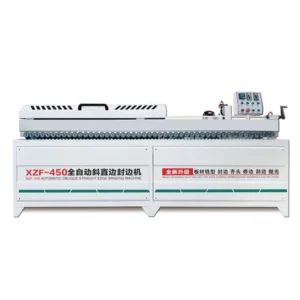
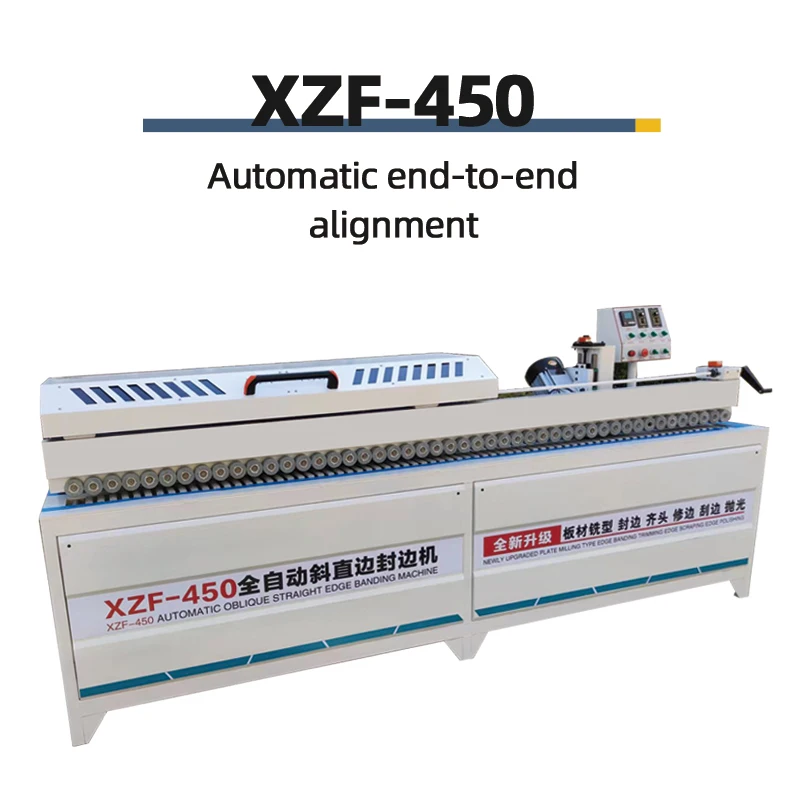
<p><strong>XZF-450 Automatic Edge Banding Machine, 9.5KW, 0-12M/min feed, 0.3-3MM banding thickness</strong> — delivers a complete 7-function edge banding sequence from pre-milling through polishing. The 4KW pre-milling station ensures a clean, square edge before glue application, critical for bond quality on MDF, plywood and particleboard. Adjustable 30/45/60-degree capability and integrated scraping produce consistent, glue-line-free finishes across diverse substrates. Backed by four-stage QC with pre-shipment verification, engineer-led configuration within 24 hours, and voltage customization confirmed before production.</p> <ul> <li>Total Power: 9.5KW, Voltage: 380V/415V</li> <li>Panel Min Dimensions: 30CM × 15CM, Edge Height: 0-50MM</li> <li>Glue Pot: 4000ml, Air Pressure: 0.5-0.7Mpa</li> </ul>
100+
Countries
MOQ 1
Unit
15-25 Days
Lead Time
380V
9.5KW
Edge Banding Machine
MDF Panel
Plywood Edge Banding
Process Application
XZF-450
- Full OEM/ODM support -- custom logo, voltage (110V-440V), multilingual panels
- ISO 9001 & CE certified, 5 national patents, 60 professional engineers
- 12-month warranty, remote technical support & spare parts service
- Professional export packaging, customs clearance support, on-time delivery
Integrated Pre-Milling and Multi-Stage Finishing — the XZF-450 sequences seven edge banding operations from panel milling through polishing, calibrated to hold consistent bond quality across MDF, plywood and particleboard substrates.
Technical Specifications
| Parameter | Value |
|---|---|
| Model | XZF-450 |
| Product Type | Automatic Edge Banding Machine |
| Total Power | 9.5 kW |
| Voltage | 380V / 415V (frequency 50Hz/60Hz to be confirmed before order) |
| Pre-milling Motor | 4 kW |
| Trimming Power | 2.2 kW × 2 |
| Polishing Power | 0.4 kW × 2 |
| Edge Power | 0.16 kW |
| Transmission Power | 180 W |
| Vacuum Power | 550 W |
| Feed Speed | 0–12 m/min |
| Edge Banding Thickness | 0.3–3 mm |
| Edge Banding Height | 0–50 mm |
| Panel Minimum Length | 30 cm |
| Panel Minimum Width | 15 cm |
| Glue Pot Capacity | 4000 ml |
| Air Source Pressure | 0.5–0.7 MPa |
| Overall Dimensions (L×W×H) | 300 × 65 × 135 cm |
| Net Weight | 430 kg |
| Standard Functions | Pre-milling, 30°/45°/60° edge banding, trimming, scraping, polishing, high-power vacuum extraction |
| Language Options | Chinese and English standard; Spanish or other languages customizable |
| Plug Options | EU, USA, AU, UK |
Application Suitability
| Application | Material or Output |
|---|---|
| Cabinet door and carcass edge finishing | MDF and melamine-faced board with PVC or ABS banding |
| Custom furniture visible-panel edging | Plywood and blockboard with veneer or melamine strips |
| Wardrobe and shelving panel production | Particleboard with 0.3–3 mm PVC edge banding |
| Angled edge profiles for designer furniture | Solid wood and polymer door blanks at 30°/45°/60° |
| Medium-volume joinery workshop output | Mixed substrate batches requiring consistent glue-line-free edges |
Why Visible Glue Lines Keep Failing Assembly Inspection
Substrate variation and unconfirmed material behavior are the root cause of most edge banding rejects, not the machine itself.
Production managers who have watched a batch pass factory testing only to fail on the shop floor know the pattern: the edge banding machine runs perfectly on the sample material, then visible glue lines appear the moment the actual production stock enters the feed. The XZF-450 addresses this through its integrated pre-milling station and adjustable feed speed, but only when the process parameters are matched to the specific substrate and banding combination in use [NEED_CITE: substrate and adhesive compatibility standards in wood panel processing]. A machine configured for one PVC formulation will not automatically produce the same edge quality on a different plasticizer ratio, and this mismatch accounts for a significant share of commissioning delays in export markets.
How Pre-Milling Directly Determines Downstream Bond Quality
The 4 kW pre-milling motor on the XZF-450 removes the saw-cut edge before adhesive application, creating a clean and square reference surface. On particleboard and MDF, saw marks and micro-chipping along the panel edge prevent uniform glue contact, which is why edge banding process application on these substrates often shows inconsistent adhesion without pre-milling. A properly pre-milled edge allows the glue film to maintain continuous contact across the full panel thickness, reducing the chance of delamination during assembly or humidity cycling.
Feed Speed, Glue Open Time and Material-Specific Tuning
The 0–12 m/min feed speed range exists because different banding materials demand different dwell times against the glue roller. Thick PVC at 3 mm requires slower feed to allow adequate heat transfer and adhesive wetting, while thin 0.3 mm melamine strips can run at the upper end of the range without bond compromise. When a workshop switches between veneer and PVC on the same shift, the operator must adjust feed speed alongside glue pot temperature to maintain edge quality — a process discipline that separates reliable output from intermittent reject batches [NEED_CITE: hot-melt adhesive open time and feed rate correlation in edge banding].
Reading the Specification Sheet Against Your Production Reality
The 0.3–3 mm banding thickness range covers most PVC, ABS, veneer and melamine edge materials in common use, but each material interacts differently with the glue pot and pressure roller assembly. The 4000 ml glue pot capacity supports continuous runs without frequent refill interruptions, though temperature recovery between batches depends on the specific adhesive formulation in use. The 0–50 mm edge banding height accommodates standard panel thicknesses from 10 mm shelving stock up to 50 mm solid wood worktops. Air source pressure at 0.5–0.7 MPa must be stable; pressure fluctuation directly affects trimming and scraping consistency, producing uneven edge profiles that become visible after polishing.
The Cost of Skipping Material-Specific Commissioning
When a machine arrives configured for standard test material rather than the buyer’s actual stock, the first production run reveals problems that no specification sheet could predict. Glue lines appear on substrates with different surface porosity, trimming blades chatter on harder PVC formulations, and polishing wheels leave burn marks on heat-sensitive melamine. These issues are not machine defects — they are process mismatches that require on-site parameter adjustment, consuming days of production time and generating panel waste that erodes the project margin [NEED_CITE: common commissioning failures in exported woodworking machinery].
Why Sourcing This Machine Through Our Process-Oriented Approach
In-house manufacturing with patented cutting mechanisms means the pre-milling and trimming stations are engineered as an integrated system, not assembled from unrelated third-party components. The four-stage quality control process covers incoming material inspection, in-process assembly checks, finished product testing, and pre-shipment verification with actual panel runs. Voltage, control panel language and plug configuration are confirmed before production begins — the XZF-450 ships with the buyer’s frequency, operator language and plug type already set. Engineer-led configuration recommendations account for the specific substrate and banding material mix the buyer processes, not just the machine’s maximum capability. Factory test records are generated using the buyer’s own material samples wherever possible, reducing on-site commissioning variables.
Documentation & Verification
- Factory test record run on buyer-specified MDF, plywood or particleboard before dispatch
- Electrical schematic confirming 380V/415V wiring and frequency setting for destination market
- Operation manual translated into operator’s working language with station-by-station parameter guidance
- Spare parts list covering trimming blades, scraping inserts and polishing wheels with replacement intervals
- Pneumatic layout diagram showing 0.5–0.7 MPa air circuit and connection points for workshop planning
Installation, Commissioning & Support
- Floor space planning based on 300 × 65 × 135 cm footprint with material infeed and outfeed clearance
- Dedicated 9.5 kW circuit with voltage and frequency verification before first energization
- Pre-milling station alignment check and trimming blade calibration on buyer’s actual panel stock
- Feed speed and glue temperature mapping across each banding material in the buyer’s production mix
- Polishing and scraping station adjustment training for operators switching between PVC and veneer runs
- Wear-part replacement schedule for trimming cutters and polishing wheels based on production volume
Preparing Your Inquiry With the Right Process Details
To configure the XZF-450 for your production environment, share the substrate types and panel thickness range you process most frequently, along with the edge banding materials and thicknesses in regular use. Confirm your facility voltage and frequency, preferred control panel language, and whether angled edge profiles at 45 or 60 degrees are part of your standard output. If sample panels are available for a pre-shipment test run, provide enough material for the full seven-station sequence to be validated before dispatch.
Frequently Asked Questions
Q: How does pre-milling affect edge quality on MDF compared to particleboard?
A: MDF edges tend to be denser and smoother after sawing, so pre-milling mainly removes minor surface irregularities. Particleboard edges are more porous and prone to chipping, making the 4 kW pre-milling station critical for creating a uniform bonding surface. Without pre-milling on particleboard, adhesive penetration into voids produces inconsistent bond strength and visible glue lines after trimming.
Q: What glue temperature range works for PVC versus veneer banding on this machine?
A: PVC banding typically requires higher glue pot temperatures to achieve proper adhesive wetting across the full 0.3–3 mm thickness range, while natural veneer is more heat-sensitive and demands lower temperatures to prevent surface damage. The 4000 ml glue pot allows stable temperature maintenance during runs, but operators must adjust settings when switching between material types on the same shift.
Q: How should feed speed be matched to banding thickness for reliable adhesion?
A: Thicker banding at the 3 mm end of the range requires slower feed speeds to allow sufficient heat transfer from the glue roller and adequate pressure roller dwell time. Thinner 0.3 mm materials can run closer to the 12 m/min maximum. Matching feed speed to material prevents both under-bonding at high speed and heat damage at excessively slow feed rates.
Q: What panel dimensions can the XZF-450 handle within its working envelope?
A: The machine accepts panels with a minimum length of 30 cm and minimum width of 15 cm, with edge banding heights from 0 to 50 mm. This range covers most cabinet, shelving and furniture panel sizes. Panels below the minimum dimensions may not feed reliably through the pressure roller sequence and should be evaluated with a test run before committing to production volumes.
Q: How can edge banding quality be verified before full production begins?
A: Request a pre-shipment test using your actual substrate and banding material combination, then inspect trimmed and polished edges under consistent lighting for glue line visibility and surface finish. Cross-section cuts at several points along the band confirm adhesive coverage uniformity. This verification step identifies material-specific parameter adjustments before the machine enters your production schedule.
Technical Specifications
| Parameter | Value |
|---|---|
| Product Name | Automatic Edge Banding Machine for MDF and Plywood – Industrial Application |
| Category | Edge banding machine |
| Voltage Options | 110V / 220V / 380V / 440V (customizable) |
| Frequency | 50Hz / 60Hz (customizable) |
| Certification | ISO 9001, CE |
| MOQ | 1 Unit |
| Lead Time | 15-25 Working Days |
| Warranty | 12 Months |
| OEM / ODM | Available -- logo, color, panel language |
* Detailed technical specifications vary by model. Please contact us with your specific requirements for a complete datasheet.
Shipping & Export
-
Export Packaging
Heavy-duty wooden crate with foam padding and moisture protection
-
Shipping Methods
Sea freight (FCL/LCL), air freight, express -- we support all methods
-
Customs Support
Full documentation: CO, commercial invoice, packing list, HS code assistance
-
Port of Loading
Tianjin / Qingdao port, China -- 20 years export experience
OEM / ODM Services
-
Logo & Branding
Custom logo printing, color scheme, and nameplate engraving
-
Voltage Configuration
110V / 220V / 380V / 440V, 50Hz / 60Hz -- any region supported
-
Multilingual Panels
Control panels in English, Spanish, French, Arabic and more
-
Custom Specifications
Modified dimensions, accessories, or feature sets on request
Get a Quote
Request Product Inquiry
Fill in your details and we'll respond within 24 hours with pricing and availability.
Direct Contact
How It Works
-
1
Confirm requirements & budget
Tell us your factory scale and processing needs
-
2
Receive recommendation & quote
We match the right machine with full specs
-
3
Negotiate & place order
OEM terms, voltage, payment and delivery
-
4
Production & QC inspection
Multi-stage quality control by 60 engineers
-
5
Export packaging & shipment
Professional packing, customs clearance
-
6
After-sales support
12-month warranty, remote tech support
You May Also Like