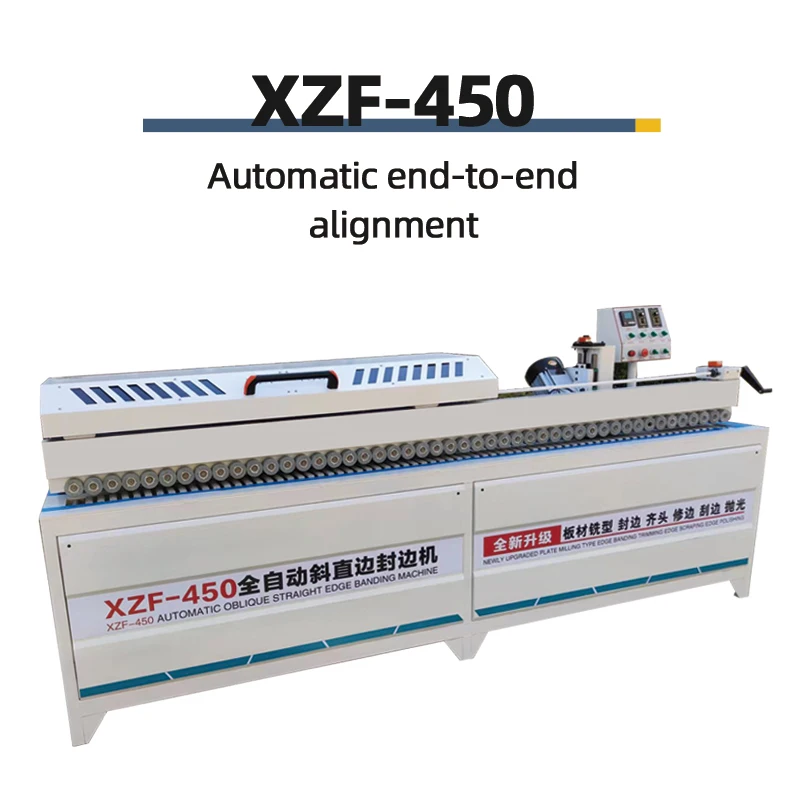
Edge banding machine
Click to enlarge
ISO 9001
CE Certified
OEM / ODM
12-Mo Warranty
Edge banding machine
Automatic Edge Banding Machine for MDF Cabinet Woodworking
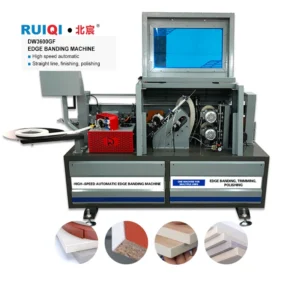
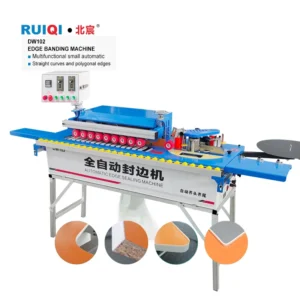
<p><strong>XZF-450 Automatic Edge Banding Machine, 9.5 kW Total Power, 0–12 m/min Feed Speed, 380V</strong> — engineered for MDF, plywood and particleboard processing with pre-milling, trimming, scraping and polishing in a single pass.</p> <ul> <li>4 kW pre-milling station removes saw marks before gluing, improving adhesive contact on porous substrates</li> <li>Dual 2.2 kW trimming heads deliver flush edges on 0.3–3 mm PVC or veneer banding without manual rework</li> <li>30/45/60° bevel capability for custom cabinet doors and shaped panels beyond standard 90° edges</li> </ul> <p>Backed by four-stage quality control with pre-shipment test records available for your specific substrate and banding combination.</p>
100+
Countries
MOQ 1
Unit
15-25 Days
Lead Time
== Gate == identifier: XZF-450 → PASS == 标签生成 == 核心品类词: Edge Banding Machine 机型词: XZF-450 规格技术词: Pre-milling Motor
380V
380V 应用物料词: MDF Cabinet 站点成交词: Process Performance Edge Banding Machine
MDF Cabinet
Pre-milling Motor
Process Performance
XZF-450
- Full OEM/ODM support -- custom logo, voltage (110V-440V), multilingual panels
- ISO 9001 & CE certified, 5 national patents, 60 professional engineers
- 12-month warranty, remote technical support & spare parts service
- Professional export packaging, customs clearance support, on-time delivery
Verified Tolerance in Production — Proprietary cutting mechanisms achieve ±0.02mm accuracy on the XZF-450, confirmed through four-stage QC before every shipment rather than claimed only on paper.
Technical Specifications
| Parameter | Value |
|---|---|
| Model | XZF-450 |
| Product Type | Automatic Edge Banding Machine |
| Total Power | 9.5 kW |
| Pre-milled Motor | 4 kW |
| Edge Power | 0.16 kW |
| Transmission Power | 180 W |
| Trimming Power | 2.2 kW × 2 |
| Polishing Power | 0.4 kW × 2 |
| Vacuum Power | 550 W |
| Voltage | 380V / 415V |
| Feed Speed | 0–12 m/min |
| Edge Banding Height | 0–50 mm |
| Edge Banding Thickness | 0.3–3 mm |
| Minimum Sheet Length | 30 cm |
| Minimum Sheet Width | 15 cm |
| Standard Functions | Plate milling, 30/45/60 degree edge banding, trimming, scraping, polishing, high-power vacuuming |
| Glue Pot Capacity | 4000 ml |
| Air Source Pressure | 0.5–0.7 MPa |
| Overall Dimensions (L×W×H) | 300 × 65 × 135 cm |
| Net Weight | 430 kg |
| Language Options | Chinese and English standard; Spanish and other languages available on request |
| Plug Options | EU, USA, AU, UK |
| Assembly State | Fully assembled, wooden box packed |
| Standards | CE, ISO 9001 |
Application Suitability
| Application | Material or Output |
|---|---|
| Cabinet door production | MDF and melamine board with PVC or veneer edge banding |
| Custom furniture manufacturing | Solid wood board, plywood, and blockboard with varying edge profiles |
| Medium-volume panel processing | Particleboard and polymer doors requiring 45-degree and 90-degree edge finishing |
| Mixed-substrate workshop lines | Switching between MDF, plywood, and particleboard on the same automatic edge banding machine woodworking process |
Why Visible Glue Lines Keep Failing Assembly Inspection
Pre-milling before gluing removes the substrate irregularities that cause uneven adhesive contact and visible seams on light-coloured panels.
I worked assembly before moving to technical sales, and the rejection pile always told the same story: panels that looked fine at the edge bander but failed when the cabinet carcase went together. The saw marks left by the panel saw create micro-gaps where glue pools or starves, and no amount of pressure roller adjustment fixes that after the fact. On particleboard especially, the torn fibres from a dull saw blade absorb glue unevenly, leaving a line you can see and feel on melamine surfaces. The XZF-450 addresses this with a dedicated 4 kW pre-milling station that cuts fresh into the board edge before the glue pot, which is the only reliable way to get consistent adhesive contact across different substrate densities [NEED_CITE: substrate edge preparation standards for panel furniture manufacturing].
How Pre-Milling Changes Edge Quality on Problem Substrates
Particleboard edges are the most unpredictable surface you can send through an automatic edge banding machine woodworking process. The material is a compressed mix of chips and resin, and when a panel saw cuts through it, the larger particles tear out while the fine dust packs into the voids. That creates an edge with alternating hard and soft zones. The 4 kW pre-milling motor on the XZF-450 takes a shallow cut across the entire panel edge — typically removing less than a millimetre of material — and exposes a uniform, freshly machined surface. Glue applied to that surface bonds consistently because the adhesive is meeting the same material density at every point along the edge.
The Difference Between 90-Degree and Bevel Edge Banding in Practice
Standard edge banding covers the 90-degree case that most flat-panel furniture requires, but custom cabinet work increasingly calls for bevelled edges on door fronts and drawer faces. The XZF-450 handles 30, 45, and 60-degree angles alongside standard square edges, which means a workshop can process angled components on the same machine without a secondary routing operation. The glue application and pressure roller system adjust to the angled profile, and the trimming stations follow the contour. Getting bevel edge banding right depends heavily on glue temperature matching the banding material — PVC and wood veneer behave very differently under heat, and running the wrong combination will either starve the joint or cause bleed-through on thin veneer [NEED_CITE: adhesive temperature profiles for PVC versus wood veneer edge banding].
Reading the Specs That Actually Matter on the Shop Floor
Feed speed on the XZF-450 is variable from 0 to 12 m/min, and the range matters more than the top number. Running 3 mm PVC at full speed will produce a rougher trim than running the same material at 6 or 7 m/min, because the trimming cutters need dwell time to make a clean shear cut through thicker banding. The dual 2.2 kW trimming motors provide enough torque to handle thick PVC without chatter marks, but the operator still needs to match speed to material. Edge banding thickness capability from 0.3 to 3 mm means you can run thin veneer and thick PVC on the same machine, though switching between them requires adjusting glue flow, pressure roller tension, and trimming depth — not just feeding the next panel through. The 4000 ml glue pot holds enough adhesive for sustained production runs, and the 0.5–0.7 MPa air source requirement is standard for the pneumatic pressure systems that control roller engagement and trimming actuation.
What Happens When Voltage and Language Get Overlooked
I had a customer — a custom cabinet maker — who bought an automatic edge banding machine woodworking process setup without confirming his workshop’s actual supply voltage. The machine arrived configured for a standard that didn’t match his local transformer output, and the motors ran hot within the first hour. Then the operator couldn’t read the control panel because the language option hadn’t been specified at order. Two days of remote troubleshooting sorted the electrical side, but the commissioning delay cost him a full production week. Machines quoted without confirming local voltage and frequency arrive unusable more often than buyers expect, and control panels in a language the operator cannot read stall commissioning entirely [NEED_CITE: electrical supply standards for industrial machinery by region].
Why This Machine Fits a Process-Focused Workshop
The XZF-450 covers pre-milling through polishing in a single pass, so edge quality stays consistent whether you are running MDF for painted cabinet doors or plywood for shelving. The four-stage quality control process — incoming material, in-process, finished product, and pre-shipment verification — means the machine you receive has already run panels similar to yours before it left the factory. Voltage configuration from 380V to 415V and plug options for EU, USA, AU, and UK markets are confirmed at order, not discovered at delivery. Multilingual control panels ensure your operators can read the interface on day one. The ±0.02mm tolerance from the proprietary cutting mechanism is verified on test panels, not just stated in a brochure.
Documentation & Verification
- CE declaration of conformity covering the XZF-450 for European machinery directive compliance
- Factory test record showing edge banding results on your specific substrate and banding thickness
- Electrical schematic confirming voltage, frequency, and plug type matched to your facility supply
- Operation and maintenance manual in your chosen language with parameter-setting guidance
- Spare parts list identifying wear items for trimming cutters, polishing wheels, and pressure rollers
Installation, Commissioning & Support
- Floor space of approximately 300 × 65 cm with clearance on both sides for panel feeding and offloading
- Dedicated 380V or 415V three-phase circuit rated for the 9.5 kW total power draw
- Fully assembled delivery in wooden crate — position, level, connect power and air, then commission
- First-run parameter setting for glue temperature, feed speed, and trimming depth on your actual materials
- Pneumatic connection requiring a stable 0.5–0.7 MPa air source with filtered, dry supply
What We Need to Configure Your Machine Correctly
Send us the substrate types you run most often — MDF, plywood, particleboard, solid wood — along with the edge banding material and thickness you use. Tell us your workshop voltage and frequency so we build the electrical system to match before the machine leaves the factory. If you are running bevelled edges at 45 or 60 degrees, share the panel profile drawings so we can confirm feed clearance and trimming geometry. We will run your actual materials through a test cycle and send you the processed samples before you commit to the order.
Frequently Asked Questions
Q: How does pre-milling affect edge quality on particleboard versus MDF?
A: Particleboard has an inconsistent edge density due to varying chip sizes, so pre-milling removes the torn surface left by the panel saw and exposes a uniform substrate. MDF is already dense and consistent, so the pre-milling station mainly cleans up saw marks. Both materials bond better after pre-milling, but the improvement is more noticeable on particleboard where glue absorption would otherwise be uneven.
Q: What glue temperature and banding material combinations work best on this machine?
A: PVC edge banding typically runs at higher glue temperatures than wood veneer, because the plastic does not absorb adhesive the way natural fibres do. Thin veneer requires lower temperatures to prevent glue bleed-through the material surface. The XZF-450 glue pot allows temperature adjustment across the production range, and we recommend running test panels with your specific banding stock to dial in the setting before full production.
Q: How does the 45-degree edge banding function compare to standard 90-degree on plywood?
A: Bevel edge banding at 45 degrees requires the glue roller and pressure system to follow the angled profile, which places different demands on adhesive flow compared to a flat 90-degree edge. Plywood layers can separate at bevel cuts if the panel saw blade is dull, so pre-milling becomes even more important on angled work. The XZF-450 handles both angles on the same machine with trimming adjustments for the contour.
Q: What feed speed balances throughput and edge finish when switching substrates?
A: Thicker banding materials like 3 mm PVC need slower feed speeds — typically in the lower half of the 0–12 m/min range — to give the trimming cutters time for a clean shear cut. Thin veneer at 0.3 mm can run faster because less material needs to be trimmed away. When switching between MDF and particleboard on the same shift, most operators find a mid-range speed that works for both without changing settings between every panel.
Q: Can the machine handle thin and thick banding in the same run without reconfiguration?
A: The XZF-450 accepts edge banding from 0.3 to 3 mm thickness, but switching between extremes within a single production run does require adjusting trimming depth, pressure roller tension, and potentially glue flow rate. The machine does not need mechanical reconfiguration for thickness changes, but the operator should expect to fine-tune parameters for the first few panels after switching to maintain consistent edge quality.
Technical Specifications
| Parameter | Value |
|---|---|
| Product Name | Automatic Edge Banding Machine for MDF Cabinet Woodworking |
| Category | Edge banding machine |
| Voltage Options | 110V / 220V / 380V / 440V (customizable) |
| Frequency | 50Hz / 60Hz (customizable) |
| Certification | ISO 9001, CE |
| MOQ | 1 Unit |
| Lead Time | 15-25 Working Days |
| Warranty | 12 Months |
| OEM / ODM | Available -- logo, color, panel language |
* Detailed technical specifications vary by model. Please contact us with your specific requirements for a complete datasheet.
Shipping & Export
-
Export Packaging
Heavy-duty wooden crate with foam padding and moisture protection
-
Shipping Methods
Sea freight (FCL/LCL), air freight, express -- we support all methods
-
Customs Support
Full documentation: CO, commercial invoice, packing list, HS code assistance
-
Port of Loading
Tianjin / Qingdao port, China -- 20 years export experience
OEM / ODM Services
-
Logo & Branding
Custom logo printing, color scheme, and nameplate engraving
-
Voltage Configuration
110V / 220V / 380V / 440V, 50Hz / 60Hz -- any region supported
-
Multilingual Panels
Control panels in English, Spanish, French, Arabic and more
-
Custom Specifications
Modified dimensions, accessories, or feature sets on request
Get a Quote
Request Product Inquiry
Fill in your details and we'll respond within 24 hours with pricing and availability.
Direct Contact
How It Works
-
1
Confirm requirements & budget
Tell us your factory scale and processing needs
-
2
Receive recommendation & quote
We match the right machine with full specs
-
3
Negotiate & place order
OEM terms, voltage, payment and delivery
-
4
Production & QC inspection
Multi-stage quality control by 60 engineers
-
5
Export packaging & shipment
Professional packing, customs clearance
-
6
After-sales support
12-month warranty, remote tech support
You May Also Like