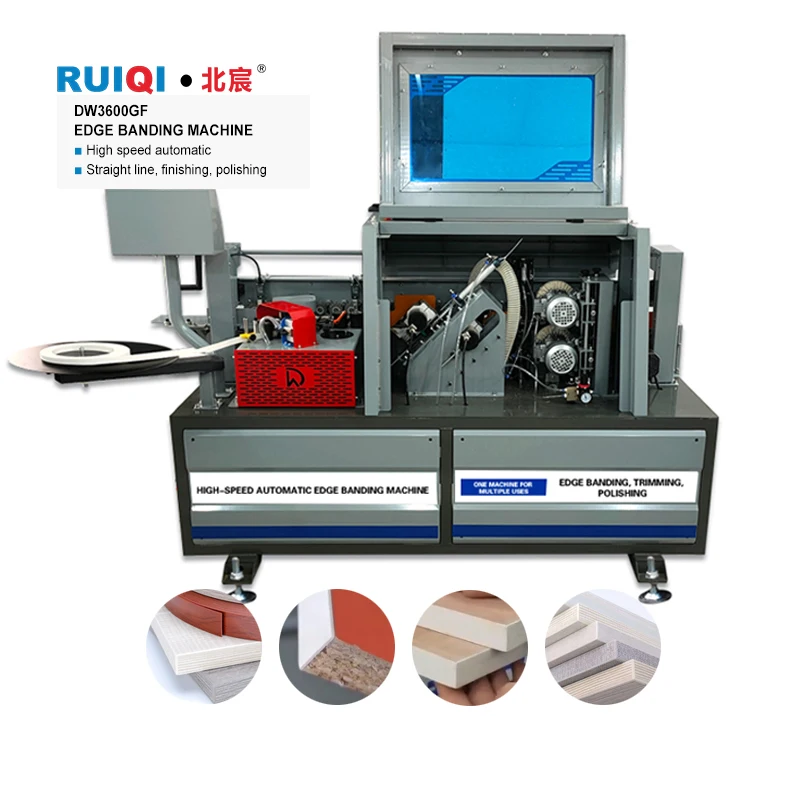
Edge banding machine
Click to enlarge
ISO 9001
CE Certified
OEM / ODM
12-Mo Warranty
Edge banding machine
Automatic Edge Banding Machine for MDF PVC – Process and Application
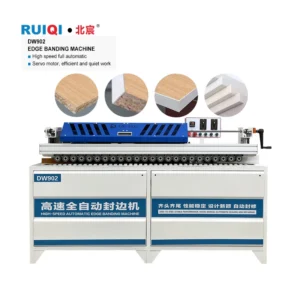
<p><strong>DW-3600GF Fully Automatic Edge Banding Machine, 380V, 4.9 kW, 0–14 m/min Feed Speed</strong> — processes MDF and PVC substrates through gluing, double trimming at 24000 r/min, scraping, and polishing stations.</p> <ul> <li>Adjustable feed speed matches glue curing behavior across 0.3–3 mm banding thickness, ensuring consistent adhesion on MDF and particleboard</li> <li>Full six-stage sequence from gluing to vacuuming delivers glue-line-free edges ready for downstream assembly</li> </ul> <p>Backed by four-stage QC with pre-shipment verification under load and engineer-led configuration support within 24 hours.</p>
100+
Countries
MOQ 1
Unit
15-25 Days
Lead Time
14 m/min Feed Speed
380V Three-phase
DW-3600GF
Edge Banding Machine
Furniture Factory
MDF PVC Edge Banding
Process And Application
- Full OEM/ODM support -- custom logo, voltage (110V-440V), multilingual panels
- ISO 9001 & CE certified, 5 national patents, 60 professional engineers
- 12-month warranty, remote technical support & spare parts service
- Professional export packaging, customs clearance support, on-time delivery
Precision Process Control — Every DW-3600GF process station is calibrated against your actual substrate and edge banding material before dispatch.
Technical Specifications
| Parameter | Value |
|---|---|
| Model | DW-3600GF |
| Product Type | Fully Automatic Edge Banding Machine |
| Voltage & Frequency | 380V Three-Phase Four-Wire |
| Total Power | 4.9 kW |
| Overall Dimensions (L×W×H) | 2200 × 650 × 1250 mm |
| Net Weight | 320 kg |
| Edge Banding Type | Straight Edge Banding |
| Edge Band Height Range | 0–50 mm |
| Edge Band Thickness Range | 0.3–3 mm |
| Minimum Panel Length | 200 mm |
| Feed Speed | 0–14 m/min (adjustable) |
| Trimming Motor Power | 800 W × 2 |
| Trimming Spindle Speed | 24000 r/min |
| Polishing Motor Power | 400 W × 2 |
| Edge Banding Feed Motor | 160 W |
| Transmission Motor | 180 W |
| Air Supply Requirement | 0.4–0.6 MPa |
| Standard Process Stations | Gluing, Trimming, Front and Rear Trimming, Scraping, Polishing, Vacuuming |
| Control Panel Language | Chinese and English standard; other languages customizable |
| Plug Options | EU, USA, AU, UK available |
| Assembly State | Fully assembled, wooden box packed |
Application Suitability
| Application | Material or Output |
|---|---|
| Custom cabinet door and carcass production | MDF and particleboard panels with PVC edge banding |
| Wardrobe and shelving panel finishing | Plywood and melamine-faced board with 0.3–3 mm banding |
| Furniture workshop straight-edge processing | Solid wood panels and veneer edge banding on flat substrates |
| Small to mid-volume batch panel edging | Boards from 200 mm minimum length across varying widths |
Why Glue Lines Still Show Up on Perfectly Calibrated Machines
Visible glue lines are rarely a machine fault — they are a process-material mismatch.
The edge banding machine woodworking process demands that glue temperature, feed speed, and banding material behavior align on every single panel. I once watched a cabinet factory run PVC banding on MDF without issues for a week, then switch to thin wood veneer using the same settings. The result was a batch of panels with obvious glue squeeze-out and poor adhesion. The trimming was clean, but the bond itself had failed because veneer absorbs heat differently than PVC [NEED_CITE: thermal conductivity differences between PVC and wood veneer edge banding]. Production managers tend to evaluate machines on mechanical precision while overlooking the thermal and chemical variables in the gluing station.
How the Process Chain Determines Final Edge Quality
The DW-3600GF runs a six-station sequence: gluing, trimming, front and rear trimming, scraping, polishing, and vacuuming. Each station addresses a specific defect mode in the edge banding machine woodworking process. The double trimming stage at 24000 r/min removes excess banding flush with the panel surface, while scraping eliminates the microscopic ridge left by the trimmer blade. Polishing then removes any residual adhesive film that would otherwise show up under workshop lighting or after surface coating.
Matching Feed Speed to Bading Material Behavior
Feed speed on this machine is adjustable from 0 to 14 m/min, and this range exists for a reason beyond throughput preference. PVC banding at 0.4 mm thickness can typically run at higher feed rates because it conforms easily to the panel edge and cools quickly. Wood veneer, by contrast, requires slower feed speeds so the glue has adequate open time to penetrate the porous substrate before pressure is applied. Running veneer at PVC speeds is one of the most common causes of edge lifting in automated edge banding [NEED_CITE: open time requirements for hot melt adhesives on porous vs non-porous edge materials].
Reading the Specification Sheet Against Your Production Reality
The trimming spindle speed of 24000 r/min with dual 800 W motors is significant for edge finish quality. At this speed, the trimming cutters shear the banding material rather than tearing it, which matters most when running thin PVC or real wood veneer where any chatter marks become visible after finishing. The edge band thickness range of 0.3–3 mm covers most furniture production requirements, but the minimum panel length of 200 mm should be checked against your smallest component — narrow drawer sides and small shelf brackets sometimes fall below this threshold. The 4.9 kW total power draw and 0.4–0.6 MPa air supply requirement are modest enough for most workshop electrical and compressor setups, but the three-phase four-wire 380V configuration must be confirmed against local supply before ordering [NEED_CITE: three-phase voltage standards across different export markets]. The adjustable feed speed interacts directly with glue pot temperature: higher speeds require higher temperatures to maintain proper wetting, which in turn affects the thermal load on heat-sensitive substrates like thin MDF.
The Downstream Cost of Skipping Process Validation
When a workshop buys an edge banding machine based on spec sheet numbers alone, the problems surface weeks after installation. Panels that pass visual inspection on the line may fail during assembly if trimming tolerance leaves even a slight overhang that prevents flush joining. Scraping and polishing stations that are not calibrated to the specific banding material leave residue that interferes with subsequent surface treatment or causes visible defects under final inspection lighting. I have seen production runs where the bond strength was adequate on the first day but degraded across the batch because the glue pot temperature drifted as ambient workshop conditions changed, and nobody had established a baseline process window for that particular material combination [NEED_CITE: hot melt adhesive performance variance with ambient temperature fluctuation].
Why This Machine Fits a Process-Focused Evaluation
The DW-3600GF carries the same six-station process chain as larger production machines, meaning the edge quality principles you validate on this unit transfer directly if your workshop scales to higher volumes. Voltage and plug configuration are confirmed before production rather than assumed, so the machine arrives ready for your local electrical supply. The control panel language is customizable beyond the standard Chinese and English, removing the operator comprehension barrier that stalls commissioning on imported equipment. Each unit undergoes pre-shipment testing across all process stations under load with actual panel material, not just a dry run. Engineer-led configuration recommendations are based on your stated substrate and banding material, not a generic default setup.
Documentation & Verification
- CE declaration of conformity covering the complete DW-3600GF machine assembly
- ISO 9001 certificate for the manufacturing quality management system
- Machine specification sheet with verified trimming tolerance and feed speed calibration data
- Factory test record on your actual panel substrate and edge banding material before dispatch
- Operation and maintenance manual in the agreed operator language with spare parts list
- Electrical schematic and voltage confirmation matched to your facility supply
Installation, Commissioning & Support
- Requires a level floor area accommodating 2200 × 650 mm footprint with clearance for panel infeed and outfeed
- Dedicated 380V three-phase four-wire circuit rated for 4.9 kW continuous draw with proper earthing
- Arrives fully assembled in wooden crate — position, level, connect power and air supply, then verify
- First-run parameter setup includes glue temperature calibration and feed speed matching to your banding material
- Operator training covers all six process stations, daily cleaning routines, and trimming cutter replacement
- Compressed air supply at 0.4–0.6 MPa with moisture trap installed upstream of the machine inlet
How to Structure Your Inquiry
To receive a configuration recommendation that actually matches your production, include the panel substrates you run most frequently, the edge banding materials and thicknesses in your typical orders, and your local voltage and frequency standard. If you process components shorter than standard panel sizes, note the minimum piece length in your workflow. Specify the language your operators need on the control panel and whether you require a sample processing test on your own materials before shipment.
Frequently Asked Questions
Q: How does glue pot temperature and feed speed affect edge adhesion on MDF vs particleboard?
A: MDF is denser and absorbs heat differently than particleboard, which is more porous. On MDF, glue temperature must be high enough to maintain wetting across the full contact area before the banding is pressed. Feed speed determines how long the glue stays in its open window before cooling. Running particleboard settings on MDF often results in starved glue joints because the adhesive sets before full contact is achieved.
Q: What edge banding materials and thicknesses produce the best finish on this machine?
A: The DW-3600GF handles 0.3–3 mm banding across PVC, veneer, and melamine materials. PVC in the 0.4–2 mm range typically produces the most consistent finish because it conforms well to the panel edge and responds predictably to trimming at 24000 r/min. Real wood veneer requires slower feed speeds and careful temperature control but produces excellent results when the process window is properly established for that specific veneer species.
Q: How does double trimming differ from single trimming in visible edge quality?
A: Double trimming uses two sequential cutting passes at 24000 r/min to remove excess banding material. The first pass takes the bulk, and the second finishes flush with the panel surface. Single trimming leaves a higher risk of chatter marks or slight overhang, particularly on thin PVC or veneer where any surface irregularity becomes visible after finishing or under angled lighting in the final installation.
Q: Can the process sequence be adjusted for veneer vs PVC banding material behavior?
A: The six-station sequence on the DW-3600GF runs in fixed order, but the parameters at each station are adjustable. For veneer, feed speed is reduced, glue temperature is modified, and scraping pressure is calibrated to the softer material. The polishing stage may also be adjusted or the abrasive wheel selection changed to avoid burning the veneer surface, which is more heat-sensitive than PVC.
Q: What downstream assembly issues arise if scraping and polishing stations are skipped?
A: Without scraping, a microscopic ridge remains along the panel edge where the trimming cutters finished. This ridge prevents panels from sitting flush against each other during cabinet assembly and creates visible shadow lines after finishing. Skipping polishing leaves adhesive residue that attracts dust, interferes with surface coatings, and becomes apparent under the angled lighting typical in kitchen and bathroom installations.
Technical Specifications
| Parameter | Value |
|---|---|
| Product Name | Automatic Edge Banding Machine for MDF PVC – Process and Application |
| Category | Edge banding machine |
| Voltage Options | 110V / 220V / 380V / 440V (customizable) |
| Frequency | 50Hz / 60Hz (customizable) |
| Certification | ISO 9001, CE |
| MOQ | 1 Unit |
| Lead Time | 15-25 Working Days |
| Warranty | 12 Months |
| OEM / ODM | Available -- logo, color, panel language |
* Detailed technical specifications vary by model. Please contact us with your specific requirements for a complete datasheet.
Shipping & Export
-
Export Packaging
Heavy-duty wooden crate with foam padding and moisture protection
-
Shipping Methods
Sea freight (FCL/LCL), air freight, express -- we support all methods
-
Customs Support
Full documentation: CO, commercial invoice, packing list, HS code assistance
-
Port of Loading
Tianjin / Qingdao port, China -- 20 years export experience
OEM / ODM Services
-
Logo & Branding
Custom logo printing, color scheme, and nameplate engraving
-
Voltage Configuration
110V / 220V / 380V / 440V, 50Hz / 60Hz -- any region supported
-
Multilingual Panels
Control panels in English, Spanish, French, Arabic and more
-
Custom Specifications
Modified dimensions, accessories, or feature sets on request
Get a Quote
Request Product Inquiry
Fill in your details and we'll respond within 24 hours with pricing and availability.
Direct Contact
How It Works
-
1
Confirm requirements & budget
Tell us your factory scale and processing needs
-
2
Receive recommendation & quote
We match the right machine with full specs
-
3
Negotiate & place order
OEM terms, voltage, payment and delivery
-
4
Production & QC inspection
Multi-stage quality control by 60 engineers
-
5
Export packaging & shipment
Professional packing, customs clearance
-
6
After-sales support
12-month warranty, remote tech support
You May Also Like