Edge banding machine
Click to enlarge
ISO 9001
CE Certified
OEM / ODM
12-Mo Warranty
Edge banding machine
Automatic Edge Banding Machine for Wood Based Panels – Process Guide
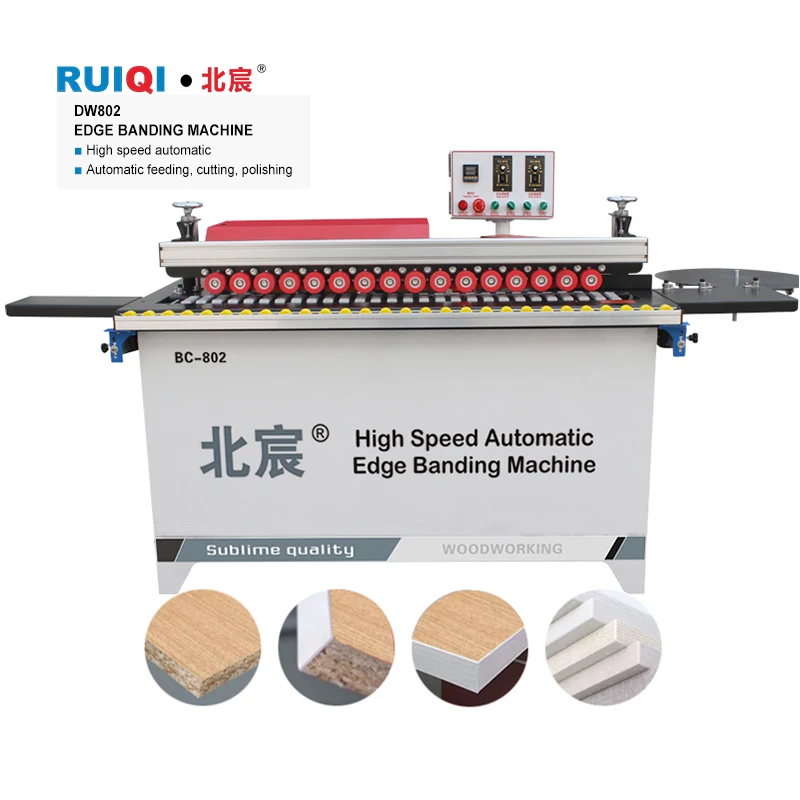
<p><strong>DW802 Automatic Edge Banding Machine</strong>, 220V/380V, 4200W total power, 0.3–3mm edge thickness — integrates gluing, trimming and polishing for MDF, particleboard and plywood straight-edge processing.</p> <ul> <li>4000ml glue pot supports continuous multi-panel runs across varying substrates</li> <li>Dual 800W trimming and 180W polishing stations deliver clean flush edges ready for assembly</li> <li>Minimum sheet size 25×10cm with vacuum-assisted panel stability during feed</li> </ul> <p>Sample processing tests on your actual panel material verify glue line quality before order, backed by engineer-led configuration within 24 hours and pre-shipment factory verification.</p>
100+
Countries
MOQ 1
Unit
15-25 Days
Lead Time
380V
DW802
Edge Banding Machine
Furniture Factory
MDF Panel
Process Guide
Vacuum System
- Full OEM/ODM support -- custom logo, voltage (110V-440V), multilingual panels
- ISO 9001 & CE certified, 5 national patents, 60 professional engineers
- 12-month warranty, remote technical support & spare parts service
- Professional export packaging, customs clearance support, on-time delivery
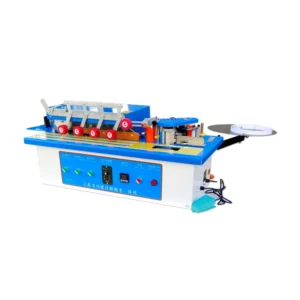
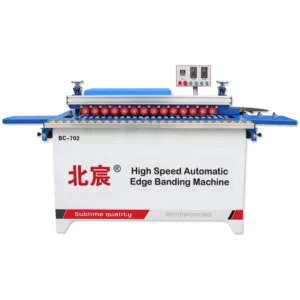
Verified Tolerance — the DW802 straight-edge automatic edge banding machine integrates gluing, trimming, end cutting and polishing in a single pass, delivering consistent edge finishes across MDF, particleboard and plywood substrates.
Technical Specifications
| Parameter | Value |
|---|---|
| Product Type | Automatic Edge Banding Machine |
| Model | DW802 |
| Total Power | 4200W |
| Voltage Options | 220V / 380V / customization |
| Edge Banding Thickness Range | 0.3–3 mm |
| Edge Banding Height Range | 0–50 mm |
| Minimum Sheet Length | 250 mm |
| Minimum Sheet Width | 100 mm |
| Glue Pot Capacity | 4000 ml |
| Edge Power | 140W |
| Transmission Power | 140W |
| Trimming Power | 800W × 2 |
| Polishing Power | 180W × 2 |
| Vacuum Power | 1200W |
| Air Source Pressure | 0.4–0.8 MPa |
| Product Dimensions | 130 × 60 × 95 cm |
| Product Weight | 135 kg |
| Key Features | Edge banding, trimming, polishing, automatic head and tail cutting, integrated vacuum |
| Language Options | Chinese and English standard; Spanish and other languages customizable |
| Plug Options | EU, USA, AU, UK |
| Assembly State | Fully assembled |
Application Suitability
| Application | Material or Output |
|---|---|
| Cabinet and wardrobe panel edge sealing | MDF, particleboard with PVC or veneer edge banding |
| Custom furniture straight-edge finishing | Ecological board, plywood with 0.3–3 mm banding |
| Small to medium workshop production runs | Wood-based panels for home decoration joinery |
| Offcut and small piece processing | Sheets as small as 250 × 100 mm |
Why Visible Glue Lines Ruin an Otherwise Clean Build
Substrate porosity and glue temperature together determine whether your edge banding disappears or telegraphs through the finish.
You can run perfect PVC on MDF all day and then switch to plywood for the next batch — only to find thick glue lines staring back at you on every panel. The issue is rarely the banding material itself. Plywood absorbs heat differently than MDF, and if the glue pot is not holding a stable temperature across a long run, adhesion becomes inconsistent board to board. The edge banding machine process and application changes every time you swap substrate, even when the panel thickness stays the same. [NEED_CITE: substrate thermal conductivity differences between MDF, particleboard and plywood]
How Glue Temperature Meets Substrate Behaviour
The DW802 holds 4000 ml of adhesive in its glue pot, which allows extended runs without stopping for refills. On porous substrates like particleboard, the glue cools quickly as the panel absorbs heat, so maintaining pot temperature across consecutive panels matters more than on dense MDF. When the pot runs low, temperature fluctuation increases and you start seeing uneven wetting along the band. This edge banding machine process and application detail is what separates a clean, invisible glue line from one the customer will notice before they open the cabinet door.
Trimming and Polishing as a Two-Stage Finish
Trimming at 800W × 2 removes the excess banding flush with the panel surface. The two stations handle the top and bottom edges in a single pass, so you are not flipping panels or making a second run. After trimming, the 180W × 2 polishing stations smooth the trimmed edge to a finish ready for assembly. For PVC banding in the 0.3–3 mm range, this sequence produces a clean radius without chipping or tear-out — critical when the next step is drilling for hinges or inserting shelf pins. [NEED_CITE: edge trimming quality requirements for downstream CNC boring accuracy]
Reading the Specs Against Your Shop Floor
The 0–50 mm edge banding height range tells you the panel thickness envelope this machine handles. The 135 kg weight and compact 130 × 60 × 95 cm footprint mean it fits into workshops where floor space is limited, without requiring a dedicated foundation pad. Air source pressure at 0.4–0.8 MPa is standard shop air — no special compressor needed, but you do need clean, dry air to keep the pneumatic end-cutting cylinders responsive. The vacuum system at 1200W holds the panel steady through the feed path, which matters especially on smaller pieces approaching the 250 × 100 mm minimum where belt friction alone is not enough to prevent drift.
What Happens When Voltage and Language Are Afterthoughts
A machine built for 380V shipped into a 220V region without confirmation will run, but the motors pull higher current and the glue pot takes longer to reach temperature. Over weeks, that thermal lag degrades every edge on the floor. Language is the same category of problem: if the operator cannot read the control panel, they cannot adjust feed parameters or diagnose a fault — they simply stop the line and wait. Every specification on the sheet becomes irrelevant if the machine cannot start on day one at the customer’s facility. [NEED_CITE: voltage and frequency standards by export market]
Why Source This Machine Here
The DW802 ships fully assembled, reducing commissioning time on arrival. Voltage is confirmed against your local supply before production begins — 220V, 380V or a custom configuration matched to your facility. The control panel language is set to match your operators before the crate closes, not treated as an afterthought. A four-stage quality check runs from incoming material through pre-shipment verification on your specified panel stock. The edge banding machine process and application is tested on your actual material before dispatch, so you receive a factory test record alongside the machine.
Documentation & Verification
- Factory test record run on your specified panel material and edge banding stock
- Electrical schematic confirming voltage, frequency and plug type for your facility
- Operation and maintenance manual printed in the language your floor operators speak
- Spare parts list with part numbers for trimming blades, polishing wheels and pneumatic seals
- CE declaration of conformity and ISO 9001 certificate included with shipping documents
Installation, Commissioning & Support
- Requires a level floor with the 130 × 60 × 95 cm footprint and clearance for panel infeed
- Dedicated electrical circuit matching the confirmed 220V or 380V supply and 4200W total draw
- Arrives fully assembled — connect power, compressed air at 0.4–0.8 MPa and begin calibration
- First-run parameter setup for glue temperature, feed rate and trimming depth on your panel stock
- Operator training covers band loading, glue pot refill procedure and control panel navigation in your language
- Spare trimming blades and polishing wheels included for initial production runs
Before You Send an Inquiry
To match the DW802 configuration to your production, share the panel substrates you process most often, the edge banding material type and thickness range you run, and the daily volume you need to sustain. Confirm your local voltage and frequency so the electrical system is built correctly from the start, and specify the language your operators need on the control panel. If you want to verify edge quality before committing, request a sample processing test using your own panel and banding stock.
Frequently Asked Questions
Q: How does glue pot capacity affect edge quality when switching between MDF and plywood?
A: Plywood draws heat from the glue faster than MDF, so a larger pot like the 4000 ml on the DW802 helps maintain stable temperature across consecutive panels. When switching substrates mid-run, allow the pot to re-stabilize before resuming production to avoid visible glue lines on the first few boards after the changeover.
Q: What edge banding materials work within the 0.3–3 mm thickness range?
A: PVC, veneer and melamine edge banding in that thickness range are all compatible with the DW802 process. The dual 800W trimming stations handle rigid PVC cleanly, while the polishing stage is particularly important for veneer where a smooth edge is needed before any staining or lacquering downstream.
Q: How does trimming and polishing accuracy affect downstream assembly?
A: Flush trimming ensures panels sit square in cabinet carcases without the edge band creating interference at joints. If trimmed banding protrudes even slightly, hinge boring depth and shelf pin alignment shift. The two-stage trimming and polishing sequence on this machine is designed to deliver edges ready for assembly without hand finishing.
Q: What is the minimum panel size this machine handles?
A: The DW802 processes sheets down to 250 mm in length and 100 mm in width. The integrated vacuum system at 1200W holds these smaller pieces stable through the feed path, preventing drift that would cause misaligned banding or trim errors on offcuts and small component parts.
Technical Specifications
| Parameter | Value |
|---|---|
| Product Name | Automatic Edge Banding Machine for Wood Based Panels – Process Guide |
| Category | Edge banding machine |
| Voltage Options | 110V / 220V / 380V / 440V (customizable) |
| Frequency | 50Hz / 60Hz (customizable) |
| Certification | ISO 9001, CE |
| MOQ | 1 Unit |
| Lead Time | 15-25 Working Days |
| Warranty | 12 Months |
| OEM / ODM | Available -- logo, color, panel language |
* Detailed technical specifications vary by model. Please contact us with your specific requirements for a complete datasheet.
Shipping & Export
-
Export Packaging
Heavy-duty wooden crate with foam padding and moisture protection
-
Shipping Methods
Sea freight (FCL/LCL), air freight, express -- we support all methods
-
Customs Support
Full documentation: CO, commercial invoice, packing list, HS code assistance
-
Port of Loading
Tianjin / Qingdao port, China -- 20 years export experience
OEM / ODM Services
-
Logo & Branding
Custom logo printing, color scheme, and nameplate engraving
-
Voltage Configuration
110V / 220V / 380V / 440V, 50Hz / 60Hz -- any region supported
-
Multilingual Panels
Control panels in English, Spanish, French, Arabic and more
-
Custom Specifications
Modified dimensions, accessories, or feature sets on request
Get a Quote
Request Product Inquiry
Fill in your details and we'll respond within 24 hours with pricing and availability.
Direct Contact
How It Works
-
1
Confirm requirements & budget
Tell us your factory scale and processing needs
-
2
Receive recommendation & quote
We match the right machine with full specs
-
3
Negotiate & place order
OEM terms, voltage, payment and delivery
-
4
Production & QC inspection
Multi-stage quality control by 60 engineers
-
5
Export packaging & shipment
Professional packing, customs clearance
-
6
After-sales support
12-month warranty, remote tech support
You May Also Like