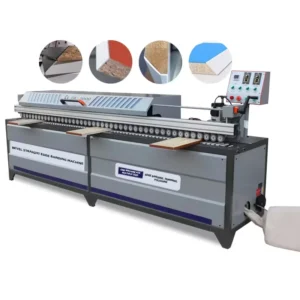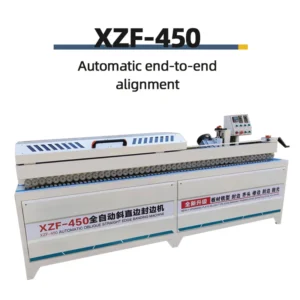
Edge banding machine
Click to enlarge
ISO 9001
CE Certified
OEM / ODM
12-Mo Warranty
Edge banding machine
Automatic MDF PVC Edge Banding Machine for Furniture – Manufacturer
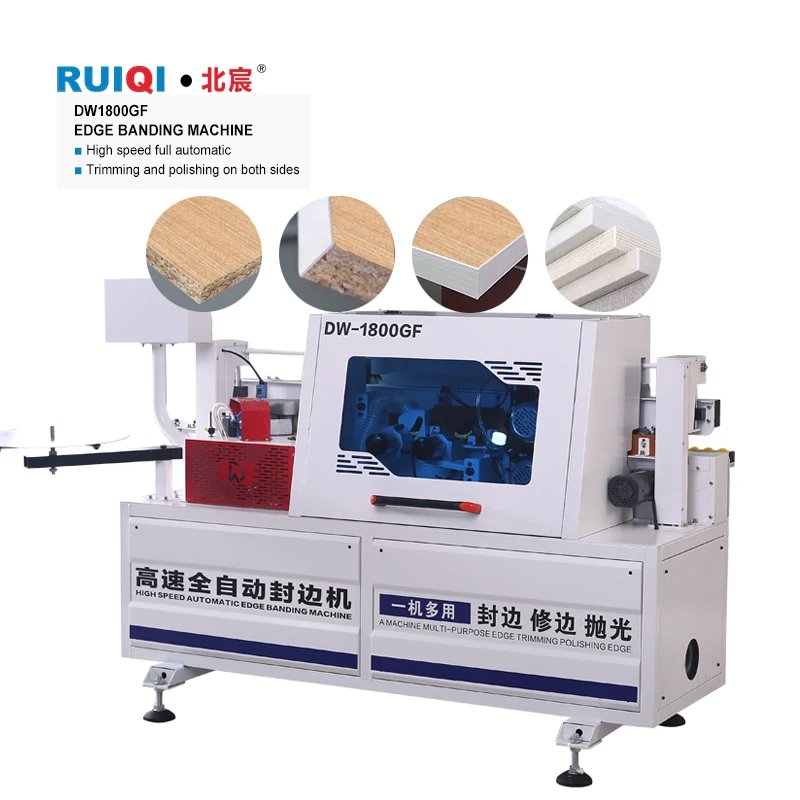
<p><strong>DW1800 Automatic Edge Banding Machine</strong>, 4.9KW, 0-14M/min feed speed, 0.3-3MM edge thickness — double-sided gluing with 4000ml glue pot ensures uniform adhesive distribution across MDF, particleboard and plywood substrates.</p> <ul> <li>Profile tracking rounds all four corners for clean, glue-line-free edge finishes that support tight downstream assembly tolerances</li> <li>Full automatic sequence from gluing through polishing handles PVC, ABS and veneer banding with adjustable feed rates matched to panel density</li> </ul> <p>Supported by four-stage QC with pre-shipment verification and sample processing tests on your specific substrate before order confirmation.</p>
100+
Countries
MOQ 1
Unit
15-25 Days
Lead Time
Automatic Machine
Double-Sided Gluing
DW1800
Edge Banding Machine
MDF Panel
Profile Tracking
- Full OEM/ODM support -- custom logo, voltage (110V-440V), multilingual panels
- ISO 9001 & CE certified, 5 national patents, 60 professional engineers
- 12-month warranty, remote technical support & spare parts service
- Professional export packaging, customs clearance support, on-time delivery
Precision-Ground Edge Finishes — the DW1800 maintains consistent glue distribution and trimming accuracy across MDF, particleboard, and plywood, verified through pre-shipment testing on your actual substrate.
Technical Specifications
| Parameter | Value |
|---|---|
| Model | DW1800 |
| Product Type | Automatic Edge Banding Machine |
| Total Power | 4.9KW |
| Voltage Options | 380V / 220V / 415V |
| Feed Speed | 0-14M/min |
| Edge Banding Thickness Range | 0.3-3MM |
| Edge Banding Height Range | 0-50MM |
| Minimum Sheet Dimensions | 200mm (L) × 100mm (W) |
| Glue Pot Capacity | 4000ml |
| Trimming Motor Power | 800W × 2 (24000 r/min) |
| Polishing Motor Power | 380W × 2 |
| Vacuum Power | 550W |
| Air Source Pressure | 0.4-0.6Mpa |
| Overall Dimensions | 220 × 65 × 125 CM |
| Net Weight | 320KG |
| Control Language | Chinese and English standard; Spanish or other languages customizable |
| Plug Options | EU, USA, AU, UK |
| Assembly State | Fully assembled |
Application Suitability
| Application | Material or Output |
|---|---|
| Custom furniture panel edge banding | MDF, particleboard, plywood with PVC or melamine edges |
| Cabinet door and carcass production | MDF and particleboard requiring clean, glue-line-free finishes |
| Mixed-substrate panel processing | Plywood, PVC panels, organic glass plates, solid wood |
| Joinery workshop automation | Transitioning from manual edge treatment to repeatable machine output |
| Batch production for assembly lines | Consistent edge profiles that allow downstream joinery to fit without rework |
Why Glue Lines Appear on Some Boards but Not Others
Double-sided gluing with a 4000ml pot keeps adhesive temperature and flow stable across the entire panel run.
Visible glue lines often trace back to uneven adhesive distribution or a glue pot that loses heat during continuous operation. On porous substrates like particleboard, insufficient glue penetration leaves gaps that show up after trimming. The edge banding machine woodworking process depends heavily on maintaining a steady thermal mass in the glue pot — smaller pots cool faster when boards feed through one after another, causing adhesion to vary from the first piece to the twentieth. [NEED_CITE: thermal stability requirements for hot-melt adhesive application on engineered wood substrates]
How Substrate Density Changes the Edge Banding Machine Woodworking Process
Not all MDF is pressed to the same density, and particleboard varies even more between manufacturers. A denser board absorbs less adhesive, meaning the glue film must be thinner to avoid squeeze-out that shows as visible lines after scraping. The DW1800’s double-sided gluing system applies adhesive to both the panel edge and the banding strip simultaneously, which compensates for low-absorption substrates by ensuring contact adhesion from both surfaces. Feed speed adjustment across the 0-14M/min range lets operators slow the line down for heavier boards that need more dwell time under the pressure rollers.
Tracking Corners Without Chipping the Banding
The profile tracking station on this edge banding machine rounds all four corners of the panel in a single pass. Without tracking, the trimmed ends of the edge banding leave sharp corners that catch during handling and chip away over time. This matters especially on cabinet doors and drawer fronts where the edge is visible and frequently touched. The tracking mechanism follows the panel contour at the trimming stage, producing a smooth radius that matches the router profile on shaped components. [NEED_CITE: edge banding corner tracking methods for panel furniture components]
Reading the Specs That Actually Affect Output Quality
The trimming motors run at 24000 r/min, which is the speed range needed for clean cuts on PVC and melamine banding without chipping or tearing the material. Lower speeds leave a rough edge that requires extra hand finishing. The 0.3-3MM banding thickness range covers standard PVC, ABS, and thin veneer strips, but attempting rigid profiles outside this range will overload the trimming cutters. Air pressure at 0.4-0.6Mpa drives the pneumatic actuators that control roller pressure and cutter engagement — running below this range causes inconsistent pressure, showing up as uneven scraping marks. The 550W vacuum system captures trimmings at the source, preventing chips from lodging between the panel and the conveyor belt where they would cause surface damage on subsequent boards.
What Happens When Voltage and Frequency Are Assumed, Not Confirmed
Machines quoted and shipped without confirming local voltage and frequency arrive at the workshop unable to start, or worse, they start and burn out the trimming motors within the first hour. A 380V motor connected to a 220V supply will draw excessive current and overheat, while a 50Hz motor running on 60Hz supply will overspeed and fail prematurely. [NEED_CITE: industrial motor failure rates from voltage and frequency mismatch in export markets] This is not a warranty issue — it is a specification failure that leaves the buyer with an unusable machine and a production schedule delayed by weeks while replacement parts ship internationally.
Why the Edge Banding Machine Woodworking Process Matters at Purchase Stage
Sourcing from a manufacturer with in-house production means the DW1800 you receive has been tested on the factory floor before crating, not assembled for the first time in your workshop. The four-stage quality control covers incoming material inspection, in-process assembly checks, finished product verification, and pre-shipment testing — each stage documented. Voltage, plug type, and control panel language are confirmed before production begins, so the machine arrives configured for your operators. Engineer-led configuration recommendations ensure the machine matches your production volume rather than being an entry-level model pushed beyond its intended use. Custom specifications within the standard platform are accommodated without requiring a completely new build.
Documentation & Verification
- CE declaration of conformity covering machinery safety directives for the DW1800
- Machine specification sheet with trimming tolerance values measured during factory testing
- Electrical schematic confirming voltage, frequency, and plug type match your local supply
- Factory test record showing edge banding results on your specified substrate and banding material
- Operation and maintenance manual provided in your operators’ working language
- Spare parts list with part numbers for trimming cutters, scraper blades, and glue pot components
Installation, Commissioning & Support
- Requires a level concrete floor with anchor points matching the 220 × 65 CM footprint
- Dedicated 3-phase circuit rated for the 4.9KW total power draw with proper earthing
- Arrives fully assembled; only air supply connection and electrical hookup needed on site
- Initial glue pot temperature and feed speed calibration performed against your panel samples
- Operator training covers banding material changes, scraper adjustment, and daily cleaning routines
- Trimming cutters and scraper blades identified on the spare parts list for reorder planning
What to Prepare Before Requesting a Quotation
Share the specific panel materials you run — MDF brand and density, particleboard type, or plywood grade — along with the edge banding material and thickness you intend to use. Confirm your local voltage and frequency so the electrical system is built to match. Let us know whether your operators need the control interface in a language beyond Chinese or English.
Frequently Asked Questions
Q: What edge banding materials does the DW1800 handle, and how does glue temperature affect each?
A: The DW1800 processes PVC, ABS, melamine, and veneer banding within the 0.3-3MM thickness range. Each material requires a different glue pot temperature setting — PVC typically needs lower heat than ABS to prevent the banding from softening before it reaches the pressure rollers. The double-sided gluing system and 4000ml pot maintain stable temperature across a production run.
Q: How does profile tracking perform across different board thicknesses?
A: The tracking station follows the panel edge contour within the 0-50MM height range, rounding all four corners consistently. Thicker boards require adjusted cutter depth settings, which operators dial in at the tracking station. This produces a uniform radius whether you are running 18MM cabinet sides or 25MM shelving stock.
Q: What substrate preparation prevents visible glue lines on particleboard?
A: Particleboard edges are porous and absorb adhesive unevenly if left unprepared. Running the panel through a pre-milling station before the gluing station creates a clean, flat edge surface. On the DW1800, ensuring the glue pot is at the correct temperature for your specific adhesive and that the air pressure stays within 0.4-0.6Mpa gives the most consistent result.
Q: How do I select feed speed for different panel densities and banding thicknesses?
A: Denser substrates and thicker banding materials generally require slower feed speeds to allow adequate dwell time under the pressure rollers. The DW1800’s 0-14M/min range lets you adjust based on output quality — start slower, inspect the trimmed edge, and increase speed until you see the first signs of adhesion weakness or trimming marks.
Q: Can I run a sample test with my own panel material before ordering?
A: Yes. Send a sample of your panel material and edge banding strip to the factory for a processing test. The test record documents glue temperature, feed speed, trimming results, and edge finish quality so you can verify the output matches your assembly requirements before committing to an order.
Technical Specifications
| Parameter | Value |
|---|---|
| Product Name | Automatic MDF PVC Edge Banding Machine for Furniture – Manufacturer |
| Category | Edge banding machine |
| Voltage Options | 110V / 220V / 380V / 440V (customizable) |
| Frequency | 50Hz / 60Hz (customizable) |
| Certification | ISO 9001, CE |
| MOQ | 1 Unit |
| Lead Time | 15-25 Working Days |
| Warranty | 12 Months |
| OEM / ODM | Available -- logo, color, panel language |
* Detailed technical specifications vary by model. Please contact us with your specific requirements for a complete datasheet.
Shipping & Export
-
Export Packaging
Heavy-duty wooden crate with foam padding and moisture protection
-
Shipping Methods
Sea freight (FCL/LCL), air freight, express -- we support all methods
-
Customs Support
Full documentation: CO, commercial invoice, packing list, HS code assistance
-
Port of Loading
Tianjin / Qingdao port, China -- 20 years export experience
OEM / ODM Services
-
Logo & Branding
Custom logo printing, color scheme, and nameplate engraving
-
Voltage Configuration
110V / 220V / 380V / 440V, 50Hz / 60Hz -- any region supported
-
Multilingual Panels
Control panels in English, Spanish, French, Arabic and more
-
Custom Specifications
Modified dimensions, accessories, or feature sets on request
Get a Quote
Request Product Inquiry
Fill in your details and we'll respond within 24 hours with pricing and availability.
Direct Contact
How It Works
-
1
Confirm requirements & budget
Tell us your factory scale and processing needs
-
2
Receive recommendation & quote
We match the right machine with full specs
-
3
Negotiate & place order
OEM terms, voltage, payment and delivery
-
4
Production & QC inspection
Multi-stage quality control by 60 engineers
-
5
Export packaging & shipment
Professional packing, customs clearance
-
6
After-sales support
12-month warranty, remote tech support
You May Also Like