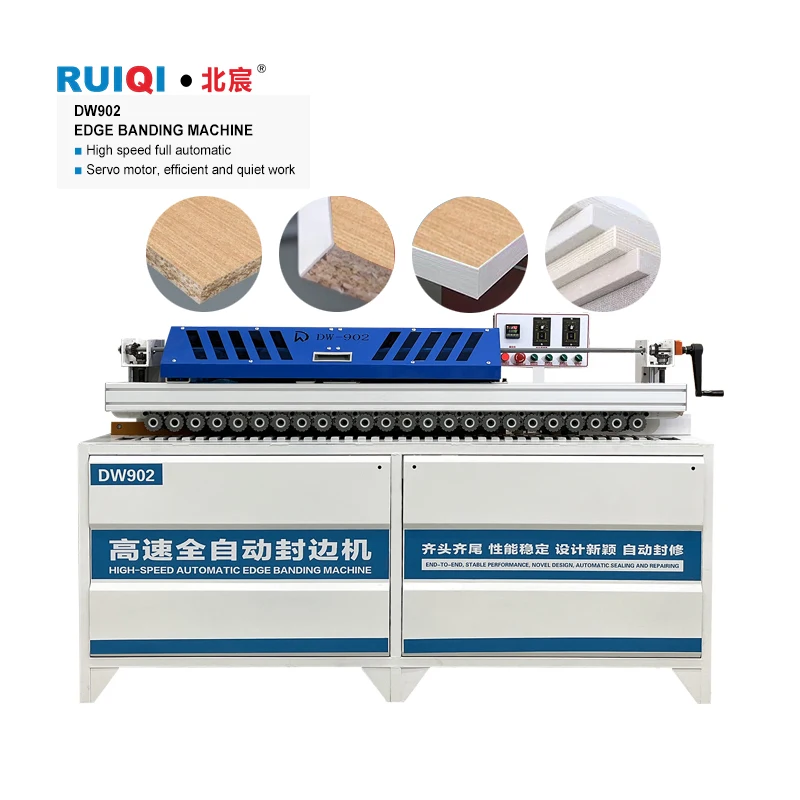
Edge banding machine
Click to enlarge
ISO 9001
CE Certified
OEM / ODM
12-Mo Warranty
Edge banding machine
Automatic Plywood Edge Banding Machine with PLC Control – Process & Application
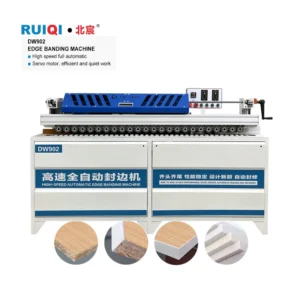
<p><strong>DW902 Automatic Edge Banding Machine, PLC Control, 220V/380V</strong> — engineered for plywood, MDF, and particleboard edge processing with 0.3–3mm banding thickness range.</p> <ul> <li>Double hot air glue activation ensures strong adhesion across varying substrate densities, while 4 groups of oblique pressure wheels deliver uniform glue lines on 90-degree edges</li> <li>Trimming at 24000r/min followed by polishing and scraping produces smooth, assembly-ready edges on PVC, melamine, and veneer banding materials</li> </ul> <p>Supported by engineer-led configuration recommendations and pre-shipment testing with sample processing verification for your specific substrate and banding combination.</p>
100+
Countries
MOQ 1
Unit
15-25 Days
Lead Time
Double Hot Air
DW902
Edge Banding Machine
MDF Panel
PLC Control
Plywood Edge Banding
Process Application
- Full OEM/ODM support -- custom logo, voltage (110V-440V), multilingual panels
- ISO 9001 & CE certified, 5 national patents, 60 professional engineers
- 12-month warranty, remote technical support & spare parts service
- Professional export packaging, customs clearance support, on-time delivery
Voltage-First Configuration Protocol — every DW902 automatic edge banding machine is matched to the buyer’s verified shop-floor voltage, frequency, and phase before the electrical schematic is finalized, preventing the twenty-day downtime scenarios that arise when 380V/50Hz motors meet 440V/60Hz grids.
Technical Specifications
| Parameter | Value |
|---|---|
| Model | DW902 |
| Product Type | Automatic Edge Banding Machine |
| Total Power | 4000W |
| Voltage & Frequency | 220V/380V/customizable per site supply |
| Control System | PLC |
| Edge Banding Thickness | 0.3–3 mm |
| Edge Banding Height | 50 mm |
| Minimum Sheet Length | 250 mm |
| Minimum Sheet Width | 100 mm |
| Trimming Motor | 800W × 2, 24000 r/min |
| Polishing Motor | 380W × 2 |
| Edge Drive Power | 140W |
| Transmission Power | 140W |
| Vacuum Power | 550W |
| Glue Pot Capacity | 4000 ml |
| Air Source Pressure | 0.5–0.8 MPa |
| Overall Dimensions | 1750 × 870 × 1120 mm |
| Net Weight | 240 kg |
| Key Features | Oblique and straight dual-purpose banding, double hot air design, feeding auxiliary slide plate, 4 groups oblique pressure wheels, double row pressing wheels |
Application Suitability
| Application | Material or Output |
|---|---|
| Cabinet panel edge banding | Plywood, MDF, particleboard with PVC or melamine tape |
| Furniture component finishing | Solid wood board and ecological board with 0.3–3 mm veneer or PVC |
| Custom home decoration panels | Mixed substrate runs requiring consistent 90-degree straight-edge finishes |
| Small-batch joinery production | Plywood and MDF boards from 250 mm minimum length upward |
Why the Voltage Question Should Precede Every Other Spec on an Automatic Edge Banding Machine for Plywood Production Process
A machine wired for the wrong grid is not a delayed project — it is a stranded asset sitting on your floor.
I once fielded a midnight call about an automatic edge banding machine shipped to Southeast Asia with a 380V/50Hz main motor. The workshop ran 440V/60Hz. The breaker tripped on first start-up, and by the time a step-down transformer arrived by sea freight, the entire panel line had been idle for over twenty days. That is why I now ask for a photo of the distribution cabinet before I touch a quotation. Voltage, frequency, phase — each one gets locked in writing [NEED_CITE: voltage and frequency standards by export market]. The DW902 is configurable across 220V and 380V standard supplies, and custom winding is available where local grids fall outside those ranges.
How Double Hot Air Changes Glue Behaviour on Porous Substrates
Plywood and particleboard absorb heat at different rates. A single heater often leaves the glue skin forming too quickly on dense MDF or failing to activate fully on open-grain plywood. The DW902’s double hot air design directs pre-heated air at both the panel edge and the banding tape simultaneously, keeping the adhesive in its open-time window longer. This matters most when an automatic edge banding machine for plywood production process runs mixed board stacks where substrate density shifts panel to panel.
Pressure Wheel Configuration and the 90-Degree Glue Line
Four groups of oblique pressure wheels paired with a double-row pressing arrangement distribute clamping force along the entire 50 mm edge height. On straight 90-degree edges this prevents the common fault where the top of the band bonds fully but the bottom lifts during trimming. The oblique wheel geometry also accommodates slight board wander without scoring the PVC surface [NEED_CITE: edge adhesion failure modes in panel furniture manufacturing].
Reading the Spec Sheet Against Your Actual Production Reality
The 24000 r/min trimming motors cut clean through PVC up to 3 mm thick, but the real test is what happens downstream. If trimming leaves a micro-ridge, the polishing and scraping stations must remove it without rounding the edge profile. The DW902 sequences trimming, scraping, then polishing — a three-stage finish that determines whether a cabinet door edge feels smooth to the hand or catches a fingernail. Glue pot capacity at 4000 ml supports continuous runs without frequent refill stops, though pot temperature settings must match your adhesive type. EVA hot-melt and PUR reactive adhesives demand different thermal windows, and running the wrong one degrades bond strength within hours [NEED_CITE: hot-melt adhesive temperature specifications for wood panel edge banding]. The 0.5–0.8 MPa air requirement also means your compressor must deliver stable pressure; drops below 0.5 MPa cause the pressure wheels to lose clamping force mid-cycle.
What Happens When Configuration Is Skipped
Ordering an automatic edge banding machine for plywood production process without confirming substrate thickness range, banding material, or local power supply leads to predictable failures. Boards below 10 mm may chatter against the feed rollers, producing wavy glue lines. PVC tape thicker than the trimming motors can handle leaves ragged ends that fail visual inspection. And a motor wound for 50Hz running on 60Hz draws excess current until the thermal overload trips repeatedly — an intermittent fault that is expensive to diagnose because it only appears under load [NEED_CITE: motor frequency mismatch symptoms in industrial woodworking equipment].
Why Procurement Through This Channel Differs
Every DW902 leaves the factory with a signed voltage confirmation sheet matching your supplied electrical data, so the motor winding and transformer spec are verified before assembly begins. The PLC control panel language is set to your operator’s working language before dispatch — not left in a default that stalls commissioning. Factory test records are generated using your specified substrate and banding combination, not a generic sample. A four-stage quality check covers incoming components, in-process assembly, finished-machine function, and pre-shipment verification. Engineer-led configuration recommendations arrive within 24 hours of receiving your production requirements, and factory visits are open so you can witness the test run on your own material [NEED_CITE: ISO 9001 quality management requirements for machinery manufacturers].
Documentation & Verification
- Electrical schematic confirming wound voltage and phase for your site supply
- Factory test record on your specified plywood or MDF substrate and PVC thickness
- Operation and maintenance manual in your chosen language covering glue system upkeep
- CE declaration of conformity for the DW902 configuration as shipped
- Spare parts list with trimming cutter and pressure wheel replacement intervals
Installation, Commissioning & Support
- 4000W total draw requires a dedicated circuit rated above the machine’s peak inrush current
- 1750 × 870 mm footprint needs 500 mm clearance on each side for board infeed and off-feed
- Air supply at 0.5–0.8 MPa must be regulated and filtered before entering the machine pneumatic manifold
- First-run commissioning includes glue temperature calibration to your specific EVA or PUR adhesive
- Trimming cutter replacement schedule established during operator training based on your banding material hardness
- 4000 ml glue pot cleaning procedure demonstrated to prevent adhesive carbonization between shifts
What to Include With Your Inquiry
Share the board types and thicknesses you process most often, along with the PVC or veneer tape thickness range you intend to run. A photo of your workshop distribution board — showing voltage, frequency, and phase — allows the electrical configuration to be finalized before quotation. If you are integrating the DW902 into an existing line, note the upstream saw and downstream boring equipment so feed height and throughput can be cross-checked.
Frequently Asked Questions
Q: How does substrate density affect glue temperature and pressure settings?
A: Plywood absorbs heat faster than MDF, so the double hot air system on the DW902 is adjusted upward for plywood to maintain adhesive open time. Particleboard, being more porous, requires higher pressure wheel force to push glue into the surface texture. Both settings are calibrated during commissioning against your actual board samples.
Q: Which edge banding materials work within the 0.3–3 mm range?
A: PVC, melamine, and wood veneer tapes all fall within this range. Thicker PVC near 3 mm requires the 24000 r/min trimming motors to take a heavier cut, which accelerates cutter wear. Veneer, being brittle, demands lighter trimming passes. Material choice directly determines your replacement cutter interval.
Q: How does double hot air improve adhesion on porous substrates?
A: By pre-heating both the panel edge and the banding tape, the system prevents the glue from skinning over before full contact is made. On porous particleboard, a single heater often loses too much heat into the substrate. The second air stream compensates, keeping the adhesive fluid through the pressure wheel zone.
Q: What assembly problems result from poor trimming quality?
A: Residual ridges left by dull or misaligned trimming cutters prevent flush panel joints during cabinet assembly. The DW902’s scraping and polishing stages remove these ridges, but if the initial trim is too far out of tolerance, the downstream stations cannot fully correct it. Consistent trimming is the foundation of the entire edge finish.
Q: How should glue pot maintenance be scheduled?
A: Adhesive left in the 4000 ml pot between production runs degrades through repeated heating cycles, forming carbon deposits that weaken bond strength. Pot cleaning should follow every extended idle period. The maintenance manual specifies drain intervals and solvent types compatible with both EVA and PUR adhesives.
Technical Specifications
| Parameter | Value |
|---|---|
| Product Name | Automatic Plywood Edge Banding Machine with PLC Control – Process & Application |
| Category | Edge banding machine |
| Voltage Options | 110V / 220V / 380V / 440V (customizable) |
| Frequency | 50Hz / 60Hz (customizable) |
| Certification | ISO 9001, CE |
| MOQ | 1 Unit |
| Lead Time | 15-25 Working Days |
| Warranty | 12 Months |
| OEM / ODM | Available -- logo, color, panel language |
* Detailed technical specifications vary by model. Please contact us with your specific requirements for a complete datasheet.
Shipping & Export
-
Export Packaging
Heavy-duty wooden crate with foam padding and moisture protection
-
Shipping Methods
Sea freight (FCL/LCL), air freight, express -- we support all methods
-
Customs Support
Full documentation: CO, commercial invoice, packing list, HS code assistance
-
Port of Loading
Tianjin / Qingdao port, China -- 20 years export experience
OEM / ODM Services
-
Logo & Branding
Custom logo printing, color scheme, and nameplate engraving
-
Voltage Configuration
110V / 220V / 380V / 440V, 50Hz / 60Hz -- any region supported
-
Multilingual Panels
Control panels in English, Spanish, French, Arabic and more
-
Custom Specifications
Modified dimensions, accessories, or feature sets on request
Get a Quote
Request Product Inquiry
Fill in your details and we'll respond within 24 hours with pricing and availability.
Direct Contact
How It Works
-
1
Confirm requirements & budget
Tell us your factory scale and processing needs
-
2
Receive recommendation & quote
We match the right machine with full specs
-
3
Negotiate & place order
OEM terms, voltage, payment and delivery
-
4
Production & QC inspection
Multi-stage quality control by 60 engineers
-
5
Export packaging & shipment
Professional packing, customs clearance
-
6
After-sales support
12-month warranty, remote tech support
You May Also Like