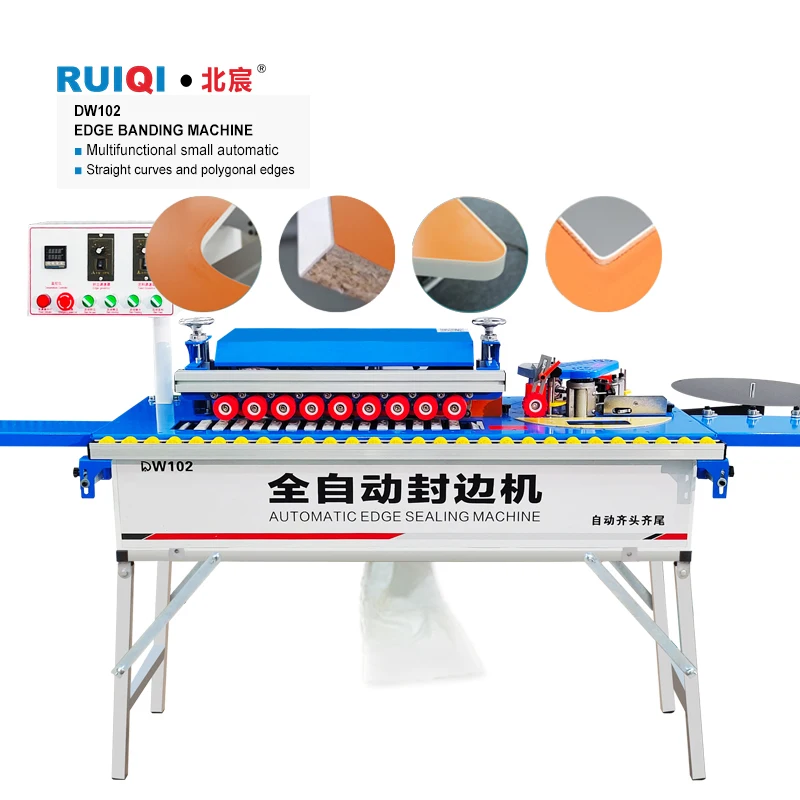
Edge banding machine
Click to enlarge
ISO 9001
CE Certified
OEM / ODM
12-Mo Warranty
Edge banding machine
Curve Straight Edge Banding Machine for Woodworking – Process Guide
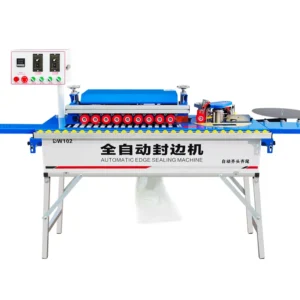
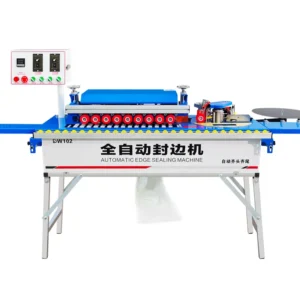
<p><strong>DW102 Manual Edge Banding Machine, 3800W Total Power, Curved & Straight Edge</strong> — handles MDF, plywood, particleboard and polymer panels with 0.3-3mm banding thickness. Integrated trimming and polishing stations deliver clean edge finish for custom furniture assembly, while 1200W vacuum holding keeps panels stable on curved paths.</p> <ul> <li>Glue pot 1000ml, air pressure 0.5-0.8 MPa, weight 75kg</li> <li>Four-stage QC with pre-shipment test record included</li> </ul>
100+
Countries
MOQ 1
Unit
15-25 Days
Lead Time
SKIPPED: no identifier found in draft.
- Full OEM/ODM support -- custom logo, voltage (110V-440V), multilingual panels
- ISO 9001 & CE certified, 5 national patents, 60 professional engineers
- 12-month warranty, remote technical support & spare parts service
- Professional export packaging, customs clearance support, on-time delivery
Precision-ground edge finishing — The DW102 manual edge banding machine targets the substrate-glue relationship that determines whether custom furniture panels pass or fail downstream assembly, handling both curved and straight profiles in a single workstation setup.
Technical Specifications
| Parameter | Value |
|---|---|
| Model | DW102 |
| Product Type | Manual Edge Banding Machine |
| Total Power | 3800W |
| Voltage & Frequency | 220V/380V/customization (frequency and phase basis not stated in source) |
| Control System | Manual operation |
| Overall Dimensions (L×W×H) | 128×47×69 cm |
| Net Weight | 75 kg |
| Minimum Sheet Length | 25 cm |
| Minimum Sheet Width | 5 cm |
| Edge Banding Height | 0-50 mm |
| Edge Banding Thickness | 0.3-3 mm |
| Edge Feed Motor Power | 20W |
| Transmission Motor Power | 60W |
| Trimming Motor Power | 650W×2 |
| Polishing Motor Power | 180W×2 |
| Vacuum Power | 1200W |
| Air Source Pressure | 0.5-0.8 MPa |
| Glue Pot Capacity | 1000 ml |
| Standard Features | Curved and straight edge banding, edge trimming, polishing, automatic head and tail cutting, with vacuum |
| Language Options | Chinese, English (other languages customizable) |
Application Suitability
| Application | Material or Output |
|---|---|
| Cabinet door edge finishing | MDF and plywood panels with PVC or melamine banding |
| Curved custom furniture components | Blockboard and solid wood panels with veneer edge banding |
| Small-batch whole-house cabinetry | Particleboard and polymer door panels requiring mixed straight and curved coverage |
| Workshop edge trimming and chamfering | Medium density fiberboard and plywood for visible seam-free assembly |
Why the Glue Temperature Question Should Come Before the Machine Order
Mismatched glue temperature and edge banding material is the most common cause of visible seam lines on finished panels.
I once worked with a cabinet factory that ran successful PVC trials on a curved-straight edge bander, signed the order, and then switched to melamine paper banding on their actual production line. The glue pot could not maintain the higher temperature melamine required, resulting in weak adhesion across an entire batch of doors that had to be stripped and re-banded. The edge banding machine woodworking process demands that material selection and thermal requirements are confirmed before the machine ships, not after it arrives on the workshop floor. [NEED_CITE: thermal requirements for different edge banding adhesives]
How Curved and Straight Paths Affect Glue Application
Running a curved edge is fundamentally different from a straight run because the banding material must stretch or compress around the radius while maintaining consistent glue contact. The DW102 addresses this with a 1000 ml glue pot that provides thermal mass to stabilise temperature during the slower feed rates curved profiles require, alongside a 1200W vacuum system that holds the workpiece against lateral shift during the banding pass.
Trimming and Polishing Sequence for Assembly-Ready Edges
The dual 650W trimming motors followed by dual 180W polishing motors create a sequential finishing path that removes excess material and glue residue in one continuous workflow. This matters because any remaining adhesive film on the edge face interferes with panel-to-panel joints during cabinet assembly, creating visible gaps that customers reject. The edge banding machine woodworking process relies on this trimming-polishing handoff to deliver edges that are ready for immediate downstream joining without secondary hand scraping. [NEED_CITE: edge finishing standards for custom cabinet assembly]
What the Numbers Mean for Your Workshop Floor
The 0.3-3 mm edge banding thickness range covers the three materials most workshops handle: thin melamine paper at the lower end, standard PVC in the middle, and real wood veneer at the upper limit. Each material demands different glue pot behaviour — melamine requires higher temperatures and faster application, while veneer needs careful heat management to prevent scorching. The 0.5-0.8 MPa air source pressure requirement drives the automatic head and tail cutting mechanism, which must fire precisely to avoid leaving overhang that the trimming stations then have to work harder to remove. Panel dimensions down to 25 cm length and 5 cm width indicate this machine handles small offcuts and narrow components common in drawer box and shelving production, not only full-size cabinet sides.
What Happens When Voltage and Frequency Are Assumed
Machines quoted without confirming local voltage and frequency regularly arrive at overseas workshops unusable or operating outside their designed thermal envelope. A glue pot calibrated for 50Hz cycling may not reach stable temperature on a 60Hz supply, causing the exact adhesion failures that lead to batch rejections. The 3800W total power draw also requires a dedicated circuit — sharing a line with other equipment causes voltage drops that manifest as inconsistent glue flow. [NEED_CITE: voltage and frequency standards by export market]
Why Configuration Verification Matters Here
The DW102 is built around a manual operation model, which means the operator controls feed rate and pressure directly. This flexibility suits workshops processing varied panel geometries but demands that the machine arrives configured correctly for the local electrical environment and the operator’s language. Multilingual control interfaces prevent the commissioning delays that occur when settings cannot be read or adjusted during initial setup.
Documentation & Verification
- Electrical schematic confirming your facility voltage and phase before production begins
- Factory test record using your specified edge banding material and panel substrate
- Operation manual translated into the agreed language for operator commissioning
- Spare parts list with wear component part numbers for local procurement planning
- Packing photographs documenting machine condition prior to container loading
Installation, Commissioning & Support
- Dedicated circuit rated for the 3800W total draw with correct breaker sizing
- Air compressor supply verified at 0.5-0.8 MPa before the automatic cutting system is activated
- Glue pot temperature profiling conducted on your actual banding material during first run
- 128×47×69 cm footprint confirmed against workshop layout with clearance for curved panel handling
- Vacuum system 1200W connection tested for adequate hold on your heaviest panel substrate
Moving Forward With Your Configuration
To size this machine correctly for your production flow, we need your primary edge banding material type and thickness, the panel substrates you process most frequently, and your workshop voltage and frequency specification. If you run both curved and straight components, share the typical radius range so we can confirm the banding path suits your geometry.
Frequently Asked Questions
Q: How does edge banding adhesion differ between MDF, particleboard and plywood substrates?
A: MDF and plywood generally provide consistent glue adhesion due to their uniform surface density. Particleboard varies more because surface porosity changes with chip size and resin content, sometimes requiring higher glue temperatures or slower feed rates to achieve full contact on the edge banding machine woodworking process pass.
Q: Which edge banding materials work within the 0.3-3 mm thickness range?
A: Thin melamine paper sits at the lower end, standard PVC occupies the middle range, and real wood veneer approaches the 3 mm upper limit. Each material requires different glue pot temperature settings and trimming approaches to achieve a clean, assembly-ready edge finish.
Q: What setup differences exist between curved and straight edge banding operations?
A: Curved profiles demand slower feed rates to allow the banding material to conform to the radius while maintaining glue contact. The vacuum holding system becomes more critical on curves because lateral panel shift causes uneven glue lines that are difficult to correct during trimming.
Q: What electrical and air supply conditions must be met before installation?
A: The machine requires a dedicated circuit matching the confirmed voltage and frequency specification, alongside an air supply maintaining 0.5-0.8 MPa pressure to drive the automatic head and tail cutting mechanism reliably during production runs.
Q: Can the interface language be configured for operators who do not read Chinese or English?
A: Yes, the control interface language is configurable beyond the standard Chinese and English options. Confirming the required language before production ensures the manual arrives translated and the machine is ready for immediate operator training upon commissioning.
Technical Specifications
| Parameter | Value |
|---|---|
| Product Name | Curve Straight Edge Banding Machine for Woodworking – Process Guide |
| Category | Edge banding machine |
| Voltage Options | 110V / 220V / 380V / 440V (customizable) |
| Frequency | 50Hz / 60Hz (customizable) |
| Certification | ISO 9001, CE |
| MOQ | 1 Unit |
| Lead Time | 15-25 Working Days |
| Warranty | 12 Months |
| OEM / ODM | Available -- logo, color, panel language |
* Detailed technical specifications vary by model. Please contact us with your specific requirements for a complete datasheet.
Shipping & Export
-
Export Packaging
Heavy-duty wooden crate with foam padding and moisture protection
-
Shipping Methods
Sea freight (FCL/LCL), air freight, express -- we support all methods
-
Customs Support
Full documentation: CO, commercial invoice, packing list, HS code assistance
-
Port of Loading
Tianjin / Qingdao port, China -- 20 years export experience
OEM / ODM Services
-
Logo & Branding
Custom logo printing, color scheme, and nameplate engraving
-
Voltage Configuration
110V / 220V / 380V / 440V, 50Hz / 60Hz -- any region supported
-
Multilingual Panels
Control panels in English, Spanish, French, Arabic and more
-
Custom Specifications
Modified dimensions, accessories, or feature sets on request
Get a Quote
Request Product Inquiry
Fill in your details and we'll respond within 24 hours with pricing and availability.
Direct Contact
How It Works
-
1
Confirm requirements & budget
Tell us your factory scale and processing needs
-
2
Receive recommendation & quote
We match the right machine with full specs
-
3
Negotiate & place order
OEM terms, voltage, payment and delivery
-
4
Production & QC inspection
Multi-stage quality control by 60 engineers
-
5
Export packaging & shipment
Professional packing, customs clearance
-
6
After-sales support
12-month warranty, remote tech support
You May Also Like