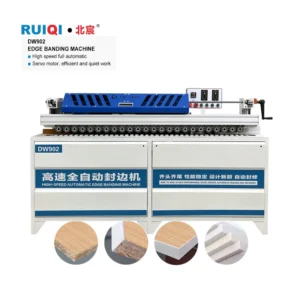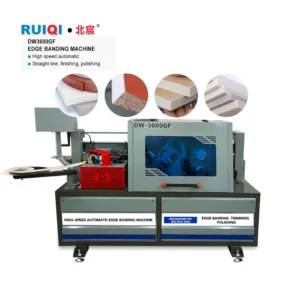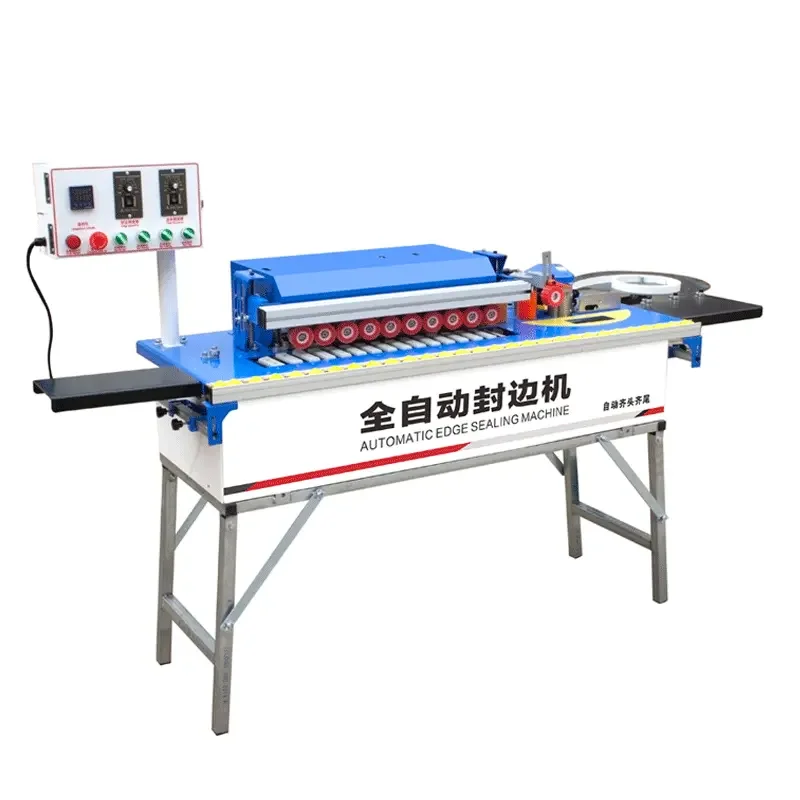
Edge banding machine
Click to enlarge
ISO 9001
CE Certified
OEM / ODM
12-Mo Warranty
Edge banding machine
DW102 Automatic Edge Banding Machine for MDF Plywood – Small Workshop
<p><strong>DW102 Automatic Edge Banding Machine, 3800W, 220V/380V, 0.3–3mm Banding Thickness</strong> — handles curved and straight edge profiles on MDF, plywood, and particleboard.</p> <ul> <li><strong>1000ml glue pot</strong> with dedicated heating supports continuous runs on mixed substrate batches without mid-job refill interruptions</li> <li>Dual 650W trimming and dual 180W polishing stations deliver two-stage edge finish, reducing visible glue lines that stall downstream assembly</li> <li>Minimum sheet size 25×5cm and 0–50mm panel height range cover standard cabinet and furniture profiles</li> </ul> <p>Backed by four-stage QC with pre-shipment test records on your actual panel material and edge stock, ensuring verified trim quality before dispatch.</p>
100+
Countries
MOQ 1
Unit
15-25 Days
Lead Time
220V 380V
Automatic Edge Trimming
Curved Edge Banding
DW102
Edge Banding Machine
MDF Plywood
Vacuum Pressing
Workshop Solution
- Full OEM/ODM support -- custom logo, voltage (110V-440V), multilingual panels
- ISO 9001 & CE certified, 5 national patents, 60 professional engineers
- 12-month warranty, remote technical support & spare parts service
- Professional export packaging, customs clearance support, on-time delivery
Verified Process Output — the DW102 automatic edge banding machine eliminates visible glue lines across MDF and plywood by sequencing gluing, trimming, and polishing in a single continuous pass, validated against your actual substrate before dispatch.
Technical Specifications
| Parameter | Value |
|---|---|
| Model | DW102 |
| Product Type | Automatic Edge Banding Machine |
| Total Power | 3800W |
| Voltage Options | 220V / 380V / customization available |
| Glue Pot Capacity | 1000 ml |
| Edge Banding Thickness | 0.3–3 mm |
| Edge Banding Height | 0–50 mm |
| Minimum Sheet Dimensions | 250 mm length × 50 mm width |
| Trimming Power | 650W × 2 |
| Polishing Power | 180W × 2 |
| Vacuum Power | 1200W |
| Air Source Pressure | 0.5–0.8 MPa |
| Overall Dimensions | 1280 × 470 × 690 mm |
| Net Weight | 75 kg |
| Assembly State | Fully assembled |
| Control Language | Chinese, English, customizable to other languages |
| Plug Options | EU, USA, AU, UK |
Application Suitability
| Application | Material or Output |
|---|---|
| Cabinet Door Production | MDF and particleboard with PVC edge banding |
| Custom Furniture Panels | Plywood and blockboard with veneer or polymer banding |
| Curved Profile Finishing | Shaped furniture components requiring curved edge trimming |
| Small Workshop Batch Runs | Mixed substrate batches including polymer doors and shelving |
Why the Voltage Question Must Precede the Machine Order
Mismatched grid frequency destroys inverters and stalls production before the first panel is edged.
I have seen a fully loaded container arrive at a workshop overseas only to sit on the dock because the local power supply operated on a frequency the machine’s drive system was never configured to handle. Production managers lose weeks waiting for replacement transformers or frequency converters while unfinished panels pile up on the floor [NEED_CITE: voltage and frequency standards by export market]. The edge banding machine woodworking process depends entirely on stable motor speed and consistent glue pot temperature, both of which collapse under incorrect electrical supply.
How Glue Temperature Affects Adhesion on Different Substrates
The edge banding machine woodworking process begins with the 1000 ml glue pot, where consistent thermal stability determines whether PVC adheres cleanly to MDF or beads and separates on plywood end-grain. Particleboard absorbs heat differently than solid wood, meaning the glue must remain at the correct viscosity throughout the entire feed cycle to avoid starved joints on long panels.
Trimming and Polishing Stages That Determine Assembly Fit
After the band is applied, the dual 650W trimming stations remove overhang flush with the panel surface. This is where visible glue lines either disappear or become permanent defects. The subsequent dual 180W polishing wheels remove micro-scratches left by trimming, leaving an edge that will not catch on hardware during hinge boring or drawer assembly. The result is a panel ready for downstream joinery without manual rework [NEED_CITE: edge finish standards for cabinet assembly].
Reading the Spec Sheet for Actual Workshop Conditions
The 0–50 mm edge banding height range covers standard cabinet door thicknesses and shelving stock. The 0.3–3 mm banding thickness range accommodates thin PVC for economical runs and thicker veneer or acrylic for visible furniture faces. The 0.5–0.8 MPa air pressure requirement means your workshop compressor must deliver clean, dry air consistently — moisture in the airline will cause the pneumatic cutters to stutter, producing chipped edges on brittle substrates like melamine-faced chipboard. The 1200W vacuum system holds the band against the panel during the critical initial bonding seconds before the pressure rollers take over.
What Happens When Substrate and Machine Configuration Are Mismatched
Ordering a machine based on its price rather than the material you actually run leads to visible defects that halt assembly. Plywood end-grain demands different glue application rates and trimming speeds than MDF, and a machine configured for one will produce poor results on the other. Panels returned from assembly with visible glue lines represent wasted material, wasted labor, and delayed customer delivery [NEED_CITE: common panel processing defects in furniture manufacturing].
Why Procurement From a Process-Focused Source Matters
- The DW102 is available with voltage and frequency configured to your local grid, verified before the crate is sealed, preventing the inverter failures that idle workshops for weeks.
- Factory test runs use your actual panel material and edge banding stock, so glue adhesion and trim quality are confirmed before the machine ships rather than discovered after installation.
- The control panel language is set to your operator’s native language before dispatch, eliminating the commissioning delays caused by mistranslated menus.
- The 1000 ml glue pot capacity supports continuous production runs without interruption for mid-batch refills, maintaining thermal consistency across the entire order.
- Curved and straight edge banding capability in one machine means your workshop can process shaped cabinet doors and rectangular shelving on the same equipment without secondary manual trimming.
Documentation & Verification
- Factory test record on your specific panel thickness and edge banding material before dispatch
- Electrical schematic confirming your ordered voltage and frequency configuration
- Operation manual in your operator’s language covering glue pot temperature settings and trimming adjustments
- Spare parts list identifying trimming blades, polishing wheels, and glue pot seals with reorder codes
Installation, Commissioning & Support
- Requires a stable, level floor surface with adequate clearance around the 1280 × 470 × 690 mm footprint for panel infeed and outfeed
- Dedicated electrical circuit matching the ordered 220V or 380V supply with correct amperage for the 3800W total draw
- Arrives fully assembled; requires only air supply connection and electrical hookup before first test run
- Initial commissioning includes glue pot temperature calibration and trimming head alignment to your banding thickness
- Operator training covers curved and straight edge procedures, glue refill timing, and blade change intervals
- Routine maintenance schedule for pneumatic filter drainage, polishing wheel inspection, and vacuum port clearing
What We Need From Your Inquiry
To configure the DW102 correctly for your production environment, please provide the panel substrates you run most frequently and the edge banding material types and thicknesses you stock. Include your workshop voltage and frequency, the language your operators read, and whether your production includes curved profiles or exclusively straight panels.
Frequently Asked Questions
Q: Which panel substrates and edge banding materials work best with the DW102 glue system?
A: The 1000 ml glue pot maintains consistent temperature for PVC and veneer banding on MDF, plywood, particleboard, and blockboard. End-grain plywood may require adjusted feed parameters. Request a factory test with your actual material to verify adhesion and trim quality before confirming your order.
Q: How do I confirm the voltage and plug type match my workshop before ordering?
A: Specify your local supply voltage, frequency in Hz, and the plug standard your facility uses during the quotation stage. The machine is configurable for 220V or 380V with EU, USA, AU, or UK plug options, and the electrical configuration is verified against your specifications before the machine is crated.
Q: Can the control interface be provided in my operator’s language?
A: Yes. The control panel is available in Chinese and English as standard, and can be customized to Spanish or other languages before shipment. Confirming the language during the order process prevents commissioning delays caused by operators unable to navigate the settings menus.
Q: What edge finish quality should I expect on MDF versus plywood?
A: MDF produces a consistently smooth trimmed edge due to its uniform density. Plywood, particularly on end-grain sections, may show slight grain tear-out depending on trimming blade condition and feed settings. A factory sample test using your plywood stock confirms the achievable finish before purchase.
Q: What does the curved and straight edge banding capability mean for my production range?
A: The DW102 processes both straight panel edges and curved profiles such as shaped cabinet doors or rounded shelf ends within the 0–50 mm height and 0.3–3 mm banding thickness range. This eliminates the need for manual trimming on curved components after machine processing.
Technical Specifications
| Parameter | Value |
|---|---|
| Product Name | DW102 Automatic Edge Banding Machine for MDF Plywood – Small Workshop |
| Category | Edge banding machine |
| Voltage Options | 110V / 220V / 380V / 440V (customizable) |
| Frequency | 50Hz / 60Hz (customizable) |
| Certification | ISO 9001, CE |
| MOQ | 1 Unit |
| Lead Time | 15-25 Working Days |
| Warranty | 12 Months |
| OEM / ODM | Available -- logo, color, panel language |
* Detailed technical specifications vary by model. Please contact us with your specific requirements for a complete datasheet.
Shipping & Export
-
Export Packaging
Heavy-duty wooden crate with foam padding and moisture protection
-
Shipping Methods
Sea freight (FCL/LCL), air freight, express -- we support all methods
-
Customs Support
Full documentation: CO, commercial invoice, packing list, HS code assistance
-
Port of Loading
Tianjin / Qingdao port, China -- 20 years export experience
OEM / ODM Services
-
Logo & Branding
Custom logo printing, color scheme, and nameplate engraving
-
Voltage Configuration
110V / 220V / 380V / 440V, 50Hz / 60Hz -- any region supported
-
Multilingual Panels
Control panels in English, Spanish, French, Arabic and more
-
Custom Specifications
Modified dimensions, accessories, or feature sets on request
Get a Quote
Request Product Inquiry
Fill in your details and we'll respond within 24 hours with pricing and availability.
Direct Contact
How It Works
-
1
Confirm requirements & budget
Tell us your factory scale and processing needs
-
2
Receive recommendation & quote
We match the right machine with full specs
-
3
Negotiate & place order
OEM terms, voltage, payment and delivery
-
4
Production & QC inspection
Multi-stage quality control by 60 engineers
-
5
Export packaging & shipment
Professional packing, customs clearance
-
6
After-sales support
12-month warranty, remote tech support
You May Also Like