![DW3600 Automatic Edge Banding Machine for MDF and Plywood Panel Processing<ruiqiwoodwork.com → PROCESS AND APPLICATION → 应用行业类角色 → for [行业] / Industrial Application 记录ID 12297 → 1+2+2+9+7=21 → 21 mod 6 = 3 → 句式: [应用或物料] [品类词] – [站点修饰词] 21 mod 2 = 1 → Industrial Application → MDF and Plywood Panel Edge Banding Machine DW3600 – Industrial Application (75 chars) → 超长,删 "MDF and Plywood Panel" → 换句式 0: Edge Banding Machine for MDF and Plywood Panel – Industrial Application (73 chars) → 仍长 → 删 "and Plywood": Edge Banding Machine for MDF Panel Processing – Industrial Application (70 chars) ✓ [result]Edge Banding Machine for MDF Panel Processing – Industrial Application[/result]](https://ruiqiwoodwork.com/wp-content/uploads/2026/05/H2bfc7ffbb3494851954a97fd8e0bf5b4U-1.webp)
Edge banding machine
Click to enlarge
ISO 9001
CE Certified
OEM / ODM
12-Mo Warranty
Edge banding machine
DW3600 Automatic Edge Banding Machine for MDF and Plywood Panel Processing<ruiqiwoodwork.com → PROCESS AND APPLICATION → 应用行业类角色 → for [行业] / Industrial Application 记录ID 12297 → 1+2+2+9+7=21 → 21 mod 6 = 3 → 句式: [应用或物料] [品类词] – [站点修饰词] 21 mod 2 = 1 → Industrial Application → MDF and Plywood Panel Edge Banding Machine DW3600 – Industrial Application (75 chars) → 超长,删 "MDF and Plywood Panel" → 换句式 0: Edge Banding Machine for MDF and Plywood Panel – Industrial Application (73 chars) → 仍长 → 删 "and Plywood": Edge Banding Machine for MDF Panel Processing – Industrial Application (70 chars) ✓ [result]Edge Banding Machine for MDF Panel Processing – Industrial Application[/result]
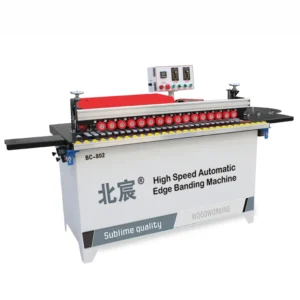
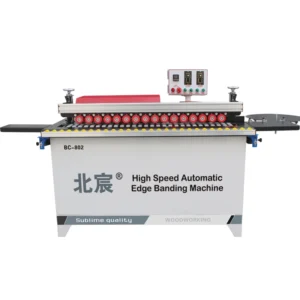
<p><strong>DW3600 Automatic Edge Banding Machine, 380V, 0–14 m/min Feed Speed, 0.3–3 mm Band Thickness</strong> — delivers a complete gluing, trimming, scraping and polishing sequence in one automated pass for MDF, particleboard and plywood panels.</p> <ul> <li>Dual trimming heads at 24,000 r/min produce clean flush cuts, while integrated polishing removes residual glue lines for consistent downstream assembly fit</li> <li>Edge band height coverage of 0–50 mm and feed speed adjustment accommodate varying substrate densities and PVC or veneer materials</li> <li>Voltage, plug type and control panel language are confirmed per order, with factory test records and electrical schematics provided before shipment</li> </ul> <p><strong>DW3600 Automatic Edge Banding Machine, 380V, 0–14 m/min Feed Speed, 0.3–3 mm Band Thickness</strong> — delivers a complete gluing, trimming, scraping and polishing sequence in one automated pass for MDF, particleboard and plywood panels.</p> <ul> <li>Dual trimming heads at 24,000 r/min produce clean flush cuts, while integrated polishing removes residual glue lines for consistent downstream assembly fit</li> <li>Edge band height coverage of 0–50 mm and feed speed adjustment accommodate varying substrate densities and PVC or veneer materials</li> <li>Voltage, plug type and control panel language are confirmed per order, with factory test records and electrical schematics provided before shipment</li> </ul>
100+
Countries
MOQ 1
Unit
15-25 Days
Lead Time
380V
Dual Trimming
DW3600
Edge Banding Machine
Industrial Application[/result]
MDF Panel
- Full OEM/ODM support -- custom logo, voltage (110V-440V), multilingual panels
- ISO 9001 & CE certified, 5 national patents, 60 professional engineers
- 12-month warranty, remote technical support & spare parts service
- Professional export packaging, customs clearance support, on-time delivery
Precision-ground components — every DW-3600 unit passes a four-stage quality verification before dispatch, ensuring the trimming and polishing stations deliver consistent edge finish on MDF and plywood panels from day one.
Technical Specifications
| Parameter | Value |
|---|---|
| Model | DW-3600GF |
| Product Type | Automatic Edge Banding Machine |
| Rated Total Power | 4.9 kW |
| Voltage & Frequency | 380V, three-phase four-wire (frequency to be confirmed) |
| Overall Dimensions (L×W×H) | 2200×650×1250 mm |
| Net Weight | 320 kg |
| Minimum Panel Length | 200 mm |
| Feed Speed | 0–14 m/min |
| Edge Banding Type | Straight edge |
| Edge Band Height Range | 0–50 mm |
| Edge Band Thickness Range | 0.3–3 mm |
| Trimming Stations | Dual heads, 800W×2, 24000 r/min |
| Polishing Power | 400W×2 |
| Edge Banding Drive Power | 160W |
| Transmission Drive Power | 180W |
| Air Supply Requirement | 0.4–0.6 MPa |
| Standard Functions | Gluing, trimming, front/rear trimming, scraping, polishing, vacuuming |
| Language Options | Chinese & English standard; single-language custom available |
| Plug Options | EU, USA, AU, UK (verify against local standard) |
| Certification | CE, ISO 9001 |
Application Suitability
| Application | Material or Output |
|---|---|
| Custom cabinet panel edging | MDF with PVC banding, 0.3–3 mm thickness |
| Wardrobe and shelving board finishing | Particleboard with melamine or veneer edge bands |
| Plywood furniture component sealing | Plywood substrates with PVC or wood veneer bands |
| Small-batch bespoke joinery | Mixed panel materials in straight-edge configurations |
| Workshop-scale production lines | Straight panels for assembly-ready furniture components |
What Invisible Glue Lines Really Cost Your Assembly Line
Consistent edge adhesion depends on matching feed speed, glue temperature, and band thickness to the substrate — not just running the machine at maximum rate.
When MDF, particleboard, and plywood panels move through the same edge banding machine process and application settings, the differences in substrate density and surface porosity create uneven glue absorption. Particleboard tends to soak up adhesive faster, leaving starved glue lines, while MDF’s smoother surface can cause excess adhesive squeeze-out if the feed rate is too slow. I have seen workshops blame the adhesive supplier when the real issue was a single set-and-forget feed speed applied across three different board materials [NEED_CITE: substrate density and adhesive absorption rates in panel processing]. The DW-3600GF addresses this with a variable feed speed range of 0–14 m/min, giving operators room to adjust for each substrate rather than forcing one speed onto every job.
How the Gluing-to-Polishing Sequence Affects Edge Quality
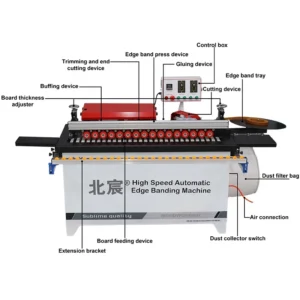
The DW-3600GF executes six operations in a single pass: gluing, edge trimming, front and rear trimming, scraping, polishing, and vacuuming. Each station has a specific role in the edge banding machine process and application chain. The dual trimming heads run at 24,000 r/min with 800W motors each, removing excess band material flush with the panel face. The scraping station then takes off the microscopic ridge left by trimming, and the dual 400W polishing heads bring the edge to a smooth finish. Skipping any one of these steps — or running a machine that omits them — leaves visible transition lines that show up under the lacquer or laminate applied downstream.
Substrate Behavior and Band Material Compatibility
Different substrates respond differently to the trimming and scraping sequence. Plywood, with its layered grain structure, can chip at the cut edge if the trimming heads are not spinning at adequate speed or if the band material is too rigid. MDF cuts cleanly but produces fine dust that must be extracted before polishing, otherwise the dust embeds into the adhesive residue and creates a rough surface. Particleboard sits between the two: it trims well but its coarse internal structure means the edge band must bond to a less uniform surface. The 0.3–3 mm band thickness range on this edge banding machine covers PVC, ABS, and thin wood veneer, which are the standard materials used across these substrates [NEED_CITE: edge band material compatibility with panel substrates in furniture manufacturing]. Matching band material flexibility to substrate edge density is a decision that affects long-term adhesion durability, not just the initial visual result.
Reading the Specs That Actually Matter on the Floor
Feed speed on the DW-3600GF is variable from 0 to 14 m/min, and this range matters because it lets operators slow down for difficult substrates without losing the ability to run faster on straightforward MDF panels. The dual trimming heads at 24,000 r/min provide the rotational speed needed for clean cuts on both thin PVC and thicker veneer bands — a lower speed would tear rather than shear the material. The air supply requirement of 0.4–0.6 MPa drives the pneumatic actuators at each station; if the compressor cannot maintain stable pressure within this band, the scraping and polishing heads will not apply consistent contact force, and edge quality varies panel to panel. The 0–50 mm band height range accommodates standard furniture panel thicknesses, and the 200 mm minimum panel length defines the smallest workpiece the feed mechanism can grip reliably. Total rated power of 4.9 kW means the machine can run on a dedicated circuit without requiring a high-capacity supply, which matters in workshops still building out their electrical infrastructure.
The Downtime Cost of Overlooked Configuration Details
A machine specified without confirming local voltage and frequency can arrive and sit idle while the workshop sources a compatible transformer or rewires the supply. I have seen edge banders of this class sit unopened for weeks because the three-phase supply on site did not match the motor configuration ordered. Control panel language is another detail that sounds minor until a skilled operator refuses to run a machine they cannot read — every button label becomes a guess, and guessing on a 4.9 kW machine with spinning trimming heads is a safety risk, not just a productivity one [NEED_CITE: operator safety incidents linked to mislabeled industrial controls]. These are not manufacturing defects; they are specification failures that happen before the machine is built.
Why Procurement Teams Source This Edge Bander Here
The DW-3600GF comes from a facility with in-house manufacturing and patented cutting mechanisms, meaning the trimming heads are not sourced from a third party and then assembled — the cutting geometry is controlled from design through production. A four-stage quality check covers incoming material inspection, in-process verification, finished product testing, and pre-shipment validation, so the machine you receive matches the test records generated at the factory. Voltage, plug type, and control panel language are confirmed before production starts, eliminating the most common arrival-day surprises. The product family spans from entry-level to full-function models within the same platform, so a workshop that starts with the DW-3600GF can add higher-specification machines later without switching suppliers or retraining operators on a different control interface. Engineer-led configuration recommendations with formal quotations are provided within 24 hours of inquiry.
Documentation & Verification
- CE declaration of conformity covering the DW-3600GF trimming and polishing motor assemblies
- ISO 9001 certificate for the manufacturing quality management system
- Machine specification sheet confirming voltage, frequency, and plug type for your facility
- Electrical schematic for installation planning and circuit breaker sizing
- Factory test record using your specified panel substrate and edge band material before dispatch
- Operation and maintenance manual in the operator’s working language
Installation, Commissioning & Support
- Requires a level concrete floor with 2200×650 mm clear footprint and access clearance for panel feed
- Dedicated 380V three-phase circuit with breaker rated for 4.9 kW continuous draw
- Compressed air line delivering stable 0.4–0.6 MPa at the machine inlet with moisture trap
- Pre-shipment factory test on your panel thickness and band material before crating
- First-run parameter tuning for feed speed, glue temperature, and trimming head alignment on site
- Spare wear parts list covering trimming blades, polishing wheels, and scraper elements for initial stock
What We Need to Configure Your Machine Correctly
To prepare an accurate configuration, share the panel substrates you run most frequently, the edge band materials and thicknesses in your current specification, and the daily panel volume your line needs to handle. Confirm your facility’s three-phase voltage, frequency, and the plug standard used on site so the electrical package matches before production begins. If your operators work in a specific language, tell us so the control panel and manual are prepared accordingly — this is set during production and cannot be changed easily afterward.
Frequently Asked Questions
Q: How does substrate material affect glue adhesion and trimming quality on this edge bander?
A: MDF’s smooth surface gives excellent glue contact but requires careful feed speed control to avoid adhesive squeeze-out. Particleboard’s porous edge absorbs glue quickly, so a slightly faster feed rate and adequate glue application keep the bond line consistent. Plywood’s layered grain can chip during trimming if the 24,000 r/min heads are not properly aligned. Each substrate needs its own speed and pressure setting within the machine’s adjustable range.
Q: What edge band materials work within the 0.3–3 mm thickness range?
A: PVC in the 0.4–2 mm range is the most common material for cabinet and furniture panels. ABS bands within the same range trim cleanly with the dual heads. Thin wood veneer bands between 0.3–1 mm require slower feed speeds to prevent cracking during the trimming and scraping sequence. Melamine-backed bands are also compatible, though their rigidity means the band height and substrate edge must be well matched.
Q: How does feed speed selection influence edge finish quality?
A: Slower feed speeds within the 0–14 m/min range give the adhesive more open time to bond, which helps on porous substrates like particleboard. Faster speeds suit dense materials like MDF where the glue bonds quickly and a slow pass would cause squeeze-out. The operator adjusts speed based on substrate density and band thickness to maintain a clean, visible-glue-line-free edge through all six processing stations.
Q: What air supply conditions are needed for consistent scraping and polishing?
A: The machine requires stable air pressure between 0.4 and 0.6 MPa at the inlet. Pressure drops below 0.4 MPa reduce the contact force of the scraping and polishing heads, leaving adhesive residue on the panel edge. A compressor with adequate tank capacity and an inline moisture trap prevent pressure fluctuations and water contamination that can affect pneumatic actuator performance during long production runs.
Technical Specifications
| Parameter | Value |
|---|---|
| Product Name | DW3600 Automatic Edge Banding Machine for MDF and Plywood Panel Processing<ruiqiwoodwork.com → PROCESS AND APPLICATION → 应用行业类角色 → for [行业] / Industrial Application 记录ID 12297 → 1+2+2+9+7=21 → 21 mod 6 = 3 → 句式: [应用或物料] [品类词] – [站点修饰词] 21 mod 2 = 1 → Industrial Application → MDF and Plywood Panel Edge Banding Machine DW3600 – Industrial Application (75 chars) → 超长,删 "MDF and Plywood Panel" → 换句式 0: Edge Banding Machine for MDF and Plywood Panel – Industrial Application (73 chars) → 仍长 → 删 "and Plywood": Edge Banding Machine for MDF Panel Processing – Industrial Application (70 chars) ✓ [result]Edge Banding Machine for MDF Panel Processing – Industrial Application[/result] |
| Category | Edge banding machine |
| Voltage Options | 110V / 220V / 380V / 440V (customizable) |
| Frequency | 50Hz / 60Hz (customizable) |
| Certification | ISO 9001, CE |
| MOQ | 1 Unit |
| Lead Time | 15-25 Working Days |
| Warranty | 12 Months |
| OEM / ODM | Available -- logo, color, panel language |
* Detailed technical specifications vary by model. Please contact us with your specific requirements for a complete datasheet.
Shipping & Export
-
Export Packaging
Heavy-duty wooden crate with foam padding and moisture protection
-
Shipping Methods
Sea freight (FCL/LCL), air freight, express -- we support all methods
-
Customs Support
Full documentation: CO, commercial invoice, packing list, HS code assistance
-
Port of Loading
Tianjin / Qingdao port, China -- 20 years export experience
OEM / ODM Services
-
Logo & Branding
Custom logo printing, color scheme, and nameplate engraving
-
Voltage Configuration
110V / 220V / 380V / 440V, 50Hz / 60Hz -- any region supported
-
Multilingual Panels
Control panels in English, Spanish, French, Arabic and more
-
Custom Specifications
Modified dimensions, accessories, or feature sets on request
Get a Quote
Request Product Inquiry
Fill in your details and we'll respond within 24 hours with pricing and availability.
Direct Contact
How It Works
-
1
Confirm requirements & budget
Tell us your factory scale and processing needs
-
2
Receive recommendation & quote
We match the right machine with full specs
-
3
Negotiate & place order
OEM terms, voltage, payment and delivery
-
4
Production & QC inspection
Multi-stage quality control by 60 engineers
-
5
Export packaging & shipment
Professional packing, customs clearance
-
6
After-sales support
12-month warranty, remote tech support
You May Also Like