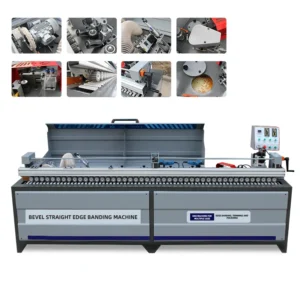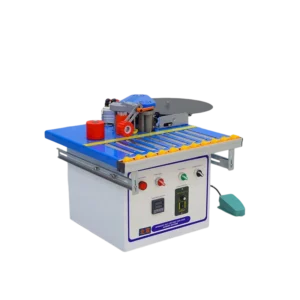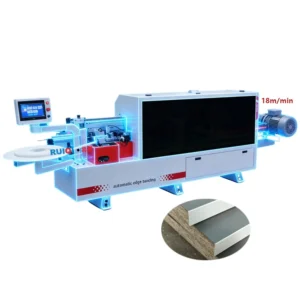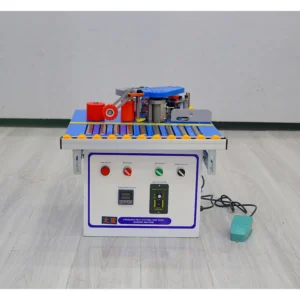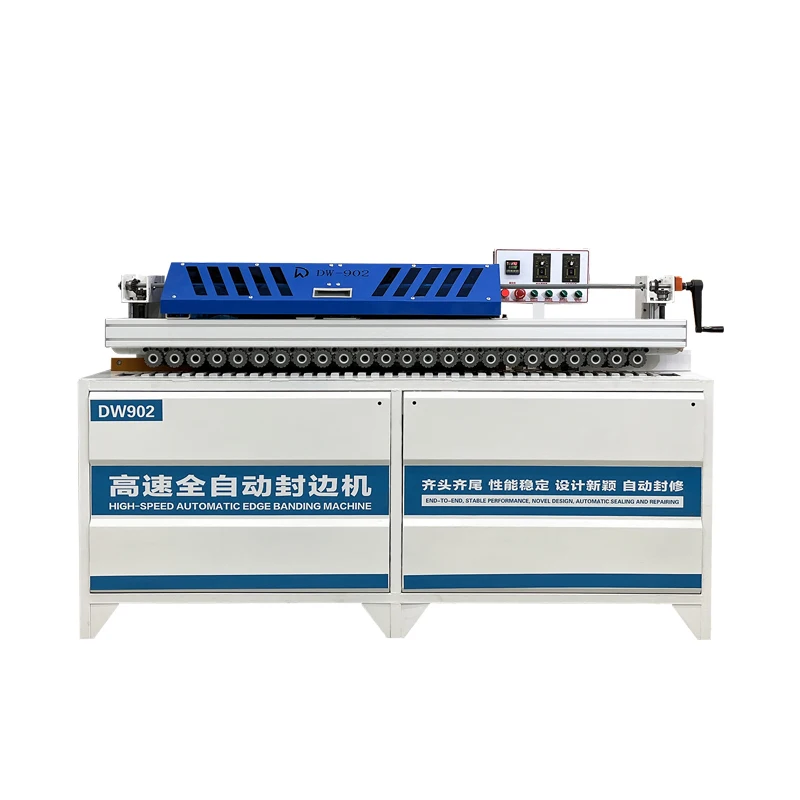
Edge banding machine
Click to enlarge
ISO 9001
CE Certified
OEM / ODM
12-Mo Warranty
Edge banding machine
DW902 Automatic Edge Banding Machine for Wood Based Panels – Industrial Application
<p><strong>DW902 Automatic Edge Banding Machine, 4000W, 0.3–3mm Edge Thickness, 220V/380V</strong> — engineered for 90° straight-line edge finishing on MDF, particleboard, plywood and solid wood panels.</p> <ul> <li>Dual hot-air activation and four oblique pressure wheel groups ensure consistent glue adhesion on porous substrates, minimizing visible glue lines across varying board densities.</li> <li>Trimming at 24,000 r/min followed by scraping and polishing delivers burr-free edges ready for downstream assembly without secondary touch-up.</li> <li>Integrated vacuuming clears debris before polishing, maintaining surface quality throughout the single-pass workflow.</li> </ul> <p>Verified pre-shipment testing on your actual panel material is available, backed by four-stage QC covering every production checkpoint.</p>
100+
Countries
MOQ 1
Unit
15-25 Days
Lead Time
Automatic Trimming
DW902
Edge Banding Machine
MDF Panel
Particleboard
Production Process
Vacuum System
- Full OEM/ODM support -- custom logo, voltage (110V-440V), multilingual panels
- ISO 9001 & CE certified, 5 national patents, 60 professional engineers
- 12-month warranty, remote technical support & spare parts service
- Professional export packaging, customs clearance support, on-time delivery
Verified Tolerance in Every Cut — DW902 achieves ±0.02mm edge accuracy through proprietary cutting mechanisms validated at each production stage, ensuring panels meet downstream assembly requirements without rework.
Technical Specifications
| Parameter | Value |
|---|---|
| Model | DW902 |
| Product Type | Automatic Edge Banding Machine |
| Total Power | 4000W |
| Voltage | 220V/380V/customization |
| Edge Banding Thickness Range | 0.3–3 mm |
| Edge Banding Height | Up to 5 cm |
| Minimum Sheet Length | 25 cm |
| Minimum Sheet Width | 10 cm |
| Trimming Power / Speed | 800W × 2, 24000 r/min |
| Polishing Power | 380W × 2 |
| Vacuum Power | 550W |
| Edge Feed Power | 140W |
| Transmission Power | 140W |
| Glue Pot Capacity | 4000 ml |
| Air Source Pressure | 0.5–0.8 MPa |
| Overall Dimensions (L×W×H) | 175 × 87 × 112 cm |
| Net Weight | 240 kg |
| Standard Functions | Edge banding, trimming, scraping, polishing, automatic trimming, vacuuming |
| Language Options | Chinese and English standard; other languages customizable |
Application Suitability
| Application | Material or Output |
|---|---|
| Cabinet door and carcass production | MDF and particleboard with PVC or melamine edging |
| Custom furniture panel finishing | Plywood and ecological board with veneer or ABS banding |
| Home decoration built-in millwork | Solid wood board with thin PVC or wood veneer strips |
| Small-to-medium batch joinery | Mixed substrate runs requiring quick changeover between 0.3 mm and 3 mm banding |
Why the Control Panel Language Can Stall Your Entire Commissioning
A machine you cannot read is a machine you cannot run.
I once spent a weekend rewriting an HMI on a cabinet factory floor in Foshan because the operator could not parse a single parameter on a Chinese-only screen. Commissioning stalled on day one, and the production schedule slipped while we rebuilt the interface from scratch. That failure had nothing to do with mechanics. It was a procurement oversight that cost the workshop days of lost output [NEED_CITE: multilingual operator interface requirements in exported woodworking machinery].
When buyers focus only on motor power and feed speed during quotation, the language on the touch screen tends to become an afterthought. Yet every parameter adjustment — glue temperature, trimming depth, pressure wheel tension — depends on the operator understanding what they see. For a woodworking automatic edge banding machine intended for cross-border delivery, confirming the HMI language before production is as critical as confirming voltage.
How Substrate Porosity Changes the Glue Game
MDF and particleboard absorb heat differently from solid wood or plywood. The DW902 addresses this with a dual hot-air system that pre-warms the substrate edge before the glue roller makes contact, improving activation on porous surfaces where cold glue application often leaves visible seam lines. This matters most when switching between 0.3 mm PVC on particleboard and thicker veneer on MDF within the same shift.
Consistent activation across substrates means the operator spends less time adjusting temperature between jobs and more time running panels. The automatic edge banding machine woodworking process becomes predictable rather than experimental when glue behaviour is managed upstream of the pressure zone.
Pressure Wheel Geometry and Ninety-Degree Adhesion
Four groups of oblique pressure wheels press the banding tape against the panel edge at calculated angles rather than flat-on. This geometry forces adhesive into the microscopic pores of MDF and particleboard while maintaining full contact along the 90-degree profile [NEED_CITE: pressure wheel configuration effects on edge adhesion in panel processing].
On straight edges, uneven pressure causes the banding to lift at the top or bottom, creating a lip that the trimming station must then overcut. The oblique arrangement distributes force across the full height of a 5 cm edge, keeping the banding seated uniformly from first contact through to the trimming station.
Reading the Numbers That Actually Matter on the Shop Floor
The 24,000 r/min trimming speed directly affects edge finish quality. At lower speeds, the trimming cutter tears through PVC and thin veneer rather than shearing cleanly, leaving micro-burrs that show up under workshop fluorescent lighting. Running at this RPM with the dual 800W trimming motors ensures a clean cut across the full 0.3–3 mm thickness range without requiring a secondary pass.
The 4000 ml glue pot capacity supports extended runs without frequent refills, though the actual consumption rate depends on banding width and feed speed. Shops running mixed batches benefit from this buffer because stopping mid-run to refill introduces temperature fluctuation in the glue film. The integrated vacuum system at 550W removes trimming debris before it can embed in the polishing wheels, preventing the scored finish that contaminated wheels produce on glossy PVC surfaces.
What Happens When Voltage Is Confirmed After the Crate Is Opened
I have watched workshops receive machines wired for 380V three-phase only to discover their facility runs on a 220V single-phase supply. The machine sits idle while an electrician is sourced, a transformer is ordered, and production deadlines slide past. The cost is not the transformer — it is the two weeks of panels that were supposed to ship [NEED_CITE: electrical supply mismatch in imported industrial machinery].
Voltage and frequency confirmation belongs in the quotation stage, not the packing stage. Every export-bound unit should carry a verified electrical schematic matching the destination facility before the control cabinet is wired.
Procurement Confidence Built on Process, Not Promises
In-house manufacturing with patented cutting mechanisms means tolerance claims on the DW902 are traceable to specific grinding operations and tooling geometries, not assembled from bought-in sub-assemblies with unknown provenance.
A full product family from entry-level to full-function allows workshops to scale output without switching suppliers or re-learning controls, keeping operator familiarity intact as volume grows.
Voltage, language, and specification customization treated as standard order parameters rather than special requests eliminates the friction that delays commissioning on arrival.
Four-stage quality control with pre-shipment verification includes a test run on actual panel material, giving buyers a factory record of how the machine handles their substrate before it leaves the production floor.
Engineer-led configuration recommendation with formal quotation means the buyer receives a machine matched to their throughput and material mix, not a generic model pushed from stock.
Documentation & Verification
- CE declaration of conformity covering the DW902 edge banding and trimming functions
- Machine specification sheet confirming 0.3–3 mm banding thickness and trimming tolerance
- Electrical schematic with voltage and frequency matched to your facility supply
- Factory test record produced on your submitted panel material before dispatch
- Operation and maintenance manual provided in the agreed language at delivery
Installation, Commissioning & Support
- Dedicated 4000W circuit with correct voltage and frequency verified before the DW902 is energized
- Floor space of at least 175 × 87 cm with clearance for panel infeed and outfeed
- Compressed air supply regulated to 0.5–0.8 MPa at the machine inlet for pressure wheel actuators
- First-run parameter setting for glue temperature and trimming depth on your actual panel stock
- Spare trimming cutters and polishing wheels included for initial operational wear
What to Share Before Requesting a Quotation
Tell us your primary substrate — MDF, particleboard, plywood, or solid wood — along with the edge banding material and thickness you run most often. Confirm your workshop voltage and frequency so the control cabinet and motors are configured before assembly. If you have upstream cutting or downstream boring equipment, share the feed height and throughput so the DW902 is matched to your line rather than operating as an isolated station.
Frequently Asked Questions
Q: How does edge banding quality vary between MDF, particleboard, and solid wood on this machine?
A: MDF and particleboard are more porous, requiring higher glue activation temperatures and consistent pressure to prevent visible seam lines. The DW902 dual hot-air system pre-warms these substrates, while the oblique pressure wheels maintain uniform adhesion. Solid wood, being denser, requires lower glue temperature but benefits from the same trimming speed for a clean finish.
Q: What glue type and temperature settings are recommended for 0.3 mm PVC vs. 3 mm solid wood edging?
A: Thin PVC typically runs with EVA hot melt at moderate temperatures, while 3 mm solid wood edging demands higher temperature and longer open time for full adhesion. The 4000 ml glue pot on the DW902 allows temperature adjustment between jobs. Request a factory test on your specific banding material to establish baseline settings.
Q: How do the dual hot-air and oblique pressure wheel systems affect adhesion on porous substrates?
A: The dual hot-air system raises the substrate edge temperature before glue contact, improving wetting on absorbent surfaces like MDF and particleboard. The four oblique pressure wheel groups then press the banding at angles that force adhesive into substrate pores, reducing the risk of edge lift during downstream machining or seasonal humidity changes.
Q: What upstream and downstream equipment is needed to integrate this edge bander into an existing workflow?
A: Upstream, a panel saw or sliding table saw cut to size feeds the DW902. Downstream, a boring machine or CNC router handles drilling and hardware preparation. Confirm that your existing equipment feed height and panel dimensions fall within the 25 cm minimum length and 5 cm maximum edge height the DW902 accepts.
Q: How is trimming and polishing quality verified before shipment — can I submit my own panels for a sample test?
A: Yes. Submit your actual panel material and preferred edge banding for a pre-shipment test run. The factory records trimming accuracy, polishing finish, and adhesion strength, then shares the test documentation. This verifies that the 24,000 r/min trimming stations produce the edge quality your assembly process demands before the machine is crated.
Technical Specifications
| Parameter | Value |
|---|---|
| Product Name | DW902 Automatic Edge Banding Machine for Wood Based Panels – Industrial Application |
| Category | Edge banding machine |
| Voltage Options | 110V / 220V / 380V / 440V (customizable) |
| Frequency | 50Hz / 60Hz (customizable) |
| Certification | ISO 9001, CE |
| MOQ | 1 Unit |
| Lead Time | 15-25 Working Days |
| Warranty | 12 Months |
| OEM / ODM | Available -- logo, color, panel language |
* Detailed technical specifications vary by model. Please contact us with your specific requirements for a complete datasheet.
Shipping & Export
-
Export Packaging
Heavy-duty wooden crate with foam padding and moisture protection
-
Shipping Methods
Sea freight (FCL/LCL), air freight, express -- we support all methods
-
Customs Support
Full documentation: CO, commercial invoice, packing list, HS code assistance
-
Port of Loading
Tianjin / Qingdao port, China -- 20 years export experience
OEM / ODM Services
-
Logo & Branding
Custom logo printing, color scheme, and nameplate engraving
-
Voltage Configuration
110V / 220V / 380V / 440V, 50Hz / 60Hz -- any region supported
-
Multilingual Panels
Control panels in English, Spanish, French, Arabic and more
-
Custom Specifications
Modified dimensions, accessories, or feature sets on request
Get a Quote
Request Product Inquiry
Fill in your details and we'll respond within 24 hours with pricing and availability.
Direct Contact
How It Works
-
1
Confirm requirements & budget
Tell us your factory scale and processing needs
-
2
Receive recommendation & quote
We match the right machine with full specs
-
3
Negotiate & place order
OEM terms, voltage, payment and delivery
-
4
Production & QC inspection
Multi-stage quality control by 60 engineers
-
5
Export packaging & shipment
Professional packing, customs clearance
-
6
After-sales support
12-month warranty, remote tech support
You May Also Like