Edge banding machine
Click to enlarge
ISO 9001
CE Certified
OEM / ODM
12-Mo Warranty
Edge banding machine
Hot Melt Glue Straight Bevel Edge Banding Machine for MDF Board
<p><strong>DW3000 45° Straight Bevel Edge Banding Machine, 11KW, 0-12M/min Feed Speed</strong> — designed for MDF and particleboard edge processing with 30-90° adjustable oblique pressure wheels and dual heat gun preheating system.</p> <ul> <li>Processes 0.3-3mm PVC and veneer edge banding on panels from 30cm length with pre-milling, trimming, scraping, and polishing stations</li> <li>4000ml glue pot capacity with edge band slotting device for improved strip compliance on cabinet door and carcass panel production</li> </ul> <p>Engineers verify voltage configuration (380V/415V) and control panel language before shipment, with factory test records demonstrating edge finish quality at your specified feed speed.</p>
100+
Countries
MOQ 1
Unit
15-25 Days
Lead Time
11KW Motor
45 Degree Bevel
Double Heat Gun
DW3000
Edge Banding Machine
MDF Board
Process And Application
- Full OEM/ODM support -- custom logo, voltage (110V-440V), multilingual panels
- ISO 9001 & CE certified, 5 national patents, 60 professional engineers
- 12-month warranty, remote technical support & spare parts service
- Professional export packaging, customs clearance support, on-time delivery
Dual Heat Gun Preheating — Two 2.2 kW heating elements keep the adhesive at a stable working temperature from the first panel to the last, reducing cold-start rejection on MDF substrates where the open time of hot melt glue is critical.
Technical Specifications
| Parameter | Value |
|---|---|
| Model | DW3000 |
| Product Type | Fully Automatic 45 Degree Straight Bevel Edge Banding Machine |
| Total Power | 11 kW |
| Voltage | 380V / 415V |
| Pre-milling Motor | 2.2 kW |
| Heating Power | 2.2 kW × 2 (dual heat gun) |
| Trimming Motor | Spindle trimming configuration |
| Polishing Power | 0.4 kW × 2 |
| Feed Speed | 0–12 m/min |
| Edge Banding Height | 0–50 mm |
| Edge Banding Thickness | 0.3–3 mm |
| Minimum Sheet Length | 30 cm |
| Minimum Sheet Width | 15 cm |
| Glue Pot Capacity | 4000 ml |
| Air Source Pressure | 0.5–0.7 MPa |
| Oblique Pressure Wheel Angle | 30°–90° adjustable (8 groups) |
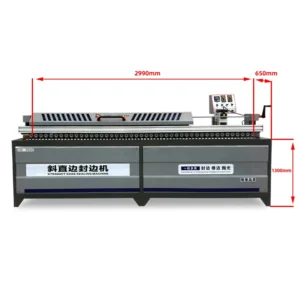
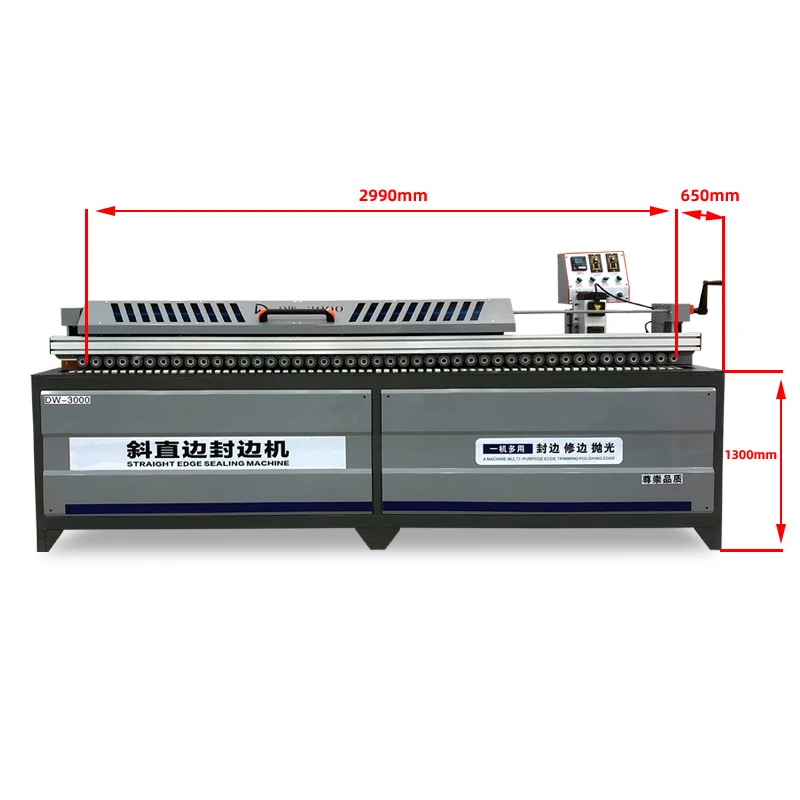
| Product Size | 299 × 65 × 130 cm |
| Product Weight | 430 kg |
| Control Panel Language | Chinese and English (customizable) |
| Plug Options | EU, USA, AU, UK |
Application Suitability
| Application | Material or Output |
|---|---|
| Cabinet door panel edge banding | MDF with PVC or ABS strip, straight and 45° bevel |
| Carcass and shelf panel processing | Particleboard with melamine or veneer edge banding |
| Custom furniture panel production | Plywood and blockboard with 0.3–3 mm strip |
| Bevel edge profile for display furniture | MDF routed to 45° and banded in a single pass |
Why Glue Lines Show on MDF but Not on Particleboard
The substrate surface density determines how fast hot melt adhesive transfers heat, and the DW3000 dual heat gun setup compensates for both extremes.
When you run MDF, the dense fiber surface absorbs heat from the glue rapidly. On particleboard, the rougher texture holds the adhesive differently, often leaving a thicker bond line that becomes visible after trimming. I have watched operators blame the glue brand when the real issue was the edge banding machine process and application settings — specifically preheat temperature and pressure wheel angle not matched to the board. One workshop in Southeast Asia ran PVC strip on MDF at high humidity and lost an entire batch to peeling before we recalibrated the temperature curve on site [NEED_CITE: hot melt adhesive open time versus ambient humidity]. The dual heat gun on this unit addresses that by maintaining a consistent thermal profile regardless of which substrate is in the feed chain.
How Preheat Temperature Affects Adhesive Conformity on Different Substrates
Hot melt EVA glue has a narrow working window. If the strip arrives at the pressure zone too cool, it will not conform to the board edge and a visible gap forms. The two 2.2 kW heat guns on the DW3000 preheat the strip before it meets the glue pot output, which is especially useful when running thicker PVC or ABS banding where the material itself acts as a heat sink. This edge banding machine process and application detail matters most when your workshop ambient temperature drops below the adhesive manufacturer’s recommended range.
Bevel and Straight Profiles in a Single Pass
The 8-group oblique pressure wheel system adjusts from 30° to 90°, letting the same machine handle a flat cabinet side panel and a 45° bevel door front without a tooling changeover. Each wheel group applies pressure at a slightly different angle along the strip, so the banding conforms progressively rather than being forced down in one point. For shops running custom furniture batches with mixed profiles, this removes the need to queue panels by edge type and keeps the edge banding machine process and application workflow continuous [NEED_CITE: bevel edge banding pressure wheel geometry for MDF conformity].
Reading the Specs That Actually Matter at the Feed Inlet
The 0–12 m/min feed speed range sounds broad, but what matters is which speed you run at which strip thickness. At 0.3 mm melamine, you can push toward the upper range because the strip bends easily around the pressure wheels. At 3 mm PVC, a slower feed gives the glue more open time and the pressure wheels more dwell to seat the strip. The 2.2 kW pre-milling motor cleans the sawn board edge before glue application — this is the station that determines whether the glue line will be uniform or wavy, because any tear-out from the panel saw gets removed here. The 4000 ml glue pot holds enough adhesive for a full shift on standard panel volumes without frequent refills that cause temperature fluctuation. Air pressure at 0.5–0.7 MPa drives the pneumatic cylinders on the trimming and scraping stations; running below this range causes incomplete trimming passes that leave strip overhang on the panel face.
What Happens When Voltage and Pressure Wheel Angle Are Ignored
A machine built for 380V / 50Hz will underperform on a 415V supply without transformer adjustment — motors run hotter, the heat gun overshoots its set point, and the glue degrades faster in the pot. I have seen workshops in regions with unstable grid supply lose heating elements repeatedly before checking whether the incoming voltage matched the machine nameplate. Similarly, if the oblique pressure wheels are left at 90° when running a 45° bevel, the strip folds over the edge rather than wrapping it, creating a gap that only appears after the trimming station cuts into the profile [NEED_CITE: voltage mismatch effects on industrial heating elements].
Why Production Managers Choose This Configuration
The patented cutting mechanism holds tolerance at the trimming station so that cabinet panels assemble without shimming. The four-stage quality check — incoming material, in-process, finished product, pre-shipment — means the glue pot, pressure wheels, and trimming motors are verified under load before the machine leaves the factory. Voltage is confirmed against your local supply before build, not assumed. The control panel language is set to your operator’s requirement, so commissioning does not stall on a menu the team cannot read. Factory visits are available if you want to run your own board samples through the line before order confirmation.
Documentation & Verification
- CE declaration of conformity covering the DW3000 electrical and mechanical safety
- ISO 9001 certificate for the manufacturing quality management system
- Machine specification sheet with trimming motor configuration confirmed
- Electrical schematic matching your local 380V or 415V supply
- Factory test record on your MDF and particleboard samples at agreed feed speed
- Operation and maintenance manual in your chosen language covering glue pot care
Installation, Commissioning & Support
- Requires a dedicated 380V/415V circuit rated for the DW3000 total 11 kW draw
- Floor must be level within the machine footprint of 299 × 65 cm for stable feeding
- Arrives as a single unit at 430 kg — plan forklift access to the production floor
- First-run commissioning includes glue temperature calibration for your local climate
- Trimming and scraping stations adjusted to your 0.3–3 mm strip thickness range
- Spare parts list provided with wear items for the pressure wheels and trimming cutters
What to Share Before Requesting a Quotation
Send the panel material types you run most often — MDF, particleboard, or plywood — along with the edge banding strip material and thickness range. Confirm your workshop voltage and frequency so the electrical system is built to match. If you are running both straight and 45° bevel profiles, note the approximate daily volume split so the configuration proposal accounts for changeover frequency.
Frequently Asked Questions
Q: How does MDF versus particleboard affect hot melt glue adhesion?
A: MDF has a dense fiber surface that pulls heat from the adhesive quickly, requiring higher preheat settings on the dual heat gun. Particleboard has a rougher texture that holds more glue but can leave a thicker bond line. The DW3000 pressure wheel angle and feed speed must be adjusted for each substrate to maintain a clean edge finish after trimming and polishing.
Q: Which edge banding materials work with this machine and how does thickness affect feed speed?
A: PVC, ABS, melamine, and veneer strips from 0.3 to 3 mm are all compatible. Thinner melamine strips allow faster feed speeds because they flex easily through the pressure wheel groups. Thicker PVC at 3 mm requires slower feeding so the hot melt glue has adequate open time to bond before the trimming station engages.
Q: How does the 45° bevel pre-milling influence cabinet assembly tolerance?
A: The 2.2 kW pre-milling motor removes saw marks and creates a flat bonding surface on the bevel before glue application. This ensures the edge banding sits flush against the routed edge, which keeps panel dimensions within assembly tolerance when cabinet boxes are joined. Inconsistent pre-milling leads to visible gaps at the corner joints.
Q: What temperature range does the dual heat gun maintain?
A: The two 2.2 kW heating elements work together to keep the strip at a stable working temperature before it reaches the glue pot zone. In high-humidity environments, the preheat compensates for moisture on the strip surface. In cooler workshops, it prevents the adhesive from setting before the pressure wheels can seat the banding fully.
Q: What inspection criteria should be used after trimming and polishing?
A: Check for visible glue lines along the panel edge under direct lighting, run a fingernail along the trimmed edge to detect any overhang, and verify that the polishing station has removed all scraping marks. On 45° bevel panels, inspect the corner where the strip wraps the profile to confirm there is no lift or gap that would affect downstream assembly.
Technical Specifications
| Parameter | Value |
|---|---|
| Product Name | Hot Melt Glue Straight Bevel Edge Banding Machine for MDF Board |
| Category | Edge banding machine |
| Voltage Options | 110V / 220V / 380V / 440V (customizable) |
| Frequency | 50Hz / 60Hz (customizable) |
| Certification | ISO 9001, CE |
| MOQ | 1 Unit |
| Lead Time | 15-25 Working Days |
| Warranty | 12 Months |
| OEM / ODM | Available -- logo, color, panel language |
* Detailed technical specifications vary by model. Please contact us with your specific requirements for a complete datasheet.
Shipping & Export
-
Export Packaging
Heavy-duty wooden crate with foam padding and moisture protection
-
Shipping Methods
Sea freight (FCL/LCL), air freight, express -- we support all methods
-
Customs Support
Full documentation: CO, commercial invoice, packing list, HS code assistance
-
Port of Loading
Tianjin / Qingdao port, China -- 20 years export experience
OEM / ODM Services
-
Logo & Branding
Custom logo printing, color scheme, and nameplate engraving
-
Voltage Configuration
110V / 220V / 380V / 440V, 50Hz / 60Hz -- any region supported
-
Multilingual Panels
Control panels in English, Spanish, French, Arabic and more
-
Custom Specifications
Modified dimensions, accessories, or feature sets on request
Get a Quote
Request Product Inquiry
Fill in your details and we'll respond within 24 hours with pricing and availability.
Direct Contact
How It Works
-
1
Confirm requirements & budget
Tell us your factory scale and processing needs
-
2
Receive recommendation & quote
We match the right machine with full specs
-
3
Negotiate & place order
OEM terms, voltage, payment and delivery
-
4
Production & QC inspection
Multi-stage quality control by 60 engineers
-
5
Export packaging & shipment
Professional packing, customs clearance
-
6
After-sales support
12-month warranty, remote tech support
You May Also Like