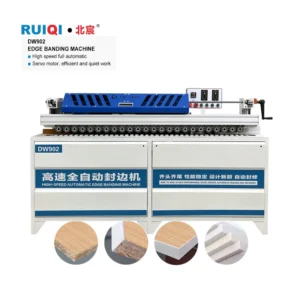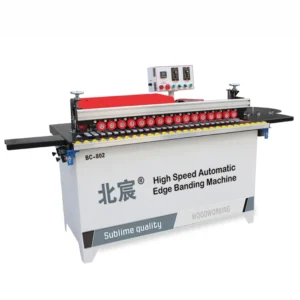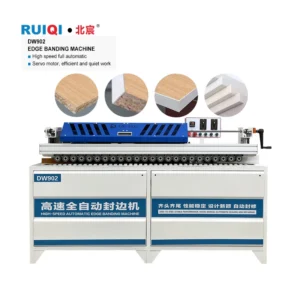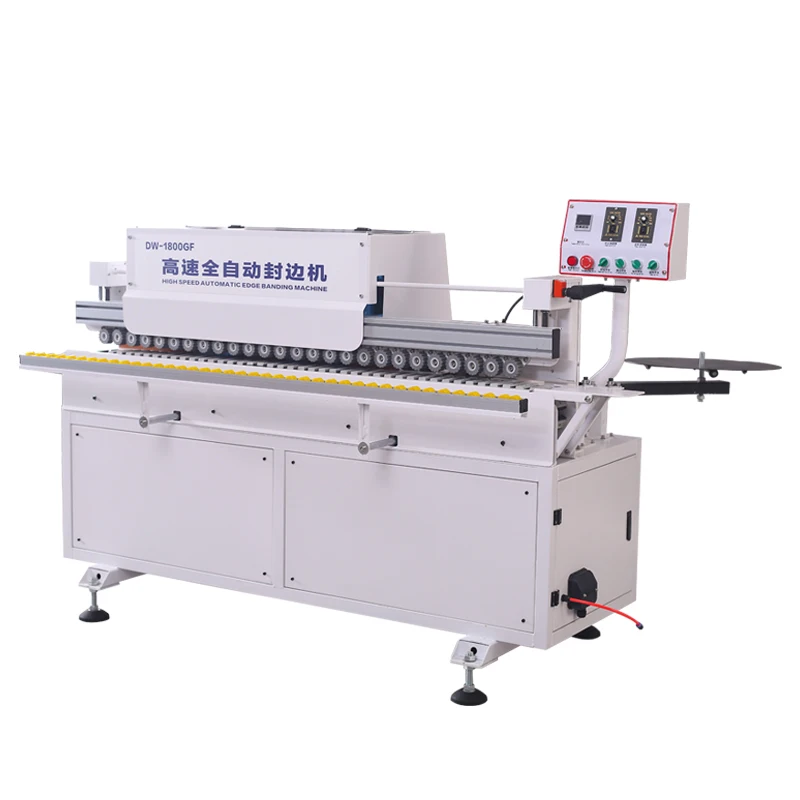
Edge banding machine
Click to enlarge
ISO 9001
CE Certified
OEM / ODM
12-Mo Warranty
Edge banding machine
Manual Edgebander DW1800 for Panel Furniture – Process and Application
<p>Four-stage QC with pre-shipment verification confirms edge quality on your actual substrate before dispatch, reducing commissioning delays.</p>
100+
Countries
MOQ 1
Unit
15-25 Days
Lead Time
Custom Furniture
Double-Sided Gluing
DW1800
Edge Banding Machine
MDF Panel
Profile Tracking
Woodworking Process
- Full OEM/ODM support -- custom logo, voltage (110V-440V), multilingual panels
- ISO 9001 & CE certified, 5 national patents, 60 professional engineers
- 12-month warranty, remote technical support & spare parts service
- Professional export packaging, customs clearance support, on-time delivery
Verified Process Control — The DW1800 integrates double-sided gluing, trimming, and polishing stages with a 4000ml glue pot and dual 800W trimming motors to maintain consistent edge quality across mixed substrate runs.
Technical Specifications
| Parameter | Value |
|---|---|
| Model | DW1800 |
| Product Type | Automatic Edge Banding Machine |
| Total Power | 4.9 kW |
| Voltage | 380V / 220V / 415V (frequency 50Hz/60Hz to be confirmed) |
| Glue Pot Capacity | 4000 ml |
| Edge Banding Height | 0 – 50 mm |
| Edge Banding Thickness | 0.3 – 3 mm |
| Minimum Sheet Length | 200 mm |
| Minimum Sheet Width | 100 mm |
| Feed Speed | 0 – 14 m/min |
| Trimming Motors | 800 W × 2 at 24,000 r/min |
| Polishing Motors | 380 W × 2 |
| Vacuum Power | 550 W |
| Air Source Pressure | 0.4 – 0.6 MPa |
| Overall Dimensions (L×W×H) | 220 × 65 × 125 cm |
| Net Weight | 320 kg |
| Control Panel Language | Chinese, English (configurable to Spanish, French, or others) |
| Plug Options | EU, USA, AU, UK |
Application Suitability
| Application | Material or Output |
|---|---|
| Custom cabinet door production | MDF and particleboard with PVC edge banding |
| Wardrobe and shelving panel processing | Plywood and melamine-faced chipboard |
| Office furniture panel edging | Particleboard with 0.4 – 2 mm PVC or ABS strips |
| Solid wood component finishing | Solid wood panels with veneer edge banding |
| Retail fixture and display manufacturing | ABB boards and organic glass plates |
Why Edge Banding Quality Shifts Between MDF, Plywood, and Particleboard
Substrate density and porosity determine glue penetration, and the edge banding machine woodworking process must account for each material’s behaviour to avoid visible glue lines.
When a panel moves from MDF to plywood on the same machine settings, the glue film thickness that worked on a smooth MDF surface leaves starved joints on porous particleboard or squeezes out on denser plywood edges. Operators who do not adjust the glue pot temperature and feed speed between material changes often discover the problem only after a batch is trimmed and the glue line becomes visible under workshop lighting. I have spent entire days on customer floors re-tuning machines after a substrate switch that was never flagged during order confirmation. [NEED_CITE: substrate porosity and hot-melt adhesion behaviour]
Glue Application Across Substrate Types
The DW1800 applies adhesive to both the panel edge and the banding strip simultaneously, which matters when the edge banding machine woodworking process involves low-density particleboard that absorbs glue quickly. The 4000 ml glue pot holds enough hot-melt for extended runs without frequent refills, reducing temperature fluctuation that can occur when cold adhesive is added mid-shift. Consistent glue temperature across the pot keeps the adhesive viscosity stable from the first panel to the last in a batch.
Corner Tracking and Profile Consistency
Profile tracking on this machine rounds all four corners of the banding strip as the panel passes through, producing a uniform radius that prevents sharp edges from catching during downstream assembly or handling. This function is especially relevant when processing 2 mm or thicker PVC banding on cabinet doors, where manual corner rounding introduces variation that accumulates across a production run. The tracking mechanism engages automatically based on panel thickness within the 0 – 50 mm range, so operators do not need to adjust stops between different door and carcass panel sizes.
Trimming Speed, Motor Power, and Edge Cleanliness
The dual 800 W trimming motors running at 24,000 r/min remove excess banding material above and below the panel surface in a single pass. Higher rotational speed combined with adequate motor power prevents the cutter from dragging or chipping brittle melamine and thin veneer banding, which is a common defect when trimming motors lack sufficient RPM under load. The feed speed range of 0 – 14 m/min allows operators to slow the panel transit for delicate veneer materials or increase speed for standard PVC runs, matching the trimmer’s cutting capacity to the banding material’s shear strength. The 550 W vacuum extraction port captures trimmings at the source, keeping the polishing station free of debris that could otherwise become embedded in the fresh adhesive film. [NEED_CITE: hot-melt adhesive contamination from trimming debris]
When Voltage Confirmation Gets Skipped
Machines built for 380 V three-phase supply will not reach rated motor speed on a 220 V single-phase workshop circuit, causing the trimming motors to stall under load and the glue pot heater to run below target temperature. I have seen this exact scenario where a machine arrived at a customer facility, was wired to an incompatible supply, and produced poor edge quality for two weeks before anyone checked the nameplate. Voltage and frequency must be confirmed before the machine leaves the factory, not after it is bolted to the workshop floor. [NEED_CITE: voltage and frequency standards by export market]
Why Procurement From a Process-Focused Source Matters
The DW1800 is configured after the buyer’s actual panel substrate and edge banding material are confirmed, not before. An engineer reviews the production requirement and issues a formal specification sheet within 24 hours that documents the agreed voltage, control language, and plug type. A factory test record is generated using the buyer’s own sample panels or a verified equivalent substrate, so edge quality is evaluated before shipment rather than after installation. The four-stage quality control process covers incoming component inspection, in-process assembly checks, finished machine testing, and pre-shipment verification with photographic documentation of each unit.
Documentation & Verification
- Machine specification sheet listing confirmed voltage, frequency, and plug type for the DW1800
- Electrical schematic matching the installed control components and motor wiring configuration
- Factory test record showing edge banding results on buyer-supplied or equivalent substrate samples
- Operation and maintenance manual produced in the agreed control panel language
- Packing photographs documenting the machine condition before crate closure
Installation, Commissioning & Support
- Foundation: level concrete floor supporting 320 kg static load across the 220 × 65 cm footprint
- Power: dedicated circuit matching confirmed voltage with appropriate breaker rating for 4.9 kW total draw
- Air supply: compressed air line delivering 0.4 – 0.6 MPa at the machine inlet with moisture trap installed
- First run: glue pot temperature calibration and feed speed adjustment using buyer’s actual banding material
- Training: operator instruction on profile tracking adjustment for panel thicknesses within the 0 – 50 mm range
- Spare parts: trimming cutter inserts and polishing wheels identified in the supplied parts list for reorder planning
What We Need to Configure Your Machine
To prepare an accurate configuration proposal, provide the panel substrates you process most frequently, the edge banding materials and thicknesses in your standard range, and your workshop’s available voltage and phase. If you are integrating the DW1800 into an existing line, share the upstream panel sizing equipment and downstream boring or drilling stations so feed height and throughput can be matched. Let us know if you require sample processing on your own material before placing the order.
Frequently Asked Questions
Q: How does edge quality differ across MDF, particleboard, and plywood on this machine?
A: MDF produces the cleanest edge due to its uniform density, allowing consistent glue film thickness. Particleboard requires slightly higher glue pot temperature to compensate for adhesive absorption into the porous core. Plywood edges vary by veneer layer orientation, so feed speed is typically reduced to prevent tearout during trimming. The DW1800’s adjustable feed speed and temperature settings accommodate all three substrates.
Q: What glue type and temperature settings are recommended for PVC versus veneer edge banding?
A: Standard EVA hot-melt adhesive works for PVC banding at typical processing temperatures around 180 – 200 °C. Veneer banding often requires a lower application temperature and slower feed speed to prevent the wood grain from splitting during trimming. PUR adhesive may be specified for moisture-resistant applications. The specific settings depend on your adhesive supplier’s data sheet and your workshop ambient conditions.
Q: How does the profile tracking function handle different panel thicknesses within the 0 – 50 mm range?
A: The tracking mechanism adjusts its corner-rounding stroke based on the panel thickness detected at the infeed. Thicker panels with heavier banding receive a longer tracking stroke to produce a smooth radius, while thin panels get a shorter stroke to avoid over-cutting. This adjustment occurs automatically as each panel enters the tracking station, so mixed-thickness batches can run without manual intervention between pieces.
Q: What downstream assembly issues can inconsistent edge banding cause?
A: Visible glue lines on finished panels lead to customer rejection and rework. Oversized banding that is not fully trimmed interferes with hinge mounting and drawer slide alignment. Sharp, untracked corners on thick PVC banding can catch on adjacent panels during packaging and transit. The DW1800 addresses these through integrated trimming, tracking, and polishing in a single pass, producing panels ready for immediate assembly or packing.
Technical Specifications
| Parameter | Value |
|---|---|
| Product Name | Manual Edgebander DW1800 for Panel Furniture – Process and Application |
| Category | Edge banding machine |
| Voltage Options | 110V / 220V / 380V / 440V (customizable) |
| Frequency | 50Hz / 60Hz (customizable) |
| Certification | ISO 9001, CE |
| MOQ | 1 Unit |
| Lead Time | 15-25 Working Days |
| Warranty | 12 Months |
| OEM / ODM | Available -- logo, color, panel language |
* Detailed technical specifications vary by model. Please contact us with your specific requirements for a complete datasheet.
Shipping & Export
-
Export Packaging
Heavy-duty wooden crate with foam padding and moisture protection
-
Shipping Methods
Sea freight (FCL/LCL), air freight, express -- we support all methods
-
Customs Support
Full documentation: CO, commercial invoice, packing list, HS code assistance
-
Port of Loading
Tianjin / Qingdao port, China -- 20 years export experience
OEM / ODM Services
-
Logo & Branding
Custom logo printing, color scheme, and nameplate engraving
-
Voltage Configuration
110V / 220V / 380V / 440V, 50Hz / 60Hz -- any region supported
-
Multilingual Panels
Control panels in English, Spanish, French, Arabic and more
-
Custom Specifications
Modified dimensions, accessories, or feature sets on request
Get a Quote
Request Product Inquiry
Fill in your details and we'll respond within 24 hours with pricing and availability.
Direct Contact
How It Works
-
1
Confirm requirements & budget
Tell us your factory scale and processing needs
-
2
Receive recommendation & quote
We match the right machine with full specs
-
3
Negotiate & place order
OEM terms, voltage, payment and delivery
-
4
Production & QC inspection
Multi-stage quality control by 60 engineers
-
5
Export packaging & shipment
Professional packing, customs clearance
-
6
After-sales support
12-month warranty, remote tech support
You May Also Like