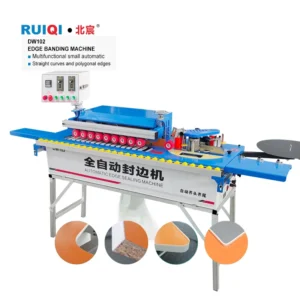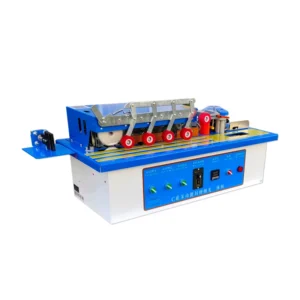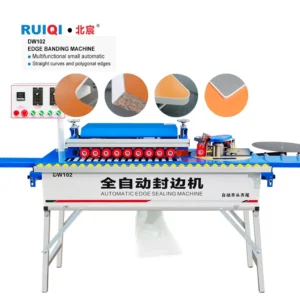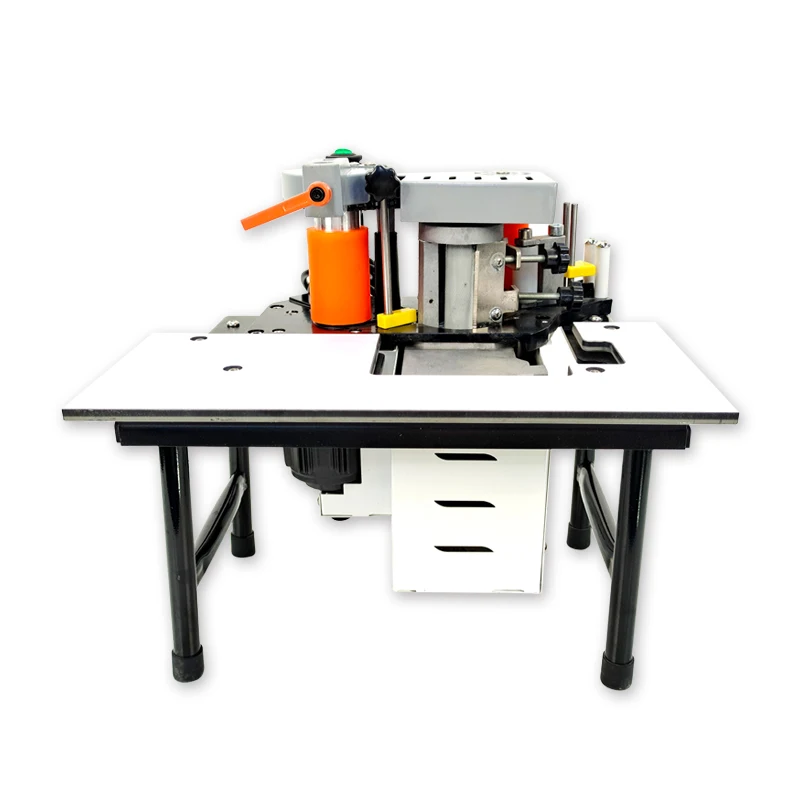
Edge banding machine
Click to enlarge
ISO 9001
CE Certified
OEM / ODM
12-Mo Warranty
Edge banding machine
Portable Edge Banding Machine ST-30 for Curved and Straight Profiles – Small Workshop
<p><strong>ST-30 Portable Edge Banding Machine</strong>, 1000W total power, 0.3–3mm tape thickness — handles both curved and straight profiles across ABS, PVC, melamine and veneer edge banding tapes in a compact 12kg unit.</p> <ul> <li>Glue pot temperature and open time directly influence bond quality, especially on melamine-faced particleboard versus raw MDF substrates where surface porosity differs significantly.</li> <li>Consistent 0.5–0.8 MPa air pressure ensures uniform trimming and pressing, reducing visible glue lines on light-coloured PVC.</li> <li>Supports minimum sheet dimensions of 25cm length and 3cm width for small trim work and on-site adjustments.</li> </ul> <p>Voltage options from 110V to 440V are confirmed before shipment, with operation manuals provided in the agreed language and a 24-hour engineer-led configuration response.</p>
100+
Countries
MOQ 1
Unit
15-25 Days
Lead Time
== Gate == identifier: ST-30 → 通过 == 标签生成 == Edge Banding Machine
220V
CE Certified
Curved And Straight Edge
MDF Panel
Portable Edge Banding
Process And Application
ST-30
- Full OEM/ODM support -- custom logo, voltage (110V-440V), multilingual panels
- ISO 9001 & CE certified, 5 national patents, 60 professional engineers
- 12-month warranty, remote technical support & spare parts service
- Professional export packaging, customs clearance support, on-time delivery
Verified Tolerance in Portable Edge Banding — The ST-30 portable edge bander relies on proprietary cutting mechanism patents and precision-ground components to maintain ±0.02 mm tolerance on both curved and straight profiles, verified through four-stage QC before dispatch.
Technical Specifications
| Parameter | Value |
|---|---|
| Model | ST-30 |
| Product Type | Portable Edge Banding Machine |
| Total Power | 1000W |
| Voltage | 220V / 380V / Customization |
| Edge Banding Height | 0–50 mm |
| Edge Banding Thickness | 0.3–3 mm |
| Minimum Sheet Length | 25 cm |
| Minimum Sheet Width | 3 cm |
| Glue Pot Capacity | 1000 ml |
| Air Source Pressure | 0.5–0.8 MPa |
| Edge Power | 20W |
| Suitable Tape Materials | ABS, PVC, Melamine, Veneer |
| Edge Type | Straight and Curve |
| Product Size | 38 × 35 × 35 cm |
| Product Weight | 12 kg |
| Plug Options | EU, USA, AU, UK |
| Language Options | Chinese, English, customizable |
| Standards | CE |
Application Suitability
| Application | Material or Output |
|---|---|
| Custom cabinet door edging | MDF and plywood panels with PVC or ABS tape on curved and straight profiles |
| On-site interior fit-out trimming | Particleboard shelving and melamine-faced boards requiring portable edge finishing |
| Small joinery workshop production | Solid wood panels and veneer banding for bespoke furniture components |
| Radius panel edge finishing | Curved MDF components for reception desks, retail fixtures and curved cabinetry |
Why Substrate Density Decides Your Edge Banding Machine Process Application Outcome
Matching tape thickness to substrate density prevents the visible glue lines and delamination that ruin finished panels.
I once watched a customer feed low-grade particleboard through an edge bander set for MDF, and the uneven surface caused the PVC tape to bubble across every single door front. The adhesive pooled in the voids of the porous substrate while starving on the high spots, leaving a finish that no amount of trimming could fix. Before specifying any edge banding machine process application, the substrate must be identified and matched to the correct tape and glue temperature range [NEED_CITE: substrate density and adhesive bonding behaviour on engineered wood panels].
How Curved and Straight Profiles Change Glue Behaviour
When the ST-30 transitions from a straight edge to a curve, the contact surface between tape and panel shrinks on convex radii and expands on concave ones. This shifts how the molten adhesive spreads and how the pressure roller conforms the tape to the substrate. Operators producing curved cabinet doors must adjust feed speed and monitor glue bead consistency, since the edge banding machine process application on a 200 mm radius demands different technique than a 2400 mm straight run. The 1000 ml glue pot maintains thermal stability across these transitions, reducing the temperature fluctuations that cause premature setting on long curved workpieces.
Tape Thickness Selection and Adhesion Reliability
The 0.3–3 mm tape thickness range covers the full span from thin melamine strips used on light-duty shelving to heavy ABS and veneer tapes required for solid wood furniture edges. Thin tape on a dense MDF substrate bonds quickly with minimal pressure, while thicker veneer tape on particleboard requires the full 0.8 MPa air pressure to ensure complete contact across the porous surface. Getting this pairing wrong is the most common cause of edge failure in small workshops [NEED_CITE: edge banding adhesion standards for engineered wood substrates]. The edge banding machine process application only delivers repeatable results when tape, substrate and pressure are all specified together before the first panel runs.
Reading the Specs That Actually Matter on the Shop Floor
The 1000W total power rating determines how quickly the glue pot reaches operating temperature from a cold start and how well it recovers between consecutive panels in a batch. A 12 kg machine weight with a 38 × 35 × 35 cm footprint means the unit can be carried to a job site or repositioned within a compact workshop without mechanical handling equipment. The 0.5–0.8 MPa air source pressure requirement dictates the compressor specification — an undersized compressor that cannot maintain pressure above 0.5 MPa will produce inconsistent trimming and incomplete tape pressing, particularly on thicker 3 mm ABS tapes. The minimum sheet dimensions of 25 cm length and 3 cm width define the smallest offcut that can be processed, which matters for workshops cutting narrow drawer fronts and small shelving brackets.
The Cost of Skipping Substrate and Tape Verification
Workshops that order a portable edge bander without confirming substrate type frequently discover adhesion failures only after an entire batch of panels is banded. Melamine-faced particleboard absorbs heat differently from raw MDF, meaning the same glue temperature setting will under-cure on one and scorch on the other. Light-coloured PVC tape shows every glue line and uneven trim mark, making rework visible and expensive [NEED_CITE: common edge banding defects and rework costs in panel furniture manufacturing]. The edge banding machine process application fails quietly — panels pass visual inspection in the workshop but delaminate weeks later when humidity changes at the installation site.
What Consistent Manufacturing Brings to Your Workshop
In-house production with patented cutting mechanisms means the trimming quality you verify on a sample panel is the same quality built into every shipped unit. The four-stage QC process — incoming material, in-process, finished product and pre-shipment verification — catches tolerance drift before machines leave the factory. Voltage and plug configuration are confirmed against your local supply before production starts, so a 220V unit does not arrive at a 380V workshop. Language options for the control interface ensure your operators can read settings without translation delays during commissioning. The ST-30 sits within a full product family, so workshops scaling from portable units to stationary edge banders can remain with a single supplier for training and spare parts continuity.
Documentation & Verification
- Factory test record run on your specified substrate and tape material before dispatch
- CE declaration of conformity covering portable woodworking machinery safety requirements
- Electrical schematic with confirmed voltage and plug type matching your facility supply
- Operation and maintenance manual provided in your operator’s agreed language
- Spare parts list with item codes for glue pot elements, pressure rollers and trimming blades
Installation, Commissioning & Support
- 1000W total power requires a dedicated 220V circuit with appropriate breaker rating for continuous operation
- 0.5–0.8 MPa air supply demands a compressor with sufficient volume to sustain pressure through trimming cycles
- 12 kg unit arrives fully assembled requiring only glue pot loading and air line connection on site
- First-run calibration includes glue temperature verification against the specific tape material in your production plan
- Daily maintenance covers glue pot cleaning and pressure roller inspection using the provided spare parts list
Tell Us About Your Panels Before We Quote
Provide the substrate type, thickness range and tape material you plan to run so the glue pot temperature and air pressure settings can be verified against your production requirements. Confirm your local voltage and frequency to avoid electrical incompatibility on arrival. Let us know whether curved profiles, straight edges or both dominate your output so the configuration recommendation matches your actual workflow.
Frequently Asked Questions
Q: Which tape materials perform best on curved profiles versus straight edges?
A: ABS and PVC tapes in the 0.3–1 mm range flex readily around tight radii without cracking, making them the standard choice for curved cabinet doors and radius panels. Thicker veneer tapes and melamine strips suit straight edges where rigidity supports clean trimming. Substrate density influences bond strength regardless of profile shape, and the glue temperature must be matched to each tape type for reliable adhesion across both curved and straight workpieces.
Q: How does glue pot temperature affect bonding on melamine-faced particleboard versus raw MDF?
A: Melamine-faced particleboard reflects heat at the sealed surface, requiring a higher glue temperature to achieve bonding within the open time window. Raw MDF absorbs heat into the porous fibres, meaning the same temperature setting can over-cure the adhesive before the tape makes full contact. Operators using the ST-30 must adjust the glue pot setting when switching between these substrates to maintain consistent bond strength across production batches.
Q: What air supply is needed to keep trimming consistent through a full production run?
A: The ST-30 requires 0.5–0.8 MPa sustained air pressure to drive the trimming and pressing mechanisms reliably. A compressor rated below this range will cause pressure drops during consecutive cycles, leading to uneven trimming on thicker tapes. Volume capacity matters equally — a small compressor that reaches the correct pressure but cannot replenish quickly enough will produce inconsistent results as the production run continues.
Q: How can I check adhesion quality and avoid visible glue lines on light PVC tape?
A: Pull-test a sample panel after the adhesive has fully cured to confirm the bond exceeds the tape’s tear strength. Visible glue lines on light PVC usually indicate excess adhesive caused by incorrect glue temperature or feed speed. Running a test batch on your exact substrate and tape combination before committing to full production reveals these variables early and allows adjustment without wasting finished panels.
Q: Can the ST-30 handle real wood veneer tape, and what technique differences apply?
A: Real wood veneer tape is within the ST-30 material range but requires careful handling because veneer is less flexible than PVC or ABS and can fracture on tight curves. Feed speed should be reduced, and the tape must be conditioned to workshop humidity before use to prevent post-application shrinkage. Straight edges present fewer challenges, and the 0.5–0.8 MPa air pressure provides sufficient pressing force for reliable veneer adhesion on flat profiles.
Technical Specifications
| Parameter | Value |
|---|---|
| Product Name | Portable Edge Banding Machine ST-30 for Curved and Straight Profiles – Small Workshop |
| Category | Edge banding machine |
| Voltage Options | 110V / 220V / 380V / 440V (customizable) |
| Frequency | 50Hz / 60Hz (customizable) |
| Certification | ISO 9001, CE |
| MOQ | 1 Unit |
| Lead Time | 15-25 Working Days |
| Warranty | 12 Months |
| OEM / ODM | Available -- logo, color, panel language |
* Detailed technical specifications vary by model. Please contact us with your specific requirements for a complete datasheet.
Shipping & Export
-
Export Packaging
Heavy-duty wooden crate with foam padding and moisture protection
-
Shipping Methods
Sea freight (FCL/LCL), air freight, express -- we support all methods
-
Customs Support
Full documentation: CO, commercial invoice, packing list, HS code assistance
-
Port of Loading
Tianjin / Qingdao port, China -- 20 years export experience
OEM / ODM Services
-
Logo & Branding
Custom logo printing, color scheme, and nameplate engraving
-
Voltage Configuration
110V / 220V / 380V / 440V, 50Hz / 60Hz -- any region supported
-
Multilingual Panels
Control panels in English, Spanish, French, Arabic and more
-
Custom Specifications
Modified dimensions, accessories, or feature sets on request
Get a Quote
Request Product Inquiry
Fill in your details and we'll respond within 24 hours with pricing and availability.
Direct Contact
How It Works
-
1
Confirm requirements & budget
Tell us your factory scale and processing needs
-
2
Receive recommendation & quote
We match the right machine with full specs
-
3
Negotiate & place order
OEM terms, voltage, payment and delivery
-
4
Production & QC inspection
Multi-stage quality control by 60 engineers
-
5
Export packaging & shipment
Professional packing, customs clearance
-
6
After-sales support
12-month warranty, remote tech support
You May Also Like