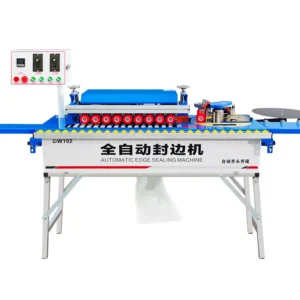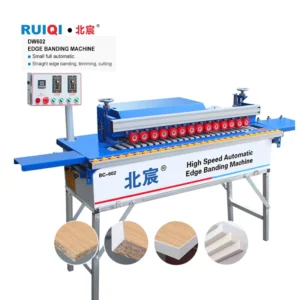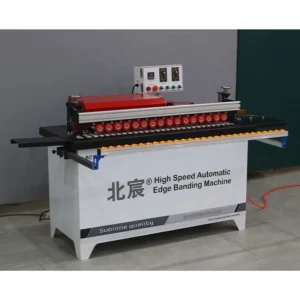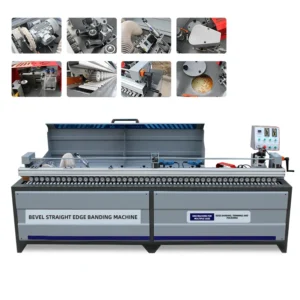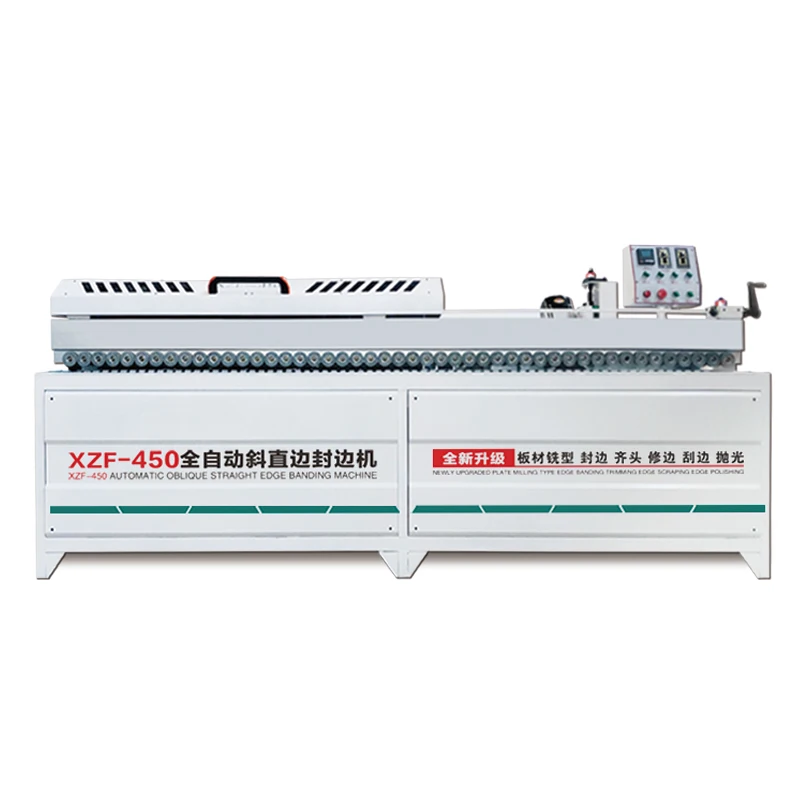
Edge banding machine
Click to enlarge
ISO 9001
CE Certified
OEM / ODM
12-Mo Warranty
Edge banding machine
XZF-450 Automatic Edge Banding Machine for MDF & Solid Wood
<p><strong>XZF-450 Automatic Edge Banding Machine, 9.5KW, 380V/415V, 0.3-3MM Banding Thickness</strong> — delivers a complete 7-function workflow from pre-milling through polishing in a single pass.</p> <ul> <li><strong>4KW pre-milling station</strong> removes saw marks on MDF, particleboard and plywood, ensuring a true edge surface before glue application for minimal visible glue lines</li> <li>30/45/60 degree banding capability supports angled panel joints beyond standard 90-degree straight edging</li> <li>Feed speed 0-12M/min with dual trimming (2.2KW×2) and dual polishing (0.4KW×2) stations produce a sealed, smooth edge ready for downstream assembly</li> </ul> <p>Engineer-led configuration with formal quotation within 24 hours, including voltage confirmation and substrate-specific test records for your production environment.</p>
100+
Countries
MOQ 1
Unit
15-25 Days
Lead Time
380V
Edge Banding Machine
MDF Panel
Pre-Milling Station
Process Application
Solid Wood Board
XZF-450
- Full OEM/ODM support -- custom logo, voltage (110V-440V), multilingual panels
- ISO 9001 & CE certified, 5 national patents, 60 professional engineers
- 12-month warranty, remote technical support & spare parts service
- Professional export packaging, customs clearance support, on-time delivery
Precision-verified edge adhesion — Four-stage QC confirms ±0.02mm tolerance on every XZF-450 before dispatch, ensuring your panel substrates leave the machine with sealed, glue-line-free edges.
Technical Specifications
| Parameter | Value |
|---|---|
| Model | XZF-450 |
| Product Type | Automatic Edge Banding Machine |
| Total Power | 9.5 KW |
| Voltage | 380V/415V (frequency to be confirmed) |
| Pre-milled Motor Power | 4 KW |
| Trimming Power | 2.2 KW × 2 |
| Polishing Power | 0.4 KW × 2 |
| Feed Speed | 0-12 M/min (basis not stated in source) |
| Minimum Sheet Length | 30 CM |
| Minimum Sheet Width | 15 CM |
| Edge Banding Height Range | 0-50 MM |
| Edge Banding Thickness Range | 0.3-3 MM |
| Glue Pot Capacity | 4000 ml |
| Air Source Pressure | 0.5-0.7 MPa |
| Overall Dimensions (L×W×H) | 300 × 65 × 135 CM |
| Net Weight | 430 KG |
Application Suitability
| Application | Material or Output |
|---|---|
| Furniture panel edge banding | MDF, melamine board, particleboard |
| Cabinet carcass finishing | Plywood, blockboard, polymer doors |
| Solid wood panel edging | Solid wood board, veneer banding |
| Multi-angle joint banding | 30/45/60 degree panel edges |
Why Visible Glue Lines Ruin Cabinet Panels and How the XZF-450 Edge Banding Machine for Woodworking Process and Application Prevents Them
The root cause is almost never the glue itself — it is an unprepared substrate edge.
I have watched production managers in European workshops spend hours adjusting glue temperature on particleboard, convinced the adhesive formula was wrong. The real issue was saw marks left by the panel saw creating micro-valleys where glue pooled unevenly. The XZF-450 addresses this with a dedicated 4 KW pre-milling station that removes up to a millimeter of material before the glue pot, creating a true reference surface. Without that step, no amount of temperature adjustment will eliminate visible seams on porous substrates [NEED_CITE: substrate preparation standards for edge banding adhesion].
Substrate Variability and Why One Glue Setting Fails Across Materials
The XZF-450 edge banding machine for woodworking process and application handles MDF, plywood, particleboard, and solid wood in a single pass, but each substrate demands different thermal behavior. MDF absorbs heat rapidly due to its fiber density, requiring higher glue pot temperatures to maintain open time. Particleboard behaves differently — its porous surface wicks moisture from the adhesive, demanding faster feed rates to prevent starved joints. Production teams switching between these materials throughout the day must adjust both temperature and speed, or accept inconsistent bonding at the transition points.
Multi-Angle Banding Beyond Standard 90-Degree Edges
Most edge banders in this class handle only straight 90-degree panel edges, limiting their usefulness for angled cabinet joints and beveled furniture components. The XZF-450 supports 30, 45, and 60-degree edge banding, which changes the pressure roller geometry and feed mechanics entirely. When running angled stock, the feed speed must be reduced to maintain consistent roller contact across the narrower bonding surface. Operators who attempt standard feed rates on beveled panels often see delamination at the acute edge [NEED_CITE: mechanical adhesion principles for angled edge banding].
Reading the Spec Sheet Against Actual Workshop Conditions
The 0-12 M/min feed speed range on this machine provides flexibility, but the usable speed depends entirely on your panel thickness and banding material. Running 3mm PVC on 18mm particleboard at maximum feed speed will produce inadequate bonding time — the glue simply cannot cure under pressure in that window. The 2.2 KW dual trimming stations remove excess banding material with enough torque to handle ABS and thick veneer without stalling, while the 0.4 KW dual polishing wheels produce the final surface finish. Glue pot capacity at 4000 ml supports extended production runs, though continuous operation depletes the reservoir faster on thick banding applications where adhesive consumption per linear meter increases substantially.
What Happens When Voltage and Frequency Do Not Match
Shipping a 380V machine into a workshop with 415V supply and different frequency will burn out the pre-milling motor within weeks, not years. The XZF-450 lists 380V/415V compatibility, but frequency must be confirmed before production — a 50Hz motor running on 60Hz supply spins twenty percent faster, generating heat the cooling system was never designed to handle. I have seen this exact scenario destroy a brand-new machine in North America before the warranty period ended [NEED_CITE: electrical frequency mismatch effects on industrial motors]. The air supply specification of 0.5-0.7 MPa also requires dry, filtered compressed air — moisture in pneumatic lines causes the trimming and scraping cylinders to stutter, producing visible chatter marks on finished edges.
Why Procurement Alignment Matters for Process Consistency
In-house manufacturing with patented cutting mechanisms means the pre-milling station on this machine was designed and validated by the same engineering team that built the trimming and polishing stages — not sourced separately and bolted on. Four-stage QC covering incoming material through pre-shipment verification catches tolerance drift before the machine leaves the factory, rather than after it arrives at your dock. Voltage and language customization as standard means your control panel displays operational parameters in the language your technicians actually read, eliminating commissioning delays caused by translation errors. The engineer-led configuration process requires your specific substrate samples before final quotation, preventing the scenario where machine settings from a factory test on MDF prove useless on your actual particleboard stock.
Documentation & Verification
- Factory test record on your specific substrate and banding combination before dispatch
- Electrical schematic confirming voltage and frequency match your local supply
- Operation manual in your operator’s language covering all seven processing stations
- Spare parts list with pneumatic cylinder and polishing wheel specifications
- Pre-shipment verification photographs of your machine running your material
Installation, Commissioning & Support
- Dedicated 380V/415V circuit required for the 9.5 KW total power draw
- Machine arrives fully assembled — no foundation work beyond level flooring needed
- Glue pot warm-up protocol must be established based on your ambient workshop temperature
- Pneumatic line requires moisture trap and regulator set to 0.5-0.7 MPa
- Initial commissioning includes feed speed calibration on your actual panel stock
- Trimming and scraping stations adjusted to your specific banding thickness range
Before We Quote, Tell Us About Your Actual Production
We need your substrate types and thicknesses, the banding materials you run most frequently, and your local voltage and frequency specification. If you are processing mixed materials throughout the day, let us know the changeover frequency so we can recommend appropriate glue pot and temperature control options. Samples of your actual panel stock and banding material allow us to validate settings before the machine ships.
Frequently Asked Questions
Q: How does substrate type affect pre-milling depth and glue adhesion on this machine?
A: Particleboard requires deeper pre-milling to remove the porous surface layer, while MDF needs shallower cuts due to its consistent fiber density. Solid wood demands the least material removal but requires careful grain orientation consideration. The 4 KW pre-milling motor on the XZF-450 provides sufficient torque for all three substrates, but depth settings must be adjusted per material change.
Q: Which edge banding materials work within the 0.3-3mm thickness range?
A: PVC, ABS, melamine, veneer, and thin solid wood banding all fall within this range. However, veneer and melamine require lower glue temperatures and different adhesive formulations than PVC and ABS. Confirm your specific material combination with us before production to ensure proper glue selection and temperature settings.
Q: How do angled banding operations change feed speed and pressure settings?
A: Running 30, 45, or 60-degree edges reduces the effective bonding surface compared to standard 90-degree edging. Feed speed must be reduced to maintain adequate open time, and pressure roller adjustment becomes more critical to prevent edge lift at the acute angle. Test runs on scrap material are essential before production.
Q: What compressed air quality is needed for consistent pneumatic operation?
A: The 0.5-0.7 MPa specification assumes dry, filtered air free of oil contamination. Moisture in pneumatic lines causes the trimming and scraping cylinders to operate inconsistently, producing chatter marks on finished edges. Install a dryer and coalescing filter upstream of the machine to prevent this issue.
Q: How does the 4000ml glue pot capacity translate to continuous run time?
A: Consumption varies significantly based on banding thickness and feed speed. Running 2mm PVC at moderate speeds typically consumes the full capacity within a standard production shift. Thicker banding materials and faster feed rates increase consumption. The warm-up protocol requires approximately twenty to thirty minutes depending on ambient temperature and glue formulation.
Technical Specifications
| Parameter | Value |
|---|---|
| Product Name | XZF-450 Automatic Edge Banding Machine for MDF & Solid Wood |
| Category | Edge banding machine |
| Voltage Options | 110V / 220V / 380V / 440V (customizable) |
| Frequency | 50Hz / 60Hz (customizable) |
| Certification | ISO 9001, CE |
| MOQ | 1 Unit |
| Lead Time | 15-25 Working Days |
| Warranty | 12 Months |
| OEM / ODM | Available -- logo, color, panel language |
* Detailed technical specifications vary by model. Please contact us with your specific requirements for a complete datasheet.
Shipping & Export
-
Export Packaging
Heavy-duty wooden crate with foam padding and moisture protection
-
Shipping Methods
Sea freight (FCL/LCL), air freight, express -- we support all methods
-
Customs Support
Full documentation: CO, commercial invoice, packing list, HS code assistance
-
Port of Loading
Tianjin / Qingdao port, China -- 20 years export experience
OEM / ODM Services
-
Logo & Branding
Custom logo printing, color scheme, and nameplate engraving
-
Voltage Configuration
110V / 220V / 380V / 440V, 50Hz / 60Hz -- any region supported
-
Multilingual Panels
Control panels in English, Spanish, French, Arabic and more
-
Custom Specifications
Modified dimensions, accessories, or feature sets on request
Get a Quote
Request Product Inquiry
Fill in your details and we'll respond within 24 hours with pricing and availability.
Direct Contact
How It Works
-
1
Confirm requirements & budget
Tell us your factory scale and processing needs
-
2
Receive recommendation & quote
We match the right machine with full specs
-
3
Negotiate & place order
OEM terms, voltage, payment and delivery
-
4
Production & QC inspection
Multi-stage quality control by 60 engineers
-
5
Export packaging & shipment
Professional packing, customs clearance
-
6
After-sales support
12-month warranty, remote tech support
You May Also Like