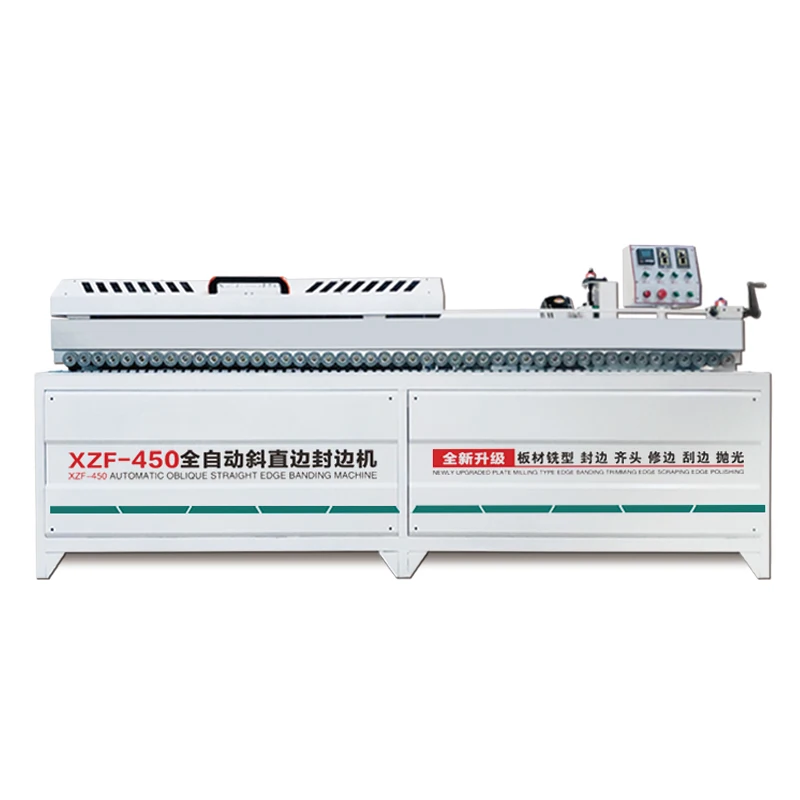
Edge banding machine
Click to enlarge
ISO 9001
CE Certified
OEM / ODM
12-Mo Warranty
Edge banding machine
XZF450 Edge Banding Machine for MDF Plywood Furniture – Process Guide
<p><strong>XZF450 Edge Banding Machine, 9.5KW Total Power, 0-12m/min Feed Speed</strong> — integrating pre-milling, 30°/45°/60° edge banding, dual trimming, scraping and polishing in a single pass for MDF, plywood and particleboard substrates.</p> <ul> <li>4KW pre-milling removes saw marks for flat bonding surfaces, minimising visible glue lines on porous materials</li> <li>Handles 0.3–3mm PVC and veneer banding with 4000ml glue pot capacity, supporting mixed batch production</li> <li>Air source requirement 0.5–0.7Mpa with high-power vacuum extraction for consistent edge quality</li> </ul> <p>Engineer-led configuration with factory test records on your actual substrate and edge material before shipment.</p>
100+
Countries
MOQ 1
Unit
15-25 Days
Lead Time
4kW Motor
Edge Banding Machine
MDF Panel
Plywood Edge Banding
Pre-milling
Process Application
XZF450
- Full OEM/ODM support -- custom logo, voltage (110V-440V), multilingual panels
- ISO 9001 & CE certified, 5 national patents, 60 professional engineers
- 12-month warranty, remote technical support & spare parts service
- Professional export packaging, customs clearance support, on-time delivery
Verified Tolerance Mechanisms — the XZF450 pre-milling and trimming stations are built on proprietary cutting mechanisms with precision-ground components, ensuring edge accuracy holds across MDF, plywood, and particleboard runs rather than drifting after the first shift.
Technical Specifications
| Parameter | Value |
|---|---|
| Model | XZF-450 |
| Product Type | Edge Banding Machine |
| Total Power | 9.5 kW |
| Voltage | 380V / 415V (confirm Hz for target market) |
| Pre-milling Motor | 4 kW |
| Trimming Motor | 2.2 kW × 2 |
| Polishing Motor | 0.4 kW × 2 |
| Edge Feed Power | 0.16 kW |
| Transmission Power | 180 W |
| Vacuum Power | 550 W |
| Feed Speed | 0–12 m/min |
| Edge Banding Height | 0–50 mm |
| Edge Banding Thickness | 0.3–3 mm |
| Minimum Sheet Length | 300 mm |
| Minimum Sheet Width | 150 mm |
| Glue Pot Capacity | 4000 ml |
| Air Source Pressure | 0.5–0.7 MPa |
| Machine Dimensions | 3000 × 650 × 1350 mm |
| Machine Weight | 430 kg |
| Key Features | Pre-milling, 30°/45°/60° multi-angle banding, trimming, scraping, polishing, high-power vacuum extraction |
Application Suitability
| Application | Material or Output |
|---|---|
| Custom cabinet door production | MDF and melamine-faced board with PVC or veneer edge banding |
| Furniture panel edge finishing | Plywood and blockboard requiring pre-milling before banding |
| Mixed-batch panel processing | Particleboard and polymer doors running 0.3–3 mm band thickness |
| Bevel-edge profile work | Solid wood panels requiring 30°, 45°, or 60° angled edge banding |
Why Glue Lines Show on MDF but Not on Melamine — and What to Do About It
Visible glue lines are almost never a glue problem; they are a surface preparation problem.
When a saw blade tears through MDF or particleboard, it leaves micro-grooves along the panel edge. If those grooves reach the gluing station untouched, adhesive fills them unevenly, and the band sits on a ridged surface. You see the result as a thick, inconsistent seam that gets flagged during cabinet assembly inspection. The edge banding machine process application here matters because the 4 kW pre-milling station on the XZF450 removes that damaged layer before adhesive meets substrate [NEED_CITE: substrate edge preparation standards for panel furniture]. A flat, freshly milled edge lets the glue spread uniformly, which is the difference between a joint you can see from across the room and one you have to look for.
How Pre-Milling Changes the Edge Banding Process on Porous Substrates
The pre-milling cutters rotate against the panel edge just ahead of the glue roller, shaving off roughly the amount of material needed to eliminate saw marks. On MDF, this exposes a dense, uniform fibre surface that accepts hot-melt adhesive consistently. On particleboard, it removes the loose chips left by the beam saw. The edge banding machine process application benefits are most noticeable on these porous substrates, where skipping pre-milling almost guarantees a visible seam. Without this station, operators compensate by increasing glue temperature or feed pressure, which creates squeeze-out on the panel face and more scraping work downstream.
Multi-Angle Banding and What It Means for Furniture Profiles
Most edge banders handle 90° straight edges only, which limits a workshop to square-profile cabinet doors and shelving. The XZF450 supports 30°, 45°, and 60° banding angles in addition to standard 90°, letting a single machine produce bevel-edge drawer fronts, chamfered shelf fronts, and angled decorative panels. This matters for custom furniture shops running varied designs across a single shift [NEED_CITE: multi-angle edge banding applications in custom cabinetry]. Switching between angles requires adjusting the banding guide and pressure roller alignment, but the machine frame accommodates these changes without swapping tooling or adding auxiliary stations.
Reading the Specs That Actually Affect Edge Quality
The 0–12 m/min feed speed range directly interacts with glue open time. At lower speeds, the adhesive has more time to set before the band reaches the pressure zone, which suits thicker veneer banding up to 3 mm. At higher speeds, thinner PVC at 0.3 mm bonds quickly before the glue skins over. The dual 2.2 kW trimming motors handle flush cuts on both sides of the panel in one pass, removing the overhang that causes problems when panels meet at cabinet corners. The 550 W vacuum extraction port captures trimming dust before it settles on the polishing wheels, which is important because embedded particles in the polishing stage leave micro-scratches on glossy PVC and melamine band surfaces. The 4000 ml glue pot holds enough adhesive for extended production runs without frequent refills, and the pot temperature must be matched to the specific hot-melt formulation being used.
What Happens When the Machine Arrives Without Voltage Confirmation
A 380V/415V machine wired for 50 Hz connected to a 60 Hz supply will run its motors faster than designed, which shifts the relationship between feed speed and glue open time. The trimming cutters spin faster, increasing the risk of chipping on brittle melamine edges. The glue pot heater may cycle differently, causing temperature drift that weakens adhesion on cold winter mornings. These problems do not appear during the factory acceptance test because the machine runs on its native supply [NEED_CITE: voltage and frequency mismatch effects on woodworking machinery]. Operators notice them weeks later when edge quality degrades without an obvious cause. Confirming local voltage and frequency before production begins avoids this entirely.
Building the Machine Around the Process, Not the Other Way Around
The XZF450 stations are sequenced so that each one prepares the workpiece for the next: pre-milling creates a flat edge, gluing applies adhesive uniformly, banding presses the strip into contact, trimming removes excess, scraping cleans the transition line, and polishing finishes the surface. This sequencing reflects how the edge banding machine process application should work when substrate variation is the norm rather than the exception. The machine does not assume every panel enters the line in perfect condition.
Why Procurement Verification Matters Before Shipment
In-house manufacturing with patented cutting mechanisms means the pre-milling and trimming stations are not sourced from third parties and bolted on; they are built and tested as integrated units. Four-stage quality control covers incoming material, in-process assembly, finished product inspection, and pre-shipment verification with test panels. Voltage, plug type, and control panel language are configured before the machine leaves the factory, not after it arrives at a workshop where the operator cannot read the interface. Engineer-led configuration recommendations match station options to the specific substrates and banding materials a buyer will run, rather than shipping a default build and hoping it fits. Factory visits are open, so buyers can watch their own material processed on the machine before committing.
Documentation & Verification
- CE declaration of conformity covering the XZF450 edge banding machine assembly and electrical systems
- Machine specification sheet confirming every station motor rating and configuration matches the agreed quotation
- Electrical schematic with voltage, frequency, and plug type confirmed for the destination facility
- Factory test record processed on buyer-supplied substrate and banding material samples before dispatch
- Operation and maintenance manual in the agreed language covering glue pot management and trimming alignment
- Spare parts list with part numbers for cutters, pressure rollers, glue roller, and polishing wheels
Installation, Commissioning & Support
- Requires a level concrete floor with adequate clearance around the 3000 × 650 mm footprint for material infeed and outfeed
- Dedicated 380V/415V circuit with confirmed Hz compatibility to protect the 9.5 kW total load and motor drives
- Arrives fully assembled; requires utility connection, dust extraction hookup to the 550 W vacuum port, and air supply at 0.5–0.7 MPa
- First-run commissioning includes glue temperature calibration, trimming alignment on buyer’s actual panel thickness, and feed speed tuning
- Operator training covers angle changeover procedures for 30°/45°/60° banding and daily glue pot cleaning
- Recommended spare stock includes trimming cutters, scraping blades, and polishing wheels sized to the machine’s station specifications
What to Share When Requesting a Quotation
Provide the substrate types and panel thickness range you plan to run, the edge banding materials and thicknesses in your current product mix, and your local voltage and frequency. If you operate existing upstream saws or downstream boring machines, note their feed heights so the XZF450 can be configured for smooth material flow between stations. Specify the control panel language your operators need.
Frequently Asked Questions
Q: How does pre-milling affect edge quality on MDF versus particleboard?
A: MDF has a uniform fibre structure that pre-milling smooths into a flat bonding surface, reducing visible glue lines. Particleboard has a chip structure where saw cuts leave loose fragments along the edge; pre-milling removes these fragments so the adhesive contacts solid material rather than loose chips that can pull away under stress.
Q: What edge banding materials work with the 4000 ml glue pot?
A: The glue pot handles standard EVA hot-melt adhesive compatible with PVC, melamine, wood veneer, and ABS edge banding in the 0.3–3 mm thickness range. Glue temperature and feed speed must be adjusted for each material combination, and the pot capacity supports extended runs without frequent refilling.
Q: How do you verify trimming accuracy before panels go to assembly?
A: Run sample panels through the full sequence and measure the trimmed edge with a straight edge and feeler gauge. The dual 2.2 kW trimming stations should leave the band flush with the panel face on both sides, with no overhang that would interfere with panel-to-panel joinery at cabinet corners.
Q: What air supply and dust extraction setup does this machine need?
A: The machine requires compressed air at 0.5–0.7 MPa for pneumatic pressure rollers and cylinder actuation. The 550 W vacuum port connects to a central or standalone dust collector to capture trimming and scraping debris, preventing particles from contaminating the polishing stage and the finished edge surface.
Q: How does feed speed interact with glue open time on thick substrates?
A: Thicker panels retain heat longer, which extends the window before the hot-melt adhesive sets. At lower feed speeds within the 0–12 m/min range, this gives adequate bonding time for thick veneer banding. Thin PVC on thin panels bonds faster, so higher feed speeds prevent the adhesive from skinning over before the pressure zone.
Technical Specifications
| Parameter | Value |
|---|---|
| Product Name | XZF450 Edge Banding Machine for MDF Plywood Furniture – Process Guide |
| Category | Edge banding machine |
| Voltage Options | 110V / 220V / 380V / 440V (customizable) |
| Frequency | 50Hz / 60Hz (customizable) |
| Certification | ISO 9001, CE |
| MOQ | 1 Unit |
| Lead Time | 15-25 Working Days |
| Warranty | 12 Months |
| OEM / ODM | Available -- logo, color, panel language |
* Detailed technical specifications vary by model. Please contact us with your specific requirements for a complete datasheet.
Shipping & Export
-
Export Packaging
Heavy-duty wooden crate with foam padding and moisture protection
-
Shipping Methods
Sea freight (FCL/LCL), air freight, express -- we support all methods
-
Customs Support
Full documentation: CO, commercial invoice, packing list, HS code assistance
-
Port of Loading
Tianjin / Qingdao port, China -- 20 years export experience
OEM / ODM Services
-
Logo & Branding
Custom logo printing, color scheme, and nameplate engraving
-
Voltage Configuration
110V / 220V / 380V / 440V, 50Hz / 60Hz -- any region supported
-
Multilingual Panels
Control panels in English, Spanish, French, Arabic and more
-
Custom Specifications
Modified dimensions, accessories, or feature sets on request
Get a Quote
Request Product Inquiry
Fill in your details and we'll respond within 24 hours with pricing and availability.
Direct Contact
How It Works
-
1
Confirm requirements & budget
Tell us your factory scale and processing needs
-
2
Receive recommendation & quote
We match the right machine with full specs
-
3
Negotiate & place order
OEM terms, voltage, payment and delivery
-
4
Production & QC inspection
Multi-stage quality control by 60 engineers
-
5
Export packaging & shipment
Professional packing, customs clearance
-
6
After-sales support
12-month warranty, remote tech support
You May Also Like