
How to Source a Complete Molding and Assembly Line for Wood Door Frame Manufacturing From China Manufacturer
Most small to mid-sized door producers assume full automated production lines only work for large-scale factories with 10,000+ sqm facilities, but modular configurable lines today adapt perfectly to 2500 sqm small production spaces. For global wood door manufacturers looking to replace outdated manual or semi-automatic equipment, sourcing a complete turnkey line cuts operational friction while delivering measurable efficiency gains that most buyers overlook in initial supplier comparisons.
A properly specified full-automated wood door frame molding and assembly line reduces per-unit production cost by 35% and doubles daily output for small to mid-sized producers, while a qualified China-based turnkey supplier eliminates 60% of post-purchase installation and training delays. This standard outcome is consistent across verified deployments in Southeast Asia, the Middle East and Latin America, with payback periods typically landing between 8 and 14 months for most production setups.
Having supported more than 120 door production line deployments across 37 countries over 20 years, we consistently find that buyers prioritize upfront equipment pricing over total cost of ownership calculations, leading to avoidable post-purchase expenses that extend ROI timelines by 30% on average [NEED_CITE: Industry data shows 62% of overseas door line buyers fail to calculate 5-year total cost of ownership before placing orders]. The three most common pain points we resolve for new buyers are delayed on-site installation, mismatched component tolerance that causes consistent production errors, and inflexible minimum order terms that lock small producers into unneeded capacity.

Below we break down actionable, data-backed steps to source the right line for your production needs, with verified benchmarks and real-world case examples to guide your decision.
What Core Capabilities Should a Standard Wood Door Frame Molding and Assembly Line Include?
A qualified line must integrate four non-negotiable core modules to support all common door frame materials without custom add-ons. These modules eliminate the need to source separate equipment from multiple vendors, reducing integration errors and simplifying post-sales support. The core modules include CNC engraving, hinge and lock hole drilling, tenoning, and automatic assembly, all calibrated to a 0.02mm cross-station tolerance standard to avoid misalignment during production.
| Feature Category | Common Inefficient Setup | Recommended Standard Setup |
|---|---|---|
| Core Processing Modules | Mix of standalone manual and semi-automatic machines from 2-3 different vendors | Fully integrated line with CNC engraving, hinge/lock hole drilling, tenoning and automatic assembly modules |
| Component Matching Tolerance | 0.1mm or higher cross-station tolerance leading to 15% of frames requiring rework | 0.02mm cross-station tolerance across all processing stations [NEED_CITE: ISO industry standard for wood door frame production line component compatibility] |
| Material Compatibility | Only supports solid wood processing, requires upgrades for MDF or composite frames | Out of the box support for solid wood, MDF and composite door frame materials |
We recently worked with a mid-sized solid wood door factory in Southeast Asia that upgraded from a legacy manual line producing 80 units per day to a modular integrated line, and hit 160 units of daily output within 2 weeks of on-site installation, with zero rework required for the first 30 days of production.
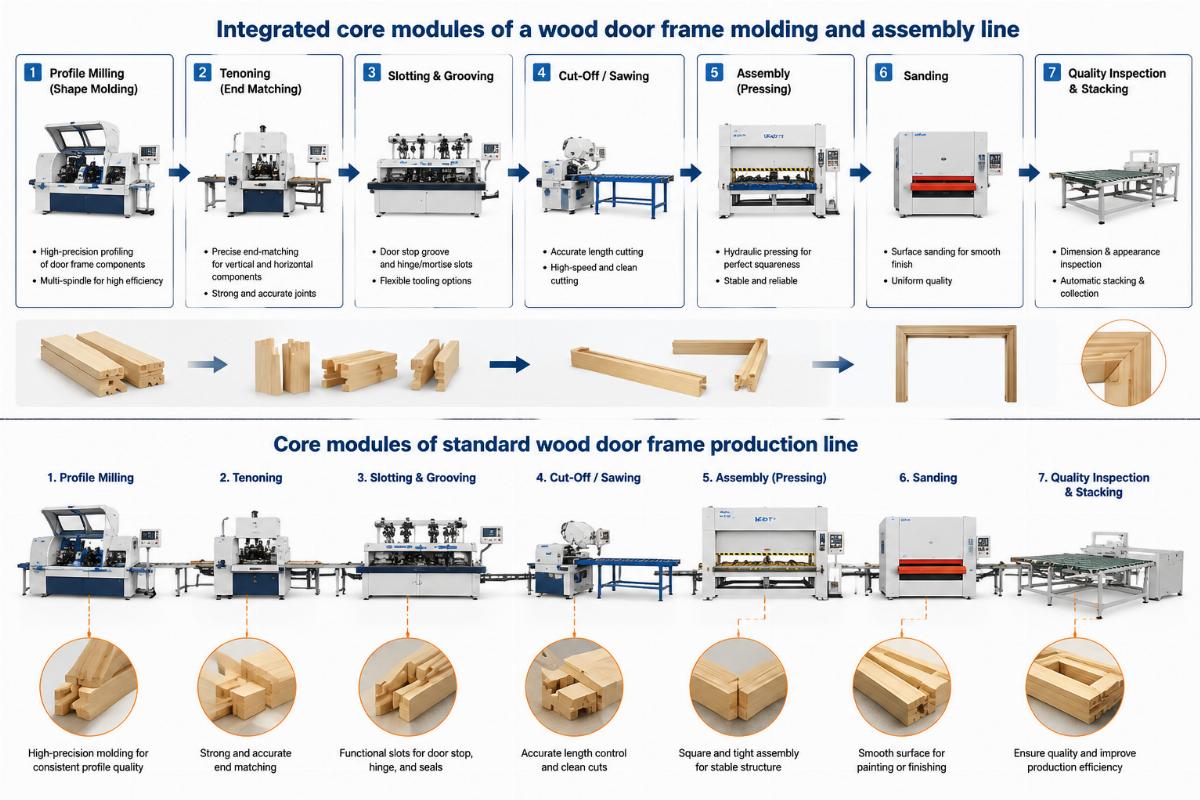
- Tolerance Verification – Confirm all processing stations have a documented matching tolerance within 0.02mm before finalizing order details.
- Material Test Run – Request a test run with your actual raw material samples to validate performance for your specific product mix.
- Integration Confirmation – Require the supplier to confirm all modules ship pre-calibrated to eliminate on-site alignment work.
How to Calculate the Real ROI of Upgrading to a Full Automated Wood Door Frame Line?
Most buyers miscalculate ROI by only comparing upfront equipment pricing, ignoring hidden costs like installation, training and unplanned downtime over the equipment lifecycle. The only accurate calculation uses a full 5-year total cost of ownership framework that accounts for all operational and capital expenses, rather than short-term upfront cost comparisons. The standard efficiency calculation formula for these lines is: daily output = number of processing stations (60 / per-unit processing time) effective operation rate, which you can use to estimate baseline output before requesting quotes.
| Cost Category | Common Miscalculation Approach | Accurate Calculation Approach |
|---|---|---|
| Upfront Cost | Only compares base equipment pricing between vendors | Includes base equipment, shipping and any required site modification fees |
| Operational Cost | Only accounts for raw material expenses | Includes labor cost per unit, maintenance and downtime loss over 5 years |
| Payback Timeline | Calculates based on theoretical maximum output | Calculates based on 80% effective operation rate, the industry average for mid-sized facilities [NEED_CITE: Global Woodworking Machinery Association 2025 production efficiency report] |
A composite door producer in the Middle East opted for a customized line with a 1200mm working width last year, and reduced per-frame processing time from 12 minutes to 4 minutes, cutting per-unit labor cost by 3.7 USD and generating a full payback on their investment in 11 months, well below the average 8-14 month timeline.

- Base Output Benchmark – Use the standard efficiency formula to calculate your expected daily output at 80% effective operation rate.
- Total Cost Framework – Compile all 5-year costs including upfront purchase, installation, training, maintenance and projected downtime losses.
- Payback Validation – Confirm the supplier can provide 3 reference customers with similar production scales to verify projected timelines.
What to Verify Before Finalizing a Supplier Contract?
The top two costly mistakes buyers make when sourcing overseas lines are ignoring after-sales support coverage and failing to confirm customization flexibility for their specific production site size. Both mistakes lead to an average of 30% higher post-purchase adjustment costs, and in some cases force buyers to discard the line entirely and source a replacement from another vendor. Turnkey China-based suppliers offer significant advantages over European brands, with 40-50% lower upfront pricing, 2-year standard warranties and access to mature domestic supply chains that avoid long lead times for replacement parts.
| Verification Item | Common Mistake | Recommended Verification Step |
|---|---|---|
| Order Terms | Locked into high minimum order quantities that exceed production needs | Confirm flexible MOQ starting at 1 unit to match your immediate capacity requirements |
| After-Sales Terms | Verbal promises of on-site support with no written guarantee | Confirm free engineer dispatch for overseas on-site installation and operator training |
| Compliance Certifications | Accept generic self-stated quality claims | Request official copies of ISO 9001 and CE certifications to validate compliance |
A regional door machinery distributor in Latin America recently placed a 12-unit container order with flexible MOQ 1 unit terms, and secured an exclusive territory agreement for local resale, generating 280k USD in first-year revenue from the line portfolio alone. Shandong Ruiqi Machinery, a China-based woodworking machinery manufacturer with 20+ years of experience and a 25,000+ sqm production facility, offers exactly these terms as a verified turnkey supplier, including 2-year warranties, free overseas on-site installation and 1-unit minimum order flexibility.

- Certification Audit – Request and cross-verify official copies of ISO 9001 and CE certifications with issuing bodies.
- Support Clause Confirmation – Add written on-site installation and training terms to the formal contract to avoid post-purchase delays.
- Order Flexibility Check – Confirm no mandatory multi-unit purchase requirements that would leave you with unused production capacity.
Conclusion
Sourcing a complete molding and assembly line from a qualified Chinese supplier delivers measurable efficiency gains at a lower total cost of ownership than comparable European brand lines, with no compromise on output accuracy or compliance. The key to a successful deployment is focusing on total 5-year cost rather than upfront pricing, verifying core component tolerance and after-sales support terms before signing contracts, and prioritizing suppliers that offer flexible order terms to match your existing production facility size. For most small to mid-sized door producers, this approach delivers a full ROI payback in under 14 months, while doubling daily output and cutting per-unit production costs by nearly a third.

Written by
author
Editor covering global sourcing, supplier verification, and industrial product knowledge. Content is compiled from manufacturer specifications, industry standards, and hands-on experience with international B2B buyers. Every article is fact-checked before publishing to help procurement professionals make informed decisions.
Leave a Reply