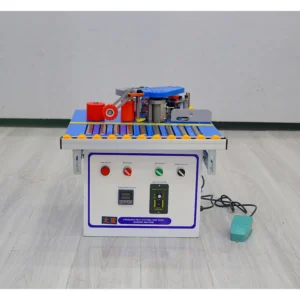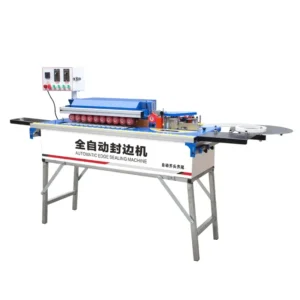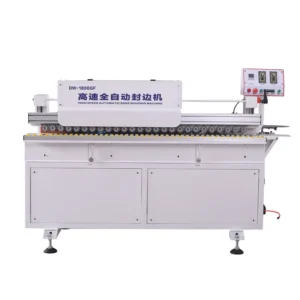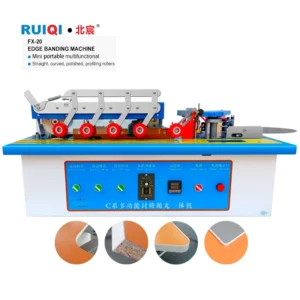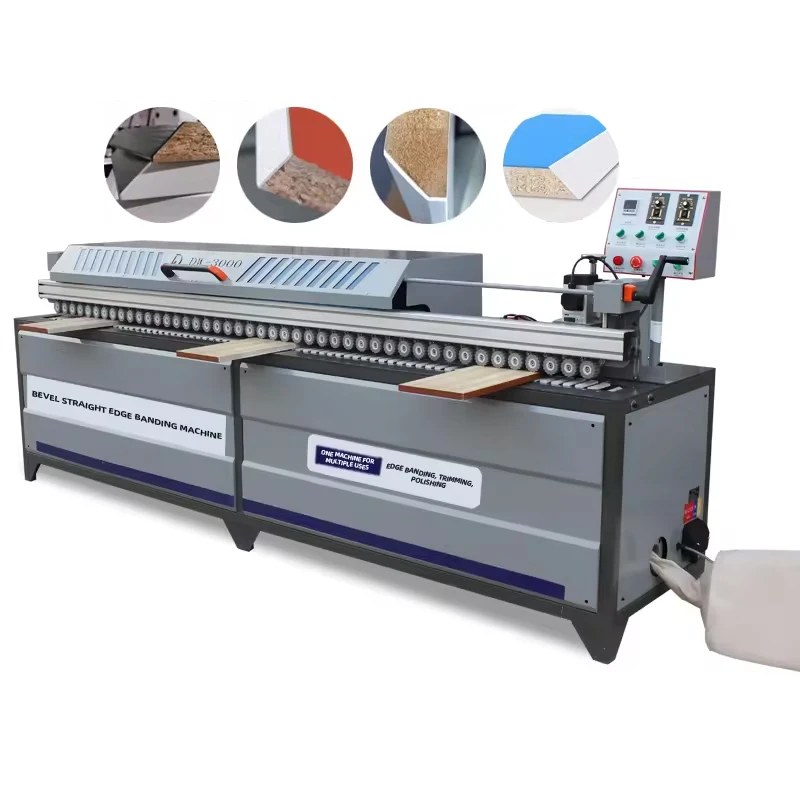
Edge banding machine
Click to enlarge
ISO 9001
CE Certified
OEM / ODM
12-Mo Warranty
Edge banding machine
Automatic 45 Degree Bevel Edge Banding Machine for MDF PVC ABS Wood Board Furniture
<p><strong>DW3000 Edge Banding Machine, 11KW, 0-12M/min Feed Speed</strong> — handles straight and 30-90 degree bevel edge banding in one pass. Double heat gun design with 2.2KW×2 ensures reliable glue activation on MDF, PVC, and ABS substrates.</p> <ul> <li>8 adjustable pressure wheel groups accommodate various bevel angles</li> <li>Spindle trimming system with 3 motors delivers clean edge finish</li> <li>Minimum sheet size 30×15CM, edge banding thickness 0.3-3MM</li> </ul> <p>Engineered for furniture factories evaluating how substrate behavior and glue temperature affect edge quality during assembly.</p> <p>Sample processing tests available to verify ±0.02mm tolerance on your specific materials before purchase commitment.</p>
100+
Countries
MOQ 1
Unit
15-25 Days
Lead Time
11KW Motor
380V
45 Degree Bevel
DW3000
Edge Banding Machine
Furniture Factory
MDF PVC ABS
Process And Application
- Full OEM/ODM support -- custom logo, voltage (110V-440V), multilingual panels
- ISO 9001 & CE certified, 5 national patents, 60 professional engineers
- 12-month warranty, remote technical support & spare parts service
- Professional export packaging, customs clearance support, on-time delivery
Double Heat Gun Configuration — Two independent 2.2 kW heating elements ensure consistent glue activation across MDF, PVC, and ABS substrates before the pressure wheel zone engages.
Technical Specifications
| Parameter | Value |
|---|---|
| Product Type | Fully Automatic 45 Degree Bevel and Straight Edge Banding Machine |
| Total Power | 11 kW |
| Voltage | 380V / 415V |
| Feed Speed | 0–12 m/min |
| Edge Banding Height | 0–50 mm |
| Edge Banding Thickness | 0.3–3 mm |
| Minimum Sheet Length | 30 cm |
| Minimum Sheet Width | 15 cm |
| Pre-milled Motor | 2.2 kW |
| Heating Power | 2.2 kW × 2 (double heat gun) |
| Trimming Power | 2.2 kW × 2 (3 spindle trimming motors total) |
| Polishing Power | 0.4 kW × 2 |
| Vacuum Power | 550 W |
| Glue Pot Capacity | 4000 ml |
| Pressure Wheel | 8 groups, adjustable 30–90 degrees |
| Feeding System | Double cylinder feeding belt |
| Air Source Pressure | 0.5–0.7 MPa |
| Product Size | 299 × 65 × 130 cm |
| Product Weight | 430 kg |
| Key Features | Plate milling, 30–90 degree edge banding, trimming, scraping, polishing, high-power vacuuming |
Application Suitability
| Application | Material or Output |
|---|---|
| Cabinet door edge finishing | MDF and particleboard with PVC or ABS banding, straight and beveled profiles |
| Custom furniture panel processing | Plywood and blockboard with veneer or melamine edge strips |
| Decorative panel production | MDF boards requiring 45-degree bevel edge banding for visible frame joints |
| Shelving and carcass components | Particleboard panels with 0.3–3 mm PVC edge banding for moisture protection |
Why Glue Line Visibility Varies Wildly Between MDF and Particleboard
Substrate density determines whether your edge banding machine process and application delivers a clean joint or a visible seam that fails inspection.
I once watched a batch of cabinet doors come off the line looking flawless on high-density MDF trial samples, only to see the same settings produce delaminated edges on recycled-content particleboard. The board density was uneven, the glue penetration was inconsistent, and an entire production run had to be reworked. The edge banding machine process and application was technically correct — the substrate was the variable nobody had checked. When panel plants switch material suppliers without recalibrating feed speed and temperature, visible glue lines become a recurring rejection reason rather than a one-time anomaly [NEED_CITE: substrate density variation and adhesive bond strength in edge banding].
How the Eight Pressure Wheel Groups Handle Bevel Geometry
The DW3000 uses eight independently adjustable pressure wheel groups that tilt between 30 and 90 degrees. For straight 90-degree edges, all wheels press uniformly against the banding strip. When you shift to a 45-degree bevel — common in frameless cabinet doors where the edge meets a mitered partner — the pressure distribution changes entirely. The adjustable angle means the wheels conform to the bevel face rather than pushing the banding away from it, which is where most entry-level machines lose adhesion on angled profiles.
What Double Heating Changes for Thick PVC Banding
Running 2 mm or 3 mm PVC on a single heat gun means the outer surface reaches activation temperature while the inner layer remains cold. The DW3000’s dual 2.2 kW heat guns address this by pre-warming the banding strip from both sides before it reaches the glue roller. This matters particularly when ambient workshop temperature drops in winter months — cold PVC becomes stiff, and a single heater cannot bring it to bonding temperature at 12 m/min feed speed. The double heating design gives the operator a wider thermal margin across the full 0.3–3 mm thickness range [NEED_CITE: thermal activation requirements for PVC and ABS edge banding materials].
Reading the Specs That Actually Affect Your Edge Quality
The 2.2 kW pre-milling motor is not just a surface prep step — it removes the saw blade tear-out layer that causes micro-gaps between the panel edge and the banding strip. Without pre-milling, even a precision-cut panel can show hairline delamination under raking light. The three spindle trimming motors work in sequence: rough trim removes the bulk overhang, finish trim brings the edge flush, and radius scraping rounds the sharp corner that would otherwise chip during handling. The 550 W vacuum system pulls chips and dust from the trimming zone before they can embed in fresh adhesive. And the 4000 ml glue pot capacity means the operator is not stopping to refill mid-batch on a full day’s run of carcass panels.
The Cost of Skipping the Substrate Test
When a buyer orders based on MDF sample results but runs recycled particleboard in production, the mismatch surfaces weeks later as field complaints. Cabinet doors warp because the edge seal failed and moisture penetrated the core. Drawer fronts separate at the bevel joint because the glue never fully activated on the uneven surface. The rework cost is never just the banding material — it is the labor to strip, re-prep, re-band, and re-deliver [NEED_CITE: edge banding failure modes in panel furniture manufacturing].
What Manufacturing Depth Means for This Machine
The pre-milling mechanism uses a proprietary cutting design that holds tolerance through extended production runs rather than degrading after the first shift. Voltage configuration from 380V to 415V is confirmed against your local supply before the machine ships, not assumed. The control panel language is set to your operator’s requirement, so commissioning does not stall over an unreadable interface. Four-stage quality control covers incoming material inspection, in-process checks, finished product verification, and pre-shipment testing with your sample panels. Factory visits are open, so you can watch your exact specification being assembled rather than taking a brochure at face value.
Documentation & Verification
- CE declaration of conformity covering the DW3000 edge banding machine assembly
- Electrical schematic confirming 380V/415V wiring and circuit protection layout
- Factory test record run on your specified panel material and banding thickness
- Operation and maintenance manual in your operator’s working language
- Spare parts list matching the 8-group pressure wheel and 3-motor trimming assembly
- Pre-shipment packing photographs showing crated machine condition
Installation, Commissioning & Support
- Dedicated 380V/415V three-phase circuit required for the 11 kW total power draw
- Floor space of approximately 300 × 65 cm plus operator clearance on the infeed side
- Machine ships partially assembled; pressure wheels and polishing units require on-site alignment
- First-run commissioning includes glue temperature calibration for your specific PVC or ABS thickness
- Compressed air supply at 0.5–0.7 MPa must be clean and dry to protect pneumatic cylinders
- Glue pot and trimming spindle bearings scheduled for periodic inspection per maintenance manual
Before You Request a Quote
Tell us what panel material you actually run in daily production — not the showroom sample, but the board that goes into shipping boxes. Specify your local voltage and frequency, the edge banding material and thickness you use most, and whether you need straight edges only or both straight and beveled profiles. If you are unsure whether the DW3000 feed speed range suits your throughput, share your average batch size and we can map it against realistic cycle expectations.
Frequently Asked Questions
Q: How does substrate density affect edge banding adhesion on this machine?
A: Low-density particleboard absorbs glue unevenly, leaving starved zones where the banding lifts within days. The DW3000’s pre-milling station creates a uniform surface, but the operator must still adjust glue roller pressure and feed speed to match the board’s actual density. We recommend running a sample test on your production substrate before finalizing machine settings for the full batch.
Q: Which edge banding materials work with the 30–90 degree bevel adjustment?
A: PVC and ABS banding from 0.3 to 3 mm thickness work across the full 30–90 degree range. Thin melamine strips handle straight edges well but can crack on tighter bevel angles. Veneer banding is suitable for straight and mild bevel applications but requires careful temperature control to prevent splitting. Always confirm compatibility with a sample run on your chosen material.
Q: How should feed speed and temperature be set for different board thicknesses?
A: Thicker boards and thicker banding both require slower feed speed and higher heating temperature to allow full glue activation. Running 3 mm PVC at maximum 12 m/min without adequate heat produces cold bonds that peel under stress. The double heat gun design extends the viable speed range, but the operator should validate adhesion with a peel test at the chosen setting before committing to a production run.
Q: How does bevel angle affect downstream panel assembly?
A: A 45-degree bevel edge is typically mated to another beveled panel in a miter joint. If the bevel angle drifts or the banding thickness is inconsistent, the joint opens a visible gap at the corner. The DW3000’s eight adjustable pressure wheel groups maintain consistent banding contact across the bevel face, but the final assembly fit depends equally on the partner panel being machined to the same tolerance.
Technical Specifications
| Parameter | Value |
|---|---|
| Product Name | Automatic 45 Degree Bevel Edge Banding Machine for MDF PVC ABS Wood Board Furniture |
| Category | Edge banding machine |
| Voltage Options | 110V / 220V / 380V / 440V (customizable) |
| Frequency | 50Hz / 60Hz (customizable) |
| Certification | ISO 9001, CE |
| MOQ | 1 Unit |
| Lead Time | 15-25 Working Days |
| Warranty | 12 Months |
| OEM / ODM | Available -- logo, color, panel language |
* Detailed technical specifications vary by model. Please contact us with your specific requirements for a complete datasheet.
Shipping & Export
-
Export Packaging
Heavy-duty wooden crate with foam padding and moisture protection
-
Shipping Methods
Sea freight (FCL/LCL), air freight, express -- we support all methods
-
Customs Support
Full documentation: CO, commercial invoice, packing list, HS code assistance
-
Port of Loading
Tianjin / Qingdao port, China -- 20 years export experience
OEM / ODM Services
-
Logo & Branding
Custom logo printing, color scheme, and nameplate engraving
-
Voltage Configuration
110V / 220V / 380V / 440V, 50Hz / 60Hz -- any region supported
-
Multilingual Panels
Control panels in English, Spanish, French, Arabic and more
-
Custom Specifications
Modified dimensions, accessories, or feature sets on request
Get a Quote
Request Product Inquiry
Fill in your details and we'll respond within 24 hours with pricing and availability.
Direct Contact
How It Works
-
1
Confirm requirements & budget
Tell us your factory scale and processing needs
-
2
Receive recommendation & quote
We match the right machine with full specs
-
3
Negotiate & place order
OEM terms, voltage, payment and delivery
-
4
Production & QC inspection
Multi-stage quality control by 60 engineers
-
5
Export packaging & shipment
Professional packing, customs clearance
-
6
After-sales support
12-month warranty, remote tech support
You May Also Like