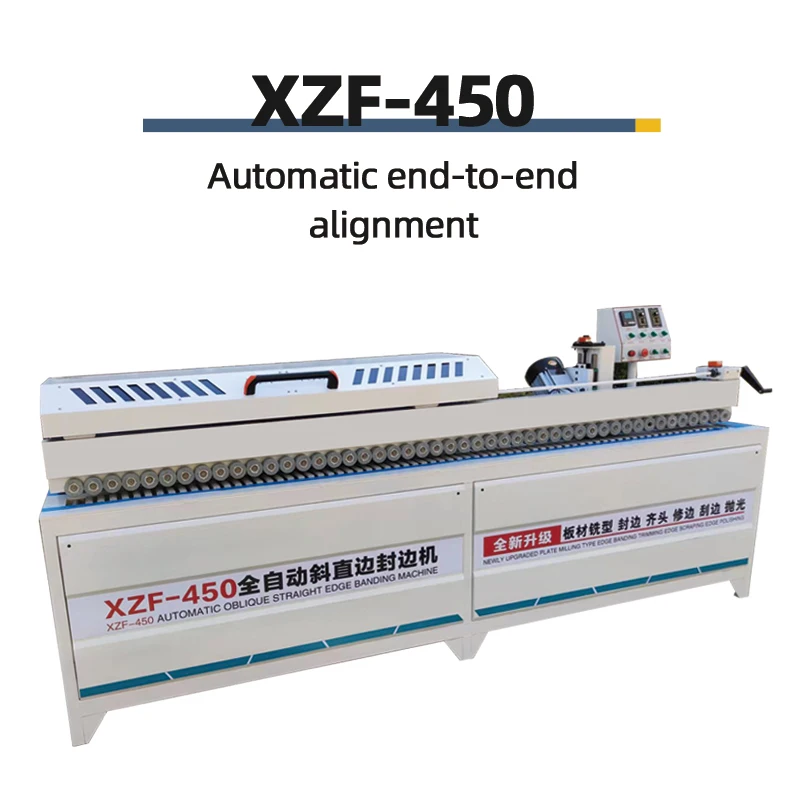
Edge banding machine
Click to enlarge
ISO 9001
CE Certified
OEM / ODM
12-Mo Warranty
Edge banding machine
Automatic Edge Banding Machine with Pre-milling – Process and Application
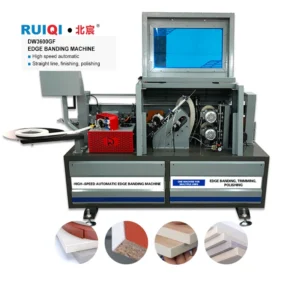
<p><strong>XZF450 Automatic Edge Banding Machine, 9.5 kW, 0.3–3 mm edge thickness, pre-milling to polishing</strong> — delivers single-pass edge finishing across MDF, particleboard and plywood substrates.</p> <ul> <li><strong>4 kW pre-milling station</strong> removes substrate imperfections before gluing, reducing visible glue lines on uneven panel edges common in mixed-material production schedules</li> <li>Seven integrated functions — pre-milling, gluing, end trimming, rough trimming, fine trimming, scraping and polishing — handle 30°/45°/60° bevels alongside standard straight edging in one pass</li> <li>Feed speed 0–12 m/min with 0–50 mm edge banding height range, supporting PVC, ABS, melamine and veneer materials</li> </ul> <p>Ruiqi provides a pre-shipment factory test record covering trimming alignment, glue pot temperature stability and feed speed consistency so edge quality is verified before the machine leaves the factory.</p>
100+
Countries
MOQ 1
Unit
15-25 Days
Lead Time
380V
Edge Banding Machine
Furniture Factory
MDF Panel
Pre-milling
Process And Application
XZF-450
- Full OEM/ODM support -- custom logo, voltage (110V-440V), multilingual panels
- ISO 9001 & CE certified, 5 national patents, 60 professional engineers
- 12-month warranty, remote technical support & spare parts service
- Professional export packaging, customs clearance support, on-time delivery
Precision-ground cutting mechanisms — verified through a four-stage QC process that tests trimming alignment on your specific substrate before dispatch.
Technical Specifications
| Parameter | Value |
|---|---|
| Model | XZF-450 |
| Product Type | Automatic Edge Banding Machine |
| Total Installed Power | 9.5 kW |
| Operating Voltage | 380V / 415V (configurable from 110V to 440V) |
| Pre-milling Motor | 4 kW |
| Feed Speed | 0–12 m/min |
| Edge Banding Thickness Range | 0.3–3 mm |
| Edge Banding Height | 0–50 mm |
| Minimum Panel Dimension | 300 mm (L) × 150 mm (W) |
| Glue Pot Capacity | 4000 ml |
| Standard Working Stations | Pre-milling, gluing, end trimming, rough trimming, fine trimming, scraping, polishing |
| Angled Edge Capability | 30° / 45° / 60° |
| Air Supply Pressure | 0.5–0.7 MPa |
| Overall Dimensions | 300 × 65 × 135 cm |
| Net Weight | 430 kg |
Application Suitability
| Application | Material or Output |
|---|---|
| Custom cabinet carcass production | Melamine-faced particleboard and MDF |
| Wardrobe and shelving panel edging | Plywood and blockboard up to 50 mm banding height |
| Polymer door and beveled component finishing | PVC and ABS banding at 30°/45°/60° angles |
| Solid wood furniture panel processing | Veneer and solid wood edge banding (0.3–3 mm) |
Why Substrate Density Dictates Your Edge Banding Machine Configuration
A machine configured for light MDF will fail on high-density particleboard within weeks if the pre-milling station lacks sufficient motor power.
I have walked into workshops where the edge banding machine woodworking process was stalled because the operator kept reducing feed speed to compensate for chipped edges on dense substrates. The root cause was almost always an underpowered pre-milling unit that could not clean the panel edge before the glue station. When particleboard density varies across a batch, a 4 kW pre-milling motor maintains consistent edge preparation, preventing the glue line from telegraphing through thin PVC banding. Production managers who specify machines based solely on price often discover this mismatch only after the first month of mixed-material scheduling [NEED_CITE: substrate density variation in panel board manufacturing].
How Pre-milling Resolves Substrate-Dependent Edge Quality
The edge banding machine woodworking process begins at the pre-milling station, where a 4 kW motor removes saw marks and micro-chips left by the panel sizing saw. On particleboard and MDF, the cut edge is rarely perfectly square; without this station, the glue bonds to an uneven surface, producing visible glue lines that worsen under angled lighting. The XZF-450’s pre-milling cutters prepare a clean, square edge that allows the downstream gluing and trimming stations to perform within tolerance, regardless of whether the panel is lightweight MDF or high-density chipboard.
Seven-Station Single-Pass Workflow for Consistent Output
Running seven functions in one pass — pre-milling, gluing, end trimming, rough trimming, fine trimming, scraping, and polishing — eliminates the handling damage and alignment drift that occurs when panels move between separate machines. Each station on the XZF-450 is sequenced so that the trimming knives engage immediately after the glue has set under pressure, producing a finished edge that requires no manual touch-up. This single-pass approach is critical when a factory runs mixed batches of cabinet sides, shelves, and door panels in the same shift [NEED_CITE: single-pass edge banding workflow advantages in furniture manufacturing].
Specifying the Numbers That Actually Affect Edge Finish
The 0–12 m/min feed speed range must be matched to the banding thickness and substrate: running 3 mm ABS on particleboard at the upper end of the speed range risks poor adhesion, while thin melamine on MDF can be processed faster. The 0.5–0.7 MPa air supply requirement drives the pneumatic pressure rollers that maintain consistent glue contact; an undersized compressor causes roller pressure fluctuation and uneven bond lines. Glue pot capacity at 4000 ml supports continuous operation through a standard shift without frequent refill stops, maintaining thermal stability that is essential for consistent melt viscosity across varying ambient workshop temperatures.
The Hidden Cost of Under-Specifying Pre-milling Power
When a workshop orders an entry-level edge bander without pre-milling to save on initial cost, the consequence appears as rework at the assembly bench. Panels with chipped edges produce visible gaps in dowel and confirmat joints because the edge profile is not square. Operators then resort to hand-scraping and filling, adding labor hours that were never budgeted. On angled components requiring 45° edge banding, the lack of a pre-milling station means the bevel edge carries saw marks directly into the glue joint, causing premature banding delamination in humid environments [NEED_CITE: edge banding adhesion failure modes in high-humidity conditions].
Why Sourcing Through Ruiqi Woodwork
The XZF-450 ships with a pre-shipment factory test record that documents trimming alignment, glue pot temperature stability, and feed speed consistency on your specified panel material. Voltage confirmation is completed before production — the standard 380V/415V configuration is adjusted to match your facility supply, available from 110V to 440V. Multilingual control panels and operation manuals are specified at order, eliminating the commissioning delays that occur when an operator cannot read the HMI. Every unit passes through a four-stage QC process covering incoming material, in-process assembly, finished product inspection, and pre-shipment verification, with a formal inspection report included in the shipping documentation.
Documentation & Verification
- CE declaration of conformity specific to the XZF-450 automatic edge banding machine
- Factory test record documenting trimming tolerance on your panel thickness range
- Electrical schematic confirming voltage and frequency matched to your facility
- Operation and maintenance manual produced in your specified language
Installation, Commissioning & Support
- Requires a dedicated 380V/415V three-phase circuit rated for the 9.5 kW total power draw
- 300 cm machine length demands clear feed and exit zones for full-length panel handling
- Air supply must deliver 0.5–0.7 MPa at the machine inlet to maintain roller pressure
- Pre-milling and trimming stations calibrated during commissioning using your panel stock
- 4000 ml glue pot requires scheduled cleaning cycles to prevent residue buildup on heating elements
Before You Send an Inquiry
Provide your primary panel material and thickness range, the edge banding materials and thicknesses you run, and your local voltage and frequency so the electrical configuration is confirmed before quotation. If your production includes beveled panels, specify the required angles and the panel dimensions involved. Let us know the control panel language your operators need and whether you would like a sample processing test on your own substrate before order confirmation.
Frequently Asked Questions
Q: How does substrate type affect edge banding quality, and what role does pre-milling play?
A: MDF produces a relatively clean saw cut, while particleboard leaves micro-chips along the edge. The 4 kW pre-milling station on the XZF-450 removes these imperfections before gluing, creating a square edge that allows consistent adhesive contact. Without pre-milling, high-density particleboard produces visible glue lines that worsen under angled lighting and fail adhesion tests over time.
Q: Which edge banding materials are compatible with the 0.3–3 mm thickness range?
A: The XZF-450 handles PVC, ABS, melamine, and veneer banding across the full 0.3–3 mm range. Glue temperature and roller pressure must be adjusted per material — ABS requires higher melt temperatures than melamine, and veneer demands careful pressure control to prevent cracking. The 4000 ml glue pot maintains thermal stability through a full shift.
Q: How do I specify the correct voltage and control panel language before shipment?
A: Confirm your facility supply voltage and frequency at inquiry stage — the XZF-450 ships standard at 380V/415V but is configurable from 110V to 440V. Specify the control panel language on the purchase order; Ruiqi provides multilingual HMI options and operation manuals in the agreed language, preventing commissioning delays on your shop floor.
Q: What edge quality tolerance is verified during the pre-shipment factory test?
A: The four-stage QC process includes a pre-shipment test on your specified panel material, documenting trimming alignment, glue line appearance, and feed speed consistency. The test record ships with the machine, providing a baseline for comparison after installation. Tolerance verification uses your actual banding thickness and substrate to confirm process capability.
Q: How does the XZF-450 integrate with upstream and downstream stations?
A: The 0–12 m/min feed speed must be matched to the output rate of your panel sizing saw and the cycle time of downstream boring or drilling stations. Confirm feed height compatibility and throughput expectations at the quotation stage so the line configuration avoids bottlenecks. Ruiqi engineers provide a layout recommendation based on your production flow.
Technical Specifications
| Parameter | Value |
|---|---|
| Product Name | Automatic Edge Banding Machine with Pre-milling – Process and Application |
| Category | Edge banding machine |
| Voltage Options | 110V / 220V / 380V / 440V (customizable) |
| Frequency | 50Hz / 60Hz (customizable) |
| Certification | ISO 9001, CE |
| MOQ | 1 Unit |
| Lead Time | 15-25 Working Days |
| Warranty | 12 Months |
| OEM / ODM | Available -- logo, color, panel language |
* Detailed technical specifications vary by model. Please contact us with your specific requirements for a complete datasheet.
Shipping & Export
-
Export Packaging
Heavy-duty wooden crate with foam padding and moisture protection
-
Shipping Methods
Sea freight (FCL/LCL), air freight, express -- we support all methods
-
Customs Support
Full documentation: CO, commercial invoice, packing list, HS code assistance
-
Port of Loading
Tianjin / Qingdao port, China -- 20 years export experience
OEM / ODM Services
-
Logo & Branding
Custom logo printing, color scheme, and nameplate engraving
-
Voltage Configuration
110V / 220V / 380V / 440V, 50Hz / 60Hz -- any region supported
-
Multilingual Panels
Control panels in English, Spanish, French, Arabic and more
-
Custom Specifications
Modified dimensions, accessories, or feature sets on request
Get a Quote
Request Product Inquiry
Fill in your details and we'll respond within 24 hours with pricing and availability.
Direct Contact
How It Works
-
1
Confirm requirements & budget
Tell us your factory scale and processing needs
-
2
Receive recommendation & quote
We match the right machine with full specs
-
3
Negotiate & place order
OEM terms, voltage, payment and delivery
-
4
Production & QC inspection
Multi-stage quality control by 60 engineers
-
5
Export packaging & shipment
Professional packing, customs clearance
-
6
After-sales support
12-month warranty, remote tech support
You May Also Like