Edge banding machine
Click to enlarge
ISO 9001
CE Certified
OEM / ODM
12-Mo Warranty
Edge banding machine
Automatic PVC MDF CNC Edge Banding Machine – Woodworking Factory Supply
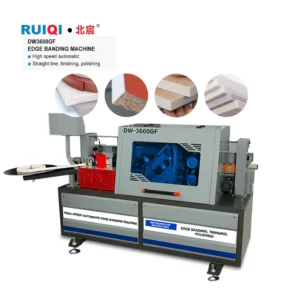
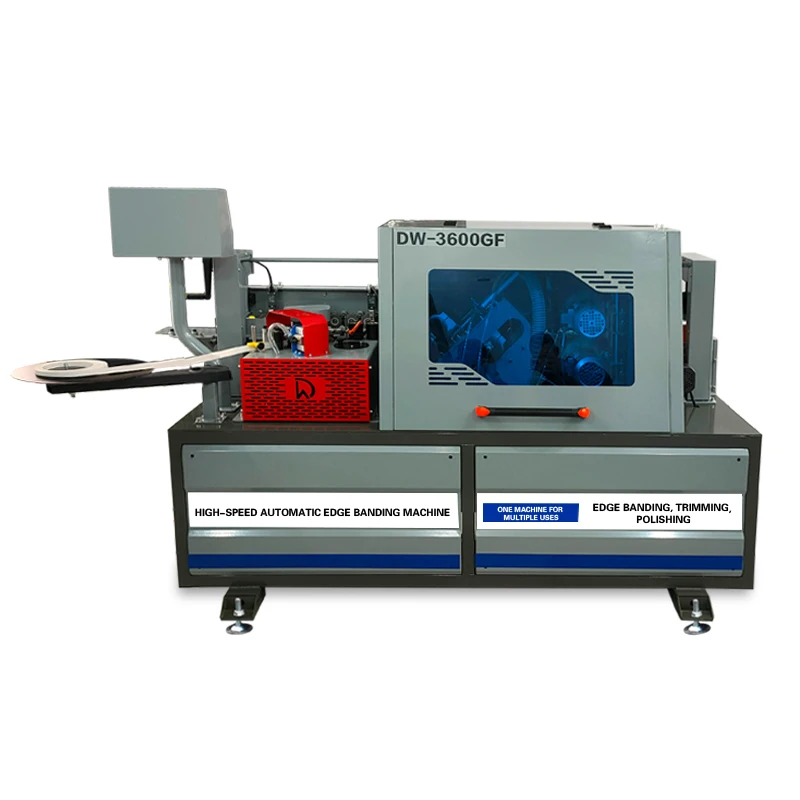
<p><strong>DW-3600GF Automatic Edge Banding Machine, 380V, 4.9kW, 0.3-3mm Band Thickness</strong> — straight edge banding unit with six-station sequence covering gluing, trimming, scraping and polishing for MDF and particleboard panels.</p> <ul> <li>24,000 r/min trimming speed for clean flush cuts on PVC and veneer banding</li> <li>0-14 m/min feed speed to adjust glue penetration across porous substrates</li> </ul> <p>Supports sample processing tests on your actual panel material before commitment, with engineer-led configuration and full voltage confirmation prior to production.</p>
100+
Countries
MOQ 1
Unit
15-25 Days
Lead Time
14m/min Feed Speed
380V
DW-3600GF
Edge Banding Machine
MDF Panel
Process And Application
PVC Edge Banding
- Full OEM/ODM support -- custom logo, voltage (110V-440V), multilingual panels
- ISO 9001 & CE certified, 5 national patents, 60 professional engineers
- 12-month warranty, remote technical support & spare parts service
- Professional export packaging, customs clearance support, on-time delivery
Voltage-verified configuration — every DW-3600GF shipment is checked against the buyer’s local grid frequency before assembly, preventing the costly scenario where a 380V machine arrives unusable on a 60Hz supply.
Technical Specifications
| Parameter | Value |
|---|---|
| Model | DW-3600GF |
| Product Type | Automatic Edge Banding Machine |
| Voltage & Frequency | 380V three-phase four-wire (frequency to be confirmed for destination market) |
| Total Power | 4.9 kW |
| Overall Dimensions (L×W×H) | 2200 × 650 × 1250 mm |
| Net Weight | 320 kg |
| Edge Banding Type | Straight edge banding |
| Edge Band Height Range | 0–50 mm |
| Edge Band Thickness Range | 0.3–3 mm |
| Minimum Panel Length | 200 mm |
| Feed Speed | 0–14 m/min |
| Trimming Power | 800 W × 2 |
| Trimming Speed | 24,000 r/min |
| Polishing Power | 400 W × 2 |
| Transmission Power | 180 W |
| Air Supply Requirement | 0.4–0.6 MPa |
| Standard Functions | Gluing, Trimming, Front and Rear Trimming, Scraping, Polishing, Vacuuming |
| Language Options | Chinese and English standard; Spanish and other languages customizable |
| Plug Options | EU, USA, AU, UK |
Application Suitability
| Application | Material or Output |
|---|---|
| Custom cabinet door production | MDF panels with 0.4 mm PVC edge banding |
| Shelving and carcass manufacturing | Particleboard with 2 mm ABS banding |
| Joinery workshop mixed-material runs | Plywood and MDF switching between veneer and PVC |
| Panel sizing and edge finishing | Straight-edge furniture components in batch or per-order production |
Why the Glue Line Tells You Everything About the Woodworking Edge Banding Process and Application
An invisible glue seam is not luck — it is the result of matching glue pot temperature, feed speed, and roller pressure to the exact substrate and banding material in use.
I once set up an automatic edge bander for a custom cabinet shop that ran PVC banding most of the week, then switched to melamine paper on Fridays. The machine was configured for PVC. When melamine paper hit the glue roller at the same temperature and feed rate, the bonding failed across dozens of panels before anyone noticed. The line was down for days while we re-calibrated. [NEED_CITE: substrate-specific glue temperature ranges for hot-melt edge banding]
That situation repeats more often than equipment suppliers admit. Boards like particleboard soak up adhesive differently from MDF, and a woodworking edge banding process and application that works perfectly on one substrate can leave visible ridges or starved joints on another.
How the Six-Station Sequence Shapes the Finished Edge
Each station on the DW-3600GF removes or refines a specific layer of imperfection. The gluing station applies a controlled film of hot-melt adhesive; the trimming heads at 24,000 r/min shear the overhang flush with the panel face; front and rear trimming squares the ends; scraping removes the microscopic ridge left by the trimming cutters; and polishing restores the surface sheen. Skipping any of these stages — or running them out of adjustment — leaves a visible defect that shows up under kitchen lighting or on a showroom floor. Understanding this woodworking edge banding process and application sequence is what separates a clean furniture edge from one that gets rejected at assembly.
Feed Speed as the Hidden Variable in Bond Quality
The 0–14 m/min feed range on this machine is wider than it needs to be for a single material — and that is intentional. Porous substrates like particleboard benefit from a slower feed because the adhesive needs slightly longer contact time under the pressure roller to penetrate the open surface structure. MDF, with its denser and more uniform face, can run at higher feed speeds without sacrificing bond strength. Veneer banding introduces a third variable: the natural fibre can scorch if the glue pot runs too hot at high speed, or fail to bond if the pot is too cool at low speed. [NEED_CITE: recommended feed speed adjustments for veneer versus thermoplastic edge banding]
What the Spec Sheet Numbers Actually Mean on the Shop Floor
The 24,000 r/min trimming speed is not just a performance figure — it determines how cleanly the cutter shears through the banding material. At lower speeds, PVC tends to tear rather than cut, leaving a ragged edge that scraping alone cannot fully correct. The 0.3–3 mm banding thickness range covers everything from thin decorative PVC to solid-wood lipping, but each thickness demands different trimming cutter geometry and pressure-wheel settings. The 0.4–0.6 MPa air supply drives the pneumatic cylinders that control roller pressure and cutter engagement; inconsistent air pressure directly causes the intermittent glue-line failures that are hardest to diagnose. Panel length down to 200 mm means small drawer fronts and narrow end-panels can be edged without a separate manual operation, which matters in custom furniture where component sizes vary by the order.
When a Misconfigured Machine Costs More Than the Machine Itself
A common failure pattern I see in the field starts with a buyer who ordered an edge bander based on price and basic throughput, without specifying the actual banding material or local electrical supply. The machine arrives, gets plugged into a circuit that does not match its voltage requirement, and either underperforms or damages its electrical components on the first run. [NEED_CITE: consequences of operating three-phase machinery on incorrect voltage supply] Even when the electrical side is correct, a glue pot calibrated for one banding type will produce visible defects on another, and those defects often go unnoticed until assembled furniture reaches the end customer. The cost of returns, re-work, and reputation damage quickly overtakes the original equipment saving.
What Sets This Configuration Apart
The DW-3600GF is built on an in-house manufacturing line with patented cutting mechanisms and verified tolerance checks at multiple stages. Voltage, plug type, and control-panel language are confirmed against the buyer’s destination before production begins — not after. The six-station process sequence sits within a single product family, so a workshop can add capacity or switch to a higher-specification model without retraining operators on an unfamiliar platform. Every unit goes through a four-stage quality check that includes pre-shipment verification on the buyer’s specified panel material and banding stock. Engineer-led configuration recommendations are provided within 24 hours of an inquiry, so buyers do not have to guess which options their production actually requires.
Documentation & Verification
- CE declaration of conformity covering the DW-3600GF edge banding machine
- Factory test record using your specified panel thickness and banding material
- Electrical schematic with confirmed voltage and frequency for your workshop
- Operation and maintenance manual in the language your operators read
- Spare parts list identifying consumables and recommended replacement intervals
- Packing photographs for customs and freight-damage verification
Installation, Commissioning & Support
- Requires a level concrete floor with clearance for the 2200 mm machine length plus infeed and outfeed space
- Dedicated 380V three-phase circuit with confirmed frequency matching the motor nameplate
- Delivered as a single assembled unit; pneumatic and dust-extraction connections completed on site
- First-run calibration of glue temperature and roller pressure for your specific banding stock
- Operator training covering all six stations from gluing through polishing
- Daily maintenance schedule for trimming cutter inspection and glue-pot cleaning at the rated 4.9 kW power level
Before You Send the Inquiry
Tell us the panel materials you run most often — MDF, particleboard, plywood, or a mix — and the specific edge banding types and thicknesses you stock. Confirm your workshop voltage and frequency, and let us know the primary language your operators need on the control panel. If you are replacing an existing machine or fitting into a line with upstream saws and downstream boring stations, share the infeed height and throughput so we can verify compatibility. We can arrange a sample processing test on your actual materials before you commit to a production order.
Frequently Asked Questions
Q: How does glue temperature affect bonding on MDF versus particleboard?
A: Particleboard has a more open surface structure and typically requires a slightly higher glue-pot temperature to achieve proper adhesive penetration, while MDF bonds well at a moderate setting due to its denser face. Running the wrong temperature causes either starved joints or excess squeeze-out. The DW-3600GF glue station should be adjusted each time you switch substrates.
Q: What banding materials does this six-station sequence handle?
A: The machine processes PVC, ABS, melamine paper, and veneer banding from 0.3 mm to 3 mm thick without changing the core tooling. Thicker solid-wood lipping at the upper limit may require specific trimming cutter profiles and a slower feed speed to maintain a clean shear cut.
Q: How does feed speed influence edge quality?
A: Slower feed speeds increase adhesive contact time under the pressure roller, which helps on porous substrates like particleboard. Veneer banding generally runs at a moderate speed to prevent scorching, while PVC and ABS can run at higher feed rates for productivity. Adjusting feed speed per material is essential to the woodworking edge banding process and application.
Q: What dust extraction setup is needed?
A: The trimming and scraping stations generate fine particulate that must be captured at source. A centralised extraction system with adequate static pressure should be connected to the machine’s dust ports before commissioning. [NEED_CITE: industrial dust extraction requirements for woodworking edge banding operations] Inadequate extraction allows debris to interfere with the polishing wheels and contaminates the workshop air.
Q: How do I verify trimming accuracy before daily production?
A: Run a batch of sample panels using your actual board and banding stock, then measure the trimmed edge with a calibrated gauge. Check for flush cuts on both top and bottom faces, square end-trims, and absence of chipping. Any deviation should be corrected at the trimming and scraping stations before the machine enters regular service.
Technical Specifications
| Parameter | Value |
|---|---|
| Product Name | Automatic PVC MDF CNC Edge Banding Machine – Woodworking Factory Supply |
| Category | Edge banding machine |
| Voltage Options | 110V / 220V / 380V / 440V (customizable) |
| Frequency | 50Hz / 60Hz (customizable) |
| Certification | ISO 9001, CE |
| MOQ | 1 Unit |
| Lead Time | 15-25 Working Days |
| Warranty | 12 Months |
| OEM / ODM | Available -- logo, color, panel language |
* Detailed technical specifications vary by model. Please contact us with your specific requirements for a complete datasheet.
Shipping & Export
-
Export Packaging
Heavy-duty wooden crate with foam padding and moisture protection
-
Shipping Methods
Sea freight (FCL/LCL), air freight, express -- we support all methods
-
Customs Support
Full documentation: CO, commercial invoice, packing list, HS code assistance
-
Port of Loading
Tianjin / Qingdao port, China -- 20 years export experience
OEM / ODM Services
-
Logo & Branding
Custom logo printing, color scheme, and nameplate engraving
-
Voltage Configuration
110V / 220V / 380V / 440V, 50Hz / 60Hz -- any region supported
-
Multilingual Panels
Control panels in English, Spanish, French, Arabic and more
-
Custom Specifications
Modified dimensions, accessories, or feature sets on request
Get a Quote
Request Product Inquiry
Fill in your details and we'll respond within 24 hours with pricing and availability.
Direct Contact
How It Works
-
1
Confirm requirements & budget
Tell us your factory scale and processing needs
-
2
Receive recommendation & quote
We match the right machine with full specs
-
3
Negotiate & place order
OEM terms, voltage, payment and delivery
-
4
Production & QC inspection
Multi-stage quality control by 60 engineers
-
5
Export packaging & shipment
Professional packing, customs clearance
-
6
After-sales support
12-month warranty, remote tech support
You May Also Like