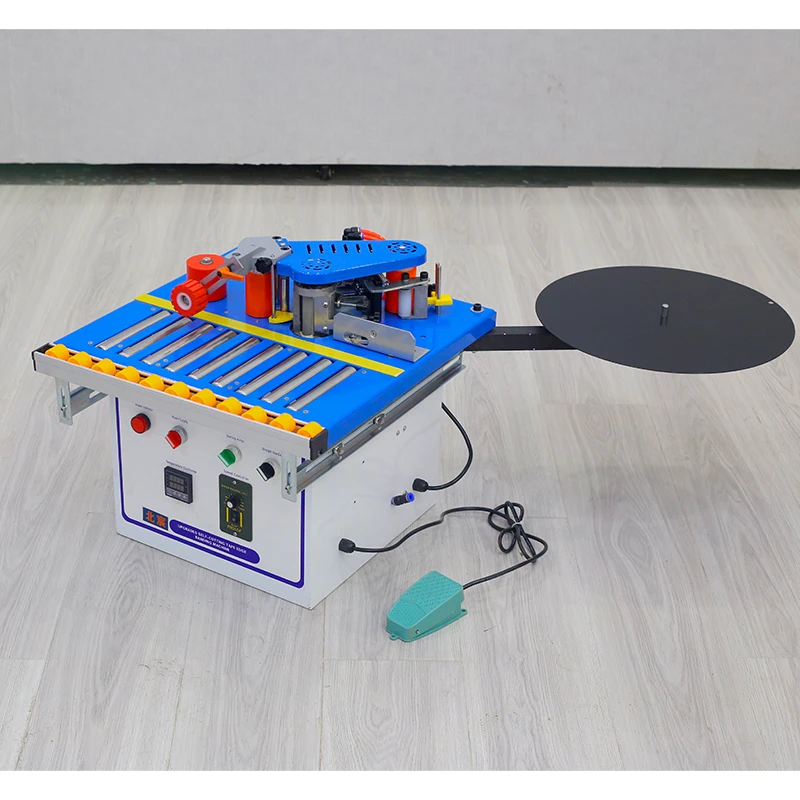
Edge banding machine
Click to enlarge
ISO 9001
CE Certified
OEM / ODM
12-Mo Warranty
Edge banding machine
Compact Handheld Mini Edge Bander for PVC ABS Melamine Tape
<p><strong>ST-70 Handheld Mini Edge Bander, 1000W, 0.3–3mm Tape Thickness, 23kg</strong> — a portable edge banding unit built for workshops moving from manual to machine-assisted finishing.</p> <ul> <li>Handles both curved and straight profiles on MDF, plywood and particleboard with PVC, ABS or melamine tape</li> <li>1000ml glue pot and 0.5–0.8 MPa air supply suit intermittent small-batch and on-site repair workflows</li> <li>Compact 50×50×47cm footprint fits any benchtop, with customizable voltage, plug type and control panel language</li> <li>Backed by four-stage QC with pre-shipment verification and engineer-led configuration support within 24 hours</li> </ul>
100+
Countries
MOQ 1
Unit
15-25 Days
Lead Time
1000W Motor
220V
Edge Banding Machine
Handheld Mini Edge Bander
Process And Application
PVC ABS Melamine Tape
Small Workshop
ST-70
- Full OEM/ODM support -- custom logo, voltage (110V-440V), multilingual panels
- ISO 9001 & CE certified, 5 national patents, 60 professional engineers
- 12-month warranty, remote technical support & spare parts service
- Professional export packaging, customs clearance support, on-time delivery
Portable Footprint, Verified Range — ST-70 covers 0.3–3 mm tape across curved and straight profiles, letting small workshops confirm material fit before the unit ships.
Technical Specifications
| Parameter | Value |
|---|---|
| Model | ST-70 |
| Product Type | Handheld Mini Edge Bander |
| Total Power | 1000 W |
| Voltage | 220V / 380V / customization (frequency and phase to be confirmed) |
| Edge Banding Type | Curved and straight edge banding |
| Minimum Sheet Length | 25 cm |
| Minimum Sheet Width | 3 cm |
| Edge Banding Height Range | 0–50 mm |
| Edge Banding Thickness Range | 0.3–3 mm |
| Edge Trimming Power | 20 W |
| Air Source Pressure | 0.5–0.8 MPa |
| Glue Pot Capacity | 1000 ml |
| Product Dimensions (L×W×H) | 50 × 50 × 47 cm |
| Net Weight | 23 kg |
| Control Panel Language | Chinese, English (customizable to Spanish or other languages) |
| Plug Options | EU, USA, AU, UK |
| Assembly State | Portable / handheld unit |
| Key Features | Single-pass curved and straight banding, benchtop or on-site operation |
Application Suitability
| Application | Material or Output |
|---|---|
| Small workshop cabinet door finishing | MDF and particleboard with PVC tape |
| On-site furniture repair and touch-up | Plywood and ecological board with melamine tape |
| Joinery startup batch production | Solid wood panels with ABS edge banding |
| Custom shelving and countertop edges | Particleboard and MDF with 0.3–3 mm tape |
| Home decoration trim and molding | Plywood panels with PVC or melamine banding |
Why the Glue Temperature Question Should Come Before the Tape Order
Matching hot-melt adhesive to your banding material prevents the most common edge failure in small workshops.
I spent two days at a custom wardrobe factory where ABS tape was peeling off within a week of installation. The Handheld Mini Edge Bander for small workshop use was performing correctly — the problem was the glue pot running at a temperature suited for PVC, not the higher melt point that ABS demands. When you process multiple tape materials on a single unit, confirming the adhesive temperature window against each substrate avoids rework that erodes margins faster than any machine cost difference. [NEED_CITE: hot-melt adhesive temperature curves for PVC, ABS and melamine edge banding]
Material Compatibility Across Thin PVC to Thick ABS
The 0.3–3 mm thickness range on this Handheld Mini Edge Bander for small workshop operations spans the three most common banding materials a joinery startup will encounter. Thin 0.3 mm PVC suits high-volume cabinet carcase edges where cost per meter matters. Thicker ABS at 2–3 mm provides the impact resistance needed for workbench tops and retail fixture edges. Melamine tape in the middle range covers shelving and drawer fronts where color matching to the board surface is the priority.
Curved and Straight Profiles Without Tooling Changes
Workshops handling custom furniture regularly encounter radius cuts on countertop corners and curved shelving profiles. The ST-70 handles both curved and straight edges in a single setup, which eliminates the downtime of swapping fixtures or adjusting feed mechanisms between panel types. This flexibility matters when a single job might include straight wardrobe sides and a curved reception desk top in the same batch. [NEED_CITE: edge banding quality standards for curved panel profiles in custom furniture]
Glue Pot Sizing and Air Supply Reality
A 1000 ml glue pot holds enough adhesive for intermittent small-batch workflows and repair tasks without requiring constant refills mid-panel. For workshops running this unit alongside a compressor, the 0.5–0.8 MPa air requirement aligns with standard pneumatic supply already present in most joinery environments — no dedicated high-pressure line needed. The 1000 W total power draw stays within the capacity of a standard single-phase workshop circuit, avoiding the electrical upgrade costs that larger automatic edge banders demand.
What the Minimum Sheet Dimensions Mean for Your Work
The 25 cm minimum length and 3 cm minimum width define the smallest offcut this unit can process reliably. Narrow drawer sides and small shelf brackets fall within this range, but very short blocks or thin strip material will need manual edge application. Understanding these boundaries before ordering prevents the frustration of discovering your most common panel size sits below the machine’s working envelope.
The Cost of Skipping Voltage Verification
Machines arriving with a fixed voltage configuration that does not match the local supply represent one of the most preventable commissioning failures. A 380V three-phase unit plugged into a 220V single-phase workshop circuit will not start — and the motor damage from repeated attempts voids most warranties. Confirming your workshop supply voltage, frequency, and phase with the supplier before production begins eliminates a problem that otherwise surfaces only when the crate is opened and the machine fails to power on. [NEED_CITE: voltage and frequency standards by export market]
Why Procurement Here Differs
In-house manufacturing with patented cutting mechanisms means tolerance claims on edge trimming are backed by verifiable engineering, not reseller specifications. The full product family from entry-level handheld units to full-function automatic banders allows a workshop to scale throughput without changing supplier relationships or retraining operators on a new control interface. Voltage, control panel language, and plug type customization are treated as standard configuration steps rather than special requests. Four-stage quality control with pre-shipment verification ensures each unit is tested against the buyer’s specified panel thickness and banding material before it leaves the factory. Engineer-led configuration recommendations arrive as formal quotations within one working day, giving buyers documented specifications to compare rather than verbal assurances.
Documentation & Verification
- CE declaration of conformity covering machinery safety requirements
- Electrical schematic confirming your specified voltage and phase configuration
- Factory test record using your panel thickness and banding material combination
- Operation and maintenance manual in the agreed control panel language
- Spare parts list with consumable glue pot components identified
Installation, Commissioning & Support
- Benchtop placement on any stable surface — no floor mounting or foundation work required for the 23 kg unit
- Standard single-phase circuit connection matching your confirmed 220V or customized voltage specification
- Glue pot initial heating and temperature calibration against your chosen PVC, ABS, or melamine tape
- Operator walkthrough of curved and straight banding setup using the confirmed control panel language
- Replacement glue pot elements and edge trimming blades included in the initial spare parts package
- Periodic air filter cleaning on the 0.5–0.8 MPa supply line to maintain consistent banding pressure
Preparing Your Configuration Inquiry
To receive a quotation matched to your workshop, share the banding materials you run most frequently — PVC, ABS, or melamine — along with typical tape thickness. Confirm your local supply voltage, frequency, and plug type so the unit ships ready to connect. If your operators require a specific control panel language beyond English, note this at the inquiry stage to avoid commissioning delays.
Frequently Asked Questions
Q: What edge height and panel thickness can the ST-70 actually handle on my material?
A: The unit covers edge banding heights from 0 to 50 mm and tape thickness from 0.3 to 3 mm, which accommodates standard MDF, particleboard, and plywood panels used in cabinet and furniture production. Minimum sheet dimensions are 25 cm length and 3 cm width. Confirming your specific panel thickness range before ordering ensures the working envelope matches your typical workload.
Q: Will my operator be able to read the control panel at commissioning?
A: The control panel ships in Chinese or English as standard, with customization available for Spanish or other languages by agreement. Specifying the required language at the inquiry stage ensures the unit arrives with an interface your operator can navigate without delay during initial setup and daily production use.
Q: How do I confirm the voltage matches my workshop before ordering?
A: Provide your local supply voltage, frequency, and phase along with the preferred plug type from the EU, USA, AU, or UK options. The unit supports 220V and 380V configurations with further customization available. An electrical schematic confirming the final configuration ships with the documentation package for your electrician to verify before connection.
Q: Which hot-melt glue types work with the 1000 ml pot for different tapes?
A: The glue pot accommodates standard EVA-based hot-melt adhesives used for PVC, ABS, and melamine edge banding tape. The critical variable is temperature — ABS typically requires a higher melt point than PVC. Request the adhesive temperature recommendation for your specific banding material to ensure the pot setting produces a durable bond without scorching.
Q: Can this handheld unit be replaced by a full automatic edge bander as volume grows?
A: The ST-70 serves as an entry point for workshops transitioning from manual banding. As production volume increases, the same supplier range includes full-function automatic edge banders with pre-milling, multi-stage trimming, and higher feed speeds. Starting with a handheld unit from the same product family simplifies the transition when a larger machine is justified by throughput requirements.
Technical Specifications
| Parameter | Value |
|---|---|
| Product Name | Compact Handheld Mini Edge Bander for PVC ABS Melamine Tape |
| Category | Edge banding machine |
| Voltage Options | 110V / 220V / 380V / 440V (customizable) |
| Frequency | 50Hz / 60Hz (customizable) |
| Certification | ISO 9001, CE |
| MOQ | 1 Unit |
| Lead Time | 15-25 Working Days |
| Warranty | 12 Months |
| OEM / ODM | Available -- logo, color, panel language |
* Detailed technical specifications vary by model. Please contact us with your specific requirements for a complete datasheet.
Shipping & Export
-
Export Packaging
Heavy-duty wooden crate with foam padding and moisture protection
-
Shipping Methods
Sea freight (FCL/LCL), air freight, express -- we support all methods
-
Customs Support
Full documentation: CO, commercial invoice, packing list, HS code assistance
-
Port of Loading
Tianjin / Qingdao port, China -- 20 years export experience
OEM / ODM Services
-
Logo & Branding
Custom logo printing, color scheme, and nameplate engraving
-
Voltage Configuration
110V / 220V / 380V / 440V, 50Hz / 60Hz -- any region supported
-
Multilingual Panels
Control panels in English, Spanish, French, Arabic and more
-
Custom Specifications
Modified dimensions, accessories, or feature sets on request
Get a Quote
Request Product Inquiry
Fill in your details and we'll respond within 24 hours with pricing and availability.
Direct Contact
How It Works
-
1
Confirm requirements & budget
Tell us your factory scale and processing needs
-
2
Receive recommendation & quote
We match the right machine with full specs
-
3
Negotiate & place order
OEM terms, voltage, payment and delivery
-
4
Production & QC inspection
Multi-stage quality control by 60 engineers
-
5
Export packaging & shipment
Professional packing, customs clearance
-
6
After-sales support
12-month warranty, remote tech support
You May Also Like