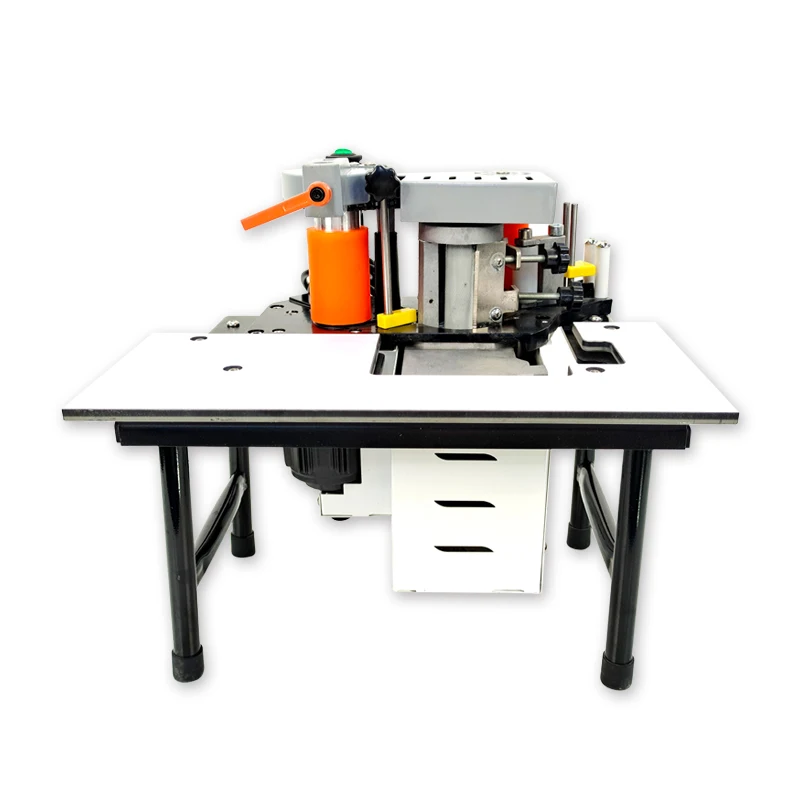
Edge banding machine
Click to enlarge
ISO 9001
CE Certified
OEM / ODM
12-Mo Warranty
Edge banding machine
Compact Portable Edge Banding Machine for Curved and Straight Edges
<p><strong>ST-30 Portable Edge Banding Machine, 1000W, 0.3-3mm Edge Thickness</strong> — processes both straight and curved edges across ABS, PVC, melamine and veneer substrates.</p> <ul> <li>Handles curved and straight edge banding with 0.5-0.8 MPa air pressure for consistent roller contact</li> <li>1000ml glue pot capacity supports continuous batch runs without frequent refills</li> <li>Minimum 25cm sheet length accommodates small offcuts and custom joinery components</li> </ul> <p>Supported by four-stage quality control with pre-shipment verification on your specified substrate and banding material combination.</p>
100+
Countries
MOQ 1
Unit
15-25 Days
Lead Time
220V
Curved Edge Banding
Edge Banding Machine
On-Site Joinery
Portable Edge Banding Machine
Process Application
PVC Edge Banding
ST-30
- Full OEM/ODM support -- custom logo, voltage (110V-440V), multilingual panels
- ISO 9001 & CE certified, 5 national patents, 60 professional engineers
- 12-month warranty, remote technical support & spare parts service
- Professional export packaging, customs clearance support, on-time delivery
Verified Tolerance Capability — Every ST-30 portable edge bander undergoes sample processing on your specific substrate and banding material before shipment, ensuring glue line quality matches your production requirements rather than relying on generic claims.
Technical Specifications
| Parameter | Value |
|---|---|
| Model | ST-30 |
| Product Type | Portable Edge Banding Machine |
| Total Power | 1000W |
| Voltage & Frequency | 220V/380V/customization (frequency 50Hz/60Hz to be confirmed) |
| Edge Banding Height | 0–50 mm |
| Edge Banding Thickness | 0.3–3 mm |
| Minimum Sheet Length | 25 cm |
| Minimum Sheet Width | 3 cm |
| Edge Power | 20W |
| Air Source Pressure | 0.5–0.8 MPa |
| Glue Pot Capacity | 1000 ml |
| Suitable Edge Banding Tape | ABS, PVC, Melamine, Veneer |
| Edge Type | Both straight and curved edges |
| Overall Dimensions (L×W×H) | 38×35×35 cm |
| Net Weight | 12 kg |
| Language Options | Chinese and English standard; Spanish or other languages customizable |
| Plug Options | EU, USA, AU, UK |
| Key Features | Curved and straight edge banding, portable configuration, compact footprint |
| Standards | CE, ISO 9001 |
Application Suitability
| Application | Material or Output |
|---|---|
| Custom furniture workshop short-run production | MDF and particleboard panels with PVC or ABS edge banding |
| On-site interior decoration joinery | Plywood and blockboard fitted cabinetry with veneer edging |
| Small joinery operations transitioning from manual application | Melamine-faced boards requiring consistent glue lines on straight and curved profiles |
| Bespoke curved panel fabrication | Radius cuts in MDF and plywood with ABS or PVC banding up to 3 mm thickness |
| Repair and rework stations in larger factories | Touch-up edge banding on pre-assembled cabinet components |
Why Visible Glue Lines Keep Appearing Despite Machine Claims
Glue line visibility is determined by the interaction between pot temperature, banding thickness, roller pressure, and substrate surface preparation — not by the machine label alone.
I have seen portable edge banders arrive at custom cabinet workshops and produce clean results on straight melamine edges, only to leave white stress marks on curved PVC applications the very next day. The operator assumed the machine was defective. In reality, the glue temperature was set for 0.4 mm PVC but the workshop was running 2 mm ABS on a tight radius, and the air pressure feeding the roller was fluctuating below the minimum threshold. Portable Edge Banding Machine process application requires understanding these variables before the first panel is fed [NEED_CITE: substrate and adhesive compatibility standards for wood panel edge banding].
The ST-30 addresses this through its adjustable glue pot and pressure range, but only if the operator knows which combination to select for each material pairing. That knowledge gap, not the machine itself, is where most edge quality failures originate.
How Banding Material Dictates Your Machine Settings
Each edge banding material behaves differently under heat and pressure. PVC softens at lower temperatures and conforms well to curves but can compress unevenly if roller pressure exceeds what the material can absorb. ABS is more rigid and demands higher glue temperatures to achieve proper wetting on the substrate surface. Veneer requires careful moisture balance — too much heat dries the wood fibers before the adhesive bonds, leaving a brittle edge that chips during trimming.
The 0.3–3 mm thickness range on the ST-30 means you are likely switching between these materials across different jobs, making the Portable Edge Banding Machine process application dependent on operator knowledge as much as mechanical capability.
Substrate Preparation and Its Effect on Bond Integrity
MDF edges are porous and absorb glue rapidly, which can starve the bond line if the application speed is too slow or the glue viscosity too high. Particleboard presents a different challenge: the uneven surface profile created by wood chips means the banding must be pressed firmly enough to push adhesive into the valleys without squeezing it entirely out of the peaks. Plywood edges, particularly on lower-grade sheets, can have voids between laminations that create gaps no amount of roller pressure will close [NEED_CITE: panel edge preparation guidelines for adhesive bonding in furniture manufacturing].
Running a test piece on your actual substrate stock before committing to a production batch eliminates guesswork and reveals whether the selected glue temperature and feed approach will produce an acceptable finish.
What the Specification Sheet Actually Means for Your Workshop
The 1000W total power rating determines how quickly the glue pot reaches operating temperature and how well it maintains that temperature during continuous use. A lower wattage would mean longer warm-up cycles between batches and potential temperature drops when cold banding material enters the pot. The 1000 ml glue pot capacity translates to extended run time before refill is needed — important when you are working through a batch of cabinet doors and cannot afford to stop mid-run for replenishment.
Air source pressure between 0.5 and 0.8 MPa directly controls roller force against the panel edge. Below this range, the banding may not seat fully into the adhesive, creating hollow spots that fail during trimming or in service. Above this range, excessive squeeze-out creates cleanup work and can distort thin PVC or melamine banding. The 0–50 mm edge banding height covers standard panel thicknesses from thin shelving stock up to worktop material, though panels at the upper end of this range will consume more glue per linear meter and require closer monitoring of pot level.
The Cost of Skipping Material-Specific Setup
When a workshop runs multiple banding materials without adjusting settings between jobs, the failures are not always immediate. Some panels pass visual inspection but develop edge lift within weeks as the adhesive bond degrades under humidity and temperature cycling. Curved panels are especially vulnerable: a glue temperature that works on straight edges may not allow sufficient open time for the banding to conform to a radius before the adhesive begins to set [NEED_CITE: adhesive open time and bond degradation in humid environments].
I recall a custom cabinet maker who purchased a portable unit and ran 0.6 mm PVC successfully for weeks, then switched to 2 mm veneer for a curved reception desk project without raising the glue temperature. Every edge developed hairline cracks along the radius within a month. The rework cost far exceeded what a material-specific test run would have required.
Why Sourcing This Machine Here Matters for Your Process
In-house manufacturing with patented cutting mechanisms means the edge trimming function is engineered alongside the banding application, not retrofitted from a generic component. The four-stage quality control process — incoming material, in-process, finished product, and pre-shipment verification — includes functional testing on both straight and curved test pieces with your specified banding material.
Voltage and plug configuration are confirmed before production rather than assumed, so the machine arrives ready to connect to your local supply without adapter workarounds. Engineer-led configuration recommendations ensure the machine you receive matches your actual production mix of materials and panel sizes, not a one-size-fits-all catalog selection. Factory visits are welcomed, allowing you to witness the assembly and testing process directly.
Documentation & Verification
- Factory test record using your specific banding material and panel substrate before dispatch
- CE declaration of conformity covering electrical safety and mechanical guarding requirements
- Operation and maintenance manual in your operator’s preferred language with illustrated setup guides
- Electrical schematic confirming voltage, frequency, and plug type match your site supply
- Spare parts list with part numbers for consumable components like glue pot heaters and pressure rollers
Installation, Commissioning & Support
- Requires stable workbench surface with minimum 40×40 cm clear area to accommodate 38×35×35 cm footprint
- Dedicated electrical circuit rated for 1000W continuous load at your confirmed voltage and frequency
- Air compressor connection capable of sustaining 0.5–0.8 MPa with clean, dry air supply
- Initial commissioning includes glue pot temperature calibration for your primary banding material
- Operator training covers material-specific settings for ABS, PVC, melamine, and veneer banding types
- Recommended spare parts inventory includes replacement heating elements and pressure roller assemblies
What We Need to Configure the Right Setup for Your Workshop
Send us samples of the panel substrates and edge banding materials you use most frequently, along with the typical panel thickness range and whether your work involves straight edges, curves, or both. Confirm your local voltage and frequency supply, preferred control panel language, and plug type. If you have an existing edge trimming or finishing workflow downstream, let us know how the portable unit will integrate with that process so we can recommend compatible feed approaches and material handling sequences.
Frequently Asked Questions
Q: How does banding material affect glue temperature and pressure settings on a portable machine?
A: PVC requires lower temperatures and moderate pressure to avoid compression distortion, while ABS needs higher heat for proper adhesive wetting. Veneer demands careful moisture and temperature balance to prevent fiber drying. Each material within the 0.3–3 mm range has an optimal combination that must be established through test runs on your specific substrate.
Q: What substrate preparation is needed to avoid visible glue lines on MDF and particleboard?
A: MDF edges should be sealed or sized to control glue absorption and prevent bond starvation. Particleboard requires sufficient roller pressure to push adhesive into surface irregularities without complete squeeze-out. Plywood edges need void filling on lower-grade sheets. Running sample pieces on your actual stock reveals the correct preparation approach.
Q: Can the ST-30 maintain consistent edge quality on tight-radius curved panels?
A: The unit processes both curved and straight edges with the same banding path. Tight radii require adequate glue open time for the banding to conform before the adhesive sets. Material thickness matters — thinner PVC conforms more easily than thicker ABS or veneer. Testing on your specific radius profile confirms achievable results.
Q: How does the 1000 ml glue pot capacity affect continuous run time and batch planning?
A: Capacity determines how many linear meters of edge banding can be applied before refill. Thicker banding and wider panel edges consume more adhesive per meter. For batch planning, calculate your total edge length per job against typical consumption rates for your material combination to schedule refill breaks without interrupting production flow.
Q: What air supply setup is required to sustain consistent pressure during operation?
A: The machine requires 0.5–0.8 MPa of clean, dry air delivered through a regulated line. Pressure fluctuations below the minimum cause incomplete banding adhesion, while spikes above the maximum create excessive squeeze-out. A dedicated compressor with adequate tank volume and inline filtration prevents quality variation during extended run sessions.
Technical Specifications
| Parameter | Value |
|---|---|
| Product Name | Compact Portable Edge Banding Machine for Curved and Straight Edges |
| Category | Edge banding machine |
| Voltage Options | 110V / 220V / 380V / 440V (customizable) |
| Frequency | 50Hz / 60Hz (customizable) |
| Certification | ISO 9001, CE |
| MOQ | 1 Unit |
| Lead Time | 15-25 Working Days |
| Warranty | 12 Months |
| OEM / ODM | Available -- logo, color, panel language |
* Detailed technical specifications vary by model. Please contact us with your specific requirements for a complete datasheet.
Shipping & Export
-
Export Packaging
Heavy-duty wooden crate with foam padding and moisture protection
-
Shipping Methods
Sea freight (FCL/LCL), air freight, express -- we support all methods
-
Customs Support
Full documentation: CO, commercial invoice, packing list, HS code assistance
-
Port of Loading
Tianjin / Qingdao port, China -- 20 years export experience
OEM / ODM Services
-
Logo & Branding
Custom logo printing, color scheme, and nameplate engraving
-
Voltage Configuration
110V / 220V / 380V / 440V, 50Hz / 60Hz -- any region supported
-
Multilingual Panels
Control panels in English, Spanish, French, Arabic and more
-
Custom Specifications
Modified dimensions, accessories, or feature sets on request
Get a Quote
Request Product Inquiry
Fill in your details and we'll respond within 24 hours with pricing and availability.
Direct Contact
How It Works
-
1
Confirm requirements & budget
Tell us your factory scale and processing needs
-
2
Receive recommendation & quote
We match the right machine with full specs
-
3
Negotiate & place order
OEM terms, voltage, payment and delivery
-
4
Production & QC inspection
Multi-stage quality control by 60 engineers
-
5
Export packaging & shipment
Professional packing, customs clearance
-
6
After-sales support
12-month warranty, remote tech support
You May Also Like