Edge banding machine
Click to enlarge
ISO 9001
CE Certified
OEM / ODM
12-Mo Warranty
Edge banding machine
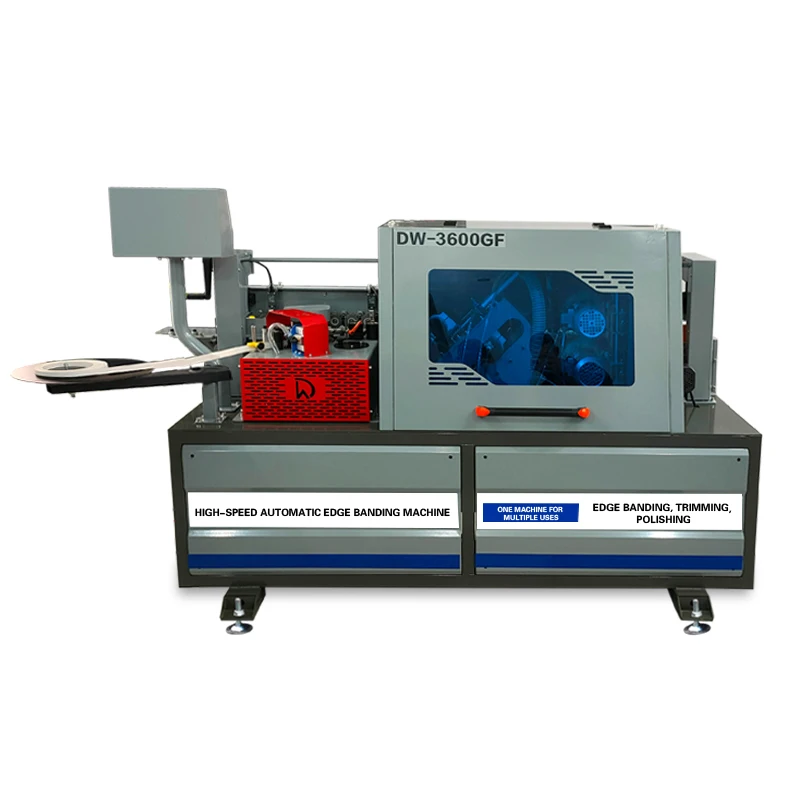
DW-3600GF Pre Milling Edge Banding Machine with 7 Functions for MDF Panel
<p><strong>DW-3600GF Fully Automatic Edge Banding Machine, 380V, 0–14 m/min Feed Speed, 0.3–3 mm Edge Band Thickness</strong> — delivers a seven-function process sequence in a single pass, covering gluing, rough and fine trimming, end trimming, scraping, polishing and vacuuming. Trimming motors run at 24000 r/min to produce chip-free edges on PVC and veneer banding across MDF, particleboard and plywood substrates. Air supply at 0.4–0.6 MPa ensures consistent pneumatic actuation at every station.</p> <ul> <li>Four-stage QC with pre-shipment test records available for your specific substrate and banding combination</li> <li>Voltage, plug type and control panel language confirmed and customized before production</li> <li>Engineer-led configuration proposal with formal quotation within 24 hours</li> </ul>
100+
Countries
MOQ 1
Unit
15-25 Days
Lead Time
380V
DW-3600GF
Edge Banding Machine
Furniture Factory
MDF Panel
Pre-milling
Process And Application
- Full OEM/ODM support -- custom logo, voltage (110V-440V), multilingual panels
- ISO 9001 & CE certified, 5 national patents, 60 professional engineers
- 12-month warranty, remote technical support & spare parts service
- Professional export packaging, customs clearance support, on-time delivery
Verified Tolerance in Production — Proprietary cutting mechanisms on the DW-3600GF maintain ±0.02mm trimming accuracy through all seven edge finishing stages, confirmed by pre-shipment factory test records on your specified panel material.
Technical Specifications
| Parameter | Value |
|---|---|
| Model | DW-3600GF |
| Product Type | Fully Automatic Edge Banding Machine |
| Total Power | 4.9 kW |
| Voltage & Frequency | 380V Three-Phase Four-Wire |
| Overall Dimensions (L×W×H) | 2200×650×1250 mm |
| Net Weight | 320 kg |
| Feed Speed | 0–14 m/min |
| Edge Banding Height Range | 0–50 mm |
| Edge Band Thickness Range | 0.3–3 mm |
| Minimum Panel Length | 200 mm |
| Edge Banding Type | Straight Edge Banding |
| Trimming Motor Power | 800W×2 at 24000 r/min |
| Polishing Motor Power | 400W×2 |
| Transmission Motor Power | 180W |
| Gluing Motor Power | 160W |
| Air Supply Requirement | 0.4–0.6 MPa |
| Standard Functions | Gluing, Rough Trimming, Fine Trimming, Front and Rear End Trimming, Scraping, Polishing, Vacuuming |
| Control Panel Language | Chinese and English standard; other languages available |
| Plug Options | EU, USA, AU, UK |
| Assembly State | Fully assembled |
| Certification | CE, ISO 9001 |
Application Suitability
| Application | Material or Output |
|---|---|
| Custom cabinet door production | MDF and particleboard with PVC edge banding |
| Kitchen and wardrobe panel finishing | Melamine-faced boards with 0.3–3 mm PVC or veneer strips |
| Plywood furniture component banding | Plywood panels with wood veneer edge banding |
| Joinery workshop automation | Solid wood panels transitioning from manual to machine finishing |
| Small-batch mixed-material runs | Alternating MDF, particleboard and plywood within a single shift |
What Inconsistent Glue Lines Reveal About Substrate Behaviour
The edge banding machine process and application outcome depends more on substrate density and ambient humidity than on machine speed alone.
When MDF, particleboard and plywood panels move through the same gluing station, each substrate absorbs heat and adhesive at a different rate. Particleboard with an open surface texture demands a thicker glue film and slower feed speed to achieve full contact, while MDF accepts a thinner, more uniform layer. In high-humidity environments — particularly common in tropical and coastal regions — moisture trapped in the panel core interferes with EVA or PUR adhesive bonding, and the resulting white glue lines only become visible after the trimming and polishing stages are complete. I have seen entire batches of cabinet doors rejected because the machine settings were calibrated for MDF, then applied unchanged to particleboard in a workshop running at 85% relative humidity. The DW-3600GF addresses this through adjustable feed speed and a gluing station with controllable temperature and film thickness, but the operator still needs to match those settings to the substrate on the floor. [NEED_CITE: substrate moisture content standards for edge banding adhesion]
How the Seven-Function Sequence Controls Edge Quality
The edge banding machine process and application sequence on the DW-3600GF completes seven stages in a single pass: gluing, rough trimming, fine trimming, front and rear end trimming, scraping, polishing and vacuuming. Each station is sequenced so that the panel surface is progressively refined — rough trimming removes the bulk of excess banding material at 24000 r/min, fine trimming follows with a lighter cut to eliminate tool marks, and scraping removes any remaining micro-ridges before polishing restores the surface finish. This integrated sequence means the operator loads the panel once and receives a finished edge, eliminating the handling damage and alignment errors that occur when trimming and polishing are performed on separate machines.
Feed Speed as the Primary Quality Variable
The 0–14 m/min adjustable feed speed on this machine is not simply a throughput control — it directly governs how much time the adhesive spends in contact with the substrate before the trimming stations engage. Running at the upper end of the range suits stable substrates like high-density MDF in climate-controlled workshops, where the glue film sets predictably. Dropping to a lower feed speed becomes necessary when processing particleboard with uneven surface porosity or when workshop temperature falls below the adhesive manufacturer’s recommended minimum. The operator’s ability to dial in feed speed per batch, rather than per machine, is what separates consistent edge quality from recurring rework.
What the Trimming Motor Speed Means for Your Panels
The twin 800W trimming motors running at 24000 r/min determine the surface finish achievable on PVC and veneer edge banding materials. Higher rotational speed produces a cleaner shear cut, reducing the chip-out and tear marks that are especially visible on wood veneer and thin PVC strips. The 0.3–3 mm edge band thickness range covers most standard PVC and veneer profiles used in cabinet and furniture production, while the 0–50 mm height range accommodates everything from thin shelf panels to thicker worktop components. Air supply at 0.4–0.6 MPa drives the pneumatic actuation at each trimming and scraping station — maintaining stable pressure across all stations is essential, because a pressure drop at one station creates an inconsistent cut that the downstream polishing stage cannot correct. [NEED_CITE: pneumatic pressure stability requirements for multi-station edge banders]
The Cost of Skipping Substrate-Specific Calibration
When a workshop purchases an edge bander based on function count alone and runs all substrates at identical settings, the failures are rarely immediate. The first week typically produces acceptable results on MDF, masking the problem until the production schedule shifts to particleboard or plywood. Glue lines that appear clean on delivery begin to separate after the panels acclimatise to the installation environment. Trimming cutters wear unevenly when forced through dense substrates at speeds optimised for softer materials, leading to premature tool changes and unplanned downtime. Scraping and polishing stations then compound the issue, because they are finishing an edge that was already poorly bonded at the gluing stage. [NEED_CITE: edge banding adhesion failure modes in furniture assembly]
Why Production Managers Source This Machine Here
In-house manufacturing with patented cutting mechanisms means the trimming accuracy is verified on the production floor, not claimed from a brochure. The full seven-function process is contained within a single product family, so a workshop can move from entry-level to full-function configurations without switching suppliers or retraining operators on a different control interface. Voltage and plug configuration — 380V three-phase with EU, USA, AU or UK plug options — is confirmed before the order enters production, eliminating the risk of a machine arriving with incompatible electrical connections. A four-stage quality control process covers incoming material, in-process assembly, finished product inspection and pre-shipment verification, documented in a factory test record that accompanies every unit. Engineer-led configuration recommendations are provided within 24 hours of an inquiry, based on the specific panel materials and production volumes you describe.
Documentation & Verification
- CE declaration of conformity covering machinery directive compliance for the DW-3600GF
- Factory test record on your specified panel thickness and edge band material before dispatch
- Electrical schematic with confirmed voltage and frequency for your facility supply
- Operation and maintenance manual in the language your operators will use daily
- Spare parts list with trimming cutter and polishing wheel specifications for consumable planning
Installation, Commissioning & Support
- Requires a level floor area of at least 2500×1000 mm to accommodate the 2200×650 mm machine footprint and operator access
- Dedicated 380V three-phase circuit with appropriate breaker rating for the 4.9 kW total power draw
- Arrives fully assembled — no on-site mechanical assembly required, reducing commissioning time
- Pneumatic line connection at 0.4–0.6 MPa must be verified before first panel run to ensure consistent trimming actuation
- Initial feed speed and glue temperature calibration performed on your sample panels during remote or on-site commissioning
- Trimming cutter and polishing wheel replacement intervals documented in the supplied maintenance schedule
What to Include in Your Inquiry
Provide the panel substrates you process most frequently — MDF, particleboard, plywood or a combination — along with the edge banding materials and thicknesses you intend to use. Confirm your facility voltage and frequency, the control panel language your operators need, and whether you require a sample processing test on your own material before committing to a production order. If the DW-3600GF will be integrated into an existing line, share the upstream and downstream equipment specifications so that feed height and throughput can be matched.
Frequently Asked Questions
Q: How does substrate type affect edge banding quality and machine settings?
A: MDF, particleboard and plywood each absorb heat and adhesive differently. Particleboard typically requires a thicker glue film and slower feed speed than MDF to achieve full bonding. The DW-3600GF allows operators to adjust feed speed and glue temperature per batch, but settings must be matched to the substrate density and moisture content present in the workshop.
Q: What edge banding materials are compatible with this machine?
A: The DW-3600GF handles PVC and veneer edge banding in thicknesses from 0.3 to 3 mm. The 24000 r/min trimming motors produce a clean cut on both material types. For veneer banding, operators typically reduce feed speed to prevent tear-out, while PVC can be processed across the full speed range depending on substrate behaviour.
Q: How does feed speed influence edge finish quality?
A: Higher feed speed reduces adhesive open time between the gluing station and the trimming stations, which suits stable substrates in controlled environments. Lower feed speed gives the adhesive more time to penetrate porous surfaces like particleboard, improving bond strength. The 0–14 m/min range on this machine allows operators to find the optimum point for each material combination.
Q: What glue type and temperature are recommended for melamine-faced boards?
A: EVA hot-melt adhesive is standard for straight-edge banding on melamine-faced boards. Glue pot temperature depends on the adhesive manufacturer’s specification, typically within a defined range that the DW-3600GF gluing station can maintain. Always confirm temperature settings against both the adhesive datasheet and the substrate moisture content in your workshop.
Q: How do I verify trimming accuracy before a production run?
A: Request a factory test record showing edge finish results on your specific panel and banding material combination. On delivery, run a small batch of sample panels and inspect the trimmed edges for chip-out, glue line visibility and squareness. The pre-shipment verification process includes a functional test of all seven stations before the machine leaves the factory.
Technical Specifications
| Parameter | Value |
|---|---|
| Product Name | DW-3600GF Pre Milling Edge Banding Machine with 7 Functions for MDF Panel |
| Category | Edge banding machine |
| Voltage Options | 110V / 220V / 380V / 440V (customizable) |
| Frequency | 50Hz / 60Hz (customizable) |
| Certification | ISO 9001, CE |
| MOQ | 1 Unit |
| Lead Time | 15-25 Working Days |
| Warranty | 12 Months |
| OEM / ODM | Available -- logo, color, panel language |
* Detailed technical specifications vary by model. Please contact us with your specific requirements for a complete datasheet.
Shipping & Export
-
Export Packaging
Heavy-duty wooden crate with foam padding and moisture protection
-
Shipping Methods
Sea freight (FCL/LCL), air freight, express -- we support all methods
-
Customs Support
Full documentation: CO, commercial invoice, packing list, HS code assistance
-
Port of Loading
Tianjin / Qingdao port, China -- 20 years export experience
OEM / ODM Services
-
Logo & Branding
Custom logo printing, color scheme, and nameplate engraving
-
Voltage Configuration
110V / 220V / 380V / 440V, 50Hz / 60Hz -- any region supported
-
Multilingual Panels
Control panels in English, Spanish, French, Arabic and more
-
Custom Specifications
Modified dimensions, accessories, or feature sets on request
Get a Quote
Request Product Inquiry
Fill in your details and we'll respond within 24 hours with pricing and availability.
Direct Contact
How It Works
-
1
Confirm requirements & budget
Tell us your factory scale and processing needs
-
2
Receive recommendation & quote
We match the right machine with full specs
-
3
Negotiate & place order
OEM terms, voltage, payment and delivery
-
4
Production & QC inspection
Multi-stage quality control by 60 engineers
-
5
Export packaging & shipment
Professional packing, customs clearance
-
6
After-sales support
12-month warranty, remote tech support
You May Also Like