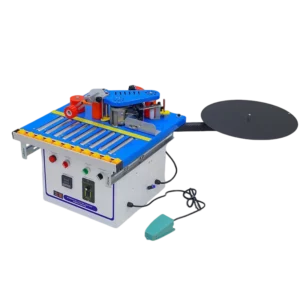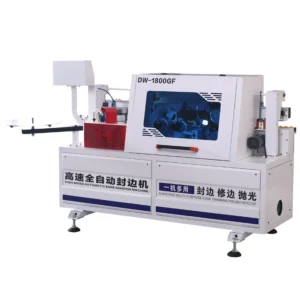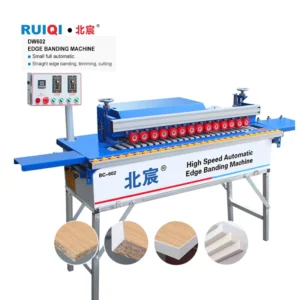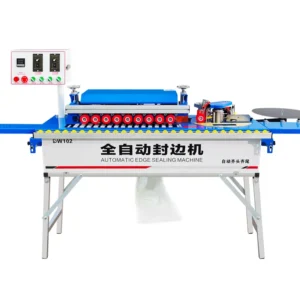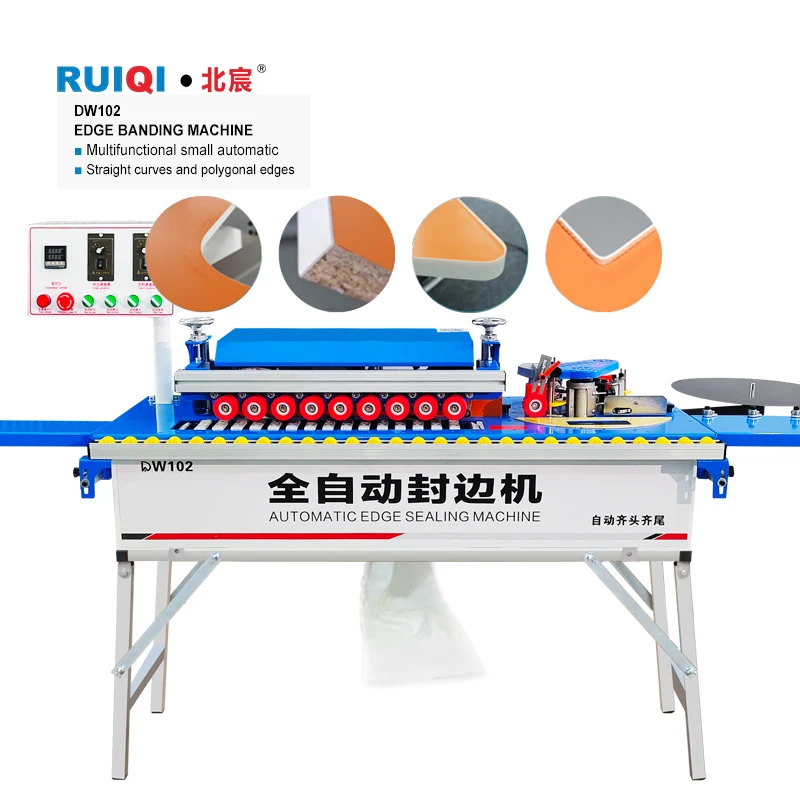
Edge banding machine
Click to enlarge
ISO 9001
CE Certified
OEM / ODM
12-Mo Warranty
Edge banding machine
DW102 Automatic Edge Banding Machine for Wood Panels – Process Guide
<p><strong>DW102 Automatic Edge Banding Machine</strong>, 3800W rated power, PLC control, 0.3–3mm banding thickness — handles both curved and straight edge profiles with automatic head and tail cutting across MDF, plywood and particleboard substrates.</p> <ul> <li>Dual 650W trimming stations deliver clean edge removal, while dual 180W polishing stations ensure smooth, tactile edge finish on visible surfaces</li> <li>1000ml glue pot capacity with vacuum hold-down stabilises panels through the full process sequence, reducing manual rework on shaped components</li> </ul> <p>Supported by engineer-led configuration review, four-stage pre-shipment QC verification, and operation manuals delivered in your team's agreed language.</p>
100+
Countries
MOQ 1
Unit
15-25 Days
Lead Time
DW102
Edge Banding Machine
MDF Panel
PLC Control
Plywood Edge Banding
Process And Application
Vacuum Hold Down
- Full OEM/ODM support -- custom logo, voltage (110V-440V), multilingual panels
- ISO 9001 & CE certified, 5 national patents, 60 professional engineers
- 12-month warranty, remote technical support & spare parts service
- Professional export packaging, customs clearance support, on-time delivery
Verified Process Parameters — every station on the DW102 is mapped to substrate-specific glue behaviour and trimming response, not just a list of functions.
Technical Specifications
| Parameter | Value |
|---|---|
| Model | DW102 |
| Product Type | Automatic Edge Banding Machine |
| Rated Power | 3800W |
| Voltage & Frequency | 220V/380V/customization (basis not stated in source) |
| Control System | PLC (basis not stated in source) |
| Overall Dimensions (L×W×H) | 128×47×69 cm |
| Net Weight | 75 kg |
| Minimum Sheet Length | 25 cm |
| Minimum Sheet Width | 5 cm |
| Edge Banding Height | 0–50 mm |
| Edge Banding Thickness | 0.3–3 mm |
| Edge Feed Power | 20W |
| Transmission Power | 60W |
| Trimming Power | 650W × 2 |
| Polishing Power | 180W × 2 |
| Vacuum Power | 1200W |
| Air Source Pressure | 0.5–0.8 MPa |
| Glue Pot Capacity | 1000 ml |
| Key Features | Curved and straight edge banding, automatic head and tail cutting, edge trimming, polishing, vacuum hold-down |
Application Suitability
| Application | Material or Output |
|---|---|
| Furniture panel edge banding | MDF, particleboard, plywood with PVC or veneer strips |
| Cabinet door and drawer front finishing | Blockboard and solid wood panels up to 50 mm edge height |
| Polymer door production | Polymer substrates with compatible hot-melt adhesives |
| Curved panel edge treatment | Shaped MDF and plywood components requiring contoured trimming |
Why Visible Glue Lines Appear on Some Substrates and Not Others
The edge banding machine woodworking process fails silently when glue temperature and feed pressure are not matched to the substrate density.
I spent years commissioning edge banders across workshops in Southeast Asia and the Middle East. The most common call I got was not about breakdowns — it was about panels coming off the line with visible glue squeeze-out on MDF but starved joints on particleboard [NEED_CITE: substrate density and hot-melt adhesive absorption behaviour]. The root cause is almost always process parameter mismatch. MDF absorbs adhesive differently than particleboard, and plywood’s layered grain structure creates uneven bonding surfaces. When a production manager treats all panels the same on the edge banding machine woodworking process line, the defect rate climbs without any obvious mechanical fault. The operator blames the glue, the maintenance team blames the temperature sensor, and the real issue — uncalibrated pressure and feed rate across stations — goes unaddressed for weeks.
Glue Application and Substrate Interaction
The DW102 uses a 1000 ml glue pot that maintains adhesive at a controlled temperature throughout the run. On MDF, the fine fibre structure draws adhesive into the surface quickly, so the edge banding machine woodworking process requires a slightly lower application temperature to prevent over-penetration. Particleboard, by contrast, has a more open structure that demands consistent pressure to force adhesive into the voids between chips. Plywood presents its own challenge — the cross-grain lamination means glue bonds differently along each veneer layer, making uniform roller pressure essential.
Trimming and Polishing Across the Thickness Range
The dual 650W trimming stations provide cutting force across the full 0.3–3 mm banding thickness range. Thinner PVC strips at 0.3 mm require precise blade alignment to avoid scoring the panel surface, while 3 mm veneer banding demands enough torque to shear cleanly without tearing [NEED_CITE: edge trimming force requirements by banding thickness]. The two 180W polishing stations follow immediately, smoothing the trimmed edge to a tactile finish. On curved panels, the vacuum hold-down system keeps the workpiece stable against the fence, which is where most curved edge defects originate — the panel shifts mid-trim and the blade catches.
Reading the Power Allocation Across Stations
Each motor on the DW102 is sized for a specific process step, and understanding this allocation matters when evaluating whether the machine fits a production sequence. The 1200W vacuum system is the single largest auxiliary load, which tells you the hold-down is designed for continuous duty rather than intermittent clamping. The 60W transmission motor drives the feed chain, and its modest rating reflects a machine built for controlled feed speed rather than high-velocity throughput. The 20W edge feed motor handles banding material delivery independently, allowing fine adjustment of strip tension without affecting the main conveyor. This separation of drives means an operator can correct feed issues at one station without stopping the entire line.
What Happens When Process Stations Are Misconfigured
A workshop running 3 mm solid wood banding on particleboard with the trimming stations set for 0.5 mm PVC will tear the material and leave rough edges that polishing cannot recover. The vacuum hold-down may not compensate if the air supply drops below 0.5 MPa, causing curved panels to drift during trimming [NEED_CITE: pneumatic pressure stability requirements for edge banding accuracy]. These are not machine failures — they are process configuration errors that compound over a production run, surfacing as rework downstream at the assembly bench where panels refuse to seat flush.
Why Sourcing the Process Matters More Than Sourcing a Machine
The DW102 ships fully assembled, which means the process sequence is factory-set and verifiable before it reaches the workshop floor. Voltage is configurable between 220V and 380V, and the control panel language is confirmed before dispatch — I learned the cost of skipping that step when a panel line in the Middle East stalled on day one because the operator could not read the default interface. The PLC system provides station-by-station control, so adjustments to glue temperature or trimming depth are logged and repeatable. Every unit undergoes a four-stage quality check covering incoming components, in-process assembly, finished product testing, and pre-shipment verification with a documented test record.
Documentation & Verification
- CE declaration of conformity matched to the DW102 configuration shipped
- Machine specification sheet with station-by-station power breakdown for the edge banding machine woodworking process
- Electrical schematic confirming voltage and frequency at destination
- Factory test record using the buyer’s specified panel thickness range
- Operation and maintenance manual in the confirmed operator language
- Spare parts list covering trimming blades, polishing wheels, and glue pot components
Installation, Commissioning & Support
- 128×47×69 cm footprint requires a level concrete floor with 80 cm clearance on the infeed side
- 3800W total load needs a dedicated circuit with correct voltage and confirmed frequency before energizing
- Fully assembled delivery means no on-site mechanical assembly — connect power, air, and run verification
- Air source at 0.5–0.8 MPa must be stable; install a regulator and moisture trap upstream of the 1200W vacuum system
- First-run commissioning includes glue pot temperature calibration against the specific adhesive and banding material
- Trimming blade and polishing wheel replacement intervals documented in the operator-language manual
Preparing Your Inquiry
Provide the panel materials you run most frequently — MDF, particleboard, plywood, or a mix — along with the edge banding type and thickness range. Confirm your local voltage and frequency so the electrical system is built correctly before shipping. If curved panels are part of your output, share the minimum radius and sheet dimensions so we can verify feed stability and trimming reach on the DW102 before the order is placed.
Frequently Asked Questions
Q: Which substrate materials does this edge banding process handle, and how does glue behaviour differ across them?
A: The DW102 processes MDF, particleboard, plywood, blockboard, and polymer panels. MDF absorbs adhesive rapidly due to its fine fibre density, requiring lower glue temperature. Particleboard needs higher pressure to fill voids between chips. Plywood’s cross-grain layers create variable bonding surfaces, making consistent roller pressure essential across the edge banding machine woodworking process.
Q: How does the 1000 ml glue pot capacity affect continuous run time before refill?
A: Capacity determines how many linear metres of banding can be completed before the pot needs replenishment. Actual run time depends on banding thickness, adhesive type, and application rate. For high-volume straight-edge runs on standard 0.5 mm PVC, the pot supports sustained processing before a scheduled refill pause.
Q: What edge banding materials and thickness range are compatible with this process sequence?
A: The DW102 accepts PVC, veneer, and compatible polymer banding from 0.3 mm to 3 mm thick, with edge heights up to 50 mm. Thinner materials require precise trimming blade alignment, while thicker veneer demands full torque from the dual 650W stations. The edge banding machine woodworking process handles both straight and curved applications within this range.
Q: How does curved edge banding differ from straight in terms of feed stability and trimming accuracy?
A: Curved panels shift against the fence during processing, which is why the vacuum hold-down system is critical. Without adequate suction, the panel drifts and the trimming blade produces uneven edges. The DW102’s 1200W vacuum and minimum sheet dimensions of 25 cm length by 5 cm width define the practical limits for stable curved edge banding machine woodworking process runs.
Q: What voltage and air supply requirements must be confirmed before installation?
A: The DW102 operates on 220V or 380V with frequency to be confirmed for the destination market. The air supply must deliver stable pressure between 0.5 and 0.8 MPa to support the vacuum hold-down and pneumatic actuators. Voltage and frequency must be verified before production to prevent motor damage and control system faults.
Technical Specifications
| Parameter | Value |
|---|---|
| Product Name | DW102 Automatic Edge Banding Machine for Wood Panels – Process Guide |
| Category | Edge banding machine |
| Voltage Options | 110V / 220V / 380V / 440V (customizable) |
| Frequency | 50Hz / 60Hz (customizable) |
| Certification | ISO 9001, CE |
| MOQ | 1 Unit |
| Lead Time | 15-25 Working Days |
| Warranty | 12 Months |
| OEM / ODM | Available -- logo, color, panel language |
* Detailed technical specifications vary by model. Please contact us with your specific requirements for a complete datasheet.
Shipping & Export
-
Export Packaging
Heavy-duty wooden crate with foam padding and moisture protection
-
Shipping Methods
Sea freight (FCL/LCL), air freight, express -- we support all methods
-
Customs Support
Full documentation: CO, commercial invoice, packing list, HS code assistance
-
Port of Loading
Tianjin / Qingdao port, China -- 20 years export experience
OEM / ODM Services
-
Logo & Branding
Custom logo printing, color scheme, and nameplate engraving
-
Voltage Configuration
110V / 220V / 380V / 440V, 50Hz / 60Hz -- any region supported
-
Multilingual Panels
Control panels in English, Spanish, French, Arabic and more
-
Custom Specifications
Modified dimensions, accessories, or feature sets on request
Get a Quote
Request Product Inquiry
Fill in your details and we'll respond within 24 hours with pricing and availability.
Direct Contact
How It Works
-
1
Confirm requirements & budget
Tell us your factory scale and processing needs
-
2
Receive recommendation & quote
We match the right machine with full specs
-
3
Negotiate & place order
OEM terms, voltage, payment and delivery
-
4
Production & QC inspection
Multi-stage quality control by 60 engineers
-
5
Export packaging & shipment
Professional packing, customs clearance
-
6
After-sales support
12-month warranty, remote tech support
You May Also Like