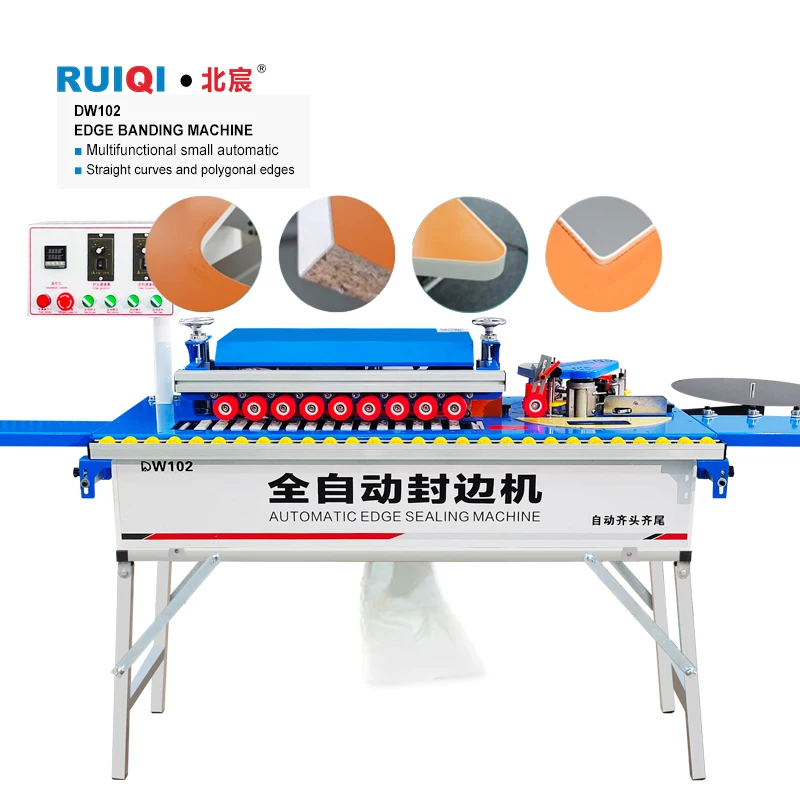
Edge banding machine
Click to enlarge
ISO 9001
CE Certified
OEM / ODM
12-Mo Warranty
Edge banding machine
DW102 Curved Edge Banding Machine for Furniture – Process Guide
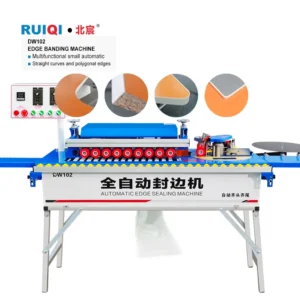
<p><strong>DW102 Curved Edge Banding Machine</strong>, 3800W total power, 0.3–3 mm edge thickness range — designed for consistent straight and curved edge banding on MDF, plywood, and particleboard.</p> <ul> <li>Handles PVC, melamine, and veneer strips with automatic head/tail cutting, dual-side trimming, and polishing stations</li> <li>Vacuum-assisted panel holding stabilizes workpieces during curved profiles; 1000 ml glue pot supports continuous batch runs</li> <li>Air source 0.5–0.8 MPa, minimum sheet 25×5 cm, multilingual control panels available (source value — verify language at order)</li> </ul> <p>Edge quality directly impacts downstream assembly fit — request a factory test record using your actual substrate and edge material before confirming configuration.</p>
100+
Countries
MOQ 1
Unit
15-25 Days
Lead Time
220V 380V
Curved Edge Bander
DW102
Edge Banding Machine
Furniture Factory
MDF Panel
Process Application
Vacuum System
- Full OEM/ODM support -- custom logo, voltage (110V-440V), multilingual panels
- ISO 9001 & CE certified, 5 national patents, 60 professional engineers
- 12-month warranty, remote technical support & spare parts service
- Professional export packaging, customs clearance support, on-time delivery
In-House Manufacturing Depth — Proprietary cutting mechanisms on the DW102 are built and tested in the same facility that handles assembly, meaning tolerance claims can be traced back to the shop floor rather than outsourced claims.
Technical Specifications
| Parameter | Value |
|---|---|
| Model | DW102 |
| Product Type | Automatic Curved and Straight Edge Banding Machine |
| Total Power | 3800W |
| Voltage Options | 220V/380V/customization |
| Edge Banding Thickness Range | 0.3–3 mm |
| Edge Banding Height Range | 0–50 mm |
| Minimum Sheet Dimensions | 25 cm (L) × 5 cm (W) |
| Glue Pot Capacity | 1000 ml |
| Air Source Pressure | 0.5–0.8 MPa |
| Trimming Motors | 650W × 2 |
| Polishing Motors | 180W × 2 |
| Vacuum Motor | 1200W |
| Edge Feed Motor | 20W |
| Transmission Motor | 60W |
| Key Features | Curved and straight edge banding, automatic head and tail cutting, edge trimming, polishing, vacuum hold-down |
| Overall Dimensions (L×W×H) | 128 × 47 × 69 cm |
| Net Weight | 75 kg |
| Language Options | Chinese, English, Spanish, or customized |
| Plug Options | EU, USA, AU, UK |
| Assembly State | Fully assembled, wooden box packed |
Application Suitability
| Application | Material or Output |
|---|---|
| Custom cabinet door fabrication | MDF and particleboard with PVC or melamine edge strips |
| Curved furniture component finishing | Plywood and blockboard with veneer banding on radiused profiles |
| Polymer door panel sealing | Polymer substrates requiring moisture-resistant edge closure |
| Small-batch workshop production | Mixed substrate runs where straight and curved edges appear in the same batch |
Why Glue Temperature Decides Edge Quality Before the Trimmer Ever Touches the Panel
The DW102 edge banding process and application DW102 depends more on thermal management at the glue pot than on downstream trimming force.
I have watched workshops blame the trimmer for rough edges when the real problem was the adhesive cooling too fast before the roller pressed the strip against the substrate. MDF pulls heat differently than plywood, and particleboard with a coarse surface structure demands a thicker glue film at a stable temperature. When the glue pot runs below the adhesive manufacturer’s recommended range, the strip lifts at the leading edge within days of installation [NEED_CITE: adhesive manufacturer technical data sheets for hot melt application temperatures]. The DW102’s 1000 ml glue pot capacity supports continuous runs, but capacity alone does not solve thermal recovery between panels. The operator must set the temperature to match both the strip material and the substrate density, then verify the bond by pulling a test strip after the first five panels.
Substrate Behaviour Across MDF, Plywood, and Particleboard
MDF presents the most uniform surface for hot melt adhesion, and the DW102 edge banding process and application DW102 shows consistent bond lines across medium-density fiberboard runs. Plywood introduces grain variation that creates uneven glue absorption, demanding slightly higher pot temperatures to maintain film thickness on the denser latewood zones. Particleboard is the most demanding of the three because its coarse chip structure requires the adhesive to flow into surface voids before gelling. When switching between these substrates within the same production day, the operator must allow the glue pot to stabilize at the new setpoint before feeding panels.
Trimming Quality on Curved Versus Straight Profiles
Straight runs allow the dual 650W trimming motors to engage at constant feed rate, producing clean flush cuts that need minimal polishing downstream. Curved profiles introduce variable feed geometry where the strip contacts the trimming cutter at changing angles, and this is where the vacuum-assisted hold-down becomes critical. Without adequate vacuum on a tight radius, the panel shifts against the fence just enough to leave a visible witness line on the trimmed edge. The 1200W vacuum motor on this machine provides hold-down force across the 50 mm maximum edge height, but the operator must confirm suction cup placement matches the panel width before starting curved runs [NEED_CITE: vacuum hold-down force requirements for curved edge banding operations].
How the 0.3–3 mm Thickness Range Maps to Material Selection
PVC strips at 0.4 mm thickness feed smoothly through the edge banding process and application DW102 with standard trimmer settings, and the automatic head and tail cutting handles the material without cracking. Real wood veneer at 1.5 mm and above requires reduced feed speed to prevent splitting at the end grain, especially on curved profiles where the veneer must bend around the radius. Melamine paper strips at the thinner end of the range demand precise glue film control because excess adhesive squeezes past the strip edge and hardens on the panel face. The 180W × 2 polishing motors remove residual haze from the panel surface, but they cannot correct a glue line that has already cured into the substrate texture.
The Cost of Ignoring Voltage and Frequency at Quotation Stage
A machine configured for 380V/50Hz will not deliver rated motor performance when connected to a 220V/60Hz supply, and the trimming motors will run hot without reaching full torque. I have seen edge banders of this class arrive in workshops where the electrician had to step up the supply voltage with an external transformer, adding heat and failure points to the power circuit. The DW102 supports 220V/380V and custom configurations, but this must be confirmed before production, not after the crate arrives on the shop floor [NEED_CITE: IEC voltage and frequency standards for industrial woodworking machinery]. A formal voltage confirmation document eliminates this failure mode entirely.
Manufacturing Verification You Can Actually Request
The facility builds the DW102 with patented cutting mechanisms that are ground and inspected in-house, not sourced as assemblies from third parties. Four-stage quality control covers incoming material inspection, in-process checks during assembly, finished product testing, and pre-shipment verification with actual panel runs. Voltage and language customization are configured during production rather than retrofitted, so the control panel arrives in the operator’s working language from the first power-on. The ISO 9001 and CE certified production environment provides documentation traceability from component sourcing through final dispatch. Factory visits are open for buyers who want to see the edge banding process and application DW102 on their own substrate before committing to an order.
Documentation & Verification
- CE declaration of conformity covering the DW102 trimmer and vacuum motor circuits
- ISO 9001 certificate for the manufacturing facility producing this model
- Electrical schematic showing the confirmed voltage and frequency configuration
- Factory test record using your substrate and edge banding material combination
- Operation and maintenance manual in the language specified at order confirmation
- Packing photographs showing the fully assembled unit in wooden crate before dispatch
Installation, Commissioning & Support
- Requires a dedicated circuit matching the confirmed 220V or 380V supply at the rated 3800W total draw
- 0.5–0.8 MPa air supply must be clean and dry to protect the pneumatic actuators on the trimming and cutting stations
- Arrives fully assembled in a wooden crate, requiring only utility connections and fence alignment verification
- First panel run should use scrap material to confirm glue temperature and trimmer depth before processing production stock
- Spare parts list included covers consumable trimming cutters and polishing wheels specific to this model
- Daily maintenance focuses on glue pot residue removal and vacuum filter inspection to maintain hold-down performance
What to Include in Your Inquiry
Provide the primary substrate types you process, the edge banding materials you run most frequently, and your workshop’s available voltage and frequency. Include the minimum and maximum panel dimensions in your typical production mix so the configuration can be matched to your feed geometry. If you are running curved profiles, specify the minimum radius you encounter and whether the curve is convex, concave, or a combination.
Frequently Asked Questions
Q: How does glue temperature affect bond quality on MDF versus plywood substrates?
A: MDF absorbs heat evenly across its uniform fiber structure, allowing standard hot melt setpoints to produce consistent bonds. Plywood varies between earlywood and latewood zones, and the denser zones cool the adhesive faster, requiring a slightly higher pot temperature to maintain film thickness and prevent starved glue lines on the harder grain areas.
Q: Can the DW102 handle both PVC and real wood veneer edge banding without tooling change?
A: The 0.3–3 mm thickness range covers both materials, but real wood veneer typically requires reduced feed speed and adjusted trimmer cutter geometry to prevent end-grain splitting. The machine handles the switch without hardware replacement, though the operator must update the feed rate and confirm trimmer depth for the veneer thickness before starting production.
Q: What edge quality tolerance can I expect on curved profiles versus straight runs?
A: Straight runs produce uniform flush trimming with the dual 650W motors operating at constant geometry. Curved profiles introduce variable cutter engagement angles, and the final edge quality depends on vacuum hold-down stability and feed speed control through the radius. Tight radii demand slower feed to maintain trimming accuracy.
Q: How do I select the right adhesive for my substrate and edge material combination?
A: Adhesive selection depends on the substrate surface structure, the edge strip material, and the operating temperature range of your workshop environment. Request a factory test record using your specific substrate and strip combination, and cross-reference the results with your adhesive supplier’s technical data sheet for the recommended application temperature window.
Q: Does the vacuum system require a separate compressor, and what air pressure is needed for reliable panel holding?
A: The DW102 includes an integrated 1200W vacuum motor for panel hold-down, separate from the pneumatic air supply that powers the trimming and cutting actuators. The pneumatic system requires 0.5–0.8 MPa clean dry air from an external compressor, while the vacuum system operates independently to secure the panel during curved edge processing.
Technical Specifications
| Parameter | Value |
|---|---|
| Product Name | DW102 Curved Edge Banding Machine for Furniture – Process Guide |
| Category | Edge banding machine |
| Voltage Options | 110V / 220V / 380V / 440V (customizable) |
| Frequency | 50Hz / 60Hz (customizable) |
| Certification | ISO 9001, CE |
| MOQ | 1 Unit |
| Lead Time | 15-25 Working Days |
| Warranty | 12 Months |
| OEM / ODM | Available -- logo, color, panel language |
* Detailed technical specifications vary by model. Please contact us with your specific requirements for a complete datasheet.
Shipping & Export
-
Export Packaging
Heavy-duty wooden crate with foam padding and moisture protection
-
Shipping Methods
Sea freight (FCL/LCL), air freight, express -- we support all methods
-
Customs Support
Full documentation: CO, commercial invoice, packing list, HS code assistance
-
Port of Loading
Tianjin / Qingdao port, China -- 20 years export experience
OEM / ODM Services
-
Logo & Branding
Custom logo printing, color scheme, and nameplate engraving
-
Voltage Configuration
110V / 220V / 380V / 440V, 50Hz / 60Hz -- any region supported
-
Multilingual Panels
Control panels in English, Spanish, French, Arabic and more
-
Custom Specifications
Modified dimensions, accessories, or feature sets on request
Get a Quote
Request Product Inquiry
Fill in your details and we'll respond within 24 hours with pricing and availability.
Direct Contact
How It Works
-
1
Confirm requirements & budget
Tell us your factory scale and processing needs
-
2
Receive recommendation & quote
We match the right machine with full specs
-
3
Negotiate & place order
OEM terms, voltage, payment and delivery
-
4
Production & QC inspection
Multi-stage quality control by 60 engineers
-
5
Export packaging & shipment
Professional packing, customs clearance
-
6
After-sales support
12-month warranty, remote tech support
You May Also Like