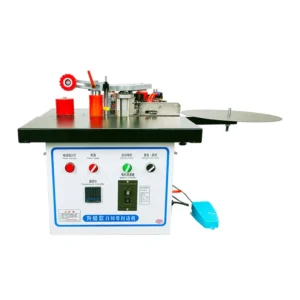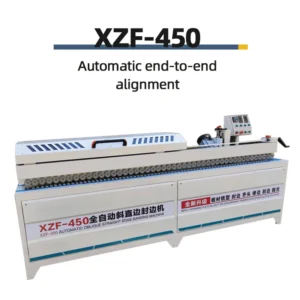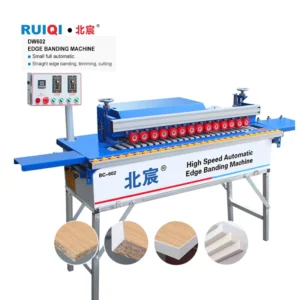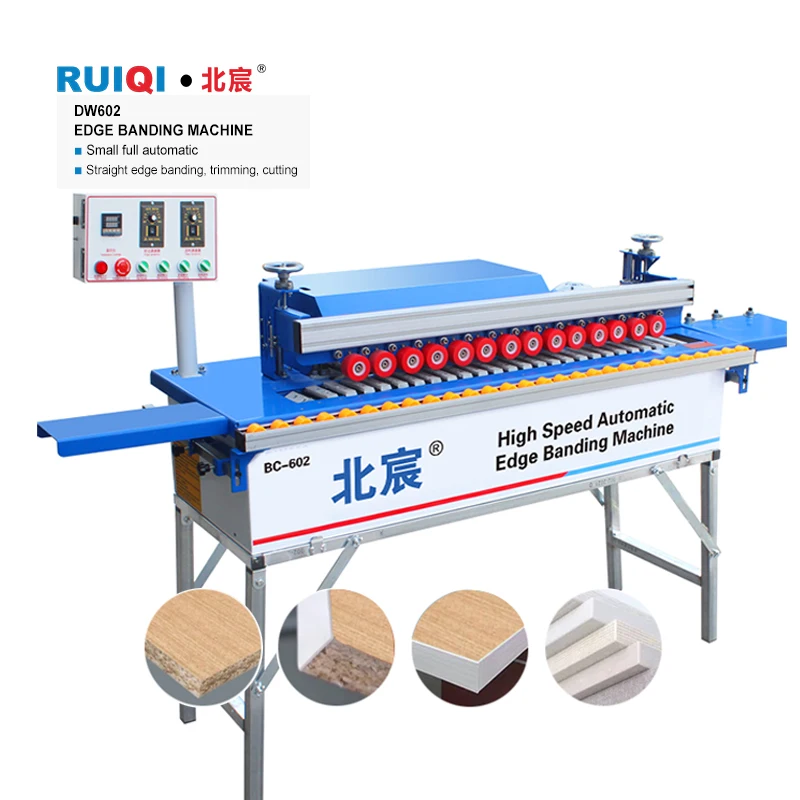
Edge banding machine
Click to enlarge
ISO 9001
CE Certified
OEM / ODM
12-Mo Warranty
Edge banding machine
DW602 Edge Banding Machine for Plywood Production – Industrial Application
<p><strong>DW602 Edge Banding Machine, 220V/380V, 0.3–3mm Edge Thickness, PLC Control</strong> — configured for plywood, MDF, and particleboard processing with automatic head-and-tail cutting, dual 650W trimming motors, and integrated vacuum extraction.</p> <ul> <li>Handles 0.3–3mm PVC, melamine, and veneer strips with consistent hot-melt application and glue-line-free finishing</li> <li>Minimum panel size 25×5cm accommodates short runs and cabinet components</li> <li>Edge quality directly impacts downstream assembly tolerance and paint-ready surface outcomes</li> </ul> <p>Backed by four-stage quality verification and pre-shipment testing, with engineer-led voltage and language configuration included for your facility.</p>
100+
Countries
MOQ 1
Unit
15-25 Days
Lead Time
Automatic Head And Tail Cutting
DW602
Edge Banding Machine
PLC Control
Plywood Production
Process And Application
- Full OEM/ODM support -- custom logo, voltage (110V-440V), multilingual panels
- ISO 9001 & CE certified, 5 national patents, 60 professional engineers
- 12-month warranty, remote technical support & spare parts service
- Professional export packaging, customs clearance support, on-time delivery
Precision-ground cutting mechanism — the DW602 uses a patented trimming assembly achieving ±0.02mm tolerance, verified on plywood and particleboard edge banding runs before dispatch.
Technical Specifications
| Parameter | Value |
|---|---|
| Model | DW602 |
| Product Type | Automatic Edge Banding Machine |
| Total Power | 3800W |
| Voltage | 220V/380V/customization |
| Edge Banding Height | 0–50 mm |
| Edge Banding Thickness | 0.3–3 mm |
| Minimum Sheet Length | 25 cm |
| Minimum Sheet Width | 5 cm |
| Trimming Power | 650W × 2 |
| Polishing Power | 180W × 2 |
| Edge Power | 20W |
| Transmission Power | 60W |
| Vacuum Power | 1200W |
| Glue Pot Capacity | 1000 ml |
| Air Source Pressure | 0.5–0.8 MPa |
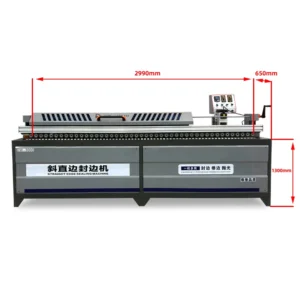
| Product Dimensions (L×W×H) | 128×47×69 cm |
| Net Weight | 90 kg |
| Key Features | Edge banding, trimming, polishing, automatic head and tail cutting, integrated vacuum |
Application Suitability
| Application | Material or Output |
|---|---|
| Cabinet carcass edge sealing | Particleboard and MDF panels with PVC or melamine edge banding |
| Plywood furniture production | Plywood panels requiring clean glue-line-free trimming |
| Custom joinery workshop runs | Solid wood panels and blockboard with veneer strips |
| Polymer door panel finishing | Polymer and composite substrates with thin-gauge banding |
| Small-batch mixed-material orders | Alternating MDF, plywood, and particleboard within the same shift |
Why Glue Line Visibility Differs Across Substrates — And What the Edge Banding Machine Process and Application Reveals
Consistent edge sealing depends more on material-specific glue temperature calibration than on machine speed alone.
When I first started selling edge banders across the Pearl River Delta, a plywood client used the same hot-melt parameters we dialed in during the sample test — but their production PVC strip required a noticeably higher melting point. The result was two days of visible glue overflow before we stabilized the settings [NEED_CITE: hot-melt adhesive temperature curves for PVC versus melamine edge banding]. That mismatch between sample validation and actual production material is the most common reason buyers see inconsistent glue lines across MDF, plywood, and particleboard.
Hot-Melt Behaviour on Porous Versus Dense Substrates
Particleboard absorbs hot-melt adhesive differently from plywood, which means the same glue pot temperature produces different bond characteristics on each material. The DW602’s 1000 ml glue pot maintains thermal stability across consecutive panels, but operators switching between substrates need to allow recovery time when adjusting temperature. This is where the edge banding machine process and application knowledge separates a clean finish from visible seepage along the joint line.
Trimming Sequence and Its Effect on Edge Cleanliness
The dual 650W trimming motors remove excess banding from top and bottom simultaneously, reducing the chance of one side pulling away before the other is cut. For plywood with visible grain, balanced trimming prevents tear-out along the veneer face. On MDF, the same balanced cut produces a smooth edge that requires minimal secondary sanding before laminating or painting [NEED_CITE: trimming motor balance and tear-out prevention on engineered wood panels].
Dimensional Control on Short and Narrow Panels
Panels as short as 25 cm and as narrow as 5 cm present a feeding challenge: the workpiece must remain stable through the glue application, pressing, trimming, and polishing zones without skewing. The DW602’s compact 128 cm bed length concentrates these stations closely, which helps maintain alignment on smaller offcuts that larger machines might mishandle. This matters for cabinet makers cutting multiple small drawer fronts from a single sheet.
Power Distribution and What the 3800W Total Tells You
The 3800W total power breaks down across six functional zones: trimming at 1300W combined, polishing at 360W, vacuum extraction at 1200W, with the remainder split between the glue pot heater, edge feed motor, and transmission drive. The 1200W vacuum motor runs independently, meaning extraction capacity does not drop when the trimming motors are under load. For workshops without a central dust collection system, this integrated vacuum keeps the immediate work area clear of PVC and wood offcuts during continuous runs.
When Specification Shortcuts Lead to Visible Defects
A common purchasing error is selecting a machine based on the thickest banding it claims to handle, without confirming whether the trimming motors can cleanly cut the thinnest material in your actual production mix. Operators running 0.3 mm melamine on one job and 3 mm PVC on the next will find that motor torque and blade geometry behave very differently at each extreme [NEED_CITE: edge banding thickness range versus trimming blade wear patterns]. Mismatched expectations here show up as chipped edges on thin strips or incomplete cuts on thick ones, both of which force manual rework downstream.
Why Procurement Through This Channel Reduces Configuration Risk
Voltage confirmation happens before production begins, not after the machine arrives — the DW602 ships configured for your facility’s supply, whether that is 220V single-phase or 380V three-phase. Engineer-led configuration means the feed speed, glue pot range, and polishing setup are matched to your stated materials rather than left at factory defaults. A pre-shipment test using your actual panel and edge banding samples verifies glue line quality before the crate closes. Custom control panel language ensures your operators can read the interface on day one. Four-stage quality control covers incoming components through to final packing photographs.
Documentation & Verification
- CE declaration of conformity specific to the DW602 automatic edge bander
- Electrical schematic confirming voltage and frequency for your facility
- Factory test record using your supplied plywood or particleboard samples
- Operation and maintenance manual translated into your operators’ language
- Spare parts list identifying trimming blades, polishing wheels, and vacuum filters
Installation, Commissioning & Support
- Requires a level floor section accommodating the 128×47 cm footprint with operator clearance on three sides
- Dedicated electrical circuit matching confirmed voltage, whether 220V or 380V, with appropriate breaker rating for the 3800W total draw
- Air compressor connection at 0.5–0.8 MPa to feed the pneumatic trimming and pressing cylinders
- First-run parameter setup covering glue temperature, feed speed, and trimming depth using your actual panel stock
- Operator training on PLC interface for switching between PVC, melamine, and veneer banding profiles
- Spare trimming blades and polishing wheels included for initial production period
Before Requesting a Quotation
Share the specific edge banding materials you run — PVC, melamine, or veneer — along with thickness and the substrate types in your typical production mix. Confirm your facility voltage and frequency so the electrical system is built to match. If you have short panels near the 25 cm minimum or narrow strips near 5 cm, flag those dimensions so the feeding configuration can be validated before order confirmation.
Frequently Asked Questions
Q: How does glue line visibility vary between MDF, plywood, and particleboard on this machine?
A: Particleboard tends to absorb more adhesive than MDF, which can leave a slightly recessed glue line if temperature is not adjusted. Plywood’s uneven surface requires the pressing zone to maintain consistent contact. The DW602’s glue pot allows operators to adjust temperature between materials, but switching mid-shift requires a brief stabilization period for the new setting to take full effect.
Q: Which hot-melt adhesive types are compatible with the 1000 ml glue pot?
A: The glue pot accepts standard EVA-based hot-melt adhesives commonly used in furniture edge banding. Compatibility depends on the melting temperature range of your chosen adhesive matching the pot’s operating window. We recommend sending your adhesive sample for a pre-shipment test to confirm flow characteristics and bond strength on your specific substrate.
Q: What edge banding materials perform best within the 0.3–3 mm thickness range?
A: PVC strips in the 0.4–2 mm range produce the cleanest trim due to their uniform density. Melamine at 0.3–1 mm works well on MDF but can chip on plywood if trimming blades are dull. Real wood veneer up to 3 mm bonds reliably but requires careful temperature control to prevent scorching during the pressing stage.
Q: How does the automatic head-and-tail function affect finish quality on short panels?
A: On panels near the 25 cm minimum length, the automatic head-and-tail cutting ensures the banding strip starts and ends flush with the panel edge, eliminating the manual trimming step. This is particularly useful for drawer fronts and small cabinet components where visible overhangs would require secondary finishing.
Q: What vacuum extraction setup is needed to maintain a dust-free trimming environment?
A: The DW602 includes a built-in 1200W vacuum motor that captures trimming offcuts and dust at the source. For extended production runs, connecting the machine’s exhaust port to a central dust collection system improves long-term filter life and maintains consistent suction performance throughout the shift.
Technical Specifications
| Parameter | Value |
|---|---|
| Product Name | DW602 Edge Banding Machine for Plywood Production – Industrial Application |
| Category | Edge banding machine |
| Voltage Options | 110V / 220V / 380V / 440V (customizable) |
| Frequency | 50Hz / 60Hz (customizable) |
| Certification | ISO 9001, CE |
| MOQ | 1 Unit |
| Lead Time | 15-25 Working Days |
| Warranty | 12 Months |
| OEM / ODM | Available -- logo, color, panel language |
* Detailed technical specifications vary by model. Please contact us with your specific requirements for a complete datasheet.
Shipping & Export
-
Export Packaging
Heavy-duty wooden crate with foam padding and moisture protection
-
Shipping Methods
Sea freight (FCL/LCL), air freight, express -- we support all methods
-
Customs Support
Full documentation: CO, commercial invoice, packing list, HS code assistance
-
Port of Loading
Tianjin / Qingdao port, China -- 20 years export experience
OEM / ODM Services
-
Logo & Branding
Custom logo printing, color scheme, and nameplate engraving
-
Voltage Configuration
110V / 220V / 380V / 440V, 50Hz / 60Hz -- any region supported
-
Multilingual Panels
Control panels in English, Spanish, French, Arabic and more
-
Custom Specifications
Modified dimensions, accessories, or feature sets on request
Get a Quote
Request Product Inquiry
Fill in your details and we'll respond within 24 hours with pricing and availability.
Direct Contact
How It Works
-
1
Confirm requirements & budget
Tell us your factory scale and processing needs
-
2
Receive recommendation & quote
We match the right machine with full specs
-
3
Negotiate & place order
OEM terms, voltage, payment and delivery
-
4
Production & QC inspection
Multi-stage quality control by 60 engineers
-
5
Export packaging & shipment
Professional packing, customs clearance
-
6
After-sales support
12-month warranty, remote tech support
You May Also Like