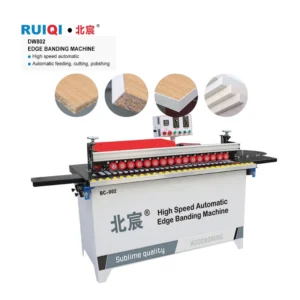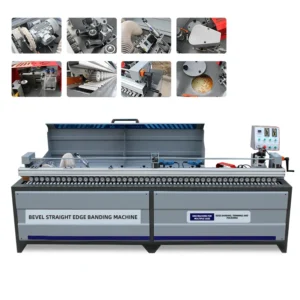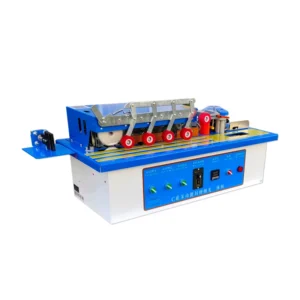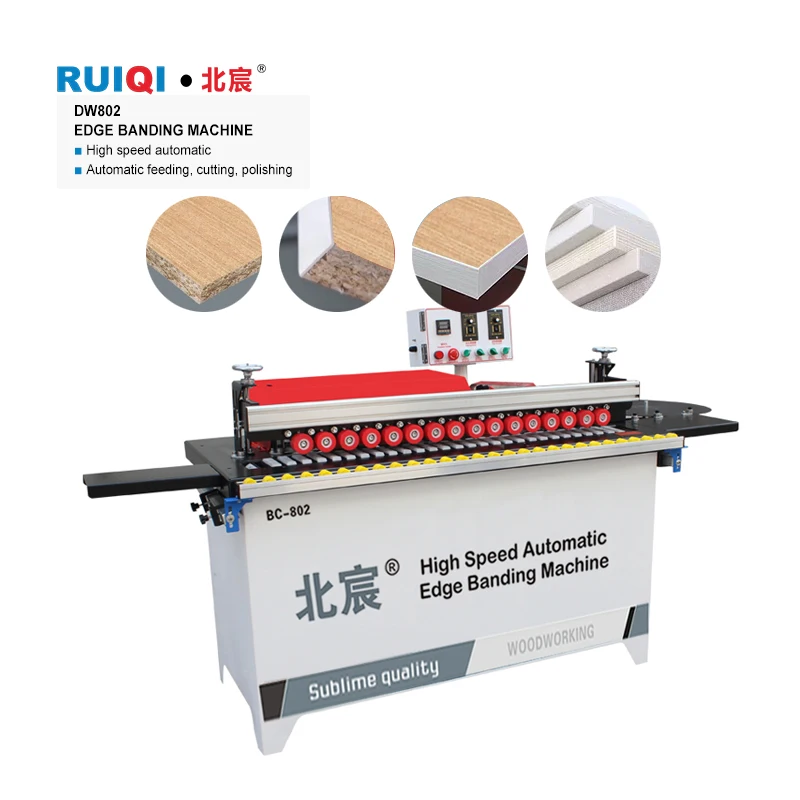
Edge banding machine
Click to enlarge
ISO 9001
CE Certified
OEM / ODM
12-Mo Warranty
Edge banding machine
DW802 Curved Edge Banding Machine for MDF Plywood – Technical Guide
<p><strong>DW802 Curved Edge Banding Machine, 4200W, 0.3-3mm Banding Thickness</strong> — handles MDF, plywood, and particleboard with consistent glue application and clean trimming. Dual 800W trimming motors deliver precise edge finishing across varying substrate densities, while the 4000ml glue pot supports continuous processing. PLC control manages temperature and feed parameters for different hot melt adhesives.</p> <ul> <li>Edge banding height: 0-50mm</li> <li>Minimum sheet: 25cm × 10cm</li> <li>Integrated vacuum extraction for dust-free operation</li> <li>Voltage options: 220V/380V/custom</li> </ul> <p>Four-stage quality verification ensures tolerance compliance, with factory test records available for your specific material requirements.</p>
100+
Countries
MOQ 1
Unit
15-25 Days
Lead Time
Custom Furniture
DW802
Edge Banding Machine
Edge Sealing Process
MDF Plywood
PLC Control
Vacuum System
- Full OEM/ODM support -- custom logo, voltage (110V-440V), multilingual panels
- ISO 9001 & CE certified, 5 national patents, 60 professional engineers
- 12-month warranty, remote technical support & spare parts service
- Professional export packaging, customs clearance support, on-time delivery
Voltage-flexible edge sealing — DW802 configurable from 220V to 380V ensures the machine matches your workshop’s actual power supply before it leaves the factory.
Technical Specifications
| Parameter | Value |
|---|---|
| Model | DW802 |
| Product Type | Edge Banding Machine |
| Total Power | 4200W |
| Voltage | 220V / 380V / customization |
| Edge Banding Height | 0–50 mm |
| Edge Banding Thickness | 0.3–3 mm |
| Minimum Sheet Length | 25 cm |
| Minimum Sheet Width | 10 cm |
| Glue Pot Capacity | 4000 ml |
| Trimming Power | 800W × 2 |
| Polishing Power | 180W × 2 |
| Vacuum Power | 1200W |
| Edge Feed Power | 140W |
| Transmission Power | 140W |
| Air Source Pressure | 0.4–0.8 MPa |
| Control System | PLC components (source value — verify against manufacturer catalog) |
| Product Size | 130 × 60 × 95 cm |
| Product Weight | 135 kg |
| Key Features | Automatic head and tail cutting, integrated vacuum extraction, edge banding, trimming, polishing |
| Assembly State | Factory-made |
| Certification | CE (machine level), ISO 9001 (company level) |
Application Suitability
| Application | Material or Output |
|---|---|
| Cabinet door edge sealing | MDF and particleboard panels with PVC or melamine banding |
| Drawer front finishing | Plywood and ecological board with veneer edge banding |
| Custom furniture production | Solid wood panels requiring clean trimmed edges |
| Small workshop batch runs | Mixed substrate panels in home decoration manufacturing |
Why Substrate Changes Everything About Edge Banding Machine Process Application
The same glue temperature that bonds perfectly to MDF will fail on plywood if feed speed and pot settings stay unchanged.
I have watched furniture factories run into trouble because they tested on one board type and then switched to another without adjusting parameters. The glue cools differently on plywood’s layered surface compared to the uniform density of MDF, and particleboard absorbs heat at its own rate. A workshop processing multiple substrates on the same shift needs a machine where the operator understands how to dial in each material. The DW802 edge banding machine process application requires this kind of attention to detail at every changeover [NEED_CITE: substrate thermal conductivity differences in wood panel edge sealing].
Glue Behavior Across Substrate Types
The 4000 ml glue pot on the DW802 holds enough adhesive for extended runs, but capacity alone does not solve substrate variation. MDF presents a smooth, consistent surface that allows hot melt to spread evenly at standard temperatures. Plywood, with its alternating grain layers, creates micro-channels where adhesive can pool or starve depending on the feed direction. When I visit workshops running mixed materials, I always ask to see their scrap pile — delamination patterns tell you immediately which substrate was running when the operator forgot to adjust. The edge banding machine process application on the DW802 demands that operators understand this relationship before they commit to a production run.
Trimming Finish and Edge Quality Consistency
Dual 800W trimming motors handle the range from thin 0.3 mm PVC up to 3 mm veneer, but the result on the panel edge depends heavily on how well the banding bonded in the first place. Plywood edges tend to be rougher than MDF after trimming because the alternating grain layers resist the cutter differently. A clean trim on MDF does not guarantee the same finish on plywood at identical feed settings [NEED_CITE: wood grain orientation effect on trimming cutter engagement]. The integrated vacuum extraction at 1200W pulls dust away from the polishing zone, keeping the final surface clear for inspection.
What the Numbers Mean for Your Production Floor
The 0.4–0.8 MPa air pressure range drives the pneumatic actuators for head and tail cutting, which must fire precisely as each panel enters and exits. If your workshop compressor cannot sustain the lower threshold consistently, the automatic cutting will stutter and leave overhanging banding. The 140W transmission motor controls feed speed, which directly interacts with glue open time — slower feed on dense substrates allows more adhesive contact, while faster feed on porous materials risks cold joints. The 0–50 mm edge banding height covers standard cabinet panel thicknesses, and the 25 cm minimum sheet length means small offcuts from nesting operations can still be processed through this machine. Understanding these parameter relationships prevents the kind of edge failures that only show up when the assembled cabinet gets shipped to a customer [NEED_CITE: hot melt adhesive open time versus ambient workshop temperature].
What Happens When Configuration Gets Ignored
A furniture factory I worked with ordered an edge bander without confirming their local three-phase supply, and the machine arrived wired for a voltage they did not have. Production stalled for weeks while they sourced a transformer. Another workshop bought a machine with a small glue pot and found themselves stopping every few panels to refill, which let the remaining adhesive cool and form lumps. When operators skip the substrate-specific test run and assume one setting covers all materials, the trimming station reveals the truth — poorly bonded banding tears away instead of cutting clean. These problems are not machine defects; they are configuration oversights that could have been caught before the order was placed [NEED_CITE: electrical supply verification before industrial equipment dispatch].
Why Source This Machine Through Our Process
Voltage confirmation happens before production starts, not after the crate arrives at your dock — the DW802 ships with an electrical schematic matching your confirmed supply. The four-stage quality control process covers incoming material inspection through pre-shipment testing, so the machine you receive has been run on actual panel stock. Patented cutting mechanisms in the trimming station hold tolerance that you can verify on your own substrate samples during the factory test. Engineer-led configuration means the specification you get accounts for your actual materials, not a generic catalog entry. Factory visits allow you to watch your own boards run through the machine before you sign off on the order.
Documentation & Verification
- CE declaration of conformity covering the DW802 machine safety requirements
- Machine specification sheet confirming trimming power and voltage configuration
- Electrical schematic matching your confirmed local voltage and frequency
- Factory test record showing edge banding quality on your specific substrate samples
- Operation and maintenance manual in your agreed language with spare parts list
- Packing photographs documenting machine condition before crate sealing
Installation, Commissioning & Support
- Power supply must match confirmed 220V or 380V configuration with dedicated circuit for the 4200W total draw
- Compressed air line capable of sustaining 0.4–0.8 MPa at the machine inlet for reliable pneumatic actuator function
- Machine arrives factory-assembled at 135 kg, requiring level floor placement within the 130 × 60 cm footprint
- First-run commissioning includes glue pot temperature calibration on your actual panel and banding material samples
- Operator training covers substrate-specific feed speed and temperature adjustment across MDF, plywood, and particleboard
- Spare parts list identifies consumable trimmer blades and polishing wheels for routine replacement intervals
What We Need From You to Configure Correctly
Send us the exact substrate types and thicknesses you plan to process, along with the edge banding materials — PVC, veneer, or melamine — and their thickness range. Confirm your workshop voltage and frequency so the DW802 ships wired correctly from day one. If you have existing upstream cutting or downstream boring equipment, share the feed heights and panel dimensions so we can verify compatibility through the line.
Frequently Asked Questions
Q: How does substrate material affect glue temperature and feed speed on this machine?
A: MDF’s uniform density allows standard hot melt temperatures with consistent spread. Plywood’s layered grain requires higher glue temperature or slower feed speed to ensure adhesive penetrates the surface variation. Particleboard absorbs heat quickly, sometimes needing a slightly richer glue application. On the DW802, operators adjust pot temperature and the 140W transmission feed rate for each substrate changeover.
Q: What edge banding materials work within the 0.3–3 mm thickness range?
A: PVC banding at 0.4–2 mm is the most common for cabinet work. Real wood veneer typically runs at 0.5–3 mm and requires careful temperature control to prevent scorching. Melamine banding sits at the thinner end around 0.3–1 mm. The DW802 glue pot and feed system handle all three, but each material needs its own temperature and speed setting verified on sample panels.
Q: How can I verify trimming accuracy before committing to production volumes?
A: Request a factory test using your own substrate and banding samples. The DW802 dual 800W trimming motors should leave a clean edge with no visible glue line and no banding overhang. Inspect the trimmed edge under good lighting across multiple panels — consistency from the first piece to the tenth tells you the machine holds its settings. Pre-shipment test records document this verification.
Q: What glue pot temperature range should I expect for different hot melt adhesives?
A: Standard EVA hot melt for PVC banding typically runs between 180–210°C. Higher-temperature PUR adhesives may exceed this range and require pot compatibility confirmation. Veneer banding often needs the upper end of EVA temperature to ensure proper bond on wood grain surfaces. Confirm your adhesive supplier’s recommended application temperature before setting the DW802 glue pot.
Q: How does the vacuum system integrate with workshop dust collection?
A: The DW802 has an integrated 1200W vacuum that captures trimming and polishing dust at the source. If your workshop has a central dust extraction system, the machine’s vacuum can supplement it or operate independently. The key is ensuring the extraction path stays clear — clogged filters reduce suction and let fine particles settle on the freshly polished edge surface.
Technical Specifications
| Parameter | Value |
|---|---|
| Product Name | DW802 Curved Edge Banding Machine for MDF Plywood – Technical Guide |
| Category | Edge banding machine |
| Voltage Options | 110V / 220V / 380V / 440V (customizable) |
| Frequency | 50Hz / 60Hz (customizable) |
| Certification | ISO 9001, CE |
| MOQ | 1 Unit |
| Lead Time | 15-25 Working Days |
| Warranty | 12 Months |
| OEM / ODM | Available -- logo, color, panel language |
* Detailed technical specifications vary by model. Please contact us with your specific requirements for a complete datasheet.
Shipping & Export
-
Export Packaging
Heavy-duty wooden crate with foam padding and moisture protection
-
Shipping Methods
Sea freight (FCL/LCL), air freight, express -- we support all methods
-
Customs Support
Full documentation: CO, commercial invoice, packing list, HS code assistance
-
Port of Loading
Tianjin / Qingdao port, China -- 20 years export experience
OEM / ODM Services
-
Logo & Branding
Custom logo printing, color scheme, and nameplate engraving
-
Voltage Configuration
110V / 220V / 380V / 440V, 50Hz / 60Hz -- any region supported
-
Multilingual Panels
Control panels in English, Spanish, French, Arabic and more
-
Custom Specifications
Modified dimensions, accessories, or feature sets on request
Get a Quote
Request Product Inquiry
Fill in your details and we'll respond within 24 hours with pricing and availability.
Direct Contact
How It Works
-
1
Confirm requirements & budget
Tell us your factory scale and processing needs
-
2
Receive recommendation & quote
We match the right machine with full specs
-
3
Negotiate & place order
OEM terms, voltage, payment and delivery
-
4
Production & QC inspection
Multi-stage quality control by 60 engineers
-
5
Export packaging & shipment
Professional packing, customs clearance
-
6
After-sales support
12-month warranty, remote tech support
You May Also Like