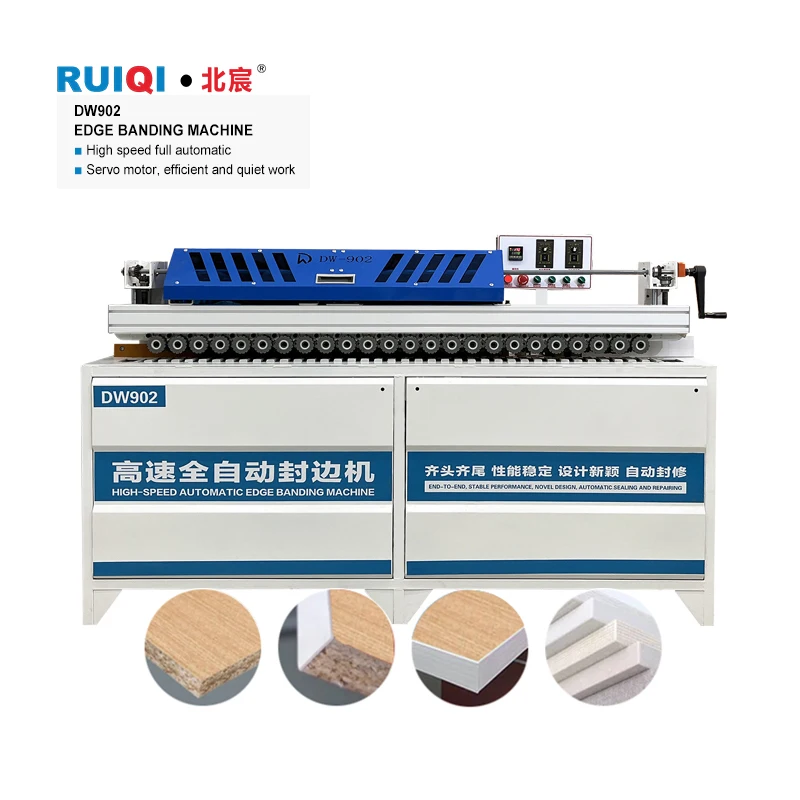
Edge banding machine
Click to enlarge
ISO 9001
CE Certified
OEM / ODM
12-Mo Warranty
Edge banding machine
DW902 Edge Banding Machine for Furniture – Process and Application Guide
<p>Supported by four-stage QC with pre-shipment verification, engineer-led configuration within 24 hours, and voltage customisation from 110V to 440V confirmed before production.</p>
100+
Countries
MOQ 1
Unit
15-25 Days
Lead Time
380V
Automatic Edge Banding
DW902
Edge Banding Machine
Furniture Factory
Process Application
PVC Edge Banding
- Full OEM/ODM support -- custom logo, voltage (110V-440V), multilingual panels
- ISO 9001 & CE certified, 5 national patents, 60 professional engineers
- 12-month warranty, remote technical support & spare parts service
- Professional export packaging, customs clearance support, on-time delivery
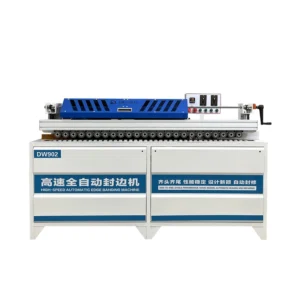
Precision-ground finishing stations — the DW902 sequences trimming, scraping and polishing in one pass to control edge quality across mixed substrate batches.
Technical Specifications
| Parameter | Value |
|---|---|
| Model | DW902 |
| Product Type | Automatic Edge Banding Machine |
| Total Power | 4000W |
| Voltage & Frequency | 220V/380V/customization (frequency to be confirmed) |
| Overall Dimensions (L×W×H) | 175×87×112 cm |
| Net Weight | 240 kg |
| Minimum Sheet Size | 25 cm (L) × 10 cm (W) |
| Edge Banding Height | Up to 5 cm |
| Edge Banding Thickness | 0.3–3 mm |
| Feed Motor Power | 140W |
| Transmission Motor Power | 140W |
| Trimming Motor Power / Speed | 800W × 2 / 24000 r/min |
| Polishing Motor Power | 380W × 2 |
| Glue Pot Capacity | 4000 ml |
| Vacuum Power | 550W |
| Air Source Pressure | 0.5–0.8 MPa |
| Machine Function | 90-degree straight and oblique dual-purpose edge banding |
| Design Features | Double hot air design, feeding auxiliary slide plate, 4 groups of oblique pressure wheels, double row pressing wheels |
| Standard Functions | Edge banding, trimming, polishing, automatic trimming, scraping, vacuuming |
| Language Options | Chinese and English standard; Spanish and other languages customizable |
| Plug Options | EU, USA, AU, UK |
| Standards | ISO 9001, CE (machine-level certification to be confirmed) |
Application Suitability
| Application | Material or Output |
|---|---|
| Cabinet carcase edge banding | MDF and particleboard with PVC edge banding (0.3–3 mm) |
| Custom furniture panel finishing | Plywood and ecological board with veneer or PVC banding |
| Home decoration fit-out components | Solid wood board panels down to 25 cm × 10 cm |
| Mixed-substrate batch production | MDF, particleboard, plywood, ecological board in sequence |
| 90-degree straight and oblique edges | Furniture and cabinet components requiring dual-angle finishing |
Why the Substrate Question Changes the Entire Edge Banding Process
The DW902 addresses visible glue lines on porous substrates through a double hot air system and a multi-stage finishing sequence that treats MDF, particleboard and plywood as fundamentally different materials.
A production manager ordering a woodworking edge banding machine process application setup often specifies the machine by its feed speed and motor count, then discovers on the first shift that particleboard absorbs glue unevenly while MDF edges swell under the same temperature profile. The glue pot reads the same setting, but the edge result diverges panel by panel. I have seen workshops in Bogotá lose an entire morning’s output because the operator assumed one glue temperature would carry across a mixed batch of carcase panels and shelving stock. [NEED_CITE: substrate porosity and glue adhesion behaviour in wood panel processing]
How Substrate Density Shapes Pressure and Glue Behaviour
Particleboard cores are porous and compressible. When the DW902’s four groups of oblique pressure wheels engage a particleboard edge, the distributed contact area prevents localized compression that would otherwise create uneven glue squeeze-out. MDF, by contrast, presents a denser and more uniform edge surface, requiring the double hot air design to maintain consistent glue activation across the full bonding zone. The woodworking edge banding machine process application outcome depends as much on how pressure meets the substrate as it does on the glue itself.
Trimming, Scraping and Polishing as a Substrate-Specific Sequence
Each finishing station responds differently to the material passing through. The twin 800W trimming motors running at 24000 r/min cut PVC and veneer banding flush against the panel edge, but chip-out risk varies with panel core density — plywood cross-grain layers demand different cutter engagement than homogeneous MDF. The scraping station removes residual adhesive film that polishing alone cannot address, and on veneer banding this step becomes critical to avoid sanding through the thin wood layer during polishing. [NEED_CITE: edge trimming chip-out mechanisms on composite wood panels]
Reading the Specifications Through a Process Lens
The 4000 ml glue pot capacity supports sustained production runs without frequent refill interruptions, which matters when a batch includes both straight 90-degree and oblique edge profiles that require continuous glue flow. The 0.3–3 mm banding thickness range covers PVC for high-wear cabinet edges and thin veneer for visible furniture faces, but the operator must adjust scraping pressure between the two. The minimum sheet size of 25 cm × 10 cm indicates the feeding auxiliary slide plate and double row pressing wheels maintain workpiece stability even on narrow offcut pieces common in custom joinery. Air source pressure between 0.5 and 0.8 MPa drives the pneumatic pressure wheel engagement, and any fluctuation in shop air supply will appear as variation in edge bond consistency before it appears as a machine fault.
The Cost of Skipping the Substrate Test Run
I have watched a commissioning stall in Medellín when the production team fed plywood panels through a machine configured and tested only on MDF at the factory. The trimming cutters chipped the plywood face veneer at the same speed setting that produced clean edges on MDF, and the scraping station left streaks on the cross-grain surface that required manual sanding to correct. Three shifts were lost before the operator adjusted trimming depth and polishing pressure for the plywood profile. [NEED_CITE: commissioning failures from unverified substrate-machine configuration]
A second recurring issue involves language settings on the control interface. When the panel displays parameters in a language the operator cannot read, the glue temperature and pressure wheel adjustments become guesswork. The DW902 ships with Chinese and English as standard, with Spanish and other languages available on request — but this must be specified before the machine leaves the factory, not discovered during installation.
Why Production Managers Source This Configuration Here
The DW902’s dual-purpose straight and oblique capability means a workshop processing both cabinet carcases and angled furniture components does not need two separate machines occupying floor space. In-house manufacturing with proprietary cutting mechanisms ensures the trimming stations are calibrated to the stated 24000 r/min specification, not assembled from mismatched third-party components. Four-stage quality control covering incoming material, in-process checks, finished product inspection and pre-shipment verification means the machine arrives with documented test records rather than relying on the buyer to discover faults during commissioning. Voltage confirmation between 220V and 380V with frequency matching prevents the scenario where a machine arrives wired for a supply standard that does not exist in the buyer’s facility. Engineer-led configuration recommendation means the pressure wheel setup, glue pot specification and language pack are matched to the buyer’s substrate mix and operator profile before production begins.
Documentation & Verification
- Factory test record using your specific MDF or particleboard substrate before dispatch
- Electrical schematic confirming voltage, frequency and plug type for your facility
- Operation and maintenance manual in the language specified on your purchase order
- Spare parts list identifying trimming cutters, polishing wheels and pressure wheel assemblies
- CE declaration of conformity and ISO 9001 certificate for import clearance
- Packing photographs documenting machine condition prior to crating
Installation, Commissioning & Support
- 175×87×112 cm footprint requires level floor with clearance for panel infeed and outfeed zones
- 4000W total power draw requires dedicated circuit matching confirmed voltage (220V/380V)
- 0.5–0.8 MPa air supply must be clean and dry to protect pneumatic pressure wheel cylinders
- First-run calibration of trimming depth and polishing pressure against your actual panel stock
- Operator training on glue pot refill procedure and 4000 ml capacity monitoring intervals
- Consumable replacement schedule for 24000 r/min trimming cutters and 380W polishing wheels
Before You Request a Quotation
To configure the DW902 for your production environment, we need to know the substrate types in your typical batch mix — MDF, particleboard, plywood or a combination — along with the edge banding material and thickness you run most frequently. Confirm your facility voltage and frequency so the electrical system is built to match, and specify the control panel language your operators will read on the shop floor. If you are processing panels near the 25 cm × 10 cm minimum, share your smallest standard workpiece dimensions so we can verify feeding stability during the pre-shipment test.
Frequently Asked Questions
Q: How does substrate type affect glue temperature and pressure settings on the DW902?
A: Particleboard absorbs heat and glue differently than MDF due to its porous core structure. The DW902’s double hot air design allows the operator to maintain consistent glue activation across both materials, but pressure wheel engagement and glue pot temperature must be adjusted between substrate changes. Factory test records on your actual stock confirm the correct settings before the machine ships.
Q: What banding materials work within the 0.3–3 mm thickness range?
A: PVC banding at the thicker end of the range suits high-wear cabinet and furniture edges, while thin veneer at 0.3–0.5 mm serves visible decorative surfaces. Each material responds differently during trimming and scraping — veneer requires lighter scraping pressure to avoid surface damage. The DW902’s trimming and scraping stations accommodate both with operator-adjustable depth settings.
Q: How does the double hot air design affect glue activation on porous substrates?
A: Porous substrates like particleboard draw heat away from the glue film faster than dense MDF does. The double hot air system on the DW902 compensates by maintaining consistent thermal input across the bonding zone, reducing the risk of cold glue joints on the trailing edge of longer panels. This is verified during pre-shipment testing on your specified substrate.
Q: What chip-out risk exists at 24000 r/min trimming speed on plywood?
A: Plywood cross-grain layers create intermittent fibre direction changes that increase chip-out risk compared to homogeneous MDF. The DW902’s 800W twin trimming motors provide sufficient torque to maintain cutter speed through these transitions, but trimming depth must be set shallower on plywood than on MDF to prevent face veneer tear-out. A sample test on your plywood stock confirms the correct setting.
Q: How does the 25 cm × 10 cm minimum panel size affect feeding stability?
A: Small workpieces have less surface contact with the feeding auxiliary slide plate and double row pressing wheels, which can cause lateral drift during the banding and trimming sequence. The DW902’s four groups of oblique pressure wheels distribute contact across the narrow edge to maintain alignment, but panels near minimum size should be fed with consistent orientation and grain direction for best results.
Technical Specifications
| Parameter | Value |
|---|---|
| Product Name | DW902 Edge Banding Machine for Furniture – Process and Application Guide |
| Category | Edge banding machine |
| Voltage Options | 110V / 220V / 380V / 440V (customizable) |
| Frequency | 50Hz / 60Hz (customizable) |
| Certification | ISO 9001, CE |
| MOQ | 1 Unit |
| Lead Time | 15-25 Working Days |
| Warranty | 12 Months |
| OEM / ODM | Available -- logo, color, panel language |
* Detailed technical specifications vary by model. Please contact us with your specific requirements for a complete datasheet.
Shipping & Export
-
Export Packaging
Heavy-duty wooden crate with foam padding and moisture protection
-
Shipping Methods
Sea freight (FCL/LCL), air freight, express -- we support all methods
-
Customs Support
Full documentation: CO, commercial invoice, packing list, HS code assistance
-
Port of Loading
Tianjin / Qingdao port, China -- 20 years export experience
OEM / ODM Services
-
Logo & Branding
Custom logo printing, color scheme, and nameplate engraving
-
Voltage Configuration
110V / 220V / 380V / 440V, 50Hz / 60Hz -- any region supported
-
Multilingual Panels
Control panels in English, Spanish, French, Arabic and more
-
Custom Specifications
Modified dimensions, accessories, or feature sets on request
Get a Quote
Request Product Inquiry
Fill in your details and we'll respond within 24 hours with pricing and availability.
Direct Contact
How It Works
-
1
Confirm requirements & budget
Tell us your factory scale and processing needs
-
2
Receive recommendation & quote
We match the right machine with full specs
-
3
Negotiate & place order
OEM terms, voltage, payment and delivery
-
4
Production & QC inspection
Multi-stage quality control by 60 engineers
-
5
Export packaging & shipment
Professional packing, customs clearance
-
6
After-sales support
12-month warranty, remote tech support
You May Also Like