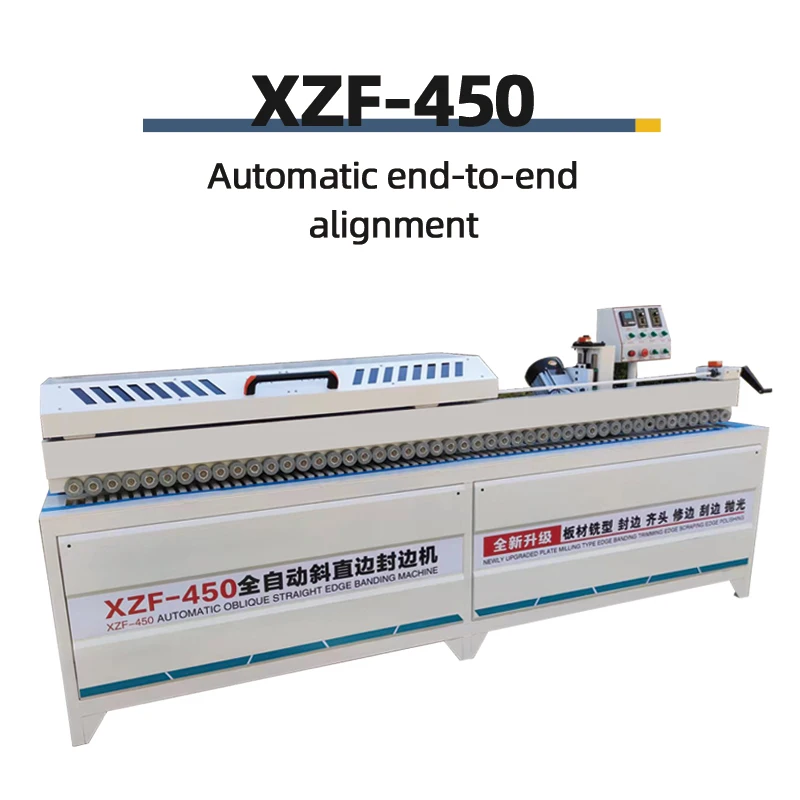
Edge banding machine
Click to enlarge
ISO 9001
CE Certified
OEM / ODM
12-Mo Warranty
Edge banding machine
Edge Banding Machine with Pre-milling for Furniture Production
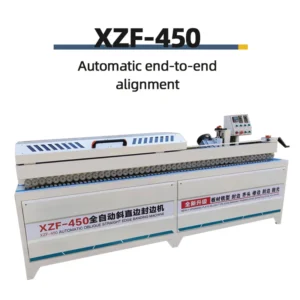
<p><strong>XZF450 Full-Automatic Edge Banding Machine with Pre-milling, 9.5 kW, 0–12 m/min Feed Speed</strong> — engineered for MDF, plywood, and particleboard edge finishing in cabinet and furniture production.</p> <ul> <li>4 kW pre-milling station prepares panel edges before glue application, reducing visible glue lines on porous substrates</li> <li>30°/45°/60° multi-angle banding capability alongside standard 90° straight edge for diverse joint designs</li> <li>Dual trimming motors (2.2 kW × 2) and dual polishing motors (0.4 kW × 2) deliver consistent edge quality in a single pass</li> <li>Variable feed speed allows process tuning for different substrate densities and edge band thicknesses (0.3–3 mm)</li> </ul> <p>The XZF450 addresses edge banding quality inconsistency through a 7-function workflow — from pre-milling through polishing — producing smooth, sealed edges across multiple panel materials for custom cabinet and furniture manufacturing.</p> <p>Factory test records with your target substrate available upon request, voltage confirmation (380V/415V) documented before shipment, and control panel language specified at order stage to ensure immediate commissioning.</p>
100+
Countries
MOQ 1
Unit
15-25 Days
Lead Time
380V
Edge Banding Machine
Furniture Factory
MDF Panel
Pre-milling
Process And Application
XZF450
- Full OEM/ODM support -- custom logo, voltage (110V-440V), multilingual panels
- ISO 9001 & CE certified, 5 national patents, 60 professional engineers
- 12-month warranty, remote technical support & spare parts service
- Professional export packaging, customs clearance support, on-time delivery
Engineer-Configured Process Parameters — Pre-milling, multi-angle banding, and dual-finishing stages validated against MDF, plywood, and particleboard substrates before the edge banding machine process and application workflow is finalized for your production line.
Technical Specifications
| Parameter | Value |
|---|---|
| Model | XZF450 |
| Product Type | Full-Automatic Edge Banding Machine with Pre-milling |
| Total Installed Power | 9.5 kW |
| Operating Voltage | 380V / 415V |
| Feed Speed Range | 0–12 m/min |
| Pre-milling Motor Rating | 4 kW |
| Trimming Power | 2.2 kW × 2 |
| Polishing Power | 0.4 kW × 2 |
| Glue Pot Capacity | 4000 ml |
| Edge Banding Height Range | 0–50 mm |
| Edge Banding Thickness Range | 0.3–3 mm |
| Minimum Sheet Length | 30 cm |
| Minimum Sheet Width | 15 cm |
| Air Source Pressure | 0.5–0.7 MPa |
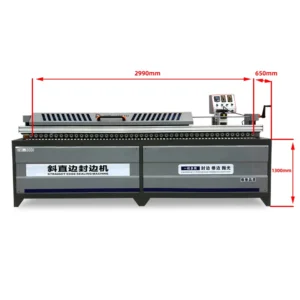
| Overall Dimensions | 300 × 65 × 135 cm |
| Net Weight | 430 kg |
Application Suitability
| Application | Material or Output |
|---|---|
| Custom Cabinet Panel Production | MDF, Melamine-faced board, Particleboard |
| Plywood Furniture Manufacturing | Plywood with veneer or PVC edge banding |
| Polymer and Composite Door Edging | Polymer panels, Blockboard, Solid wood board |
Why Substrate Density Changes the Edge Banding Machine Process and Application
The same machine settings that produce invisible glue lines on standard MDF will often leave visible seams on high-resin particleboard unless the pre-milling depth and feed speed are adjusted to match.
When I spent years on the assembly floor here in Shandong and later moved into technical support, I saw this mismatch repeatedly. A customer would receive a machine tested on our standard-density boards, run their own high-glue-content panels through it, and find the edges separating within days [NEED_CITE: substrate density and resin content variance in panel manufacturing]. The pre-milling station on this model addresses that problem by removing a thin layer of the panel edge before glue application, exposing a fresh, uniform surface for adhesion.
Pre-Milling and Its Role in Edge Quality
The 4 kW pre-milling motor is the first working station the panel encounters. It removes material from the sawn edge to eliminate micro-chipping and surface irregularities left by the panel saw. For porous substrates like MDF and particleboard, this step is where the edge banding machine process and application either succeeds or fails — a poorly prepared edge absorbs glue unevenly, leaving starved spots that show up as visible seams after trimming.
Multi-Angle Banding and Downstream Assembly
Beyond standard 90° straight edges, this machine handles 30°, 45°, and 60° bevel banding in the same pass sequence. Cabinet makers producing angled carcases or display furniture use these functions to band mitered joints before assembly, avoiding the secondary hand-finishing step that un-banded miters otherwise require [NEED_CITE: multi-angle edge banding requirements in custom joinery]. The dual trimming motors at 2.2 kW each manage the increased cutting load that angled profiles impose.
Reading the Specifications Against Your Production Needs
Feed speed variability from 0 to 12 m/min is not just a throughput number — it directly governs how much dwell time the glue has to set before the trimming station engages. Thicker banding materials in the upper end of the 0.3–3 mm range need slower feed speeds to allow adequate heat transfer from the glue pot, which holds 4000 ml to sustain longer runs without interruption. The 550 W vacuum system pulls dust and trimmings away at each station; if your workshop runs fine MDF dust all day, that extraction capacity keeps the polishing wheels from loading up and scoring the band surface.
The Cost of Skipping the Sample Panel Test
Buying an edge bander without running your actual production material through it is one of the most common causes of early commissioning failure. Operators spend the first weeks chasing parameter combinations — adjusting glue temperature, slowing feed speed, re-tensioning the pressure beam — while output piles up in the rework area [NEED_CITE: commissioning delays from untested substrate-machine parameter mismatch]. The visible glue lines that appear on high-resin boards are rarely a machine defect; they are a parameter gap that a pre-shipment sample run would have closed.
Manufacturing Depth Behind This Configuration
The pre-milling and trimming stations on the XZF450 use proprietary cutting mechanisms developed in-house, with precision-ground components inspected through a four-stage quality protocol covering incoming material, in-process assembly, finished product, and pre-shipment verification. Voltage is configurable between 380V and 415V, and the control panel language — standard in Chinese and English — can be specified to match your operator’s working language at order stage. A full electrical schematic accompanies every unit so your local electrician can verify circuit requirements before the machine arrives.
Documentation & Verification
- Factory test record run on your specified panel thickness and substrate type before dispatch
- Electrical schematic confirming voltage, frequency, and circuit breaker rating for your facility
- Operation and maintenance manual in the control panel language you select at order
- CE declaration of conformity for machinery directive compliance in export markets
- Spare parts list with part numbers matching the trimming and polishing consumables on your unit
Installation, Commissioning & Support
- Requires a level concrete floor supporting 430 kg net weight plus dynamic feed load across the 300 cm machine length
- Dedicated 380V/415V three-phase circuit sized for 9.5 kW total draw with appropriate breaker rating
- Air supply line delivering 0.5–0.7 MPa clean, dry compressed air to the pneumatic pressure beam
- Initial parameter calibration for your substrate density and banding thickness range during commissioning
- Operator training covering glue pot refill intervals based on the 4000 ml capacity and your daily throughput
- Wear parts guidance for trimming cutters and polishing wheels under your specific material mix
Planning Your Inquiry
To configure the right setup, share the substrate types and panel thicknesses you run most often, along with the edge banding materials and thickness range your product line requires. Let us know your local voltage and frequency, and the preferred control panel language for your operators. If your production involves angled joints or non-standard profiles, note the angles and quantities so the tooling package can be prepared before your machine ships.
Frequently Asked Questions
Q: How does pre-milling change edge quality on MDF compared to plywood?
A: MDF edges are porous and absorb glue unevenly, so the 4 kW pre-milling station removes the damaged saw-cut surface to expose uniform fibers. Plywood edges have alternating grain layers that can chip during sawing; pre-milling cleans those micro-fractures. Both substrates show noticeably reduced glue lines after pre-milling, but plywood typically requires a slightly deeper cut due to its laminated structure.
Q: Which glue types work within the 0.3–3 mm banding thickness range?
A: Standard EVA hot-melt adhesives cover most PVC and melamine banding within this range. For thicker wood veneer banding approaching 3 mm, higher-temperature EVA formulations improve penetration. The 4000 ml glue pot maintains stable temperature across the feed speed range, and PUR glue systems can be discussed if your production requires moisture-resistant bonds for humid environments.
Q: What feed speeds suit different panel thicknesses?
A: Thinner panels in the 10–18 mm range typically run at higher feed speeds since less glue penetration depth is needed. Heavier panels above 25 mm, especially with thick veneer banding, benefit from reduced feed speed to allow full heat transfer from the glue pot to the bond line before trimming engages. The 0–12 m/min variable drive lets you dial in the right balance for each material combination.
Q: How do 30° and 45° banding angles apply to cabinet construction?
A: Angled banding is used on miter-fold carcase panels and beveled display shelving where the visible edge meets the face at a non-90° junction. The XZF450 bands these profiles in the same automated sequence as straight edges, trimming and polishing the angle in one pass. This eliminates the hand-finishing step that would otherwise be required after assembling mitered joints with un-banded edges.
Q: Does dual trimming and dual polishing produce a different finish than single stations?
A: Dual trimming motors at 2.2 kW each allow one set to handle the rough cut removing excess banding overhang while the second performs a finish trim, reducing chatter marks on the edge. The two 0.4 kW polishing wheels then work sequentially — the first with a coarser buffing compound to remove any remaining tooling marks, the second bringing the edge to a uniform sheen in a single machine pass.
Technical Specifications
| Parameter | Value |
|---|---|
| Product Name | Edge Banding Machine with Pre-milling for Furniture Production |
| Category | Edge banding machine |
| Voltage Options | 110V / 220V / 380V / 440V (customizable) |
| Frequency | 50Hz / 60Hz (customizable) |
| Certification | ISO 9001, CE |
| MOQ | 1 Unit |
| Lead Time | 15-25 Working Days |
| Warranty | 12 Months |
| OEM / ODM | Available -- logo, color, panel language |
* Detailed technical specifications vary by model. Please contact us with your specific requirements for a complete datasheet.
Shipping & Export
-
Export Packaging
Heavy-duty wooden crate with foam padding and moisture protection
-
Shipping Methods
Sea freight (FCL/LCL), air freight, express -- we support all methods
-
Customs Support
Full documentation: CO, commercial invoice, packing list, HS code assistance
-
Port of Loading
Tianjin / Qingdao port, China -- 20 years export experience
OEM / ODM Services
-
Logo & Branding
Custom logo printing, color scheme, and nameplate engraving
-
Voltage Configuration
110V / 220V / 380V / 440V, 50Hz / 60Hz -- any region supported
-
Multilingual Panels
Control panels in English, Spanish, French, Arabic and more
-
Custom Specifications
Modified dimensions, accessories, or feature sets on request
Get a Quote
Request Product Inquiry
Fill in your details and we'll respond within 24 hours with pricing and availability.
Direct Contact
How It Works
-
1
Confirm requirements & budget
Tell us your factory scale and processing needs
-
2
Receive recommendation & quote
We match the right machine with full specs
-
3
Negotiate & place order
OEM terms, voltage, payment and delivery
-
4
Production & QC inspection
Multi-stage quality control by 60 engineers
-
5
Export packaging & shipment
Professional packing, customs clearance
-
6
After-sales support
12-month warranty, remote tech support
You May Also Like