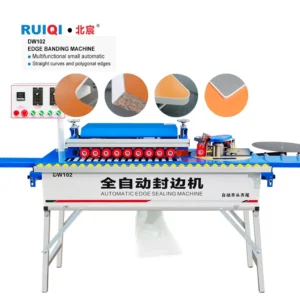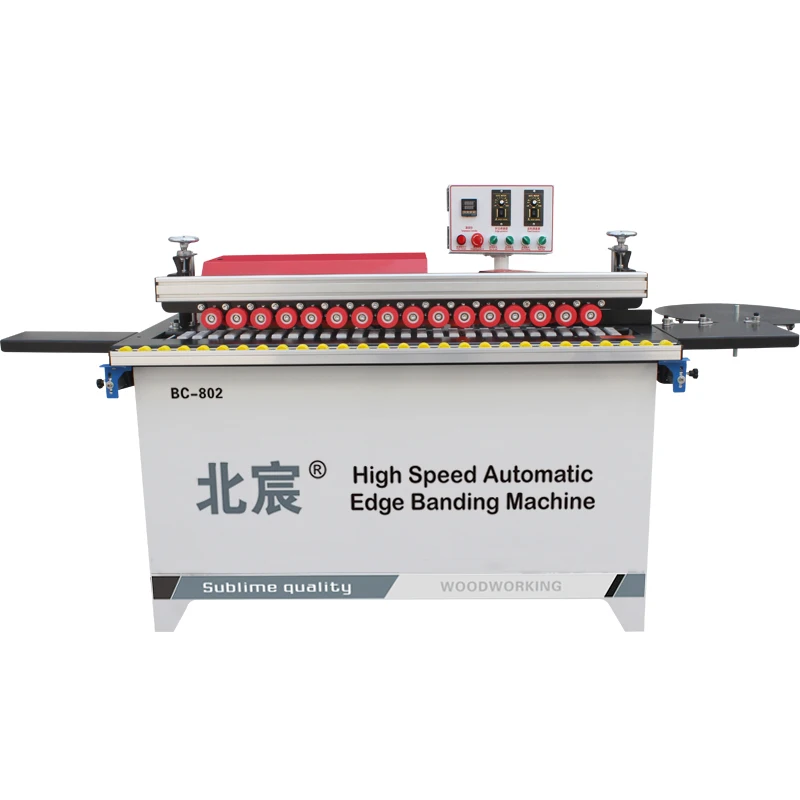
Edge banding machine
Click to enlarge
ISO 9001
CE Certified
OEM / ODM
12-Mo Warranty
Edge banding machine
Edge Gluing Machine for MDF Plywood Panel – Process Application
<p><strong>DW802 Automatic Edge Banding Machine</strong>, 4200W, 0.3–3mm edge thickness, 220V/380V — integrates gluing, automatic head-and-tail cutting, trimming and polishing in one pass for clean edges on MDF, particleboard and plywood substrates.</p> <ul> <li>4000ml glue pot supports continuous multi-panel runs without frequent refilling</li> <li>Integrated vacuum system extracts dust at trimming and polishing stations</li> <li>Edge banding height 0–50mm, minimum sheet 25×10cm for small offcut processing</li> <li>Language and plug configurable (EU/USA/AU/UK) to match operator and site requirements</li> </ul> <p>Engineer-led configuration with formal quotation within 24 hours and pre-shipment test records on your specific substrate.</p>
100+
Countries
MOQ 1
Unit
15-25 Days
Lead Time
Automatic Edge Banding Machine
Automatic Head And Tail Cutting
DW802
MDF Plywood Panel
Panel Edge Quality
Process Application
Vacuum System
- Full OEM/ODM support -- custom logo, voltage (110V-440V), multilingual panels
- ISO 9001 & CE certified, 5 national patents, 60 professional engineers
- 12-month warranty, remote technical support & spare parts service
- Professional export packaging, customs clearance support, on-time delivery
Precision-Ground Components — verified ±0.02mm tolerance on the DW802 trimming station directly addresses the edge finish inconsistency custom furniture makers face across mixed panel densities.
Technical Specifications
| Parameter | Value |
|---|---|
| Model | DW802 |
| Product Type | Automatic Edge Banding Machine |
| Total Power | 4200W |
| Voltage & Frequency | 220V/380V/customization (frequency not stated in source — confirm 50Hz/60Hz) |
| Edge Banding Thickness | 0.3-3MM |
| Edge Banding Height | 0-50MM |
| Minimum Sheet Length | 25CM |
| Minimum Sheet Width | 10CM |
| Glue Pot Capacity | 4000ml |
| Air Source Pressure | 0.4-0.8Mpa |
| Trimming Power | 800W*2 |
| Polishing Power | 180W*2 |
| Vacuum Power | 1200W |
| Product Size | 1306095CM |
| Product Weight | 135KG |
| Key Features | Edge banding, trimming, polishing, automatic head and tail cutting, integrated vacuum |
Application Suitability
| Application | Material or Output |
|---|---|
| Custom cabinet edge sealing | Melamine-faced particleboard, MDF |
| Joinery workshop production | Solid wood board, ecological board |
| Home decoration batch runs | Plywood, mixed panel substrates |
| Small-batch furniture manufacturing | PVC and veneer edge banding on panel stock |
Why Visible Glue Lines Keep Appearing on Particleboard Edges
The substrate density dictates the outcome as much as the machine does.
I remember a customer in the Middle East running custom cabinet fronts on particleboard that looked fine during the sample test on standard-density board. When his actual production stock arrived — different supplier, lower density — the glue line on every panel was visible and unacceptable. An edge banding machine process application like the DW802 maintains consistent pressure across the trimming and polishing stations, but if the board itself absorbs glue unevenly, no amount of mechanical adjustment compensates for that mismatch. The integrated vacuum system clears debris that would otherwise lodge between band and substrate, yet the fundamental variable remains the pairing of board density with glue temperature and feed rate [NEED_CITE: substrate density and edge adhesion standards].
How Glue Pot Capacity Affects Continuous Run Behaviour
The DW802 carries a 4000ml glue pot, which is substantial for a machine in this footprint class. For a joinery workshop processing batch after batch of cabinet sides, a smaller pot means stopping to refill mid-run — and each refill introduces a temperature drop that can affect the next panel’s adhesion. The edge banding machine process application on this unit keeps thermal mass stable enough that operators can run through a morning’s worth of panels without interruption, maintaining consistent glue viscosity throughout.
Vacuum Integration at the Trimming and Polishing Stage
When the trimming cutters shave excess PVC or veneer from the panel edge, fine particles scatter across the work surface. Without extraction, those particles settle back onto freshly polished edges or into the glue pot, degrading the finish on subsequent panels. The 1200W vacuum on the DW802 pulls debris away at the point of generation [NEED_CITE: dust extraction requirements in woodworking machinery]. This matters particularly when switching between light-coloured melamine and dark walnut veneer within the same shift, where cross-contamination shows immediately.
Reading the Spec Sheet Against Your Actual Production Needs
The edge banding thickness range of 0.3–3MM covers the three dominant material families: thin veneer for visible furniture faces, PVC for moisture-prone cabinet interiors, and melamine strips for cost-sensitive carcass work. Trimming power at 800W per station provides enough torque to shear 3MM PVC cleanly without slowing the feed, while the dual 180W polishing wheels bring the trimmed edge to a finish that will not catch on assembly hardware. The minimum sheet dimensions — 25CM length and 10CM width — define the smallest offcut this machine will accept, which matters when a workshop processes drawer bottoms and narrow filler strips alongside full cabinet sides. Edge height coverage up to 50MM accommodates standard panel thicknesses from 16MM particleboard through to double-layered MDF tops without manual reconfiguration between jobs.
What Happens When Voltage and Frequency Are Assumed, Not Confirmed
A 4200W machine drawing across trimming motors, polishing wheels, vacuum and glue pot heater simultaneously places a real load on the workshop supply. If the local grid runs at 60Hz and the machine ships configured for 50Hz, motor speeds shift, the glue pot heater cycles differently, and the feed motor runs faster than the trimming cutters expect. The result is chipped edges that the operator cannot diagnose because every individual component is technically functional. The DW802 is available in 220V/380V with customisation, but frequency confirmation must happen before production, not after delivery [NEED_CITE: voltage and frequency standards by export market].
Why Configuration Choices Matter Here
The DW802 runs its full sequence — gluing, head-and-tail cutting, trimming, polishing — in one pass, which means a misconfigured parameter at any station affects every downstream station. The language on the control panel determines whether the operator can actually adjust glue temperature when switching from veneer to PVC, and a Spanish-speaking workshop receiving a Chinese-only interface will stall at commissioning. Voltage customisation, multilingual panels and plug options (EU, USA, AU, UK) are configurable because a machine that cannot be operated is a machine that cannot produce.
Documentation & Verification
- CE declaration of conformity matched to this automatic edge banding machine class
- Factory test record processed on your specific panel substrate and edge material before dispatch
- Electrical schematic confirming voltage and frequency as configured for your local supply
- Operation and maintenance manual supplied in your operator’s agreed language
- Spare parts list covering trimming blades, polishing wheels and glue pot consumables
Installation, Commissioning & Support
- Requires a stable 220V or 380V dedicated circuit to handle 4200W total draw across all stations
- Footprint of 130×60CM allows placement against a workshop wall with access clearance on the feed side
- Air supply at 0.4–0.8Mpa must be plumbed to the machine before first run for pneumatic head-and-tail cutters
- Glue pot requires initial heating cycle before first panel enters to stabilise adhesive viscosity
- Vacuum port connects to workshop extraction or uses standalone dust collector for the 1200W onboard unit
What to Include in Your Inquiry
To receive a configuration proposal that matches your actual production environment, provide the panel substrates you process (MDF, particleboard, plywood or a mix), the edge banding materials you run (PVC thickness, veneer type, melamine strip), and your local voltage and frequency. Specify whether you need control panel language beyond Chinese or English, and indicate your typical panel dimensions to confirm the 25CM minimum length and 10CM minimum width cover your range. A sample panel sent for a factory test run will surface any substrate-specific issues before the machine ships.
Frequently Asked Questions
Q: Which edge banding materials work best on MDF versus particleboard with this machine?
A: MDF accepts veneer and thin PVC well due to its uniform density, giving a clean trim line at the 0.3–3MM range. Particleboard varies more by manufacturer, and lower-density cores can absorb glue unevenly, making thicker PVC or melamine strips more forgiving. The 4000ml glue pot maintains temperature stability across either substrate during continuous runs.
Q: How does glue pot temperature affect adhesion on different substrate densities?
A: Higher-density boards such as MDF transfer heat from the glue quickly, requiring the pot to maintain a stable setpoint for consistent bonding. Lower-density particleboard insulates more, so the glue stays workable longer but can fail to penetrate if the temperature is set too low. Operators adjust the pot temperature through the control panel when switching substrates.
Q: What feed speed considerations apply for thin veneer versus thick PVC?
A: Thin 0.3MM veneer requires a controlled feed to prevent tearing at the trimming station, where the dual 800W cutters must shear cleanly without pulling the material. Thicker 3MM PVC tolerates faster feed rates because the strip has more rigidity entering the glue roller. The automatic head-and-tail station cuts both materials flush without manual intervention.
Q: How does the automatic head-and-tail station affect panels shorter than typical cabinet sides?
A: The DW802 accepts panels down to 25CM in length and 10CM in width, which covers drawer fronts, small shelf boards and filler strips. The head-and-tail cutters trim the leading and trailing edge overhang automatically, eliminating the manual scoring step that typically damages narrow stock. This keeps small components assembly-ready without a secondary bench operation.
Technical Specifications
| Parameter | Value |
|---|---|
| Product Name | Edge Gluing Machine for MDF Plywood Panel – Process Application |
| Category | Edge banding machine |
| Voltage Options | 110V / 220V / 380V / 440V (customizable) |
| Frequency | 50Hz / 60Hz (customizable) |
| Certification | ISO 9001, CE |
| MOQ | 1 Unit |
| Lead Time | 15-25 Working Days |
| Warranty | 12 Months |
| OEM / ODM | Available -- logo, color, panel language |
* Detailed technical specifications vary by model. Please contact us with your specific requirements for a complete datasheet.
Shipping & Export
-
Export Packaging
Heavy-duty wooden crate with foam padding and moisture protection
-
Shipping Methods
Sea freight (FCL/LCL), air freight, express -- we support all methods
-
Customs Support
Full documentation: CO, commercial invoice, packing list, HS code assistance
-
Port of Loading
Tianjin / Qingdao port, China -- 20 years export experience
OEM / ODM Services
-
Logo & Branding
Custom logo printing, color scheme, and nameplate engraving
-
Voltage Configuration
110V / 220V / 380V / 440V, 50Hz / 60Hz -- any region supported
-
Multilingual Panels
Control panels in English, Spanish, French, Arabic and more
-
Custom Specifications
Modified dimensions, accessories, or feature sets on request
Get a Quote
Request Product Inquiry
Fill in your details and we'll respond within 24 hours with pricing and availability.
Direct Contact
How It Works
-
1
Confirm requirements & budget
Tell us your factory scale and processing needs
-
2
Receive recommendation & quote
We match the right machine with full specs
-
3
Negotiate & place order
OEM terms, voltage, payment and delivery
-
4
Production & QC inspection
Multi-stage quality control by 60 engineers
-
5
Export packaging & shipment
Professional packing, customs clearance
-
6
After-sales support
12-month warranty, remote tech support
You May Also Like
![DW3600 Automatic Edge Banding Machine for MDF and Plywood Panel Processing<ruiqiwoodwork.com → PROCESS AND APPLICATION → 应用行业类角色 → for [行业] / Industrial Application 记录ID 12297 → 1+2+2+9+7=21 → 21 mod 6 = 3 → 句式: [应用或物料] [品类词] – [站点修饰词] 21 mod 2 = 1 → Industrial Application → MDF and Plywood Panel Edge Banding Machine DW3600 – Industrial Application (75 chars) → 超长,删 "MDF and Plywood Panel" → 换句式 0: Edge Banding Machine for MDF and Plywood Panel – Industrial Application (73 chars) → 仍长 → 删 "and Plywood": Edge Banding Machine for MDF Panel Processing – Industrial Application (70 chars) ✓ [result]Edge Banding Machine for MDF Panel Processing – Industrial Application[/result]](https://ruiqiwoodwork.com/wp-content/uploads/2026/05/H2bfc7ffbb3494851954a97fd8e0bf5b4U-1-300x300.webp)