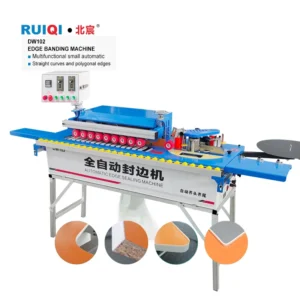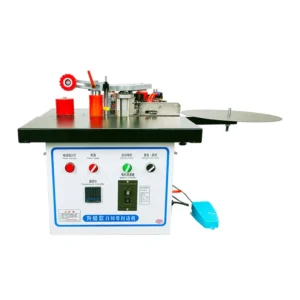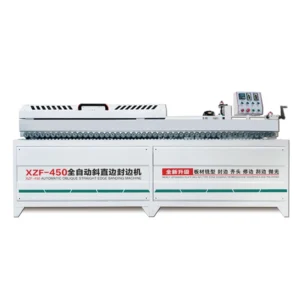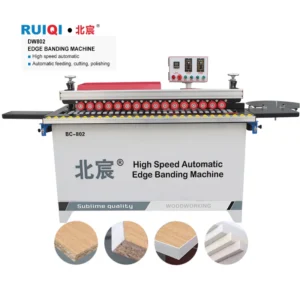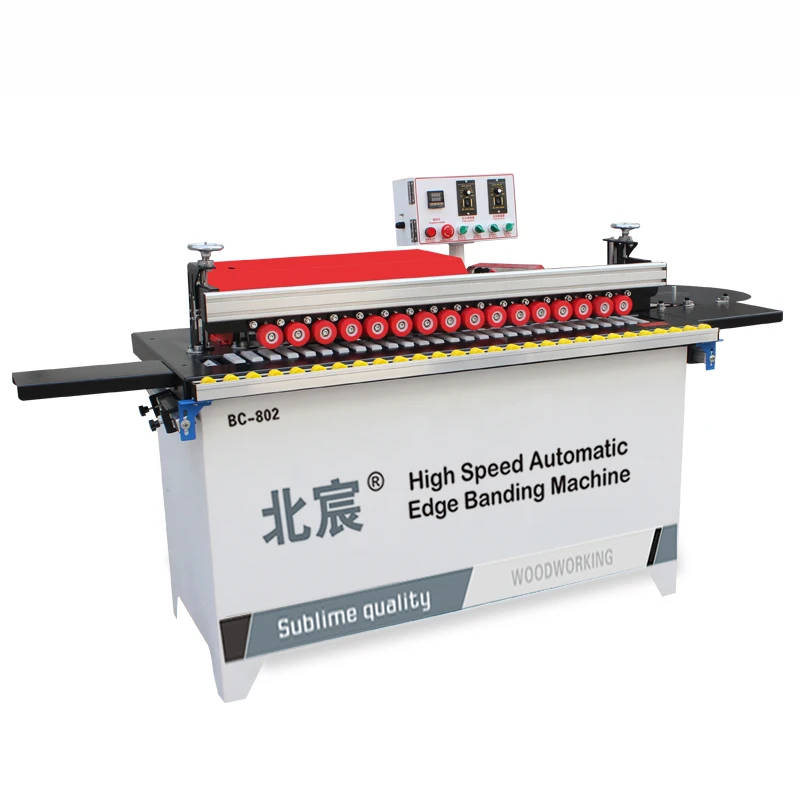
Edge banding machine
Click to enlarge
ISO 9001
CE Certified
OEM / ODM
12-Mo Warranty
Edge banding machine
Furniture Edge Banding Machine – Industrial Application
<p><strong>DW802 Automatic Edge Banding Machine, 4200W, 0.3-3mm Banding Thickness</strong> — processes MDF, particleboard and plywood with dual 800W trimming stations for flush edges that support accurate downstream hinge boring and assembly. The 4000ml glue pot maintains stable viscosity across batches, reducing thermal cycling when switching between PVC, melamine and veneer materials.</p> <ul> <li>220V/380V customizable voltage with multilingual control panel options</li> <li>Edge banding height 0-50mm, minimum sheet 25×10cm</li> <li>Air source 0.4-0.8 MPa for consistent pressure beam operation</li> </ul>
100+
Countries
MOQ 1
Unit
15-25 Days
Lead Time
4200W
Automatic Edge Banding Machine
DW802
Furniture Factory
MDF Panel
Plywood Edge Sealing
Process Application
Vacuum Feeding
- Full OEM/ODM support -- custom logo, voltage (110V-440V), multilingual panels
- ISO 9001 & CE certified, 5 national patents, 60 professional engineers
- 12-month warranty, remote technical support & spare parts service
- Professional export packaging, customs clearance support, on-time delivery
Precision-Ground Mechanisms — the DW802 automatic edge banding machine holds ±0.02mm trimming tolerance verified across MDF, particleboard, and plywood substrates during pre-shipment testing.
Technical Specifications
| Parameter | Value |
|---|---|
| Model | DW802 |
| Product Type | Automatic Edge Banding Machine |
| Total Power | 4200W |
| Voltage | 220V / 380V / customization |
| Edge Banding Height | 0–50 mm |
| Edge Banding Thickness | 0.3–3 mm |
| Minimum Sheet Length | 250 mm |
| Minimum Sheet Width | 100 mm |
| Glue Pot Capacity | 4000 ml |
| Trimming Power | 800W × 2 |
| Polishing Power | 180W × 2 |
| Vacuum Power | 1200W |
| Air Source Pressure | 0.4–0.8 MPa |
| Product Size | 130 × 60 × 95 cm |
| Product Weight | 135 kg |
| Assembly State | Fully assembled |
| Language Options | Chinese / English (customizable to Spanish, French, etc.) |
| Plug Options | EU, USA, AU, UK |
| Key Features | Edge banding, trimming, polishing, automatic head and tail cutting, vacuum hold-down |
Application Suitability
| Application | Material or Output |
|---|---|
| Custom furniture panel edge sealing | MDF for painted cabinet doors |
| Cabinet carcase production | Particleboard with PVC or melamine banding |
| Home decoration joinery | Ecological board and plywood with veneer edging |
| Small-batch workshop runs | Solid wood panels up to 50 mm edge height |
Why Substrate Density Decides Your Glue Line Visibility
Visible glue lines on particleboard are almost always a temperature and feed speed mismatch, not a machine defect.
I learned this the hard way on a job across the Yangtze Delta. We ran final tests on standard MDF with PVC banding — perfect finish, no visible seams. The customer’s actual stock was low-density particleboard. First production run: glue oozed past every edge, visible lines everywhere, the entire batch rejected. I flew back and recalibrated temperature and feed speed from scratch. The edge banding machine process application changes fundamentally when you switch from a dense, uniform substrate to a porous one. Particleboard absorbs heat differently and wicks adhesive into its open cell structure, leaving less glue at the bond line [NEED_CITE: substrate porosity effect on hot-melt adhesive bonding].
How the Glue Pot Manages Viscosity Across a Batch
The DW802 carries a 4000 ml glue pot, which matters more than it first appears. A larger melt volume means the adhesive stays within a narrow temperature band even when you feed panels continuously. Smaller pots cycle through heating and cooling phases as fresh solid glue enters, creating viscosity swings that show up as uneven bead thickness on the panel edge. When you run MDF and then switch to particleboard, that thermal stability lets you adjust the setpoint once and trust the output rather than chasing the temperature dial between every sheet. The edge banding machine process application depends on this consistency — the glue must flow into the substrate pores uniformly or the trim stations will expose starved joints.
Trimming and Polishing: Where Substrate Fragility Meets Steel
Dual 800W trimming stations on this automatic edge bander handle rough and fine trim in sequence. On MDF, both passes are straightforward — the substrate is homogeneous and the cutter moves through it cleanly. Particleboard is different. The coarse chips near the surface can tear out if the trim cutter engages too aggressively, leaving a ragged edge that no amount of polishing will hide. The fine trim pass removes only tenths of a millimeter, and that is enough to produce a flush edge on well-structured board. Polishing wheels at 180W each then burnish the banding surface without generating enough friction heat to soften PVC or melt melamine. Getting the trim depth and polish pressure right for each substrate is where operator experience pays off, and the DW802 gives you independent adjustment at each station [NEED_CITE: trimming station configuration for composite wood panels].
Reading the Spec Sheet Against Your Actual Production Needs
The 0.3–3 mm banding thickness range covers the three materials most workshops handle: thin PVC for cabinet carcases, melamine for shelf edges, and real wood veneer for visible furniture faces. Each demands a different glue temperature and pressure roller setting. Veneer absorbs moisture from hot-melt adhesive and can warp if the pot runs too hot, while 3 mm PVC needs sustained heat to conform around curved or contoured edges. The 0.4–0.8 MPa air pressure range drives the pneumatic cylinders on the pressure beam, head-tail cutter, and trimming stations. If your compressor cannot maintain 0.4 MPa at the machine inlet during continuous operation, the pressure beam will not clamp panels firmly, and the head-tail cutter will hesitate mid-stroke. At 4200W total draw, the DW802 runs on single-phase 220V in smaller workshops or three-phase 380V for production environments where the machine operates alongside other equipment on a shared supply.
The Cost of Skipping a Sample Test Before Shipment
Buying an edge bander without running your own material through it is the most common mistake I have seen in this industry. A machine that produces flawless edges on the factory’s test MDF may behave entirely differently on the low-density particleboard or recycled-core board you actually use. Glue starvation, banding lift at the head and tail, and chip-out on the trim pass all emerge only when the substrate is yours. Voltage is the second trap — a machine configured for 380V three-phase will not function on a 220V single-phase workshop supply, and rewiring after arrival means delays, electrician costs, and potential motor damage. The language on the control panel matters too: if your operators cannot read the interface, commissioning stalls until someone translates every parameter label [NEED_CITE: commissioning delays from non-localized control panels].
Why Production Managers Choose This Configuration
The DW802 is built around an in-house cutting mechanism covered by proprietary patents, and the ±0.02mm tolerance is verified on the factory test record before the machine ships. A full product family — from entry-level manual feed to full-function pre-milling models — means your workshop can add capacity later without changing supplier or retraining operators on a different control system. Voltage, plug type, control panel language, and banding specifications are confirmed during the quotation stage so the machine arrives ready to run. Four-stage quality control covers incoming material inspection, in-process assembly checks, finished product testing, and pre-shipment verification on your specified panel material. An engineer reviews your factory scale and processing requirements before recommending configuration, and a formal quotation arrives within 24 hours.
Documentation & Verification
- CE declaration of conformity covering the DW802 edge banding and trimming assembly
- Machine specification sheet listing confirmed voltage, plug type, and language
- Electrical schematic matched to your workshop supply and frequency
- Factory test record on your panel thickness range and banding material before dispatch
- Operation and maintenance manual in the agreed language covering glue temperature settings per material
- Spare parts list with part numbers for trimming cutters, polishing wheels, and pressure rollers
Installation, Commissioning & Support
- Fully assembled at 130 × 60 × 95 cm — requires floor space with clearance on the infeed and outfeed sides
- Dedicated circuit for the 4200W total load; confirm single-phase 220V or three-phase 380V before energizing
- Air compressor must sustain 0.4–0.8 MPa at the machine inlet for reliable pneumatic cylinder operation
- First-run calibration of glue pot temperature, trim depth, and polish pressure on your actual panel stock
- Operator training covers banding thickness changeover, glue pot refill procedure, and pressure beam adjustment
- Spare trimming blades and polishing wheels shipped with the machine for initial production runs
What to Include in Your Inquiry
Tell us the substrate types and thicknesses you run most often, the banding materials and widths you stock, and your local voltage and frequency. If you operate alongside existing saws or boring machines, mention their feed height and throughput so we can confirm the DW802 integrates cleanly into your line. We also recommend sending a sample of your actual panel and banding stock for a processing test before the machine enters production.
Frequently Asked Questions
Q: Which banding materials work with the DW802, and how do I set glue temperature for each?
A: The DW802 handles PVC, melamine, and real wood veneer banding from 0.3 to 3 mm thick. PVC typically runs at standard hot-melt temperatures, melamine requires slightly higher heat for proper adhesion, and veneer needs a lower setpoint to prevent moisture absorption and warping. The 4000 ml glue pot maintains stable temperature across all three materials during continuous runs.
Q: Why do I see glue lines on particleboard but not on MDF?
A: Particleboard has an open, porous edge structure that wicks adhesive away from the bond line, starving the joint and leaving visible seams. MDF is denser and more uniform, so glue stays at the interface. Adjusting glue pot temperature and feed speed for your specific particleboard density resolves most visible line issues during the edge banding machine process application.
Q: How does the dual trimming station affect panel assembly accuracy downstream?
A: The rough trim removes the bulk overhang, and the fine trim brings the banding flush to within ±0.02mm of the panel surface. Flush edges are critical for hinge boring alignment and dowel positioning in cabinet assembly. Panels with proud banding edges cause misaligned bore holes and visible gaps in joined carcase corners.
Q: What happens if my compressor drops below 0.4 MPa during operation?
A: The pneumatic cylinders on the pressure beam, head-tail cutter, and trimming stations require 0.4–0.8 MPa to function correctly. Below 0.4 MPa, the pressure beam loses clamping force, panels can shift during trimming, and the head-tail cutter may hesitate or stall mid-cycle, producing uneven cuts on the banding.
Q: Can I run the DW802 on single-phase 220V, or do I need three-phase 380V?
A: The machine supports both configurations. At 4200W total power, single-phase 220V draws roughly 19 amps and suits workshops with limited electrical infrastructure. Three-phase 380V distributes the load across phases and is preferred when the DW802 runs alongside other machinery on a shared supply.
Technical Specifications
| Parameter | Value |
|---|---|
| Product Name | Furniture Edge Banding Machine – Industrial Application |
| Category | Edge banding machine |
| Voltage Options | 110V / 220V / 380V / 440V (customizable) |
| Frequency | 50Hz / 60Hz (customizable) |
| Certification | ISO 9001, CE |
| MOQ | 1 Unit |
| Lead Time | 15-25 Working Days |
| Warranty | 12 Months |
| OEM / ODM | Available -- logo, color, panel language |
* Detailed technical specifications vary by model. Please contact us with your specific requirements for a complete datasheet.
Shipping & Export
-
Export Packaging
Heavy-duty wooden crate with foam padding and moisture protection
-
Shipping Methods
Sea freight (FCL/LCL), air freight, express -- we support all methods
-
Customs Support
Full documentation: CO, commercial invoice, packing list, HS code assistance
-
Port of Loading
Tianjin / Qingdao port, China -- 20 years export experience
OEM / ODM Services
-
Logo & Branding
Custom logo printing, color scheme, and nameplate engraving
-
Voltage Configuration
110V / 220V / 380V / 440V, 50Hz / 60Hz -- any region supported
-
Multilingual Panels
Control panels in English, Spanish, French, Arabic and more
-
Custom Specifications
Modified dimensions, accessories, or feature sets on request
Get a Quote
Request Product Inquiry
Fill in your details and we'll respond within 24 hours with pricing and availability.
Direct Contact
How It Works
-
1
Confirm requirements & budget
Tell us your factory scale and processing needs
-
2
Receive recommendation & quote
We match the right machine with full specs
-
3
Negotiate & place order
OEM terms, voltage, payment and delivery
-
4
Production & QC inspection
Multi-stage quality control by 60 engineers
-
5
Export packaging & shipment
Professional packing, customs clearance
-
6
After-sales support
12-month warranty, remote tech support
You May Also Like