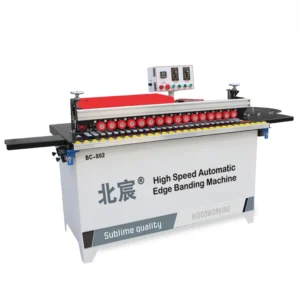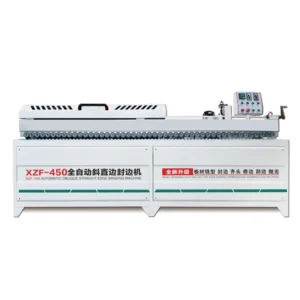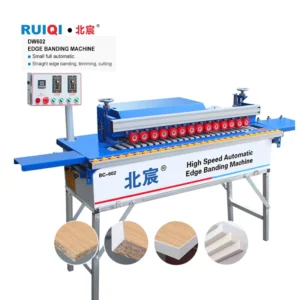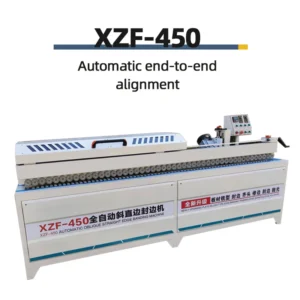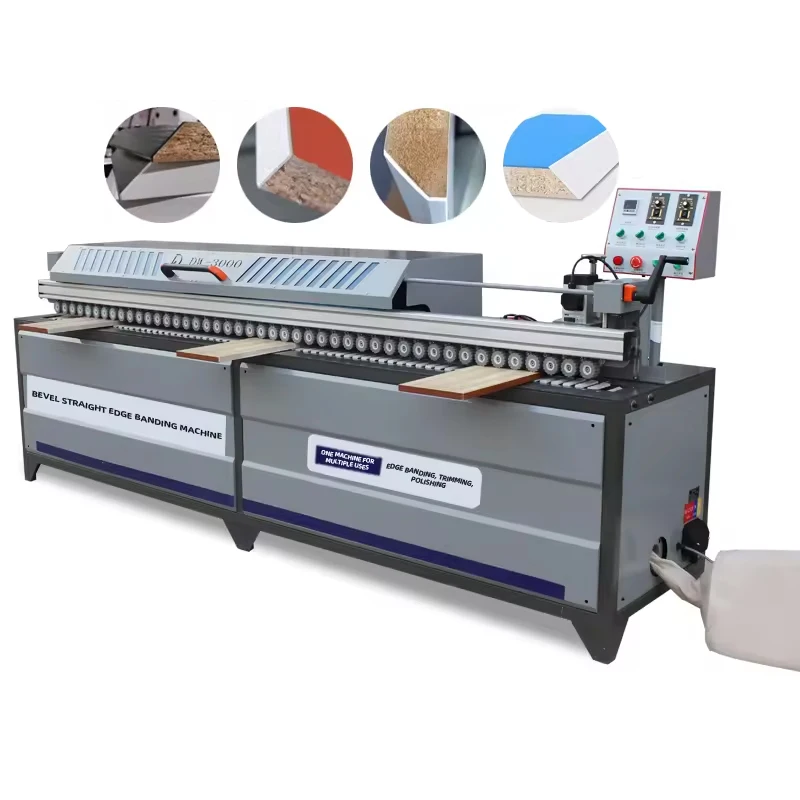
Edge banding machine
Click to enlarge
ISO 9001
CE Certified
OEM / ODM
12-Mo Warranty
Edge banding machine
Furniture Making DW3000 Edge Banding Machine – Industrial Application
<p><strong>DW3000 Edge Banding Machine, 11KW, 30-90° Bevel, 0-12m/min Feed Speed</strong> — full-automatic bevel and straight edge banding with 2.2KW×2 double heat gun for stable glue adhesion across MDF, particleboard and plywood.</p> <ul> <li>8-group oblique pressure wheel system handles 0.3-3mm PVC and veneer banding with 3 spindle trimming motors for clean finish</li> <li>Edge band slotting device and adjustable pre-milling ensure proper seating on contoured panels before trimming and polishing</li> </ul> <p>Pre-shipment test records covering glue temperature stability, bevel accuracy and trimming quality are provided with every unit.</p>
100+
Countries
MOQ 1
Unit
15-25 Days
Lead Time
Bevel Angle Adjustment
Double Heat Gun
DW3000
Edge Banding Machine
MDF Panel
Process Application
PVC Banding Material
- Full OEM/ODM support -- custom logo, voltage (110V-440V), multilingual panels
- ISO 9001 & CE certified, 5 national patents, 60 professional engineers
- 12-month warranty, remote technical support & spare parts service
- Professional export packaging, customs clearance support, on-time delivery
Precision-ground components — the DW3000 full-automatic edge banding machine integrates multi-stage inspection on every pressure wheel and trimming spindle before it leaves the assembly floor.
Technical Specifications
| Parameter | Value |
|---|---|
| Model | DW3000 |
| Product Type | Full-Automatic Adjustable Bevel & Straight Edge Banding Machine |
| Total Power | 11 kW |
| Pre-milling Motor | 2.2 kW |
| Heating System | 2.2 kW × 2 (double heat gun design) |
| Trimming Power | 2.2 kW × 2 (spindle trimming motors, 3 spindle motors total) |
| Polishing Power | 0.4 kW × 2 |
| Vacuum Power | 550 W |
| Voltage | 380V / 415V |
| Feed Speed | 0–12 m/min |
| Edge Banding Height | 0–50 mm |
| Edge Banding Thickness | 0.3–3 mm |
| Minimum Sheet Length | 30 cm |
| Minimum Sheet Width | 15 cm |
| Air Source Pressure | 0.5–0.7 MPa |
| Glue Pot Capacity | 4000 ml |
| Bevel Angle Range | 30–90° (8 groups of adjustable oblique pressure wheels) |
| Overall Dimensions (L×W×H) | 299 × 65 × 130 cm |
| Net Weight | 430 kg |
| Feeding Mechanism | Double cylinder feeding belt |
| Control Panel Language | Chinese and English (customizable to Spanish or other languages) |
| Standard Features | Pre-milling, 30–90° bevel & straight banding, trimming, scraping, polishing, high-power vacuuming, edge band slotting device |
| Certification | CE, ISO 9001 |
Application Suitability
| Application | Material or Output |
|---|---|
| Cabinet door and carcass edge finishing | MDF and particleboard with PVC or melamine banding, 0.3–3 mm thickness |
| Plywood panel edge banding for shelving and storage units | Plywood substrates with veneer or PVC edge strips |
| Custom furniture requiring bevel edge profiles | Solid wood panels and engineered boards at 30–90° bevel angles |
| Small-batch production with mixed panel sizes | Sheets from 30 cm minimum length, processed at variable feed speeds |
Why Glue Temperature Stability Matters More Than Feed Speed in the Edge Banding Machine Process and Application
Uneven glue melt across substrates is the most common root cause of visible glue lines and band lifting on assembled panels.
I spent years on the assembly floor watching edge banders produce clean finishes on MDF in the morning and then fail on particleboard after lunch, with operators blaming the banding material. The real variable was glue temperature consistency across the panel cross-section. Particleboard absorbs heat differently from MDF, and a single heat gun often leaves cold spots near the core where the glue fails to wet the substrate properly [NEED_CITE: thermal conductivity differences between MDF and particleboard substrates]. When I moved into technical sales, a Middle Eastern customer sent me a sample batch of high-gloss acrylic banding after their initial run on a single-heat-gun machine produced adhesion failures on over two hundred panels. That experience changed how I evaluate the edge banding machine process and application for every configuration I recommend.
How Double Heat Gun Design Controls Glue Line Quality
The DW3000 uses a 2.2 kW × 2 double heat gun configuration rather than a single heating element. This arrangement maintains more even glue temperature across the full height of the banding strip, particularly important when running 50 mm tall edges on MDF where thermal loss at the upper and lower extremes creates adhesion weak points. Consistent glue temperature means the adhesive wets both the panel edge and the back of the banding material uniformly, which directly affects how the trimmed edge looks under angled lighting in a finished kitchen or wardrobe installation.
Managing Substrate Variation Without Retooling
Workshops that process MDF, particleboard, and plywood on the same machine face a real challenge: each substrate demands different glue behaviour. Particleboard’s porous surface pulls moisture from hot-melt adhesive faster than MDF, requiring either higher glue temperature or slower feed speed to compensate. The 4000 ml glue pot capacity on this edge banding machine provides enough thermal mass to buffer these changes, and the adjustable feed speed from 0 to 12 m/min allows operators to dial back throughput when switching to a more absorbent substrate [NEED_CITE: hot-melt adhesive open time variation with substrate porosity]. Rather than maintaining separate machines for different board types, a production manager can standardize on one unit and adjust parameters per job sheet.
Reading the Spec Sheet: What Drives Edge Finish Quality
The three spindle trimming motors are the most consequential specification on this machine for downstream assembly fit. Two 2.2 kW spindle motors handle rough and finish trimming, while the third supports auxiliary trimming or slotting operations. Spindle-type trimming motors deliver smoother cuts than the 800 W silent motors fitted to lighter machines, which matters when trimming 3 mm PVC banding where chatter marks translate directly into visible defects on the panel face. The 0.02 mm tolerance achievable on the cutting mechanism means trimmed panels fit together in cabinet carcass assembly without shimming, reducing the fitter’s time at the bench. Pre-milling at 2.2 kW removes saw marks and surface contamination from the panel edge before glue application, which is essential when working with boards that have been stored in humid conditions or cut with dull saw blades. The 30–90° bevel range with eight groups of oblique pressure wheels allows furniture designers to specify chamfered edge profiles without requiring a secondary routing operation.
The Cost of Configuring Without Substrate Data
Shipping an edge bander configured for one substrate into a factory that primarily processes another creates problems that only appear after installation. I have seen machines arrive at workshops where the operator spent the first week chasing adhesion failures because the factory test before shipment used standard PVC on MDF, while the customer’s actual production involved veneer banding on particleboard [NEED_CITE: edge banding adhesion failure rates linked to substrate-machine mismatch]. The glue temperature that works for PVC at 12 m/min feed speed will starve the glue line on porous particleboard. Voltage mismatches compound this: a machine wired for 380V running on a 415V supply without proper transformer adjustment will overheat the heat gun elements, altering glue viscosity in ways the operator cannot diagnose from the control panel alone.
Why Production Managers Choose This Configuration
The DW3000 sits in the product range as a machine that covers both straight and bevel edge profiles in a single pass, eliminating the need for workshops to maintain separate machines for different furniture lines. The four-stage quality control process — incoming material inspection, in-process checks, finished product verification, and pre-shipment testing — means every unit ships with documented test records. Voltage customization from 380V to 415V is confirmed before production rather than discovered after delivery. The control panel ships in the language the operator reads, whether English, Spanish, or another specified language, so commissioning does not stall on mistranslated parameter labels [NEED_CITE: multilingual control panel configuration for export machinery]. An engineer reviews the factory layout and processing requirements before issuing the configuration proposal, rather than shipping a catalog model and leaving the buyer to discover throughput mismatches after installation.
Documentation & Verification
- Factory test record using your specified substrate, banding material, and thickness before dispatch
- Electrical schematic confirming voltage and frequency match your facility supply
- Operation and maintenance manual in your agreed language covering all bevel angle settings
- Pre-shipment inspection photographs of trimming finish on your sample panels
- Spare parts list identifying consumable scraper blades and polishing wheels with part numbers
Installation, Commissioning & Support
- Requires a level concrete floor capable of supporting 430 kg with clearance for the 299 cm machine length and infeed/outfeed zones
- Dedicated 380V/415V three-phase circuit rated for 11 kW total draw with proper earth bonding
- Compressed air supply at 0.5–0.7 MPa with inline moisture filtration to protect pneumatic cylinders
- First-run commissioning covers glue pot temperature calibration, pressure wheel alignment, and feed speed mapping to your panel materials
- Operator training on bevel angle adjustment across the 30–90° range and trimming motor parameter settings
- Consumable spare parts package including replacement scraper blades and polishing wheels for initial production period
What We Need to Configure Your Machine Correctly
Before issuing a configuration proposal, we need to know the substrate types and thicknesses you process most frequently, the banding materials and thicknesses in your regular production, and whether your furniture lines require bevel edge profiles alongside straight edges. Confirm your facility voltage and frequency, and specify the control panel language your operators require. If you are integrating this machine into an existing line, share the upstream saw specifications and downstream assembly tolerances so we can match feed speed and trimming accuracy to your workflow.
Frequently Asked Questions
Q: How does glue temperature control affect edge quality on different substrates like MDF vs. particleboard?
A: Particleboard absorbs heat from hot-melt adhesive faster than MDF due to its porous structure. The double heat gun design on this machine maintains more stable glue temperature across both substrates, but operators typically reduce feed speed when switching to particleboard to allow adequate glue wetting time. Factory testing on your specific substrate before shipment confirms the correct parameter set.
Q: What banding materials and thicknesses are compatible with this edge banding machine process and application?
A: The machine processes PVC, veneer, and melamine banding from 0.3 mm to 3 mm thickness, with edge heights up to 50 mm. High-gloss acrylic and other specialty materials require specific glue temperature and pressure wheel settings. We confirm compatibility through sample testing on your actual banding stock before the machine ships.
Q: How does the 30–90° bevel adjustment impact downstream assembly tolerances and panel fit?
A: Bevel edge profiles change how panels meet at corners and joints. The eight groups of adjustable oblique pressure wheels maintain consistent banding contact across the full angle range, and the spindle trimming motors cut to verified tolerance so beveled panels still assemble within cabinet carcass specifications without shimming or rework at the bench.
Q: How does pre-milling improve edge banding adhesion on panels with surface contamination or rough cut edges?
A: The 2.2 kW pre-milling motor removes saw marks, dust contamination, and moisture-damaged surface fibers from the panel edge before glue application. This exposes clean substrate material for the adhesive to bond with, which is particularly important for boards that have been stored in non-climate-controlled environments or cut with blades that have exceeded their service interval.
Technical Specifications
| Parameter | Value |
|---|---|
| Product Name | Furniture Making DW3000 Edge Banding Machine – Industrial Application |
| Category | Edge banding machine |
| Voltage Options | 110V / 220V / 380V / 440V (customizable) |
| Frequency | 50Hz / 60Hz (customizable) |
| Certification | ISO 9001, CE |
| MOQ | 1 Unit |
| Lead Time | 15-25 Working Days |
| Warranty | 12 Months |
| OEM / ODM | Available -- logo, color, panel language |
* Detailed technical specifications vary by model. Please contact us with your specific requirements for a complete datasheet.
Shipping & Export
-
Export Packaging
Heavy-duty wooden crate with foam padding and moisture protection
-
Shipping Methods
Sea freight (FCL/LCL), air freight, express -- we support all methods
-
Customs Support
Full documentation: CO, commercial invoice, packing list, HS code assistance
-
Port of Loading
Tianjin / Qingdao port, China -- 20 years export experience
OEM / ODM Services
-
Logo & Branding
Custom logo printing, color scheme, and nameplate engraving
-
Voltage Configuration
110V / 220V / 380V / 440V, 50Hz / 60Hz -- any region supported
-
Multilingual Panels
Control panels in English, Spanish, French, Arabic and more
-
Custom Specifications
Modified dimensions, accessories, or feature sets on request
Get a Quote
Request Product Inquiry
Fill in your details and we'll respond within 24 hours with pricing and availability.
Direct Contact
How It Works
-
1
Confirm requirements & budget
Tell us your factory scale and processing needs
-
2
Receive recommendation & quote
We match the right machine with full specs
-
3
Negotiate & place order
OEM terms, voltage, payment and delivery
-
4
Production & QC inspection
Multi-stage quality control by 60 engineers
-
5
Export packaging & shipment
Professional packing, customs clearance
-
6
After-sales support
12-month warranty, remote tech support
You May Also Like