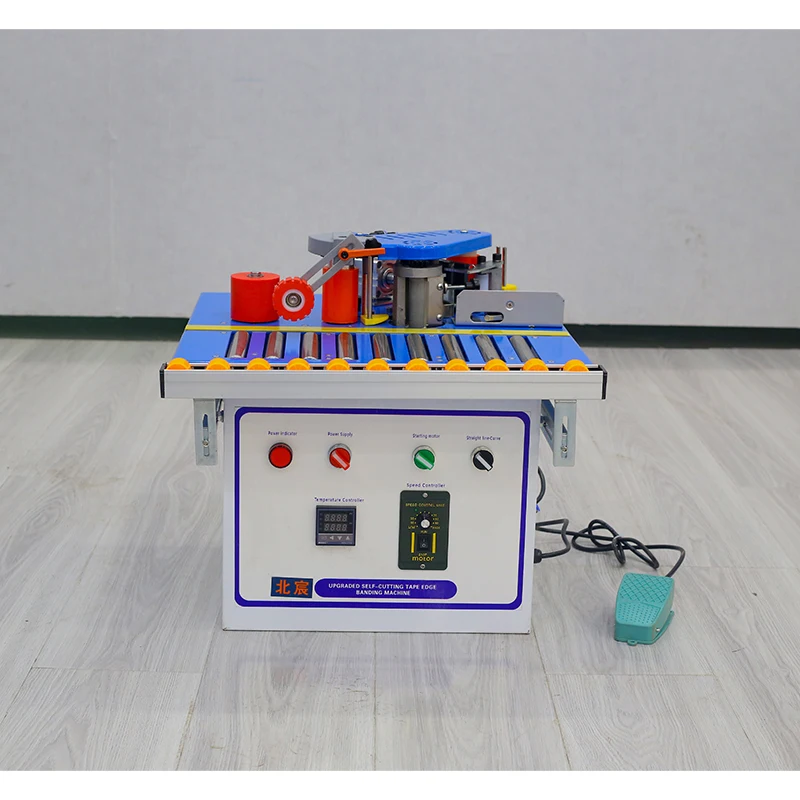
Edge banding machine
Click to enlarge
ISO 9001
CE Certified
OEM / ODM
12-Mo Warranty
Edge banding machine
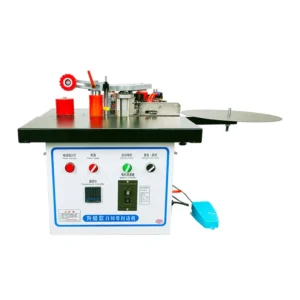
Portable Edge Bander for MDF Cabinet Making – Industrial Application
<p><strong>Portable Edge Banding Machine, 100W, 20V/380V, 0.3–3m Banding Thickness</strong> — handles curved and straight edge sealing on MDF, plywood and particleboard with 100ml glue pot capacity and 0–50mm panel height range.</p> <ul> <li>Ideal for short-run shaped cabinet components and on-site finishing where stationary edge banders cannot reach</li> <li>Glue temperature stability and material thickness compatibility directly influence edge adhesion and downstream assembly fit</li> <li>Suports PVC, melamine and veneer banding; voltage and plug configurable to local supply</li> <li>Air source 0.5–0.8MPa required for consistent triming across profiles Engineer-led configuration ensures voltage and language match your workshop before dispatch, backed by four-stage QC with pre-shipment verification.</li> </ul>
100+
Countries
MOQ 1
Unit
15-25 Days
Lead Time
220V
Edge Banding Machine
Hot Melt Glue
MDF Cabinet Making
Portable Tabletop
Process Application
ST-70
- Full OEM/ODM support -- custom logo, voltage (110V-440V), multilingual panels
- ISO 9001 & CE certified, 5 national patents, 60 professional engineers
- 12-month warranty, remote technical support & spare parts service
- Professional export packaging, customs clearance support, on-time delivery
[Portable Edge Banding Machine process application] — a tabletop hot-melt glue unit designed for workshops where curved profiles and short panel runs make a stationary automatic line impractical.
Technical Specifications
| Parameter | Value |
|---|---|
| Product Type | Portable Edge Banding Machine |
| Total Power | 1000W |
| Voltage | 220V / 380V / customization available |
| Minimum Sheet Length | 25 cm |
| Minimum Sheet Width | 3 cm |
| Edge Banding Height Range | 0 – 50 mm |
| Edge Banding Thickness Range | 0.3 – 3 mm |
| Edge Trimmer Power | 20W |
| Air Source Pressure | 0.5 – 0.8 MPa |
| Glue Pot Capacity | 1000 ml |
| Machine Dimensions (L×W×H) | 50 × 50 × 47 cm |
| Net Weight | 23 kg |
| Banding Path | Curved and straight edges |
| Plug Options | EU, USA, AU, UK |
| Control Language | Chinese, English; customizable to Spanish or other languages |
Application Suitability
| Application | Material or Output |
|---|---|
| Cabinet door edge sealing on short runs and sample batches | MDF, particleboard, plywood |
| Curved profile banding on shaped shelving and radius cabinet components | MDF, ecological board, solid wood |
| On-site furniture repair and field installation finishing | Plywood, melamine-faced board |
| Small joinery workshop production where a full line is not justified | MDF, particleboard, solid wood panels |
Why Glue Lines Look Different on MDF Versus Particleboard
Substrate porosity dictates hot-melt adhesion behaviour, not the machine itself.
When the same portable edge banding machine process application runs on a dense MDF board and then on a low-density particleboard, the glue penetrates differently. MDF absorbs hot melt slowly and leaves a consistent bond line; particleboard can suck the glue into its voids before the banding material presses down, producing a starved joint. I learned this the hard way supplying a Vietnamese cabinet factory — sample runs on high-density board looked clean, but the moment they switched to a cheaper particleboard for production, every edge showed frayed glue residue and visible gaps. Rework took weeks. [NEED_CITE: hot-melt glue penetration differences across wood composite substrates]
How a 1000 ml Glue Pot Affects a Production Session
A 1000 ml glue pot capacity lets an operator run continuous edge banding on small batches before stopping to refill. On a portable edge bander used for curved cabinet doors, this means several panels can be sealed without a cold-restart cycle — important because every time the glue cools below working temperature, the bond quality on the next piece is compromised until the pot recovers. For a custom workshop running short batches of five to ten panels at a time, the pot size keeps the workflow moving without constant temperature monitoring.
Curved and Straight Edges From a Single Portable Unit
The ST-70 handles both curved and straight edge sealing, which matters when a single cabinet order includes radius shelves alongside flat side panels. A stationary automatic edge bander forces every piece to travel a linear path; shaped components must be hand-fed or processed on a separate contour machine. A portable unit eliminates that split — the operator guides the banding around the curve manually, maintaining feed pressure and glue contact across the radius. This single-machine flexibility is what makes a portable edge banding machine process application viable for joinery shops producing mixed geometries. [NEED_CITE: manual feed pressure requirements for curved edge banding on wood panels]
What the Specs Mean at the Workbench
The 0–50 mm edge banding height range covers standard 16 mm, 18 mm, and 25 mm panel thicknesses used in cabinet carcasses and shelving, so the operator does not need to change tooling between common board sizes. The 0.3–3 mm thickness range spans PVC, melamine paper, and thin wood veneer banding — materials that behave very differently under hot melt. PVC bonds readily at moderate glue temperatures, while veneer requires precise temperature control because excessive heat scorches the wood grain. The 0.5–0.8 MPa air pressure requirement drives the trimming unit; below 0.5 MPa the trimmer struggles to cut flush, leaving a ridge that interferes with panel-to-panel assembly downstream. Voltage configurability from 220V to 380V prevents the common export problem where a machine arrives at a workshop and the local supply cannot run it — confirming this before order avoids weeks of electrical rework.
What Happens When Voltage and Air Supply Are Ignored at Inquiry Stage
A workshop running on single-phase 220V receives a machine wired for three-phase 380V, and the unit will not start. The operator assumes a fault and opens the casing, voiding the warranty before the first panel is edged. Air supply miscalculation causes a different failure — if the workshop compressor delivers only 0.3 MPa to a machine rated at 0.5 MPa minimum, the trimmer chatters and leaves ragged cuts on every panel. Both problems are preventable but appear only after delivery, when the machine is already bolted to the bench and production is waiting. [NEED_CITE: compressor pressure drop over extended pneumatic hose runs in small workshops]
Why Procurement Through This Channel Works for Process-Focused Buyers
In-house manufacturing with patented cutting mechanisms means the trimming unit is built to a verified tolerance rather than assembled from off-the-shelf components, which directly affects flush-cut quality on veneer and PVC edges. The four-stage QC process with pre-shipment verification ensures the machine is tested on an actual panel before dispatch — not just powered on and packed. Engineer-led configuration recommendation means the inquiry response addresses substrate type, banding material, and local voltage together, rather than quoting a standard unit that may not suit the buyer’s production conditions. Language and plug customization ship as standard, eliminating the commissioning delay caused by an operator who cannot read the control panel or an electrician who cannot match the plug.
Documentation & Verification
- CE declaration of conformity covering portable woodworking machinery safety requirements
- Electrical schematic and voltage confirmation sheet for local electrician review before installation
- Operation and maintenance manual delivered in the language confirmed at order stage
- Factory test record showing edge adhesion results on the buyer’s specified panel material
- Spare parts list with item codes for glue pot elements, trimming blades, and feed rollers
Installation, Commissioning & Support
- Requires a stable bench surface rated for the 23 kg machine weight plus operator feed pressure
- Dedicated electrical circuit matching confirmed voltage (220V or 380V) with appropriate breaker rating
- Air line connection at 0.5–0.8 MPa with moisture filter to prevent glue pot contamination
- Initial glue temperature calibration on the buyer’s actual PVC or veneer banding stock before production starts
- Trimming blade replacement schedule provided based on banding material abrasiveness
What to Include in Your Inquiry
Describe the panel materials you actually run in production — not just the samples — including board density and the exact PVC, melamine, or veneer banding thickness. Specify your workshop voltage and phase, and whether your compressor can sustain 0.5–0.8 MPa continuously. State the language your operators need on the control panel.
Frequently Asked Questions
Q: How does glue temperature and pot capacity affect edge adhesion on MDF versus solid wood?
A: MDF absorbs hot melt slowly due to its fine fibre structure, so a stable glue pot temperature across the 1000 ml volume produces a consistent bond line. Solid wood has open grain that can wick glue away from the joint surface; slightly lower pot temperature reduces penetration and keeps more adhesive at the bond interface where it is needed.
Q: What banding materials work best within the 0.3–3 mm range on curved edges?
A: PVC from 0.4 mm to 2 mm bends readily around radii without cracking, making it the most reliable choice for curved profiles. Thin wood veneer at 0.3–0.6 mm follows curves but requires careful temperature control to avoid scorching. Melamine paper banding is limited to gentle curves and is prone to fracture on tight radii.
Q: How does feed speed on a portable unit influence glue line visibility?
A: Too fast and the hot melt does not wet the substrate fully, leaving a visible starved glue line. Too slow and excess glue squeezes out under the banding, requiring post-trim cleanup. On a portable unit the operator controls feed speed by hand, so consistent training and substrate-specific practice are necessary for repeatable results.
Q: What air supply requirements must be met for consistent trimming on curved profiles?
A: The trimming unit requires 0.5–0.8 MPa sustained pressure. On curved edges the trimmer must follow a changing contour, demanding steady pneumatic force to keep the blade flush. Pressure drops below 0.5 MPa cause chatter marks; spikes above 0.8 MPa risk cutting into the panel face.
Q: Can the control panel language be customized to prevent commissioning delays?
A: Yes — the unit ships with Chinese and English as standard, and can be configured to Spanish or other languages at order. Receiving a manual and control layout in the operator’s working language prevents misinterpretation of glue temperature settings and avoids the production stall caused by an unreadable interface.
Technical Specifications
| Parameter | Value |
|---|---|
| Product Name | Portable Edge Bander for MDF Cabinet Making – Industrial Application |
| Category | Edge banding machine |
| Voltage Options | 110V / 220V / 380V / 440V (customizable) |
| Frequency | 50Hz / 60Hz (customizable) |
| Certification | ISO 9001, CE |
| MOQ | 1 Unit |
| Lead Time | 15-25 Working Days |
| Warranty | 12 Months |
| OEM / ODM | Available -- logo, color, panel language |
* Detailed technical specifications vary by model. Please contact us with your specific requirements for a complete datasheet.
Shipping & Export
-
Export Packaging
Heavy-duty wooden crate with foam padding and moisture protection
-
Shipping Methods
Sea freight (FCL/LCL), air freight, express -- we support all methods
-
Customs Support
Full documentation: CO, commercial invoice, packing list, HS code assistance
-
Port of Loading
Tianjin / Qingdao port, China -- 20 years export experience
OEM / ODM Services
-
Logo & Branding
Custom logo printing, color scheme, and nameplate engraving
-
Voltage Configuration
110V / 220V / 380V / 440V, 50Hz / 60Hz -- any region supported
-
Multilingual Panels
Control panels in English, Spanish, French, Arabic and more
-
Custom Specifications
Modified dimensions, accessories, or feature sets on request
Get a Quote
Request Product Inquiry
Fill in your details and we'll respond within 24 hours with pricing and availability.
Direct Contact
How It Works
-
1
Confirm requirements & budget
Tell us your factory scale and processing needs
-
2
Receive recommendation & quote
We match the right machine with full specs
-
3
Negotiate & place order
OEM terms, voltage, payment and delivery
-
4
Production & QC inspection
Multi-stage quality control by 60 engineers
-
5
Export packaging & shipment
Professional packing, customs clearance
-
6
After-sales support
12-month warranty, remote tech support
You May Also Like