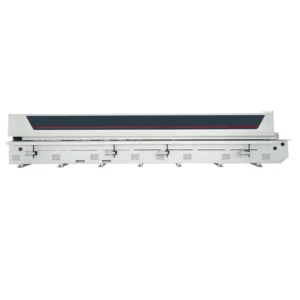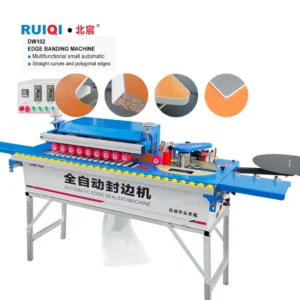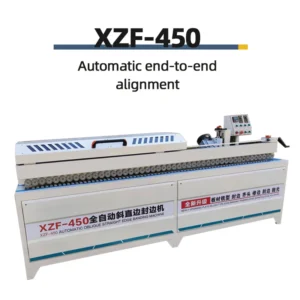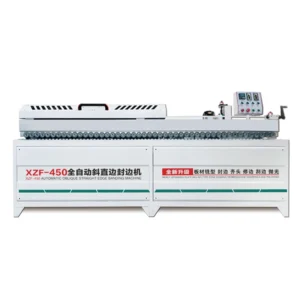
Edge banding machine
Click to enlarge
ISO 9001
CE Certified
OEM / ODM
12-Mo Warranty
Edge banding machine
Pur Glue Italy Edge Banding Machine for Wood Based Panels – Industrial Application
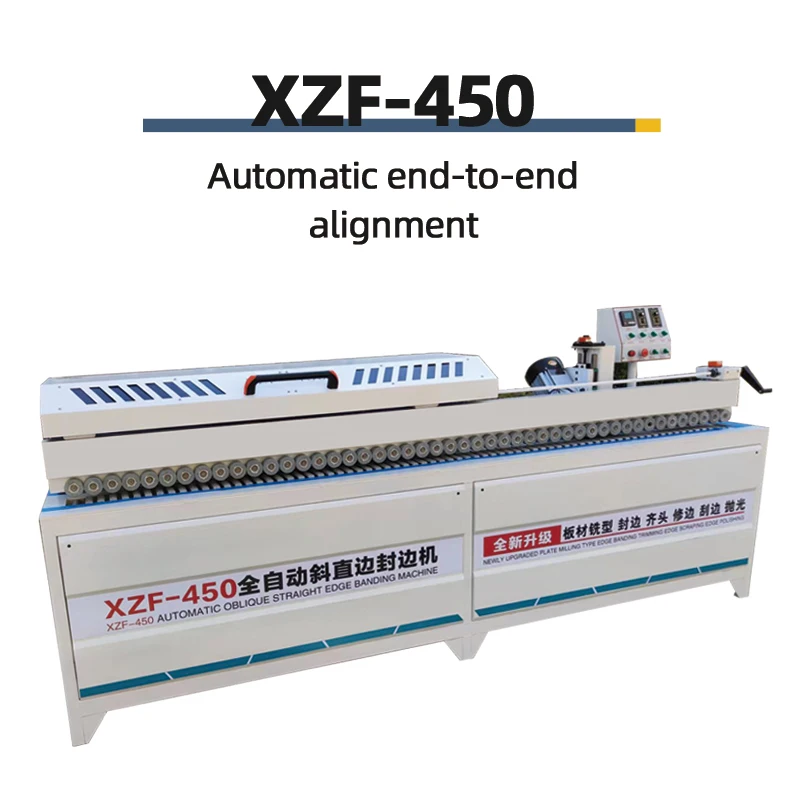
<p><strong>XZF450 45 Degree Full-Automatic Edge Banding Machine, 9.5KW, 380V/415V, 0.3-3mm Banding Thickness</strong> — pre-milling, trimming, scraping and polishing stations handle 30°, 45° and 60° edge profiles on MDF, plywood, particleboard and solid wood. The 4KW pre-milling motor prepares panel edges before glue application, reducing visible glue lines on porous substrates while the 4000ml glue pot supports extended runs. Feed speed ranges 0-12M/min with ±0.02mm tolerance verified through four-stage QC and pre-shipment testing.</p> <ul> <li>Edge banding height 0-50mm, minimum sheet 30×15cm</li> <li>High-power 550W vacuuming integrated for dust extraction</li> <li>Factory test record available for your specific substrate material</li> </ul>
100+
Countries
MOQ 1
Unit
15-25 Days
Lead Time
380V
45 Degree Edge Banding
Edge Banding Machine
Furniture Factory
MDF Panel
Plywood Panel
Process Application
XZF-450
- Full OEM/ODM support -- custom logo, voltage (110V-440V), multilingual panels
- ISO 9001 & CE certified, 5 national patents, 60 professional engineers
- 12-month warranty, remote technical support & spare parts service
- Professional export packaging, customs clearance support, on-time delivery
Pur Glue Italy Edge Banding Machine for Wood Based Panels – Industrial Application
Precision pre-milling — the 4KW pre-milling motor on the XZF-450 prepares uneven panel edges before the glue station, a critical step for MDF and particleboard substrates where saw marks compromise edge finish.
Technical Specifications
| Parameter | Value |
|---|---|
| Model | XZF-450 |
| Product Type | 45 Degree Full-Automatic Edge Banding Machine |
| Total Power | 9.5KW |
| Pre-milling Motor | 4KW |
| Trimming Motor | 2.2KW × 2 |
| Polishing Motor | 0.4KW × 2 |
| Vacuum Motor | 550W |
| Glue Pot Capacity | 4000ml |
| Edge Banding Height | 0–50mm |
| Edge Banding Thickness | 0.3–3mm |
| Feed Speed | 0–12 m/min |
| Minimum Sheet Length | 300mm |
| Minimum Sheet Width | 150mm |
| Voltage | 380V / 415V |
| Air Source Pressure | 0.5–0.7 MPa |
| Product Size | 3000 × 650 × 1350mm |
| Product Weight | 430kg |
| Key Features | Plate milling, 30°/45°/60° edge banding, trimming, scraping, polishing, high-power vacuuming |
Application Suitability
| Application | Material or Output |
|---|---|
| Cabinet door edge finishing | MDF, melamine board with PVC edge banding |
| Furniture panel production | Particleboard, blockboard, plywood |
| Polymer door manufacturing | Polymer door panels requiring 45° edge profiles |
| Custom furniture workshop | Solid wood board and veneer banding |
Why the Voltage Question Should Come Before the Price
A machine that cannot start because the voltage is wrong wastes far more money than an incorrect specification on paper.
I have seen factories receive equipment rated for 380V when their facility runs 415V three-phase, and the first motor start trips the breaker before the operator even loads a panel. The woodworking process edge banding machine you select must match both the voltage and the frequency of the site where it will operate. The XZF-450 supports 380V and 415V, but confirmation before order avoids weeks of delay. [NEED_CITE: voltage and frequency standards by export market]
When the control panel language does not match the operator’s native language, commissioning stalls. I once watched a production line sit idle for three days because the HMI was entirely in Chinese and the local technician could not navigate the glue temperature settings. That is not a machine fault — it is a process gap that belongs in the pre-order conversation.
Substrate Behaviour Across MDF, Plywood, and Particleboard
Each wood-based panel reacts differently to edge pressure and heat. MDF edges are soft and tend to compress under the feed chain, which means pre-milling becomes non-negotiable for a clean glue line. Plywood, with its layered grain structure, requires a sharp trimming setup to avoid tear-out on the cross-grain plies.
The woodworking process edge banding machine addresses these differences through a sequence of stations: pre-milling squares the edge, the glue pot applies a controlled film, and the dual trimming motors at 2.2KW each cut the banding flush without scoring the panel surface. The 550W vacuum motor pulls dust from trimming and scraping into the extraction port, keeping the glue line clean throughout the run.
Glue Selection and Edge Banding Thickness Range
The 0.3–3mm banding thickness range on the XZF-450 covers PVC, veneer, and melamine strips commonly used in furniture and cabinet manufacturing. Thinner PVC bands in the 0.4–1mm range bond well at moderate feed speeds, while veneer strips approaching 2–3mm require slower feed and careful scraping to prevent chipping along the wood grain.
The 4000ml glue pot capacity provides continuous run time for standard production batches before refill is necessary. For high-density particleboard, the pre-milling station at 4KW removes surface irregularities left by panel saws, ensuring the glue makes full contact with a flat edge. Without this step, visible glue lines appear on lighter substrates, and downstream assembly tolerances drift. [NEED_CITE: edge banding adhesion standards for furniture-grade MDF]
How Feed Speed and Station Sequence Determine Edge Quality
The variable feed speed of 0–12 m/min gives the operator control over edge finish quality. At lower speeds, the pre-milling cutter produces a cleaner edge on soft MDF, and the trimming blades have more time to remove excess banding without leaving micro-ridges. Higher feed speeds suit harder substrates like high-density particleboard where the material holds its edge under the cutter.
The dual 2.2KW trimming motors handle rough and finish trimming in sequence, while the 0.4KW polishing motors at the final station burnish the edge to a uniform sheen. The scraping station between trimming and polishing removes any remaining glue residue that could interfere with assembly. Together, the feed speed and station sequence determine whether the finished panel passes visual inspection on the furniture line or gets rejected for visible seam lines.
The Cost of Skipping Pre-Milling on Particleboard
When a workshop skips pre-milling on particleboard panels, the saw marks from the panel saw remain under the edge banding. These marks create voids in the glue film, and the banding lifts during temperature cycling or when the furniture is moved. The 4KW pre-milling motor on the XZF-450 removes a controlled amount of material from the panel edge, leaving a flat surface for consistent adhesive contact.
Factories that run particleboard without pre-milling often report higher rework rates on cabinet doors and drawer fronts, where edge quality is directly visible to the end customer. The rework cost accumulates across production runs and erodes the margin that the edge bander was supposed to protect. [NEED_CITE: furniture assembly tolerance requirements for edge banded panels]
Why the Process Matters More Than the Spec Sheet
The XZF-450 covers 30°, 45°, and 60° edge banding within one machine, so a workshop producing both straight-edge cabinets and angled polymer doors does not need two separate machines. The in-house manufacturing process includes four-stage quality control — incoming material inspection, in-process checks, finished product verification, and pre-shipment testing — with the panel test run on the buyer’s actual substrate before dispatch.
Voltage and control panel language are confirmed during the specification stage, not after the machine arrives. The factory test record documents edge quality on the specific MDF or plywood grade the buyer uses, providing verifiable output quality rather than claimed tolerance. An engineer-led configuration recommendation is provided with a formal quotation, matching the machine stations to the buyer’s production volume and substrate mix.
Documentation & Verification
- Factory test record showing edge finish on your specific MDF, plywood, or particleboard grade
- Machine specification sheet confirming 380V/415V voltage and frequency for your facility
- Operation and maintenance manual in the agreed language for operator commissioning
- Spare parts list covering trimming blades, scraping tools, and glue pot components
- CE declaration of conformity and ISO 9001 certificate for customs clearance
Installation, Commissioning & Support
- Dedicated 9.5KW three-phase circuit required for the XZF-450 at 380V/415V
- Machine footprint of 3000 × 650mm requires level concrete floor with vibration dampening
- 0.5–0.7 MPa compressed air supply needed for pneumatic trimming and scraping cylinders
- First-run calibration of feed chain tension and glue temperature for your banding material
- Operator training on control panel navigation in the agreed language before production start
- Spare trimming blades and scraping tools stocked for consumable replacement intervals
What to Include in Your Inquiry
Share the substrate types and thickness range you process most frequently, along with the banding material — PVC, veneer, or melamine — and its typical thickness. Confirm your facility voltage and frequency, the preferred control panel language, and whether you need a sample processing test on your actual panels before committing to an order. If your production line includes upstream panel saws or downstream drilling stations, mention their feed heights and throughput so the edge bander configuration aligns with the rest of the workflow.
Frequently Asked Questions
Q: How does substrate type affect glue selection and edge finish on this machine?
A: MDF edges are softer and benefit from the 4KW pre-milling station to flatten the surface before glue application. Plywood cross-grain plies require sharp trimming blades to prevent tear-out. Particleboard with its porous structure needs a controlled glue film to fill voids without squeeze-out. The XZF-450 glue pot and station sequence are configured to your substrate during the pre-shipment test.
Q: What banding materials work within the 0.3–3mm thickness range?
A: PVC, veneer, and melamine strips all fall within this range. Thinner PVC bands bond at standard feed speeds, while veneer approaching 3mm requires slower feed and careful scraping to avoid grain chipping. The dual trimming motors and polishing station adapt to each material type during setup.
Q: How does pre-milling improve adhesion on uneven panel edges?
A: The 4KW pre-milling motor removes saw marks and surface irregularities from the panel edge, creating a flat bonding surface. This ensures full glue contact across the edge, reducing voids that cause banding lift during temperature changes or furniture movement. It is essential for particleboard and MDF substrates.
Q: What effect does feed speed have on edge smoothness?
A: Lower feed speeds within the 0–12 m/min range give the trimming and scraping stations more contact time per panel, producing a smoother edge on softer materials like MDF. Higher speeds suit harder substrates where the material resists the cutter. The variable speed control lets the operator match feed rate to the specific panel and banding combination.
Q: How is cut accuracy verified before the machine ships?
A: A factory test record is produced using your actual substrate material and banding type, documenting edge quality, glue-line visibility, and trimming precision. The pre-shipment verification checks all station alignments and confirms the voltage matches your facility before the machine is packed for dispatch.
Technical Specifications
| Parameter | Value |
|---|---|
| Product Name | Pur Glue Italy Edge Banding Machine for Wood Based Panels – Industrial Application |
| Category | Edge banding machine |
| Voltage Options | 110V / 220V / 380V / 440V (customizable) |
| Frequency | 50Hz / 60Hz (customizable) |
| Certification | ISO 9001, CE |
| MOQ | 1 Unit |
| Lead Time | 15-25 Working Days |
| Warranty | 12 Months |
| OEM / ODM | Available -- logo, color, panel language |
* Detailed technical specifications vary by model. Please contact us with your specific requirements for a complete datasheet.
Shipping & Export
-
Export Packaging
Heavy-duty wooden crate with foam padding and moisture protection
-
Shipping Methods
Sea freight (FCL/LCL), air freight, express -- we support all methods
-
Customs Support
Full documentation: CO, commercial invoice, packing list, HS code assistance
-
Port of Loading
Tianjin / Qingdao port, China -- 20 years export experience
OEM / ODM Services
-
Logo & Branding
Custom logo printing, color scheme, and nameplate engraving
-
Voltage Configuration
110V / 220V / 380V / 440V, 50Hz / 60Hz -- any region supported
-
Multilingual Panels
Control panels in English, Spanish, French, Arabic and more
-
Custom Specifications
Modified dimensions, accessories, or feature sets on request
Get a Quote
Request Product Inquiry
Fill in your details and we'll respond within 24 hours with pricing and availability.
Direct Contact
How It Works
-
1
Confirm requirements & budget
Tell us your factory scale and processing needs
-
2
Receive recommendation & quote
We match the right machine with full specs
-
3
Negotiate & place order
OEM terms, voltage, payment and delivery
-
4
Production & QC inspection
Multi-stage quality control by 60 engineers
-
5
Export packaging & shipment
Professional packing, customs clearance
-
6
After-sales support
12-month warranty, remote tech support
You May Also Like