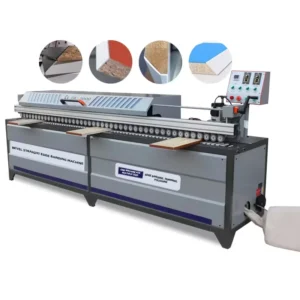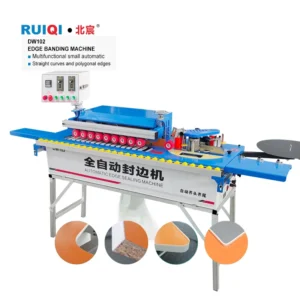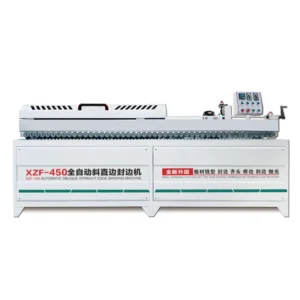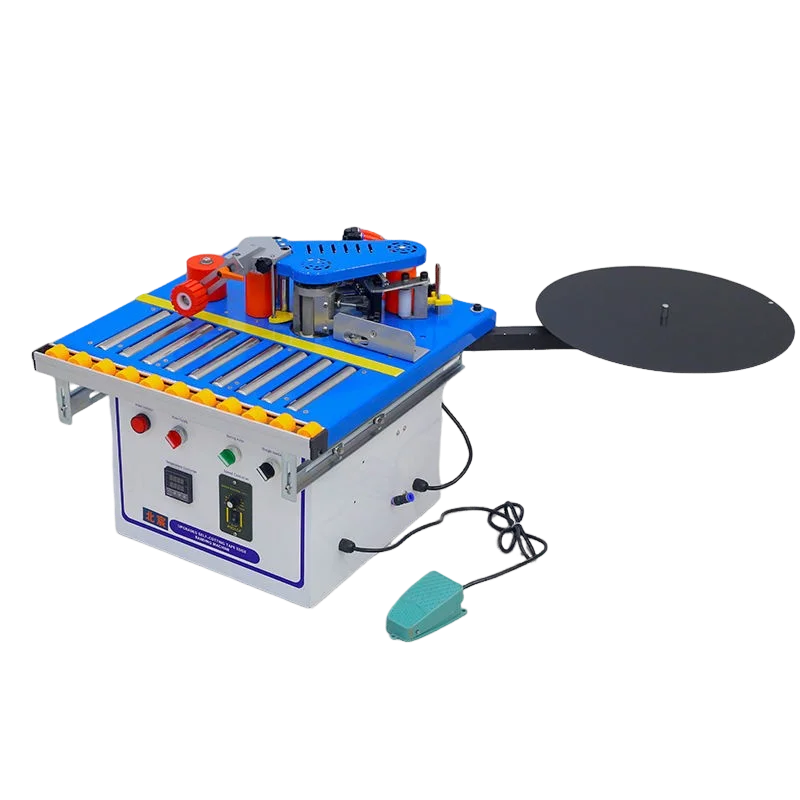
Edge banding machine
Click to enlarge
ISO 9001
CE Certified
OEM / ODM
12-Mo Warranty
Edge banding machine
Small Automatic Edge Banding Machine for PVC ABS Wood Veneer – Compact
<p><strong>Small Automatic Edge Banding Machine</strong> with 1000W total power and 0.3–3mm edge banding thickness — handles both curved and straight edge sealing on MDF, particleboard, and plywood substrates. Compact at 50×50×47cm and 23kg, this portable unit lets small workshops achieve consistent glue adhesion across PVC, ABS, and wood veneer materials without a full-size stationary line. The 1000ml glue pot supports continuous small-batch runs while 0.5–0.8Mpa air pressure aligns with standard workshop compressors. Voltage configurable from 220V to 380V with multilingual control panels available. Four-stage quality control with pre-shipment test records provided, backed by engineer-led configuration guidance and formal quotation within 24 hours.</p>
100+
Countries
MOQ 1
Unit
15-25 Days
Lead Time
220V 380V
Curved Edge Banding
Edge Banding Machine
Portable Edge Banding Machine
Process And Application
PVC ABS Veneer
Small Workshop Edge Sealing
ST-70
- Full OEM/ODM support -- custom logo, voltage (110V-440V), multilingual panels
- ISO 9001 & CE certified, 5 national patents, 60 professional engineers
- 12-month warranty, remote technical support & spare parts service
- Professional export packaging, customs clearance support, on-time delivery
Adjustable glue control — A 1000ml glue pot and 0.3–3mm banding thickness range keep adhesion consistent when switching between porous particleboard and sealed MDF in the same batch.
Technical Specifications
| Parameter | Value |
|---|---|
| Product Type | Portable Edge Banding Machine |
| Total Power | 1000W |
| Voltage | 220V / 380V / customization |
| Edge Banding Height | 0–50mm |
| Edge Banding Thickness | 0.3–3mm |
| Minimum Sheet Length | 25cm |
| Minimum Sheet Width | 3cm |
| Air Source Pressure | 0.5–0.8 MPa |
| Glue Pot Capacity | 1000ml |
| Product Size | 50 × 50 × 47 cm |
| Product Weight | 23 kg |
| Edge Motor Power | 20W |
| Assembly State | Portable / Tabletop |
| Standard Features | Curved and straight edge banding |
| Plug Options | EU, USA, AU, UK |
| Language Options | Chinese, English, customizable |
Application Suitability
| Application | Material or Output |
|---|---|
| Custom cabinet door edge sealing | MDF with PVC and ABS banding |
| Small-batch wardrobe panel finishing | Particleboard with melamine or wood veneer tape |
| Shaped furniture component banding | Curved plywood edges with thin veneer |
| On-site home decoration repair | Ecological board and solid wood panels |
| Workshop prototyping and sample runs | Mixed substrates with 0.3–3mm banding materials |
Why Visible Glue Lines Appear Even When the Machine Runs Fine
Substrate density variation changes how much glue the panel absorbs before the banding makes contact.
I configured a compact automatic edge bander for a cabinet shop that was processing MDF on paper but running rough particleboard in practice. The edge banding machine process and application looked correct on paper — same feed, same temperature — yet the particleboard sucked glue into its open surface before the PVC strip could bond, leaving starved joints and visible gaps along the edge. MDF panels from the same batch came out clean. Without a pre-milling station or adjustable glue flow, the operator had to manually tune pressure and temperature every time the substrate changed, which is unrealistic in a small shop running mixed materials [NEED_CITE: substrate porosity and hot-melt adhesive absorption rates].
Glue Pot Behavior Across Substrate Types
The 1000ml glue pot on this unit holds enough hot-melt adhesive for continuous small-batch runs without stopping to refill mid-panel. That capacity matters when you are banding particleboard, which demands a thicker glue film than MDF or sealed plywood to achieve full contact. With the edge banding machine process and application dialed in for one material, the operator can run an entire batch before the pot needs topping up, reducing temperature fluctuation that causes inconsistent bead thickness.
Curved and Straight Edges Without Changing Jigs
Switching between straight panels and curved components normally requires a separate fixture or a second machine station. This portable unit handles both profiles in a single setup, which keeps small workshops from bottlenecking at the edge sealing stage. The 0–50mm banding height range covers standard 18mm board stock plus thicker solid wood panels used in furniture legs and shaped shelving brackets [NEED_CITE: typical furniture panel thickness range for small workshop production].
Reading the Specs That Actually Affect Edge Quality
Edge banding thickness of 0.3–3mm spans three material families: thin PVC and melamine tapes at the lower end, ABS in the middle, and real wood veneer at the upper limit. Each material responds differently to glue temperature and pressure roller contact time. The 0.5–0.8 MPa air pressure requirement drives the pneumatic pressure rollers that squeeze the banding onto the panel — below 0.5 MPa, the roller force drops and veneer edges may lift at the corners, while above 0.8 MPa risks crushing thin PVC tape against sharp panel edges. Air source stability often gets overlooked in small shops running a single compressor for multiple tools.
The Cost of Ignoring Voltage Before You Order
Machines quoted without confirming local voltage and frequency arrive unusable — a problem I have seen delay workshop openings by weeks while transformers are sourced locally. This unit ships in 220V or 380V with customization available, and plug options cover EU, USA, AU, and UK standards. Skipping voltage confirmation means the motor may run at the wrong speed, altering feed rate and glue application timing in ways that show up only after production starts [NEED_CITE: voltage and frequency standards by export market].
Why Sourcing from a Process-Focused Manufacturer Matters
In-house manufacturing with patented cutting mechanisms means the edge trimming unit is built and tested at the same facility, not assembled from unrelated third-party modules. Voltage, language, and specification customization is standard rather than a special order, so the control panel arrives in a language the operator can actually read. The four-stage QC process includes pre-shipment verification with a factory test record on your specific substrate — not a generic run on clean MDF that hides problems you will find on your own shop floor. Engineer-led configuration means someone reviews your panel dimensions, banding material, and daily volume before recommending settings, reducing the chance of buying a machine designed for a different production profile.
Documentation & Verification
- CE declaration of conformity matched to portable edge bander category
- Factory test record using your panel thickness and banding material combination
- Electrical schematic confirming voltage, plug type, and frequency before dispatch
- Operation and maintenance manual provided in your operator’s agreed language
- Spare parts list covering glue pot elements, pressure rollers, and trimming blades
Installation, Commissioning & Support
- Tabletop assembly on a stable bench with 50 × 50 cm footprint clearance and 23 kg load capacity
- Dedicated power circuit matching confirmed voltage — 1000W total draw plus compressor load
- Pneumatic line connection at 0.5–0.8 MPa from existing workshop compressor or standalone unit
- First-run parameter setting for glue temperature and roller pressure on your actual substrate sample
- Operator training on curved vs. straight feed technique and glue pot refill timing
- Replacement glue pot heating elements and pressure roller pads included in initial spare parts kit
Before You Request a Quotation
Send a sample of your actual panel substrate — the specific MDF, particleboard, or plywood you run daily — along with the edge banding material and thickness you plan to use. Specify your local voltage and frequency, the language your operators need on the control panel, and whether your production includes curved components or only straight edges. This information allows an engineer to confirm glue temperature range, roller pressure settings, and air supply requirements before a formal proposal is issued.
Frequently Asked Questions
Q: How does edge banding thickness of 0.3–3mm map to PVC, ABS, and wood veneer?
A: Thin PVC and melamine tapes sit at 0.3–1mm, ABS typically runs 1–2mm, and wood veneer occupies the upper range up to 3mm. Each material requires different glue temperature and roller pressure. The machine handles all three within its specified range, but the operator must adjust settings when switching material families to maintain consistent adhesion and avoid squeeze-out or starved joints.
Q: What substrate preparation prevents visible glue lines on MDF versus particleboard?
A: Particleboard has an open, porous surface that absorbs hot-melt adhesive before the banding strip makes full contact, often requiring a thicker glue film or pre-sealed edge. MDF is denser and more uniform, accepting a thinner glue layer cleanly. Running a test sample on your actual substrate before production confirms whether the standard glue flow is sufficient or needs adjustment.
Q: How does curved edge banding differ from straight in feed technique and adhesion?
A: Curved edges reduce the contact area between the pressure roller and the banding strip at any given moment, demanding steadies hand feed and consistent roller pressure. Glue must bond quickly before the curve pulls the strip away. Straight edges allow uniform contact along the full roller width, making adhesion more forgiving. Both profiles are handled by this unit without separate jigs.
Q: What compressor specs meet the 0.5–0.8 MPa air source requirement?
A: Most standard workshop compressors rated for pneumatic tools deliver air within this range. The critical factor is maintaining stable pressure under continuous use, not just peak output. If your compressor also feeds spray guns or other air tools simultaneously, verify that pressure does not drop below 0.5 MPa at the edge bander’s connection point during operation.
Q: How to verify edge sealing quality before committing to production volumes?
A: Request a factory test record showing edge banding results on your specific substrate, banding material, and thickness combination. Inspect the sample for glue line visibility, corner adhesion on curved sections, and trimming cleanliness. Running your own verification sample on-site after installation confirms that settings transferred correctly from factory conditions to your workshop environment.
Technical Specifications
| Parameter | Value |
|---|---|
| Product Name | Small Automatic Edge Banding Machine for PVC ABS Wood Veneer – Compact |
| Category | Edge banding machine |
| Voltage Options | 110V / 220V / 380V / 440V (customizable) |
| Frequency | 50Hz / 60Hz (customizable) |
| Certification | ISO 9001, CE |
| MOQ | 1 Unit |
| Lead Time | 15-25 Working Days |
| Warranty | 12 Months |
| OEM / ODM | Available -- logo, color, panel language |
* Detailed technical specifications vary by model. Please contact us with your specific requirements for a complete datasheet.
Shipping & Export
-
Export Packaging
Heavy-duty wooden crate with foam padding and moisture protection
-
Shipping Methods
Sea freight (FCL/LCL), air freight, express -- we support all methods
-
Customs Support
Full documentation: CO, commercial invoice, packing list, HS code assistance
-
Port of Loading
Tianjin / Qingdao port, China -- 20 years export experience
OEM / ODM Services
-
Logo & Branding
Custom logo printing, color scheme, and nameplate engraving
-
Voltage Configuration
110V / 220V / 380V / 440V, 50Hz / 60Hz -- any region supported
-
Multilingual Panels
Control panels in English, Spanish, French, Arabic and more
-
Custom Specifications
Modified dimensions, accessories, or feature sets on request
Get a Quote
Request Product Inquiry
Fill in your details and we'll respond within 24 hours with pricing and availability.
Direct Contact
How It Works
-
1
Confirm requirements & budget
Tell us your factory scale and processing needs
-
2
Receive recommendation & quote
We match the right machine with full specs
-
3
Negotiate & place order
OEM terms, voltage, payment and delivery
-
4
Production & QC inspection
Multi-stage quality control by 60 engineers
-
5
Export packaging & shipment
Professional packing, customs clearance
-
6
After-sales support
12-month warranty, remote tech support
You May Also Like