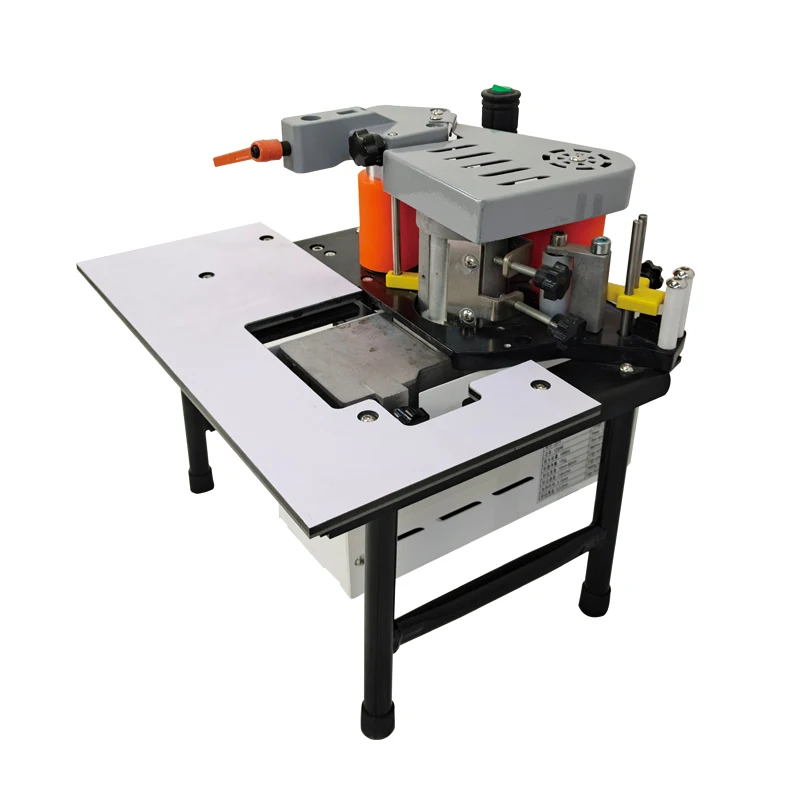
Edge banding machine
Click to enlarge
ISO 9001
CE Certified
OEM / ODM
12-Mo Warranty
Edge banding machine
Small DW400 Portable Edge Banding Machine – Entry Level for Woodworking
<p><strong>DW400 Portable Edge Banding Machine, 1000W, 0.3-3mm Band Thickness</strong> — handles straight and curved profiles across ABS, PVC, melamine, and veneer tapes. Glue pot at 1000ml supports consistent viscosity through short-batch runs, while 0.5-0.8MPa air pressure ensures clean adhesion on MDF, particleboard, and plywood substrates without visible glue lines. </p> <ul> <li>Backed by four-stage QC with pre-shipment verification</li> <li>Voltage and plug configurable to local supply standards</li> <li>Operation manual provided in your operator's language</li> </ul>
100+
Countries
MOQ 1
Unit
15-25 Days
Lead Time
220V
ABS PVC Veneer
Curved Edge Banding
DW400
Edge Banding Machine
Portable Edge Bander
Process Application
Woodworking Process
- Full OEM/ODM support -- custom logo, voltage (110V-440V), multilingual panels
- ISO 9001 & CE certified, 5 national patents, 60 professional engineers
- 12-month warranty, remote technical support & spare parts service
- Professional export packaging, customs clearance support, on-time delivery
Precision edge control — a portable bander delivering consistent glue lines across straight and curved profiles without a stationary line’s footprint.
Technical Specifications
| Parameter | Value |
|---|---|
| Product Type | Portable Edge Banding Machine |
| Total Power | 1000W |
| Voltage & Frequency | 220V / 380V / customization available |
| Edge Banding Height | 0–50 mm |
| Edge Banding Thickness | 0.3–3 mm |
| Minimum Sheet Length | 250 mm |
| Minimum Sheet Width | 30 mm |
| Glue Pot Capacity | 1000 ml |
| Air Source Pressure | 0.5–0.8 MPa |
| Edge Trimming Power | 20W |
| Product Size | 380 × 350 × 350 mm |
| Product Weight | 12 kg |
| Compatible Edge Banding Tape | ABS, PVC, Melamine, Veneer |
| Edge Type | Straight and curved |
| Plug Options | EU, USA, AU, UK |
| Language Options | Chinese and English standard; other languages customizable |
Application Suitability
| Application | Material or Output |
|---|---|
| Custom cabinet door edge finishing | MDF and particleboard with PVC or ABS tape |
| Curved shelving and shaped panel banding | Plywood and blockboard with veneer or melamine |
| On-site interior fit-out joinery | Installed panels with straight and curve edge profiles |
| Small-batch furniture prototyping | Solid wood panels with thin veneer banding |
| Joinery workshop scale-up from manual finishing | MDF, particleboard, and plywood substrates |
Why Glue Lines Show Up on MDF but Not on Plywood — and What a Portable Setup Means for That
Substrate porosity and glue temperature interact differently on every material, and a portable machine forces you to manage that interaction manually at each station.
I once watched a small cabinet shop run PVC tape over MDF on a portable unit and get clean edges all morning — then switch to particleboard after lunch and see the glue squeeze out in thin ridges along every curve. The machine had not changed, the operator had not changed, but the substrate had. Particleboard absorbs heat faster and draws moisture from hot-melt adhesive at a different rate. Without a pre-milling station or an adjustable glue roller, the operator must compensate by adjusting feed pace and temperature on the fly [NEED_CITE: substrate thermal absorption rates in edge banding applications]. That woodworking process portable edge banding machine demands real attention from whoever is pushing the panel through.
How Curve Radius Changes Glue Behaviour on a Handheld Unit
When you band a straight edge, gravity and feed direction work together — the tape seats flat, the glue spreads evenly, and trimming is straightforward. Introduce a curve and the tape is under tension on the outer face while compressing on the inner face. A radius tighter than the tape’s natural bend will cause the veneer or melamine to lift at the edges before the adhesive cures. The DW400 handles both straight and curved edges, but the operator must slow feed speed on tighter radii to let the 1000 ml glue pot maintain consistent viscosity at the contact point. Rushing a curve is where most visible glue lines originate on shaped panels, and no amount of downstream sanding fully hides that.
Banding Material Compatibility and the Heat Problem
ABS, PVC, melamine, and veneer each respond to hot-melt adhesive differently. PVC softens at a relatively low temperature and conforms to slight panel irregularities without much pressure. Veneer, by contrast, is stiff and porous — it absorbs glue quickly, which means the open time before it sets is shorter. On a portable woodworking process portable edge banding machine, there is no enclosed heating tunnel to maintain the tape at an elevated temperature before it meets the panel. The operator controls adhesion through feed speed and manual pressure [NEED_CITE: hot-melt adhesive open time by banding material type]. Melamine tape sits in between — it does not absorb glue like veneer, but it also does not stretch like PVC around curves. Knowing which material is on the bench and adjusting the glue pot temperature accordingly is the difference between a clean edge and a reject.
Reading the Specs That Actually Affect Your Edge Finish
The 0.3–3 mm edge banding thickness range determines what trimming effort looks like downstream. At 0.3 mm, a veneer tape trims almost flush with the panel surface — minimal scraping needed, but the tape is fragile during handling. At 3 mm, an ABS tape provides impact resistance for furniture edges but leaves a thicker glue bead that must be trimmed or scraped flush before assembly. The air source pressure requirement of 0.5–0.8 MPa is not optional: without a stable compressed air supply, the glue roller pressure fluctuates, producing uneven adhesive coverage that shows up as starved spots or squeeze-out depending on where the pressure dropped. The 1000 ml glue pot capacity supports short production runs comfortably, but continuous banding over several hours will require a refill — and pausing mid-run to refill the pot disrupts temperature stability, affecting the next panel’s glue line.
What Happens When the Voltage Spec Gets Skipped
I shipped a portable edge bander to a small overseas workshop once and did not lock down their local frequency before it left the dock. The machine arrived, the operator plugged it in, and the breaker tripped immediately. That workshop sat with a silent floor for weeks while they sourced a transformer retrofit. On a portable woodworking process portable edge banding machine, voltage and frequency are not academic — the glue pot heater and the trimming motor both depend on correct supply [NEED_CITE: voltage and frequency standards by export market]. A heater running on 50 Hz instead of 60 Hz will not reach set temperature, and the glue viscosity stays too high for clean application. Always confirm your site’s electrical specification before the unit ships, including whether the plug type matches your workshop outlets or if an adapter is needed for the compressor connection.
Why This Configuration Works for Small-Scale Edge Work
The 12 kg weight and compact 380 × 350 × 350 mm footprint mean this unit can sit on a workbench in a tight joinery shop or be carried to a fit-out site without a forklift. Straight and curved edge capability on a single unit means a small team does not need two separate machines when a job mixes cabinet sides with arched display panels. The glue pot and trimming head are integrated, so there is no external feed system to align — reducing the setup time that stalls production in a small workshop. Custom plug options across EU, USA, AU, and UK configurations reduce the risk of the voltage mismatch I have seen sideline equipment for weeks. The ability to handle ABS, PVC, melamine, and veneer on one machine means material changes during a short run do not require a different bander.
Documentation & Verification
- Electrical schematic confirming your specified voltage and frequency before dispatch
- Operation manual in the agreed operator language with glue temperature charts per banding material
- Factory test record showing edge banding output on your substrate and tape combination
- Spare parts list covering glue pot elements, trimming blades, and air fittings
- Packing photographs documenting unit condition at point of shipment
Installation, Commissioning & Support
- Connect to a dedicated circuit matching the confirmed voltage specification — the 1000W total draw requires a stable supply
- Verify air compressor output meets the 0.5–0.8 MPa requirement before first glue pot fill
- The 12 kg unit mounts to any flat workbench — no foundation or anchoring required
- Run test panels on your actual substrate to calibrate glue temperature before production begins
- Confirm the manual language matches your operator’s reading language before commissioning
What We Need from Your Side
To configure this machine correctly for your workshop, we need your standard panel materials and the banding tape types you run most often. Send us your site voltage and frequency so we can set the electrical specification before production. If your team operates in a language other than Chinese or English, let us know early so the manual and control labels are prepared accordingly.
Frequently Asked Questions
Q: Which banding material works best on MDF versus particleboard, and why does glue adhesion differ?
A: PVC adheres well to MDF because both are relatively smooth and consistent, allowing the hot-melt to spread evenly. Particleboard is more porous and absorbs adhesive moisture faster, which can starve the glue line. Veneer behaves similarly on particleboard but requires higher glue pot temperature. We recommend a sample test on your actual substrate before committing to a tape supplier.
Q: How does curved edge banding differ from straight in feed technique and final trim quality?
A: On curves, the tape stretches on the outer radius and compresses on the inner radius, requiring slower feed speed to prevent lifting. Glue application must be consistent through the curve, which is harder to maintain by hand. Trimming curved edges takes more care because the blade must follow the contour. The DW400 supports both profiles, but operator technique directly affects the final edge finish.
Q: What air pressure and glue temperature settings produce clean edges without visible glue lines?
A: The machine requires 0.5–0.8 MPa air pressure to maintain consistent glue roller contact. Too low, and you get starved spots; too high, and glue squeezes past the tape edge. Glue temperature depends on the tape material — PVC runs cooler than veneer. We provide temperature charts in the operation manual for each banding material type, and we recommend test runs before full production.
Q: How do I confirm voltage and frequency compatibility before the machine ships?
A: Provide your workshop’s supply voltage and frequency along with your preferred plug type from the EU, USA, AU, or UK options. We configure the glue pot heater and trimming motor to match. This step must be completed before production — retrofitting electrical components after arrival causes extended downtime that we have seen cost small shops weeks of work.
Q: What edge banding thickness range is compatible with my panel assembly tolerances?
A: The 0.3–3 mm range covers thin veneer for fine furniture up to thick ABS for impact-resistant cabinet edges. Thicker banding leaves a wider glue line that requires trimming before the panel enters assembly. If your downstream joinery has tight fit tolerances, specify the banding thickness carefully — excess material after trimming can interfere with hinge boring or dowel alignment if not accounted for.
Technical Specifications
| Parameter | Value |
|---|---|
| Product Name | Small DW400 Portable Edge Banding Machine – Entry Level for Woodworking |
| Category | Edge banding machine |
| Voltage Options | 110V / 220V / 380V / 440V (customizable) |
| Frequency | 50Hz / 60Hz (customizable) |
| Certification | ISO 9001, CE |
| MOQ | 1 Unit |
| Lead Time | 15-25 Working Days |
| Warranty | 12 Months |
| OEM / ODM | Available -- logo, color, panel language |
* Detailed technical specifications vary by model. Please contact us with your specific requirements for a complete datasheet.
Shipping & Export
-
Export Packaging
Heavy-duty wooden crate with foam padding and moisture protection
-
Shipping Methods
Sea freight (FCL/LCL), air freight, express -- we support all methods
-
Customs Support
Full documentation: CO, commercial invoice, packing list, HS code assistance
-
Port of Loading
Tianjin / Qingdao port, China -- 20 years export experience
OEM / ODM Services
-
Logo & Branding
Custom logo printing, color scheme, and nameplate engraving
-
Voltage Configuration
110V / 220V / 380V / 440V, 50Hz / 60Hz -- any region supported
-
Multilingual Panels
Control panels in English, Spanish, French, Arabic and more
-
Custom Specifications
Modified dimensions, accessories, or feature sets on request
Get a Quote
Request Product Inquiry
Fill in your details and we'll respond within 24 hours with pricing and availability.
Direct Contact
How It Works
-
1
Confirm requirements & budget
Tell us your factory scale and processing needs
-
2
Receive recommendation & quote
We match the right machine with full specs
-
3
Negotiate & place order
OEM terms, voltage, payment and delivery
-
4
Production & QC inspection
Multi-stage quality control by 60 engineers
-
5
Export packaging & shipment
Professional packing, customs clearance
-
6
After-sales support
12-month warranty, remote tech support
You May Also Like