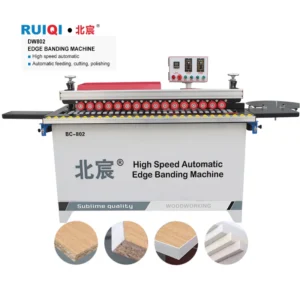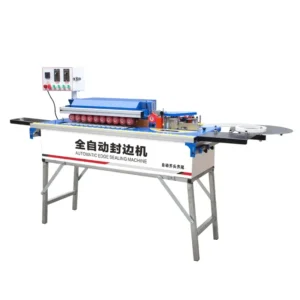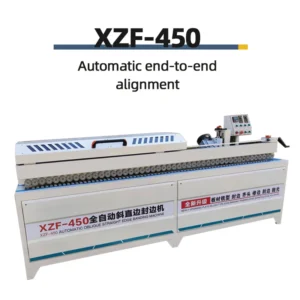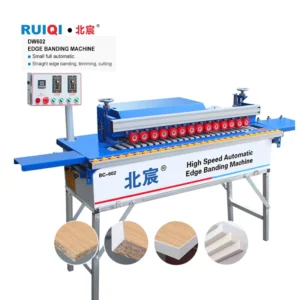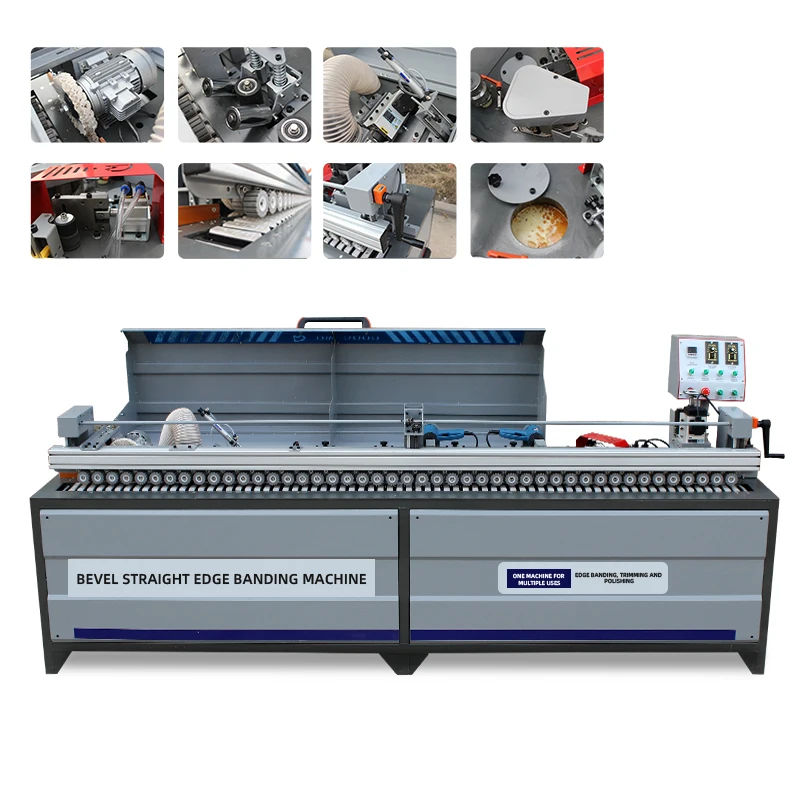
Edge banding machine
Click to enlarge
ISO 9001
CE Certified
OEM / ODM
12-Mo Warranty
Edge banding machine
Automatic Edge Banding Machine for MDF Board – Process Guide
<p><strong>DW3000 Automatic Edge Banding Machine, 11KW Total Power, 0-12M/min Feed Speed</strong> — engineered for MDF, plywood, and particleboard edge processing with dual hot air heating (2.2KW×2) and 8-set adjustable oblique pressure wheels for 30-90° bevel and straight edge banding.</p> <ul> <li>Pre-milling station (2.2KW) prepares panel edges for superior glue adhesion, addressing substrate density variations across MDF grades and particleboard compositions</li> <li>3 spindle motors with dedicated trimming and flexible edge scraper deliver clean glue line removal without surface damage on 0.3-3MM PVC and veneer banding materials</li> <li>Double cylinder feeding belt with auxiliary slide maintains consistent material flow for panels from 15CM minimum width, supporting both custom furniture factories and cabinet makers switching between edge banding types</li> </ul> <p>Request factory test records with your actual substrate and edge banding combination, verify voltage and frequency match your facility's electrical system before production, and confirm operation manuals will arrive in your operator's language with pre-shipment verification covering all functional stations.</p>
100+
Countries
MOQ 1
Unit
15-25 Days
Lead Time
380V
DW3000
Edge Banding Machine
MDF Board
Plywood Panel
Pre-milling Motor
Process And Application
- Full OEM/ODM support -- custom logo, voltage (110V-440V), multilingual panels
- ISO 9001 & CE certified, 5 national patents, 60 professional engineers
- 12-month warranty, remote technical support & spare parts service
- Professional export packaging, customs clearance support, on-time delivery
Engineer-Led Configuration — Every DW3000 quotation starts with substrate, banding material, and daily runtime confirmed before specs are locked.
Technical Specifications
| Parameter | Value |
|---|---|
| Model | DW3000 |
| Product Type | Automatic Edge Banding Machine |
| Total Power | 11 kW |
| Voltage | 380V / 415V (basis not stated in source — confirm frequency and phase) |
| Pre-milling Motor | 2.2 kW |
| Heating Power | 2.2 kW × 2 (dual hot air) |
| Feed Speed | 0–12 m/min |
| Feed Motor Power | 160 W |
| Transmission Motor Power | 180 W |
| Trimming Motor Power | 2.2 kW × 2 (spindle trimming, 3 spindle motors total) |
| Polishing Motor Power | 0.4 kW × 2 |
| Vacuum Power | 550 W |
| Glue Pot Capacity | 4000 ml |
| Air Source Pressure | 0.5–0.7 MPa |
| Edge Banding Height | 0–50 mm |
| Edge Banding Thickness | 0.3–3 mm |
| Minimum Sheet Length | 30 cm |
| Minimum Sheet Width | 15 cm |
| Overall Dimensions (L×W×H) | 299 × 65 × 130 cm |
| Net Weight | 430 kg |
| Pressure Wheel System | 8 sets, adjustable 30–90° oblique |
| Standard Functions | Pre-milling, 30–90° bevel and straight edge banding, slotting, trimming, scraping, polishing, vacuuming |
| Language Options | Chinese, English (customizable to Spanish or other languages) |
| Plug Options | EU, USA, AU, UK |
| Assembly State | Fully assembled |
| Standards | CE, ISO 9001 |
Application Suitability
| Application | Material or Output |
|---|---|
| Custom cabinet door and carcass edge finishing | MDF and particleboard with PVC edge banding |
| Furniture panel straight and 45° bevel edges | Plywood panels with veneer or melamine banding |
| Small-batch bespoke joinery runs | Solid wood panels requiring adjustable pressure profiles |
| Shelving and storage unit edge processing | Melamine-faced chipboard with ABS banding |
Why Visible Glue Lines Persist Across Different Panel Substrates
Substrate density and edge banding material must drive the temperature and pressure settings, not a generic factory default.
I have watched production managers accept a machine after a successful trial on melamine-faced chipboard, only to discover visible glue lines the moment they switch to raw MDF or plywood. The problem is not the glue itself — it is the heat profile and contact pressure that were never adjusted for the new substrate. MDF absorbs heat differently from particleboard, and veneer reacts to pressure wheels far more sensitively than PVC. The woodworking edge banding process MDF plywood workflow demands a machine that lets operators dial in dual-zone heating and variable pressure rather than relying on a single preset [NEED_CITE: substrate-specific heat absorption rates in panel processing].
Dual Hot Air Preheating Across Varying Panel Densities
The DW3000 carries two 2.2 kW hot air units flanking the glue application zone. This dual-zone arrangement lets the operator set a higher preheat temperature for dense MDF while keeping a gentler profile for thinner plywood or particleboard, directly addressing the adhesion inconsistency that plagues single-heater machines in mixed-material woodworking edge banding process MDF plywood production.
Adjustable Pressure Wheels for Bevel and Straight Profiles
Eight sets of oblique pressure wheels adjust through a 30–90° range, maintaining uniform contact whether the panel edge is square-cut or bevelled at 45°. Consistent pressure across the entire banding height prevents the partial-bond failures that typically appear only after the panel reaches the trimming station — or worse, after it reaches the customer [NEED_CITE: pressure uniformity standards for edge adhesion on angled profiles].
Spindle Trimming and Flexible Scraping for Clean Glue Lines
Three spindle motors handle trimming duties, including a dedicated spindle trimmer paired with a flexible edge scraper. This combination removes residual glue squeeze-out without scoring the panel surface — a critical step when processing veneer banding on plywood, where even minor surface damage is visible after finishing. The pre-milling station upstream, driven by a 2.2 kW motor, squares the panel edge before glue application, ensuring the bond surface is flat and free of saw marks that would otherwise telegraph through thin banding materials.
What Feed Speed and Glue Pot Capacity Mean for Daily Output
The variable feed speed of 0–12 m/min allows operators to slow down for thick veneer on curved-edge panels or accelerate for high-volume PVC runs on particleboard. The 4000 ml glue pot provides enough adhesive volume for sustained runs without frequent refills, reducing thermal cycling that can degrade glue consistency. When evaluating the woodworking edge banding process MDF plywood setup, matching feed speed to banding thickness is essential — running 3 mm PVC at maximum feed speed risks incomplete adhesion, while running 0.3 mm veneer too slowly can overheat and warp the material.
The Hidden Cost of Skipping Substrate Trials
When a machine is configured for a single material combination and shipped without testing the buyer’s actual substrate and banding pairing, the consequences surface on day one of production. Veneer cracks under pressure settings meant for PVC. Glue beads remain visible on MDF because the hot air temperature was set for denser particleboard. The production line stops while operators experiment with parameters that should have been documented before the machine left the factory [NEED_CITE: common causes of commissioning delays in woodworking machinery installation].
What This Machine Brings to Your Workshop
In-house manufacturing with patented cutting mechanisms means the pre-milling and trimming spindles are built and inspected under one roof, not assembled from mismatched third-party components. Voltage options spanning 380V to 415V with plug configurations for EU, USA, AU, and UK markets mean the electrical system is configured before shipment rather than adapted on-site. The four-stage QC process covers incoming material inspection through pre-shipment verification, so the test record you receive reflects actual functional testing of every station — pre-milling, gluing, trimming, scraping, and polishing. Engineer-led configuration ensures the quotation you receive accounts for your specific panel thickness range, banding material, and daily runtime rather than a generic catalog price. Operation and maintenance manuals are delivered in the language your operators actually read, eliminating the commissioning stalls caused by untranslated control panels [NEED_CITE: importance of localized documentation in industrial equipment deployment].
Documentation & Verification
- Factory test record processed on your specific MDF or plywood thickness before dispatch
- Electrical schematic confirming voltage, phase, and frequency matched to your facility supply
- Operation and maintenance manual delivered in your chosen operator language
- CE declaration of conformity covering the complete machine assembly
- Pre-shipment photographs documenting all functional stations and cosmetic condition
Installation, Commissioning & Support
- 299 × 65 × 130 cm footprint requires level concrete floor with 130 cm overhead clearance
- 11 kW total draw requires dedicated circuit; confirm 380V or 415V three-phase supply before wiring
- Arrives fully assembled — position, level, connect air at 0.5–0.7 MPa, and power on
- First-run parameter calibration for your substrate and banding thickness conducted with operator present
- Spare parts list identifies wear items: scraper blades, pressure wheel surfaces, trimming cutters
- Glue pot and hot air units require scheduled cleaning cycle to maintain adhesive consistency
Before You Request a Quote
To receive an accurate configuration for the woodworking edge banding process MDF plywood workflow in your facility, share your primary panel substrate and thickness range, the edge banding materials you run most frequently, and your local voltage and frequency specification. If you process both straight and 45° bevel edges, note the approximate ratio so the pressure wheel setup can be optimized before shipment.
Frequently Asked Questions
Q: How does dual hot air heating affect glue adhesion on different MDF densities?
A: The two independent 2.2 kW heaters allow separate temperature zones before and during glue application. Denser MDF grades absorb more heat, so the upstream zone can run hotter to prepare the surface, while the downstream zone maintains optimal glue viscosity. This staged approach prevents the cold-bond failures common when a single heater tries to serve all substrate densities.
Q: What edge banding materials are compatible with the 0.3–3 mm thickness range?
A: The DW3000 handles PVC, ABS, melamine, and wood veneer within this range. Thicker PVC and ABS banding benefits from reduced feed speed and higher hot air temperature, while thin veneer requires gentler pressure wheel settings to avoid cracking. Confirm your specific material before the factory test run.
Q: How does pre-milling affect panel edge quality and downstream assembly fit?
A: The 2.2 kW pre-milling station removes saw marks and edge irregularities before banding, creating a flat bond surface. This directly improves edge band adhesion and ensures the trimmed profile is flush with the panel face, which is critical when panels must meet tight assembly tolerances in cabinet carcass construction.
Q: What substrate and banding combinations should I test before committing to production?
A: Request factory test runs using your actual panel material and banding stock. At minimum, test your most common MDF or plywood thickness with your primary PVC or veneer banding at the feed speed you intend to run in production. Review the trimmed and scraped edge quality before authorizing shipment.
Q: How do I verify trim and scrape quality on my panel material before the machine ships?
A: Ask for pre-shipment sample panels processed through all stations — pre-milling, gluing, trimming, scraping, and polishing. Inspect the edge profile for flush trimming, absence of visible glue lines, and surface finish quality. Request photographs documenting each station’s output on your specific material combination.
Technical Specifications
| Parameter | Value |
|---|---|
| Product Name | Automatic Edge Banding Machine for MDF Board – Process Guide |
| Category | Edge banding machine |
| Voltage Options | 110V / 220V / 380V / 440V (customizable) |
| Frequency | 50Hz / 60Hz (customizable) |
| Certification | ISO 9001, CE |
| MOQ | 1 Unit |
| Lead Time | 15-25 Working Days |
| Warranty | 12 Months |
| OEM / ODM | Available -- logo, color, panel language |
* Detailed technical specifications vary by model. Please contact us with your specific requirements for a complete datasheet.
Shipping & Export
-
Export Packaging
Heavy-duty wooden crate with foam padding and moisture protection
-
Shipping Methods
Sea freight (FCL/LCL), air freight, express -- we support all methods
-
Customs Support
Full documentation: CO, commercial invoice, packing list, HS code assistance
-
Port of Loading
Tianjin / Qingdao port, China -- 20 years export experience
OEM / ODM Services
-
Logo & Branding
Custom logo printing, color scheme, and nameplate engraving
-
Voltage Configuration
110V / 220V / 380V / 440V, 50Hz / 60Hz -- any region supported
-
Multilingual Panels
Control panels in English, Spanish, French, Arabic and more
-
Custom Specifications
Modified dimensions, accessories, or feature sets on request
Get a Quote
Request Product Inquiry
Fill in your details and we'll respond within 24 hours with pricing and availability.
Direct Contact
How It Works
-
1
Confirm requirements & budget
Tell us your factory scale and processing needs
-
2
Receive recommendation & quote
We match the right machine with full specs
-
3
Negotiate & place order
OEM terms, voltage, payment and delivery
-
4
Production & QC inspection
Multi-stage quality control by 60 engineers
-
5
Export packaging & shipment
Professional packing, customs clearance
-
6
After-sales support
12-month warranty, remote tech support
You May Also Like