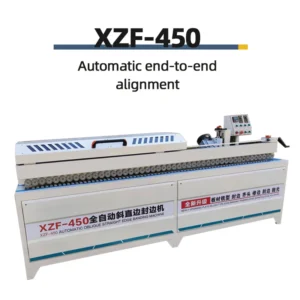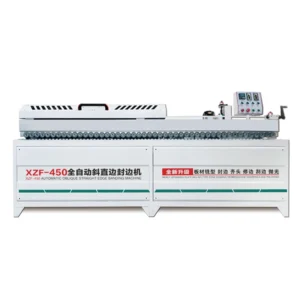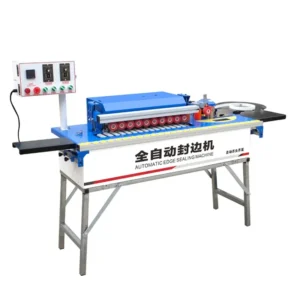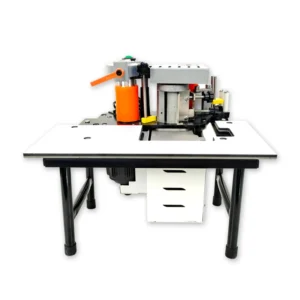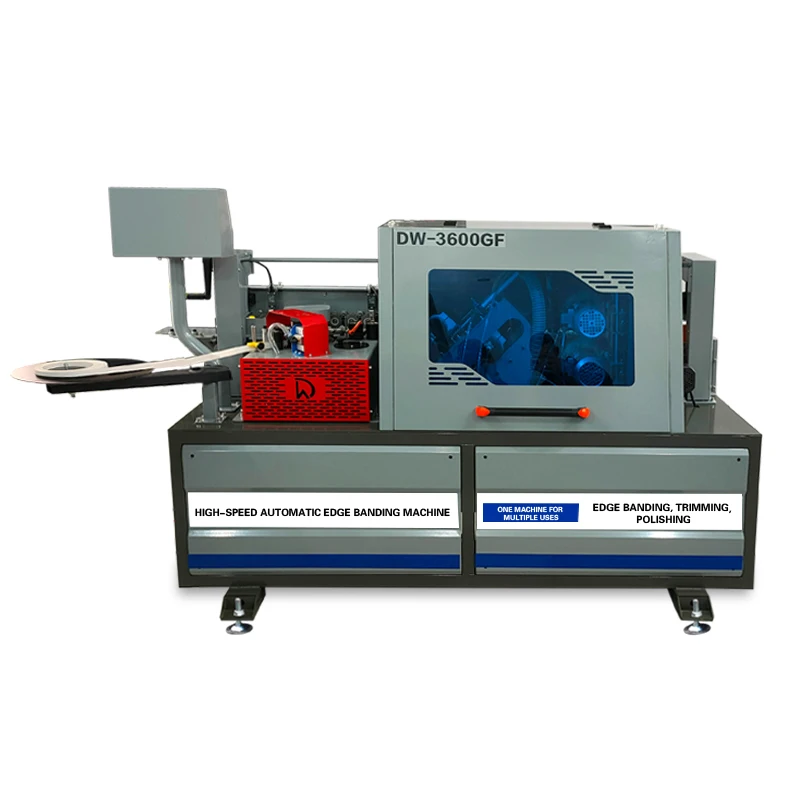
Edge banding machine
Click to enlarge
ISO 9001
CE Certified
OEM / ODM
12-Mo Warranty
Edge banding machine
DW-3600GF Edge Banding Machine for MDF Panel – Process Guide
<p><strong>DW-3600GF Automatic Edge Banding Machine, 380V Three-Phase, 0.3–3mm Band Thickness, 0–14m/min Feed</strong> — delivers a 7-function straight-edge process from gluing through polishing and vacuuming, controlling glue-line visibility and trimming tear-out on MDF, particleboard and plywood substrates. High-frequency 24,000 r/min trimming motors produce chip-free edges on melamine-faced panels, supporting consistent downstream assembly tolerances in cabinet and furniture production.</p> <ul> <li>Backed by four-stage QC with pre-shipment verification on your actual panel material and banding stock</li> <li>Voltage, plug type and control panel language customized to your workshop before dispatch</li> <li>Engineer-led configuration review with formal specification confirmation within 24 hours</li> </ul>
100+
Countries
MOQ 1
Unit
15-25 Days
Lead Time
380V Three-phase
7-Function Automatic
DW-3600GF
Edge Banding Machine
MDF Panel
Plywood Panel
Process Application
- Full OEM/ODM support -- custom logo, voltage (110V-440V), multilingual panels
- ISO 9001 & CE certified, 5 national patents, 60 professional engineers
- 12-month warranty, remote technical support & spare parts service
- Professional export packaging, customs clearance support, on-time delivery
Verified Tolerance in Production — Every DW-3600GF edge banding machine process application is validated through a four-stage QC protocol that includes pre-shipment testing on your actual panel substrates, ensuring ±0.02mm accuracy translates from specification to finished furniture.
Technical Specifications
| Parameter | Value |
|---|---|
| Model | DW-3600GF |
| Product Type | Automatic Edge Banding Machine |
| Voltage & Frequency | 380V Three-Phase Four-Wire |
| Total Power | 4.9 kW |
| Overall Dimensions (L×W×H) | 2200×650×1250 mm |
| Net Weight | 320 kg |
| Edge Banding Type | Straight Edge Banding |
| Edge Band Height Range | 0–50 mm |
| Edge Band Thickness Range | 0.3–3 mm |
| Minimum Plate Length | 200 mm |
| Feed Speed | 0–14 m/min |
| Edge Banding Motor Power | 160 W |
| Transmission Motor Power | 180 W |
| Trimming Motor Power | 800 W × 2 |
| Trimming Speed | 24,000 r/min |
| Polishing Motor Power | 400 W × 2 |
| Air Supply Requirement | 0.4–0.6 MPa |
| Standard Functions | Gluing, Trimming, Front & Rear Trimming, Scraping, Polishing, Vacuuming |
| Control Panel Language | Chinese / English standard; Spanish and other languages customizable |
| Plug Options | EU / USA / AU / UK |
Application Suitability
| Application | Material or Output |
|---|---|
| Custom cabinet door production | MDF and melamine-faced particleboard with PVC or melamine edge banding |
| Plywood furniture components | Plywood substrates with veneer or PVC banding to conceal laminated core |
| Mixed-material workshop runs | MDF, particleboard and plywood processed sequentially without recalibration |
| Small-batch joinery output | Straight-edge panels for frameless cabinet and shelving assembly |
Why Glue Lines Appear on Some Substrates but Not Others — and What the Edge Banding Machine Process Application Must Control
Visible glue seams are a process failure, not a material defect — the edge banding machine process application must match glue open time to substrate porosity.
Production managers encounter this repeatedly: MDF panels come off the line with clean, nearly invisible seams, while the next batch of particleboard shows pronounced glue lines along every edge. The inconsistency is not random. Porous substrates absorb adhesive differently, and the feed speed determines how long the glue remains open before the trimming station engages. When that relationship is mismanaged, the edge banding machine process application fails exactly where the customer will notice — at the visible joint [NEED_CITE: substrate porosity effects on hot-melt adhesive bonding].
How Substrate Porosity Dictates Feed Speed and Glue Behaviour
The DW-3600GF operates across a feed speed range of 0–14 m/min, which directly governs the interval between adhesive application and edge trimming. On porous MDF, a slower feed rate allows the hot-melt glue to penetrate the fibre structure before pressure from the banding roller sets the bond. Particleboard, being denser and less absorptive, requires a faster feed to prevent squeeze-out that manifests as a visible bead along the seam. The edge banding machine process application depends on the operator understanding this relationship and adjusting the variable-speed transmission accordingly rather than running a single setting across all materials.
Edge Band Thickness, Trimming Load and Surface Finish
Processing banding materials from 0.3 mm thin PVC up to 3 mm thick veneer or solid-wood lipping places different demands on the trimming and scraping stations. Thin PVC trims cleanly at high spindle speeds but requires careful scraping to avoid rounding the arris. Thicker banding demands more cutting force from the 800 W × 2 trimming motors, and the 24,000 r/min spindle speed must be maintained to prevent tear-out on melamine-faced chipboard. The edge banding machine process application covers this full material range within a single 7-function sequence — gluing, trimming, front and rear trimming, scraping, polishing and vacuuming — so the production manager does not need to swap tooling between jobs [NEED_CITE: trimming speed requirements for melamine-faced panel edge finishing].
Trimming Spindle Speed and Chip-Free Edges on Melamine-Faced Board
Melamine-faced chipboard is among the most common substrates in cabinet manufacturing, yet its brittle surface layer chips easily during trimming. The DW-3600GF addresses this with dual trimming motors running at 24,000 r/min, producing a cut that shears the melamine layer cleanly rather than fracturing it. Lower spindle speeds leave micro-chips along the trimmed edge that become visible under workshop lighting and fail visual inspection at the assembly bench. For a production manager evaluating the edge banding machine process application, the trimming motor specification is the single most relevant indicator of whether finished panels will pass downstream quality gates without rework.
What Happens When Feed Rate and Glue Temperature Are Mismatched
Setting the feed speed too high for the glue temperature causes cold bonding — the adhesive does not achieve adequate wetting on the substrate surface before the banding is pressed into place. The result is an edge that appears bonded at the trimming station but delaminates during scraping or, worse, after the panel reaches the customer’s assembly line. Conversely, excessive glue temperature at slow feed speeds causes thermal degradation of the adhesive, producing a stringy, discoloured seam. The seven-station process sequence on this machine exposes these failures progressively: a poorly bonded edge will show separation at the scraping station, giving the operator immediate feedback before the panel completes the line [NEED_CITE: hot-melt adhesive temperature and open time parameters for wood panel edge banding].
The Hidden Cost of Ignoring Process Parameters During Installation
Machines arrive at workshops and are powered on without a process validation run on the actual materials the shop will produce. Operators default to mid-range settings and discover problems only when assembled cabinets reveal inconsistent edge quality across different panel types. Rework at the assembly stage — sanding visible glue lines, replacing delaminated banding, re-running entire batches — consumes far more labour than a proper commissioning run would have required. The edge banding machine process application demands that the first hour of production time be invested in test panels across every substrate the workshop handles, verifying glue-line appearance and trimming finish before full-volume output begins.
Why Sourcing This Edge Bander Through an Engineer-Led Configuration Process Matters
The manufacturer provides engineer-led configuration recommendations with a formal quotation within 24 hours, ensuring the DW-3600GF is specified against your actual panel materials and production volume rather than sold as a generic catalogue item. In-house manufacturing with patented cutting mechanisms means the trimming accuracy claimed in the specification sheet is verifiable through a factory test record on your substrates. Voltage, control panel language and plug type are confirmed before production — the 380V three-phase configuration, language options and EU/USA/AU/UK plug selections are locked in at the quotation stage. A four-stage QC protocol covering incoming material through pre-shipment verification catches assembly and electrical faults before the machine leaves the factory. Factory visits are welcomed, so production managers can witness the edge banding machine process application running on their own material samples before authorising shipment [NEED_CITE: pre-shipment testing protocols for woodworking machinery exports].
Documentation & Verification
- Machine specification sheet listing all seven function stations with individual motor power ratings
- Electrical schematic confirming 380V three-phase wiring and plug type for your market
- Factory test record documenting edge quality on your specific panel substrates and banding materials
- Operation and maintenance manual in your agreed language covering glue-pot setup and feed-speed calibration
- Spare parts list identifying trimming cutters, scraping blades and polishing wheels by part number
Installation, Commissioning & Support
- 2200×650 mm footprint requires level concrete floor with clearance for panel infeed and outfeed
- 4.9 kW total load demands a dedicated 380V three-phase circuit with appropriate breaker rating
- Arrives as a single 320 kg unit; position with pallet jack and level before energising
- First commissioning run should process test panels across your full substrate range at varying feed speeds
- Trimming cutters and scraping blades require periodic inspection; schedule based on banding material abrasiveness
- Daily vacuuming of the glue pot area prevents adhesive buildup that affects banding roller pressure
What to Include in Your Enquiry
Provide the panel substrates you process most frequently — MDF, particleboard, plywood or a combination — along with the edge banding materials and thicknesses you run. Specify your workshop voltage and frequency so the electrical configuration is confirmed before production. Indicate whether your operators need the control panel in a language beyond Chinese or English, and whether you require a sample processing test on your own material stock before dispatch.
Frequently Asked Questions
Q: How does substrate type affect glue-line visibility and what process adjustments are needed?
A: Porous MDF absorbs hot-melt adhesive readily, allowing a slower feed speed for strong bonding. Denser particleboard requires faster feed to prevent squeeze-out. Plywood falls between the two but demands attention to grain direction during trimming. On the DW-3600GF, the operator adjusts feed speed within the 0–14 m/min range and monitors glue-line appearance at the scraping station to confirm the bond before panels proceed to assembly.
Q: What edge banding materials are compatible and how does thickness affect trimming quality?
A: The DW-3600GF handles PVC, melamine and veneer banding from 0.3 mm to 3 mm thick. Thin PVC trims easily but requires careful scraping to preserve a sharp arris. Thicker veneer demands full cutting force from the 800 W dual trimming motors at 24,000 r/min to avoid tear-out. Material choice directly influences the trimming load and the scraping finish the operator should expect at the final stations.
Q: How do I set feed speed and glue temperature for different panel materials?
A: Start with the glue manufacturer’s recommended temperature for your adhesive type, then set feed speed based on substrate porosity — slower for MDF, faster for sealed particleboard. Run test panels and inspect the glue line at the scraping station. Cold bonding shows as edge separation; excessive temperature produces stringy, discoloured adhesive. The DW-3600GF variable feed and independent glue-pot control allow fine-tuning without stopping the line.
Q: What causes chipping during trimming on melamine-faced boards and how is it prevented?
A: Chipping occurs when the trimming cutter fractures the brittle melamine surface rather than shearing it cleanly. Maintaining the 24,000 r/min spindle speed on both trimming motors is essential — worn or dull cutters and lower speeds both produce micro-chips visible under workshop lighting. Regular cutter inspection and replacement according to the spare parts list keeps the edge chip-free through the full production run.
Q: How does edge banding accuracy affect downstream assembly tolerances?
A: Panels with inconsistent edge banding thickness or visible glue lines cause alignment issues during frameless cabinet assembly, where joint gaps become visible to the end customer. The seven-function process on the DW-3600GF — through trimming, scraping and polishing — produces a flush, consistent edge that maintains panel dimensions within assembly tolerances, reducing rework at the fitting bench and preventing rejected deliveries.
Technical Specifications
| Parameter | Value |
|---|---|
| Product Name | DW-3600GF Edge Banding Machine for MDF Panel – Process Guide |
| Category | Edge banding machine |
| Voltage Options | 110V / 220V / 380V / 440V (customizable) |
| Frequency | 50Hz / 60Hz (customizable) |
| Certification | ISO 9001, CE |
| MOQ | 1 Unit |
| Lead Time | 15-25 Working Days |
| Warranty | 12 Months |
| OEM / ODM | Available -- logo, color, panel language |
* Detailed technical specifications vary by model. Please contact us with your specific requirements for a complete datasheet.
Shipping & Export
-
Export Packaging
Heavy-duty wooden crate with foam padding and moisture protection
-
Shipping Methods
Sea freight (FCL/LCL), air freight, express -- we support all methods
-
Customs Support
Full documentation: CO, commercial invoice, packing list, HS code assistance
-
Port of Loading
Tianjin / Qingdao port, China -- 20 years export experience
OEM / ODM Services
-
Logo & Branding
Custom logo printing, color scheme, and nameplate engraving
-
Voltage Configuration
110V / 220V / 380V / 440V, 50Hz / 60Hz -- any region supported
-
Multilingual Panels
Control panels in English, Spanish, French, Arabic and more
-
Custom Specifications
Modified dimensions, accessories, or feature sets on request
Get a Quote
Request Product Inquiry
Fill in your details and we'll respond within 24 hours with pricing and availability.
Direct Contact
How It Works
-
1
Confirm requirements & budget
Tell us your factory scale and processing needs
-
2
Receive recommendation & quote
We match the right machine with full specs
-
3
Negotiate & place order
OEM terms, voltage, payment and delivery
-
4
Production & QC inspection
Multi-stage quality control by 60 engineers
-
5
Export packaging & shipment
Professional packing, customs clearance
-
6
After-sales support
12-month warranty, remote tech support
You May Also Like