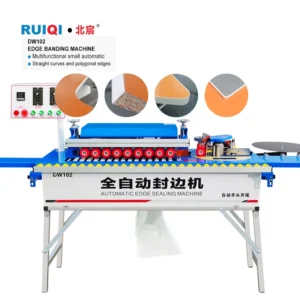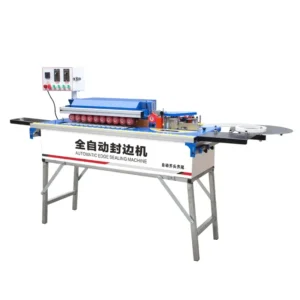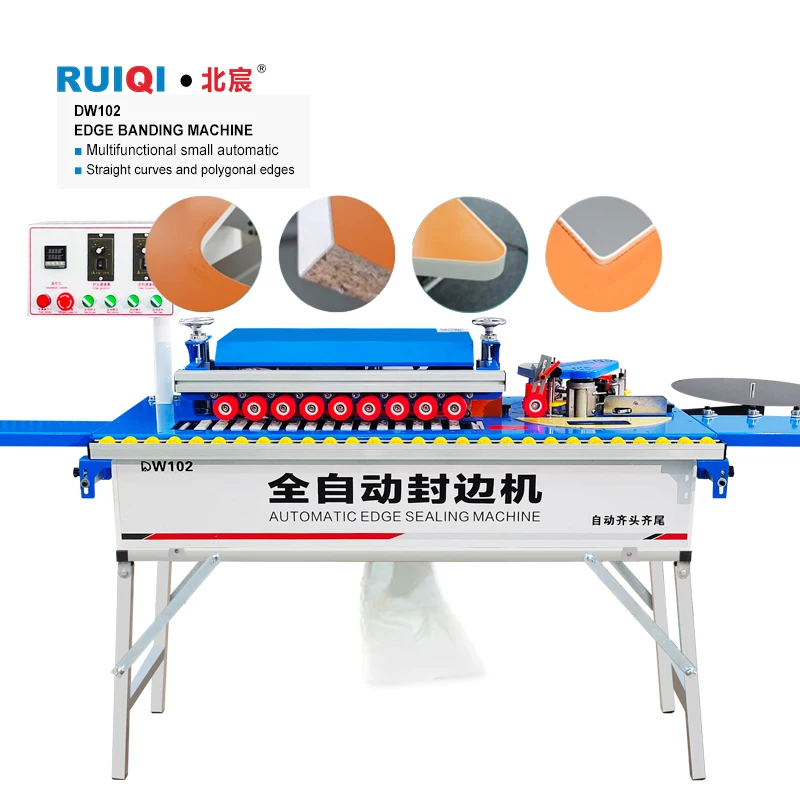
Edge banding machine
Click to enlarge
ISO 9001
CE Certified
OEM / ODM
12-Mo Warranty
Edge banding machine
DW102 Edge Banding Machine for Plywood Production – Industrial Application
<p><strong>DW102 Automatic Edge Banding Machine, 220V/380V, 0.3–3mm Banding Thickness, 0–50mm Edge Height</strong> — handles curved and straight edge banding with automatic head-and-tail cutting, trimming and polishing in a single pass.</p> <ul> <li>Processes plywood, MDF and particleboard with integrated vacuum and 1000ml glue pot for continuous runs</li> <li>Edge quality directly impacts assembly fit and visible glue-line elimination on cabinet interiors</li> </ul> <p>Backed by four-stage QC with pre-shipment verification and engineer-led configuration support for your substrate and banding material combination.</p>
100+
Countries
MOQ 1
Unit
15-25 Days
Lead Time
Automatic Head And Tail Cutting
Curved And Straight Edge Banding
DW102
Edge Banding Machine
Plywood Production
Process And Application
Vacuum Edge Banding
- Full OEM/ODM support -- custom logo, voltage (110V-440V), multilingual panels
- ISO 9001 & CE certified, 5 national patents, 60 professional engineers
- 12-month warranty, remote technical support & spare parts service
- Professional export packaging, customs clearance support, on-time delivery
Verified Process Output — Every substrate from plywood to MDF responds differently to heat, pressure and feed rate; the DW102 lets you dial in each stage so the edge banding machine woodworking process matches your exact material.
Technical Specifications
| Parameter | Value |
|---|---|
| Model | DW102 |
| Product Type | Automatic Edge Banding Machine |
| Total Power | 3800W |
| Voltage & Frequency | 220V / 380V / customizable (basis to be confirmed) |
| Minimum Sheet Length | 25 cm |
| Minimum Sheet Width | 5 cm |
| Edge Banding Height | 0–50 mm |
| Edge Banding Thickness | 0.3–3 mm |
| Trimming Power | 650W × 2 |
| Polishing Power | 180W × 2 |
| Vacuum Power | 1200W |
| Glue Pot Capacity | 1000 ml |
| Air Source Pressure | 0.5–0.8 MPa |
| Overall Dimensions (L×W×H) | 128 × 47 × 69 cm |
| Net Weight | 75 kg |
| Key Features | Curved and straight edge banding, automatic head and tail cutting, edge trimming, polishing, integrated vacuum |
| Language Options | Chinese and English standard; Spanish and other languages customizable |
| Plug Options | EU, USA, AU, UK |
Application Suitability
| Application | Material or Output |
|---|---|
| Cabinet carcass production | MDF and particleboard panels requiring clean, glue-line-free interior edges |
| Plywood furniture components | Straight and curved edge banding on custom-shaped panels |
| Polymer door manufacturing | Veneer and PVC banding on flat and profiled door blanks |
| Mid-volume joinery workshops | Automated single-pass edge finishing replacing manual routing |
| Blockboard edge treatment | Trimming and polishing of solid-wood-core panels up to 50 mm height |
Why Substrate Choice Changes Every Setting on the Edge Banding Machine Woodworking Process
The same machine produces flawless edges or visible glue lines depending on whether you run MDF, plywood, or particleboard — and most buyers discover this only after the first batch is ruined.
I worked with a cabinet maker in Shandong who ran MDF samples on a new edge bander and got perfect results. He signed the order, switched to particleboard in production, and every panel came out with uneven glue penetration and visible seams. The glue temperature, feed rate, and trimming pressure all need adjustment when you change substrates. Particleboard’s porous edge absorbs glue faster than MDF’s dense surface, and plywood’s alternating grain layers create inconsistent trimming resistance. Without testing your actual production material on the machine before it ships, you are essentially guessing. [NEED_CITE: edge adhesion behavior across wood-based panel substrates]
How the DW102 Handles the Gluing Stage Across Different Substrates
The DW102’s 1000 ml glue pot maintains consistent thermal mass during extended runs, which matters when switching between porous particleboard and dense MDF. A smaller pot loses temperature faster as cold panels pass through, causing the glue to thicken mid-run and leave uneven coverage. On this machine, the air supply requirement of 0.5–0.8 MPa ensures the glue roller applies uniform pressure regardless of edge density variations. The edge banding machine woodworking process depends heavily on this consistency — a drop in air pressure shows up immediately as starved glue lines on plywood end grain.
Curved and Straight Edges in One Setup
Many small and mid-size workshops handle both straight cabinet sides and curved countertop profiles. Sending curved components to a secondary manual routing station adds handling time and introduces alignment errors that affect downstream assembly. The DW102 processes both geometries without reconfiguration, which means the operator feeds the part once and the machine handles the contour change through the trimming and polishing stations. For plywood furniture producers running batch-of-one custom orders, eliminating that second handling step removes a frequent source of edge damage and rework. [NEED_CITE: secondary routing errors in custom panel production]
What the Specs Actually Mean for Your Production Floor
The 0.3–3 mm edge banding thickness range covers the three materials most furniture and cabinet shops use daily: thin PVC for carcass panels, melamine paper for budget runs, and real wood veneer for visible surfaces. Running 0.3 mm melamine requires lighter trimming pressure than 3 mm PVC, and the DW102’s dual 650W trimming motors provide enough torque to cleanly shear thicker stock without stalling on thin material. The 0–50 mm height range accommodates standard 18 mm cabinet board as well as thicker blockboard and multi-layer panels used in commercial furniture. Two 180W polishing wheels follow the trimming stage to remove micro-burrs that would otherwise telegraph through thin foil and paper banding under side lighting. The integrated 1200W vacuum captures trimming dust at the source, keeping the polishing zone clean and preventing particulate from embedding in fresh glue on subsequent panels.
The Hidden Cost of Skipping Substrate-Specific Testing
When a machine arrives configured for one material and the shop runs another, the visible result is poor edge quality. The hidden cost is assembly failure downstream. Panels with even slight edge buildup from excess glue or incomplete trimming will not sit flush in a cabinet box, creating gaps at the back panel and misaligned hinge mounting points. On a full kitchen run of forty-plus carcass panels, these small deviations accumulate into doors that will not hang square and drawer fronts that fight the slides. Shops that skip pre-shipment testing on their exact substrate combination often spend more time reworking assembled boxes than they would have spent on a sample run before the machine left the factory. [NEED_CITE: cumulative tolerance stack-up in cabinet assembly]
Why Sourcing This Edge Banding Machine Woodworking Process Through Ruiqi Makes Sense
The DW102 comes from an in-house manufacturing operation with proprietary cutting mechanism patents and verified ±0.02 mm tolerance on trimming output. Every unit passes through a four-stage quality control sequence — incoming material, in-process, finished product, and pre-shipment verification — before it is crated. Voltage, plug type, and control panel language are confirmed with the buyer before production starts, not assumed from a default setting. The product range spans entry-level to full-function pre-milling models within one family, so a workshop can add capacity later without switching suppliers or retraining operators. Engineers provide a configuration proposal within 24 hours of receiving your substrate samples and production requirements, and factory visits for live testing are standard practice.
Documentation & Verification
- CE declaration of conformity matched to the DW102 configuration shipped
- ISO 9001 certificate covering the manufacturing facility and QC process
- Factory test record on your specific panel thickness and banding material combination
- Electrical schematic with confirmed voltage, frequency, and plug type for your market
- Operation and maintenance manual in the operator’s agreed language with illustrated spare parts list
Installation, Commissioning & Support
- Requires a dedicated circuit matching the confirmed 220V or 380V supply; verify breaker rating before connection
- Overall footprint of 128 × 47 cm fits through standard workshop doors without partial disassembly
- Air compressor must deliver stable 0.5–0.8 MPa to the machine’s single pneumatic inlet
- First commissioning includes glue temperature calibration for your banding material thickness range
- Trimming blades and polishing wheels documented in the spare parts list with replacement intervals
- Multilingual control panel reduces operator training time during initial setup
Before You Request a Quote
To match the DW102 to your production environment, provide the substrate types you run most often along with the edge banding material and thickness you plan to use. Confirm your local voltage and frequency so the electrical system is built correctly before assembly begins. If you process curved panels, include the minimum radius and the panel dimensions so we can verify feed clearance and trimming geometry against your actual components.
Frequently Asked Questions
Q: How does edge banding quality on plywood differ from MDF, and what machine settings affect the glue line?
A: Plywood’s cross-laminated layers create uneven edge density, causing the glue roller to apply inconsistent coverage compared to MDF’s uniform surface. Glue pot temperature and roller pressure both need adjustment when switching between these substrates. On the DW102, the regulated air supply maintains consistent roller contact pressure, and testing your plywood grade before shipment confirms the correct thermal setting for clean, gap-free edges.
Q: Which banding materials are compatible within the 0.3–3 mm thickness range?
A: The DW102 handles PVC, melamine paper, and real wood veneer banding within this range. Thin 0.3 mm melamine requires reduced trimming pressure and lower polishing speed to prevent edge burning, while 3 mm PVC needs full motor engagement on both trimming stations. Confirming your banding material type before configuration ensures the factory sets the correct defaults for your production mix.
Q: How does the automatic head-and-tail cutting function improve corner finish on panel components?
A: Manual end trimming often leaves slight overhang or undercut at panel corners, creating visible gaps when the cabinet is assembled. The DW102’s automatic head-and-tail cutting shears the banding flush at both ends in the same pass as edge trimming, eliminating the secondary hand operation where most corner defects originate. This is particularly noticeable on lighter-colored PVC banding where any overhang casts a shadow line.
Q: What air supply specifications are required, and how does insufficient pressure affect trimming quality?
A: The machine needs a stable 0.5–0.8 MPa supply to operate the pneumatic feed system, glue roller, and trimming actuators. Pressure below this range causes the trimming cutters to retract partially during the pass, leaving untrimmed banding sections that must be reworked by hand. A dedicated regulator on the compressor line, rather than sharing a line with other pneumatic tools, prevents pressure drops during simultaneous use.
Q: Can the DW102 handle curved edges, and what is the minimum radius it can process reliably?
A: The DW102 is designed for both straight and curved edge banding in a single setup, eliminating the need for a separate routing station for shaped panels. The minimum reliable radius depends on the banding material thickness and the panel’s edge profile, so we verify this against your actual curved components during the pre-shipment sample test rather than quoting a generic figure that may not match your production geometry.
Technical Specifications
| Parameter | Value |
|---|---|
| Product Name | DW102 Edge Banding Machine for Plywood Production – Industrial Application |
| Category | Edge banding machine |
| Voltage Options | 110V / 220V / 380V / 440V (customizable) |
| Frequency | 50Hz / 60Hz (customizable) |
| Certification | ISO 9001, CE |
| MOQ | 1 Unit |
| Lead Time | 15-25 Working Days |
| Warranty | 12 Months |
| OEM / ODM | Available -- logo, color, panel language |
* Detailed technical specifications vary by model. Please contact us with your specific requirements for a complete datasheet.
Shipping & Export
-
Export Packaging
Heavy-duty wooden crate with foam padding and moisture protection
-
Shipping Methods
Sea freight (FCL/LCL), air freight, express -- we support all methods
-
Customs Support
Full documentation: CO, commercial invoice, packing list, HS code assistance
-
Port of Loading
Tianjin / Qingdao port, China -- 20 years export experience
OEM / ODM Services
-
Logo & Branding
Custom logo printing, color scheme, and nameplate engraving
-
Voltage Configuration
110V / 220V / 380V / 440V, 50Hz / 60Hz -- any region supported
-
Multilingual Panels
Control panels in English, Spanish, French, Arabic and more
-
Custom Specifications
Modified dimensions, accessories, or feature sets on request
Get a Quote
Request Product Inquiry
Fill in your details and we'll respond within 24 hours with pricing and availability.
Direct Contact
How It Works
-
1
Confirm requirements & budget
Tell us your factory scale and processing needs
-
2
Receive recommendation & quote
We match the right machine with full specs
-
3
Negotiate & place order
OEM terms, voltage, payment and delivery
-
4
Production & QC inspection
Multi-stage quality control by 60 engineers
-
5
Export packaging & shipment
Professional packing, customs clearance
-
6
After-sales support
12-month warranty, remote tech support
You May Also Like