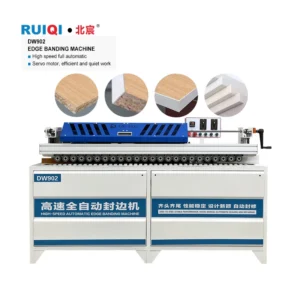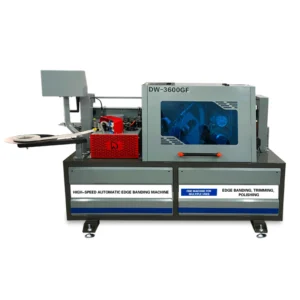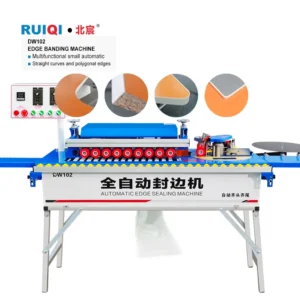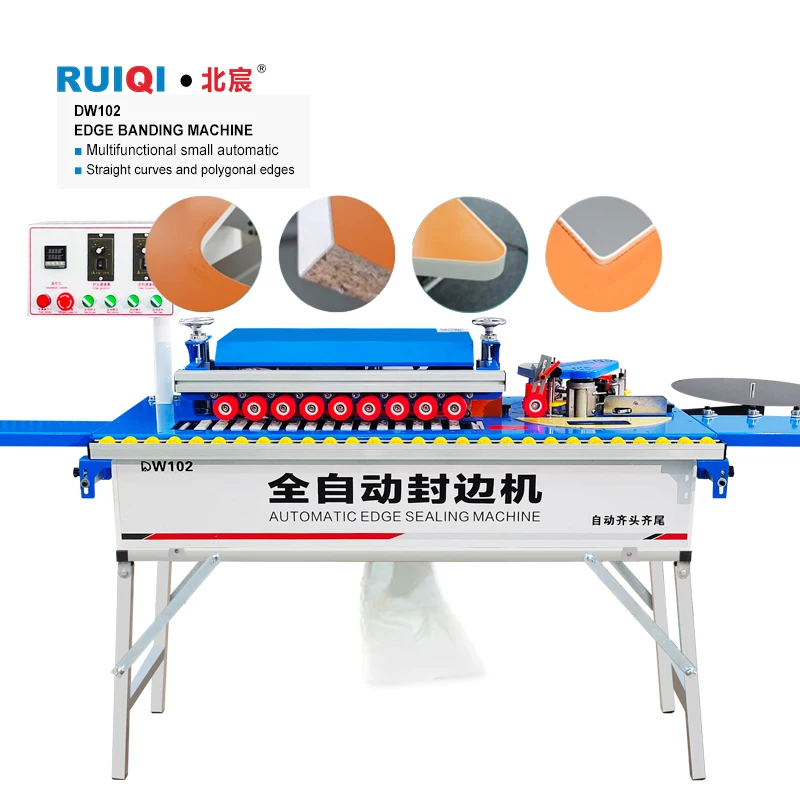
Edge banding machine
Click to enlarge
ISO 9001
CE Certified
OEM / ODM
12-Mo Warranty
Edge banding machine
DW102 High Speed Edge Bander for Furniture Manufacturing – Technical Guide
<p><strong>DW102 Automatic Edge Banding Machine, 220V/380V, 0.3–3mm Edge Thickness, Dual Trimming</strong> — delivers consistent edge sealing on MDF, particleboard and plywood with controlled glue pot temperature and 650W×2 trimming stations for smooth, glue-line-free profiles on both curved and straight edges.</p> <ul> <li>Automatic head and tail cutting with minimum 25cm sheet length for precise panel end finish</li> <li>1000ml glue pot capacity and 0.5–0.8Mpa air source ensure uniform adhesion across mixed substrates</li> <li>Edge banding height 0–50mm suits cabinet and furniture production with PVC, veneer or melamine strips</li> </ul> <p>Pre-shipment test records document actual edge finish on your specific substrate and banding material before dispatch.</p>
100+
Countries
MOQ 1
Unit
15-25 Days
Lead Time
Automatic Head And Tail Cutting
Curved And Straight Edge Banding
DW102
Edge Banding Machine
Furniture Manufacturing
MDF Panel
Process And Application
- Full OEM/ODM support -- custom logo, voltage (110V-440V), multilingual panels
- ISO 9001 & CE certified, 5 national patents, 60 professional engineers
- 12-month warranty, remote technical support & spare parts service
- Professional export packaging, customs clearance support, on-time delivery
Glue Flow Control — The DW102 maintains uniform adhesion on MDF and particleboard through a regulated 1000ml glue pot, verified by pre-shipment test records on your specific substrate.
Technical Specifications
| Parameter | Value |
|---|---|
| Model | DW102 |
| Product Type | Automatic Edge Banding Machine |
| Total Power | 3800W |
| Voltage | 220V / 380V / customization available |
| Edge Banding Height | 0–50mm |
| Edge Banding Thickness | 0.3–3mm |
| Minimum Sheet Length | 25cm |
| Minimum Sheet Width | 5cm |
| Glue Pot Capacity | 1000ml |
| Trimming Power | 650W × 2 |
| Polishing Power | 180W × 2 |
| Vacuum Power | 1200W |
| Edge Feed Power | 20W |
| Transmission Power | 60W |
| Air Source Pressure | 0.5–0.8MPa |
| Product Size | 128 × 47 × 69cm |
| Product Weight | 75kg |
| Plug Options | EU, USA, AU, UK |
| Language Options | Chinese, English, Spanish, French (customizable) |
| Key Features | Curved and straight edge banding, automatic head and tail cutting, dual trimming, dual polishing, vacuum extraction |
Application Suitability
| Application | Material or Output |
|---|---|
| Cabinet panel edge sealing | MDF, particleboard, plywood with PVC or melamine strip |
| Furniture component finishing | Blockboard and solid wood panels with veneer banding |
| Polymer door profile banding | Polymer composite substrates requiring chamfer and polish |
| Small-batch custom joinery | Mixed substrate orders from 5cm minimum width |
| Workshop-scale production runs | Medium-volume furniture and cabinet components |
Why Visible Glue Lines Appear on Some Substrates But Not Others
Consistent edge sealing depends on matching glue temperature, feed pressure, and material porosity — not just machine speed.
In my time commissioning edge banders across furniture workshops, the most common complaint arrives a week after startup: the edge looked perfect on the sample MDF, but the particleboard the factory actually runs produces a visible glue line along the top edge. The woodworking process edge banding quality depends on substrate density, moisture content, and surface texture [NEED_CITE: substrate porosity and glue penetration behavior in panel materials]. Particleboard absorbs adhesive unevenly compared to MDF, and plywood presents a cross-grain surface that demands different pressure settings.
The DW102 addresses this through its regulated glue pot and dual trimming stations. The 1000ml capacity provides thermal stability during continuous runs, reducing temperature fluctuation that causes thin adhesive application on porous substrates. When a workshop switches between MDF and particleboard on the same shift, the operator adjusts feed speed and glue flow rather than replacing hardware.
Substrate Behavior and Glue Adhesion Across Panel Types
MDF presents the most uniform surface for edge banding, allowing consistent glue film thickness across the panel edge. Particleboard introduces variable density zones where coarse wood chips create micro-gaps in the substrate edge, requiring slightly higher glue application to achieve full coverage. The DW102 handles this material range through adjustable feed pressure and trimming depth on its 650W × 2 trimming stations. Plywood adds another variable: the cross-laminated veneer layers create an uneven edge surface that can trap air pockets during banding if the feed system does not maintain steady contact pressure.
Curved Profiles and the Limits of Straight-Line Setup
Many workshops discover too late that their edge bander handles straight panels well but struggles with curved components. The DW102 is configured for both curved and straight edge banding, though the minimum radius depends on banding thickness and substrate rigidity. Curved profiles place uneven pressure on the glue line, particularly on the inside radius where compression forces the banding away from the substrate [NEED_CITE: edge banding adhesion mechanics on curved panel geometries]. The automatic head and tail cutting function removes the need for manual trimming at panel ends, which is where curved components most frequently show defects.
Reading the Spec Sheet Against Your Production Reality
The 3800W total power distributed across trimming, polishing, vacuum, and feed systems determines what the machine can sustain during continuous operation. The 650W × 2 trimming motors provide sufficient torque for clean cuts through 3mm PVC banding on dense particleboard, while the 180W × 2 polishing stations remove residual adhesive haze without scorching veneer materials. The 0.5–0.8MPa air source pressure range drives the pneumatic feed cylinders — insufficient pressure causes intermittent feed, producing chatter marks on the trimmed edge.
Edge banding thickness range of 0.3–3mm covers the standard spectrum from thin melamine strips to thick PVC profiles used on cabinet fronts. The 0–50mm banding height accommodates standard panel thicknesses, though the operator must set trimming depth relative to actual board thickness to avoid cutting into the substrate face. The 1000ml glue pot capacity supports sustained runs, as smaller pots lose thermal mass during extended operation, causing adhesive viscosity to fluctuate.
The Cost of Configuring for the Wrong Material
A workshop processing primarily plywood that configures an edge bander for MDF specifications will produce panels with incomplete adhesion at the veneer layer transitions. The trimming stations then encounter hardened glue pockets, causing chipped trim edges and rejected components. I have seen operators compensate by slowing feed speed and running the glue pot hotter, which degrades adhesive chemistry over time [NEED_CITE: thermal degradation of hot-melt adhesives in edge banding applications]. The DW102’s adjustable parameters allow configuration matching, but the setup must reflect the dominant substrate — not the test sample.
Why Procurement Starts With Your Material, Not the Machine
Every DW102 undergoes four-stage quality control covering incoming material inspection, in-process assembly checks, finished product testing, and pre-shipment verification with photographic documentation. The manufacturer holds CE certification and ISO 9001 compliance, with proprietary cutting mechanism patents applied across the trimming assembly [NEED_CITE: CE machinery directive compliance for woodworking equipment]. Voltage and frequency are confirmed against your facility specifications before production begins, preventing the scenario where a 380V machine arrives at a 220V-only workshop.
The engineer-led configuration process matches the machine to your actual substrate mix, banding material, and production volume rather than quoting a standard package. Factory test records document edge quality on your specific materials before dispatch, and the operation manual arrives in your chosen language to support operator commissioning without translation delays.
Documentation & Verification
- CE declaration of conformity for the DW102 edge banding machine
- ISO 9001 certificate covering manufacturing process standards
- Electrical schematic with confirmed voltage and plug configuration
- Factory test record showing edge finish on your substrate samples
- Operation and maintenance manual in agreed language
- Spare parts list with part numbers for trimming and polishing consumables
Installation, Commissioning & Support
- Dedicated circuit required for 3800W total draw, separate from other production equipment
- Pneumatic line delivering 0.5–0.8MPa clean dry air within 2m of machine position
- Machine arrives assembled; operator installs vacuum hose and connects power and air
- First-run calibration sets trimming depth and glue flow for your panel thickness range
- Multilingual control panel configured to operator language before commissioning
- Routine maintenance covers glue pot cleaning, trim blade inspection, and vacuum filter service
Requesting a Process-Matched Quotation
Provide the substrate types and thicknesses you process most frequently, along with the banding materials and thicknesses in use. Specify your facility voltage and frequency, preferred plug type, and the control panel language your operators require. If your production includes curved components, share the typical radii and panel dimensions so the feed system configuration can be matched to your profile range.
Frequently Asked Questions
Q: How does edge quality differ between MDF, particleboard and plywood on this machine?
A: MDF produces the cleanest edge due to uniform density. Particleboard requires adjusted glue flow to compensate for variable chip density, while plywood demands steady feed pressure across cross-grain veneer layers. The DW102’s dual trimming stations and adjustable parameters allow operators to configure for each substrate without hardware changes.
Q: What glue types and banding materials are compatible with the 0.3–3mm thickness range?
A: The DW102 handles standard hot-melt adhesives with PVC, melamine, and veneer banding materials across the full 0.3–3mm range. Glue temperature and feed speed must be matched to banding thickness and substrate porosity for consistent adhesion without visible glue lines.
Q: How does automatic head and tail cutting affect edge finish on short panels?
A: The automatic head and tail cutting eliminates manual trimming at panel ends, where operator error most commonly causes edge defects. The minimum sheet length of 25cm is sufficient for most cabinet component widths, and the pneumatic cutting mechanism produces clean termination without banding tear-back.
Q: Can the machine handle curved edge profiles and what limits apply?
A: The DW102 is configured for both curved and straight edge banding. Inside radius limits depend on banding thickness and substrate rigidity, with thinner banding allowing tighter curves. Glue application uniformity and feed pressure consistency are critical on curved profiles to prevent adhesion gaps.
Q: What air supply pressure is needed and how does it affect trimming consistency?
A: The DW102 requires 0.5–0.8MPa clean dry air to drive the pneumatic feed cylinders and cutting mechanisms. Insufficient pressure causes intermittent feed, producing chatter marks on trimmed edges. A dedicated air line with inline filtration prevents moisture contamination that degrades pneumatic component life.
Technical Specifications
| Parameter | Value |
|---|---|
| Product Name | DW102 High Speed Edge Bander for Furniture Manufacturing – Technical Guide |
| Category | Edge banding machine |
| Voltage Options | 110V / 220V / 380V / 440V (customizable) |
| Frequency | 50Hz / 60Hz (customizable) |
| Certification | ISO 9001, CE |
| MOQ | 1 Unit |
| Lead Time | 15-25 Working Days |
| Warranty | 12 Months |
| OEM / ODM | Available -- logo, color, panel language |
* Detailed technical specifications vary by model. Please contact us with your specific requirements for a complete datasheet.
Shipping & Export
-
Export Packaging
Heavy-duty wooden crate with foam padding and moisture protection
-
Shipping Methods
Sea freight (FCL/LCL), air freight, express -- we support all methods
-
Customs Support
Full documentation: CO, commercial invoice, packing list, HS code assistance
-
Port of Loading
Tianjin / Qingdao port, China -- 20 years export experience
OEM / ODM Services
-
Logo & Branding
Custom logo printing, color scheme, and nameplate engraving
-
Voltage Configuration
110V / 220V / 380V / 440V, 50Hz / 60Hz -- any region supported
-
Multilingual Panels
Control panels in English, Spanish, French, Arabic and more
-
Custom Specifications
Modified dimensions, accessories, or feature sets on request
Get a Quote
Request Product Inquiry
Fill in your details and we'll respond within 24 hours with pricing and availability.
Direct Contact
How It Works
-
1
Confirm requirements & budget
Tell us your factory scale and processing needs
-
2
Receive recommendation & quote
We match the right machine with full specs
-
3
Negotiate & place order
OEM terms, voltage, payment and delivery
-
4
Production & QC inspection
Multi-stage quality control by 60 engineers
-
5
Export packaging & shipment
Professional packing, customs clearance
-
6
After-sales support
12-month warranty, remote tech support
You May Also Like