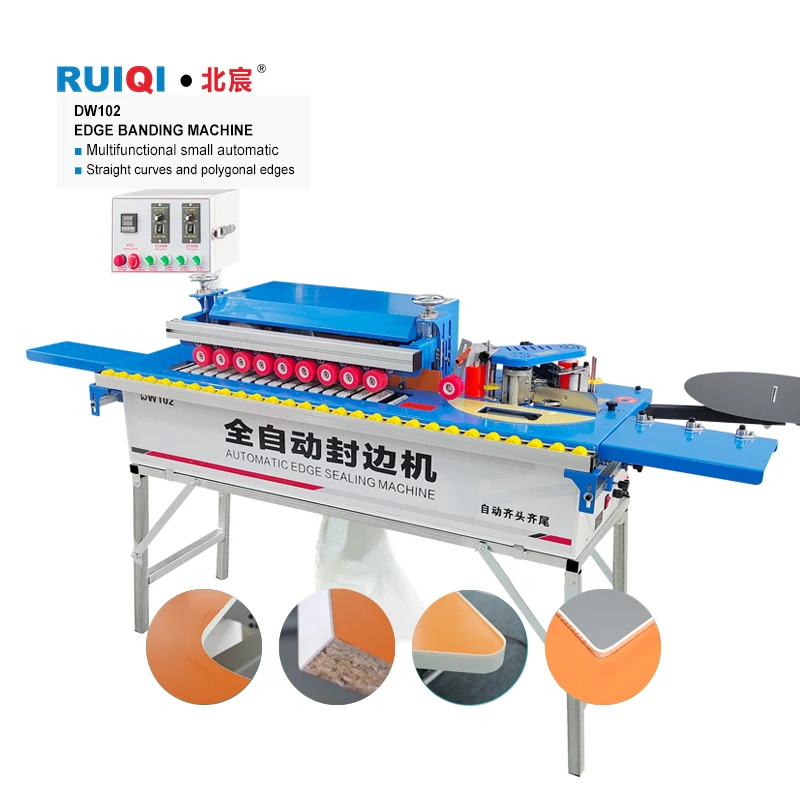
Edge banding machine
Click to enlarge
ISO 9001
CE Certified
OEM / ODM
12-Mo Warranty
Edge banding machine
DW102 Semi Automatic Edge Banding Machine for MDF Wood Panel – CompactDW102 Semi Automatic Edge Banding Machine for MDF Wood Panel – Compact
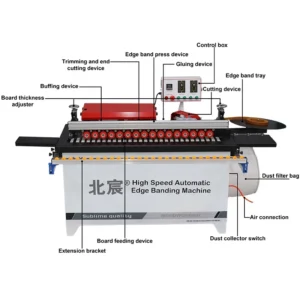
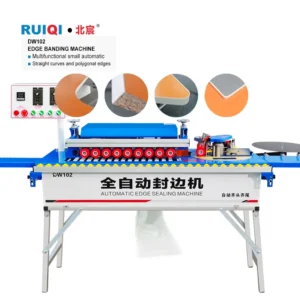
<p><strong>DW102 Semi-Automatic Edge Banding Machine, 0.3–3mm Banding Thickness, 220V/380V</strong> — designed for consistent edge finishing on MDF, particleboard and plywood substrates.</p> <ul> <li>Handles straight and curved edge profiles with automatic head and tail cutting, vacuum hold, and dual 650W trimming stations for clean results on varying panel densities</li> <li>1000ml glue pot supports stable thermal performance across mixed batch runs; 0–50mm banding height accommodates cabinet and polymer door components</li> </ul> <p>Backed by four-stage QC with pre-shipment test records and engineer-led voltage confirmation to match your workshop supply.</p>
100+
Countries
MOQ 1
Unit
15-25 Days
Lead Time
CE Certified
DW102
Edge Banding Machine
MDF Panel
Process Application
Semi Automatic
Vacuum Hold
- Full OEM/ODM support -- custom logo, voltage (110V-440V), multilingual panels
- ISO 9001 & CE certified, 5 national patents, 60 professional engineers
- 12-month warranty, remote technical support & spare parts service
- Professional export packaging, customs clearance support, on-time delivery
Voltage, Language and Specification Customization as Standard — the DW102 supports configurable 220V/380V supply and multilingual control interfaces to match the exact workshop conditions where the edge banding process takes place.
Technical Specifications
| Parameter | Value |
|---|---|
| Model | DW102 |
| Product Type | Semi-Automatic Edge Banding Machine |
| Total Power | 3800 W |
| Voltage | 220V / 380V / customization (frequency to be confirmed) |
| Edge Banding Thickness | 0.3–3 mm |
| Edge Banding Height | 0–50 mm |
| Minimum Sheet Length | 250 mm |
| Minimum Sheet Width | 50 mm |
| Trimming Power | 650 W × 2 |
| Polishing Power | 180 W × 2 |
| Vacuum Power | 1200 W |
| Glue Pot Capacity | 1000 ml |
| Air Source Pressure | 0.5–0.8 MPa |
| Overall Dimensions (L×W×H) | 1280 × 470 × 690 mm |
| Net Weight | 75 kg |
| Assembly State | Benchtop / compact standalone |
| Language Options | Chinese, English (other languages customizable) |
| Plug Options | EU, USA, AU, UK |
| Key Features | Curved and straight edge banding, edge trimming, polishing, automatic head and tail cutting, vacuum hold |
| Certification | CE (verify against documentation), ISO 9001 (company-level) |
Application Suitability
| Application | Material or Output |
|---|---|
| Cabinet door edge finishing | MDF and melamine-faced particleboard with PVC or melamine banding |
| Custom furniture panel edging | Plywood and blockboard with thin veneer or PVC strips |
| Polymer door profile banding | Shaped polymer door components requiring curved edge application |
| Small-batch joinery production | Mixed substrate runs across MDF, particleboard and solid wood panels |
Why Substrate Density Decides Your Edge Quality Before the Machine Even Starts
Glue adhesion fails at the substrate surface long before it fails inside the glue pot.
I learned this the hard way not long ago. A cabinet maker in our region ordered a machine to run PVC edge banding on standard MDF. The test samples came off the line clean, no visible glue line, solid adhesion. Then he switched to a cheaper particleboard his supplier had substituted without notice. The substrate surface was porous and uneven, the glue could not form a consistent film, and within a day an entire batch of panels had edges lifting in sheets. The rework cost him a full run of board stock and a delayed shipment to his client. This is the reality of the edge banding machine process and application — the machine can only work with what the substrate gives it [NEED_CITE: substrate density and glue adhesion behaviour in wood panel processing].
How Glue Temperature and Banding Thickness Interact on Mixed Substrates
The DW102 carries a 1000 ml glue pot, which provides enough thermal mass to maintain stable adhesive temperature across a continuous run of panels. When you switch from dense MDF to lighter particleboard, the surface absorbs heat differently, and the glue film thickness needs adjustment. A 0.3 mm veneer band demands precise temperature control because it has no thermal buffer — too hot and the veneer blisters, too cool and the bond line shows white. A 2 mm PVC band is more forgiving but requires consistent pressure through the feed path to seat fully against a coarse particleboard edge. The edge banding machine process and application hinges on understanding these interactions before the first panel enters the feed.
Dual Trimming Stations and What They Mean for Edge Profile Consistency
Two trimming heads rated at 650 W each allow the operator to stage a rough cut followed by a fine pass. On MDF, the rough trim removes the bulk of the overhang and the fine pass cleans the arris to a smooth profile ready for assembly. On particleboard, the first pass encounters uneven density and may leave micro-tears along the cut line; the second pass at a lighter depth setting cleans those up [NEED_CITE: trimming pass configuration and edge finish quality on particleboard]. This two-stage approach matters because downstream hardware — hinges, shelf pins, drawer runners — all reference the panel edge. If the trimmed edge is not square and clean, holes drilled into the face near the edge will wander, and the cabinet will not close true.
Reading the Specifications That Actually Matter in Production
The 0.3–3 mm edge banding thickness range covers the full spectrum from thin veneer wraps on visible cabinet faces to heavy PVC protection on worktop edges. Running 0.3 mm veneer requires the feed path to be free of burrs and the pressure rollers to be set light — any mark on the banding surface is a reject. At 3 mm PVC, the trimming motors do the heavy work, and the dual 650 W heads carry the load without stalling. The 0–50 mm edge banding height accommodates standard 18 mm board stock as well as thicker solid wood panels used in table and benchtop production. The vacuum system at 1200 W holds the workpiece against the fence during curved edge work, which is where manual feeding typically introduces drift and the banding misses the panel edge by a millimetre or two. Feed speed and panel thickness range should be confirmed against your specific production requirement before committing to a configuration [NEED_CITE: feed speed and panel thickness parameters for semi-automatic edge banders].
What Happens When the Wrong Configuration Ships to Your Workshop
I have seen machines arrive at a workshop and sit for weeks because the local power supply was single-phase 220V and the machine was wired for three-phase 380V. The electrician quotes a new supply line, the workshop owner delays the decision, and the machine gathers dust. Others arrive with a control panel labelled entirely in a language the operator does not read, so settings get guessed rather than set. These are not machine faults — they are configuration oversights that turn a productive asset into a floor obstruction. Every specification mismatch compounds into lost production days [NEED_CITE: machinery commissioning failures caused by voltage and language mismatch].
What This Manufacturer Puts Behind the DW102
The patented cutting mechanism is engineered in-house, which means tolerance claims can be verified against the actual tool path rather than sourced from a third-party component supplier. The four-stage quality check covers incoming material inspection, in-process assembly verification, finished product testing and pre-shipment validation — each stage documented and available for review. Voltage and plug configuration is confirmed before the machine enters production, not after it ships. The engineering team provides a formal configuration recommendation based on your substrate, banding material and production volume, typically within one working day. Factory visits are open, and you can watch your exact material run through the DW102 before placing an order.
Documentation & Verification
- CE declaration of conformity specific to the DW102 model configuration
- Factory test record using your supplied panel material and banding stock
- Electrical schematic confirming voltage, frequency and plug type for your market
- Operation and maintenance manual in your operator’s preferred language
- Spare parts list with cross-reference to consumable components
Installation, Commissioning & Support
- Benchtop footprint of 1280 × 470 mm requires a stable workbench, not a dedicated foundation
- Dedicated circuit matching confirmed voltage, with isolation switch within reach of the operator position
- Arrives fully assembled; connect power and air supply at 0.5–0.8 MPa to begin commissioning
- Initial parameter setup for glue temperature, feed rate and trimming depth matched to your material
- Daily glue pot cleaning routine prevents adhesive carbonisation and extends heating element life
- Trimming and polishing consumables included with spare parts list for reorder planning
What We Need to Recommend the Right Setup
Send us the substrate you run most often — MDF grade, particleboard density, or the specific polymer door profile — along with the banding material and thickness you intend to use. Confirm your workshop supply voltage and frequency so the electrical configuration is locked before assembly begins. If you have curved edge work in your production mix, share the minimum radius so we can verify the vacuum hold and feed path will handle it.
Frequently Asked Questions
Q: Which edge banding materials work best with the DW102 on MDF versus particleboard?
A: PVC and melamine banding in the 0.4–2 mm range perform reliably on both substrates. MDF gives a denser edge for the glue to grip, so thinner veneer at 0.3 mm is also viable. On particleboard, the porous edge absorbs more adhesive, and thicker PVC at 1–3 mm with a higher glue film weight generally produces a more consistent bond line and a cleaner trim result.
Q: How does the glue pot capacity affect edge quality during batch runs?
A: The 1000 ml pot holds enough adhesive to sustain a continuous batch without frequent refills, which avoids the temperature drop that occurs each time cold glue is added. Stable thermal mass means the glue viscosity stays within the working window, and the bond line remains uniform from the first panel to the last in a given run.
Q: What should I know about trimming curved edges on polymer door panels?
A: Curved edges require the vacuum hold to keep the panel steady against the fence while the operator guides the workpiece. The dual trimming stations handle the profile change across a curve, but feed speed should be reduced compared to straight runs. Confirm the minimum curve radius with your engineering contact before production begins.
Q: How can I verify edge finish tolerance meets my assembly standard before ordering?
A: Request a sample processing test using your actual panel stock and banding material. The factory will run the DW102 under production conditions and ship the finished samples along with the test record. You can then measure edge squareness, check for glue line visibility, and trial-fit hardware against the trimmed edge in your own workshop.
Q: What electrical and air supply conditions must my workshop meet before the DW102 arrives?
A: Confirm your available voltage and frequency so the machine can be wired correctly during build. You need a dedicated circuit rated for the 3800 W total load, and a compressed air supply delivering 0.5–0.8 MPa at the machine inlet. The plug type — EU, USA, AU or UK — should be specified at order stage to avoid adaptor delays on arrival.
Technical Specifications
| Parameter | Value |
|---|---|
| Product Name | DW102 Semi Automatic Edge Banding Machine for MDF Wood Panel – CompactDW102 Semi Automatic Edge Banding Machine for MDF Wood Panel – Compact |
| Category | Edge banding machine |
| Voltage Options | 110V / 220V / 380V / 440V (customizable) |
| Frequency | 50Hz / 60Hz (customizable) |
| Certification | ISO 9001, CE |
| MOQ | 1 Unit |
| Lead Time | 15-25 Working Days |
| Warranty | 12 Months |
| OEM / ODM | Available -- logo, color, panel language |
* Detailed technical specifications vary by model. Please contact us with your specific requirements for a complete datasheet.
Shipping & Export
-
Export Packaging
Heavy-duty wooden crate with foam padding and moisture protection
-
Shipping Methods
Sea freight (FCL/LCL), air freight, express -- we support all methods
-
Customs Support
Full documentation: CO, commercial invoice, packing list, HS code assistance
-
Port of Loading
Tianjin / Qingdao port, China -- 20 years export experience
OEM / ODM Services
-
Logo & Branding
Custom logo printing, color scheme, and nameplate engraving
-
Voltage Configuration
110V / 220V / 380V / 440V, 50Hz / 60Hz -- any region supported
-
Multilingual Panels
Control panels in English, Spanish, French, Arabic and more
-
Custom Specifications
Modified dimensions, accessories, or feature sets on request
Get a Quote
Request Product Inquiry
Fill in your details and we'll respond within 24 hours with pricing and availability.
Direct Contact
How It Works
-
1
Confirm requirements & budget
Tell us your factory scale and processing needs
-
2
Receive recommendation & quote
We match the right machine with full specs
-
3
Negotiate & place order
OEM terms, voltage, payment and delivery
-
4
Production & QC inspection
Multi-stage quality control by 60 engineers
-
5
Export packaging & shipment
Professional packing, customs clearance
-
6
After-sales support
12-month warranty, remote tech support
You May Also Like