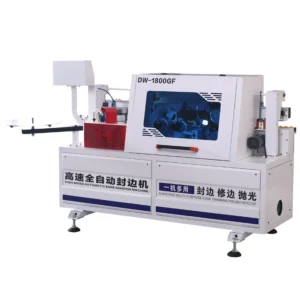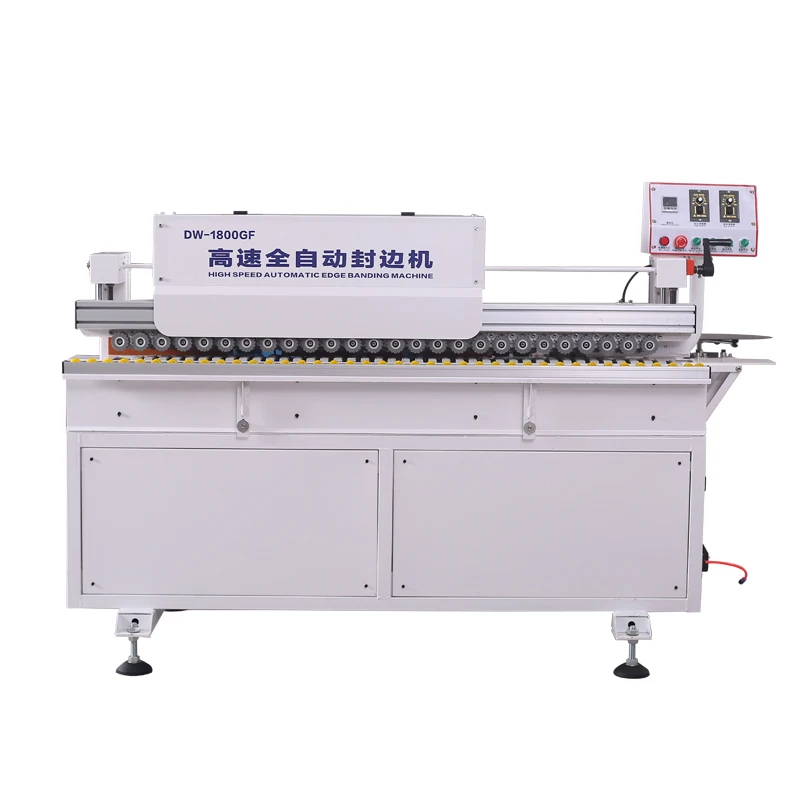
Edge banding machine
Click to enlarge
ISO 9001
CE Certified
OEM / ODM
12-Mo Warranty
Edge banding machine
DW1800 High Speed Edge Bander for MDF Panel – Manufacturer
<p><strong>DW1800 High Speed Straight Line Automatic Edge Bander</strong>, 4.9KW, 0–14 m/min feed speed — handles MDF, particleboard and plywood from 200mm minimum length with 0.3–3mm edge banding thickness.</p> <ul> <li>Double-sided gluing via 4000ml pot delivers uniform adhesive spread, followed by top/bottom trimming, flexible scraping and dual polishing in one pass</li> <li>Profile tracking rounds all four corners; feed speed adjustable to match substrate density and PVC or veneer strip behaviour</li> </ul> <p>Pre-shipment test records verify glue line consistency and trim accuracy on your actual panel material before dispatch.</p>
100+
Countries
MOQ 1
Unit
15-25 Days
Lead Time
Double-Sided Gluing
DW1800
Edge Banding Machine
High-speed Edge Bander
MDF Panel
Plywood Edge Banding
Process And Application
- Full OEM/ODM support -- custom logo, voltage (110V-440V), multilingual panels
- ISO 9001 & CE certified, 5 national patents, 60 professional engineers
- 12-month warranty, remote technical support & spare parts service
- Professional export packaging, customs clearance support, on-time delivery
Precision-Ground Gluing Stations — verified under four-stage QC before the DW1800 leaves the factory floor, not just promised on a brochure.
Technical Specifications
| Parameter | Value |
|---|---|
| Model | DW1800 |
| Product Type | High Speed Straight Line Automatic Edge Bander |
| Total Power | 4.9 kW |
| Voltage Options | 380V / 220V / 415V (50Hz/60Hz to be confirmed) |
| Feed Speed | 0–14 m/min |
| Edge Banding Thickness | 0.3–3 mm |
| Edge Banding Height | 0–50 mm |
| Minimum Sheet Length | 20 cm |
| Minimum Sheet Width | 10 cm |
| Glue Pot Capacity | 4000 ml |
| Trimming Power / Speed | 800 W × 2 / 24,000 r/min |
| Polishing Power | 380 W × 2 |
| Vacuum Power | 550 W |
| Air Source Pressure | 0.4–0.6 MPa |
| Product Size (L×W×H) | 220 × 65 × 125 cm |
| Net Weight | 320 kg |
| Control Panel Languages | Chinese, English (other languages on request) |
| Plug Options | EU, USA, AU, UK |
| Key Features | Double-sided gluing, front/rear alignment, top/bottom trimming, flexible edge scraping, dual polishing, dust extraction |
Application Suitability
| Application | Material or Output |
|---|---|
| Custom cabinet door edging | MDF and particleboard with 0.4–2 mm PVC banding |
| Wardrobe side panel finishing | Plywood panels with melamine or veneer edge strips |
| Shelving and storage unit production | ABB boards and organic glass plates up to 50 mm thickness |
| Small-batch furniture workshop runs | Solid wood panels requiring single-pass glue, trim and polish |
| Office furniture component edging | Particleboard substrates with thin PVC or ABS banding |
Why Glue Lines Look Different on Every Substrate You Run
Uniform adhesive transfer depends on matching glue temperature and feed speed to the panel core, not just the edge strip material.
I once spent three days troubleshooting visible glue seams on MDF that had run perfectly on particleboard. The DW1800 addresses this variability through its double-sided gluing station paired with adjustable feed speed. MDF absorbs heat differently than plywood, and particleboard surface porosity changes how adhesive spreads under pressure. When the woodworking edge banding process DW1800 performs is dialled in for one substrate and then switched to another without parameter adjustment, the result is either starved glue joints or squeeze-out that ruins the panel face [NEED_CITE: substrate thermal conductivity differences in wood composite panels]. The 4000 ml glue pot maintains thermal mass so temperature stays stable across a full shift of mixed-material runs.
How the DW1800 Manages the Glue-to-Substrate Interface
The double-sided gluing system applies adhesive to both the panel edge and the banding strip simultaneously. This dual application matters most when working with porous substrates like particleboard, where single-sided gluing often results in the panel absorbing adhesive before the strip makes contact. The 4000 ml pot capacity means the heating element cycles less frequently during a production run, reducing the temperature swings that cause inconsistent viscosity. For a workshop running MDF cabinet doors in the morning and plywood shelving in the afternoon, this thermal stability keeps the woodworking edge banding process DW1800 delivers consistent across material changeovers.
What the Trimming and Polishing Sequence Actually Does to Your Edge
After the strip is pressed and cooled, the board passes through front and rear alignment, then top and bottom trimming at 24,000 r/min. That spindle speed matters because slower trimming tears PVC and leaves micro-chips on veneer. The flexible edge scraping station that follows removes the knife marks left by trimming, which is where most visible edge defects originate. Finally, dual polishing wheels bring the edge to a smooth finish. Each station in this sequence addresses a specific defect that the previous, more aggressive station leaves behind [NEED_CITE: edge finishing defect progression in automated banding]. Skipping any one of them — or running them out of adjustment — means the final edge will show the evidence somewhere downstream.
Reading the Spec Sheet Against Your Actual Production Needs
The 0.3–3 mm edge banding thickness range covers most PVC, ABS and veneer strips used in cabinet and furniture production. Thinner strips below 0.4 mm demand lower trimming feed speeds to avoid strip lift at the leading edge, while 3 mm solid wood or thick ABS requires the full 800 W per trimming spindle to cut cleanly without stalling. The 0–50 mm edge banding height corresponds to panel thickness, which determines whether you can run 18 mm standard cabinet stock and 25 mm worktop material on the same setup. The 20 cm minimum sheet length and 10 cm minimum width define the smallest offcut you can edge — critical for workshops cutting nesting layouts where small components are common. Air pressure at 0.4–0.6 MPa drives the pneumatic actuators on alignment and scraping stations; pressure below this range causes lazy cylinder response that shows up as misaligned strip placement.
The Cost of Specifying a Bander Without Checking Your Air and Power Supply
A 4.9 kW total power draw sounds manageable until you realize it assumes stable voltage at the rated frequency. If your workshop runs on a shared circuit with compressors and dust collectors, voltage dips during compressor start-up can cause the glue pot heater to underperform — and the first sign is weak adhesion on panels that were banded during that dip. Similarly, if your compressor cannot maintain 0.4 MPa at the machine inlet while other pneumatic tools are running, the alignment and scraping cylinders will hesitate. I have seen edge banders of this class produce perfect samples during commissioning, then drift into inconsistent quality once the rest of the workshop air demand comes online [NEED_CITE: pneumatic pressure drop effects on automated machinery accuracy]. These are not machine defects — they are specification mismatches that a site survey before ordering would have prevented.
What Makes This Machine Different from Others in Its Class
In-house manufacturing with patented cutting mechanisms means the trimming spindles are not generic sourced components — they are built to hold tolerance on the specific feed speeds and material ranges this machine covers. The full product family from entry-level to full-function means a workshop can start with the DW1800 and add more capable models later without retraining operators on a different control logic. Voltage and plug customization as standard eliminates the scenario where a machine arrives with a hardwired connection that does not match your local supply. Four-stage QC with pre-shipment verification catches glue pot thermostat drift and trimming alignment errors before the crate is sealed. Engineer-led configuration recommendation within 24 hours means the quotation you receive already accounts for your substrate mix and edge banding material.
Documentation & Verification
- CE declaration of conformity covering the DW1800 trimming and gluing safety guards
- Machine specification sheet confirming your ordered voltage and plug configuration
- Factory test record using your specified panel material and edge banding thickness
- Electrical schematic showing glue pot heater circuit and pneumatic valve layout
- Operation and maintenance manual written in your agreed control panel language
- Pre-shipment photograph set showing machine packed with spare trimming blades and polishing wheels
Installation, Commissioning & Support
- Requires a dedicated 380V or 220V circuit rated above 4.9 kW with correct frequency
- Compressed air line must sustain 0.4–0.6 MPa at the DW1800 inlet with moisture filtration
- Machine footprint of 220 × 65 cm needs operator clearance on infeed and outfeed sides
- First-run commissioning includes glue temperature calibration for your specific edge banding material
- Trimming spindle alignment verified on your panel thickness range before operator handover
- Spare parts kit includes replacement trimming blades, polishing wheels and pneumatic seals
What to Include in Your Inquiry
To get a configuration recommendation that matches your workshop, share the panel substrates you run most often along with their typical thickness range. Specify your local voltage and frequency so the electrical system is built correctly from the start. If you are replacing a manual edge banding process, note your current daily panel count so the feed speed recommendation aligns with your throughput target. Mentioning your edge banding material types — PVC, ABS, veneer or melamine — allows the glue system to be set up and tested before dispatch.
Frequently Asked Questions
Q: How does glue application differ across MDF, particleboard and plywood substrates?
A: MDF is denser and absorbs more heat from the glue, often requiring slightly higher pot temperatures than particleboard. Plywood surface veneers can be sensitive to excessive heat, causing delamination risk. The DW1800 double-sided gluing system compensates by applying adhesive to both panel and strip, reducing the thermal demand on any single surface. Feed speed adjustment across the 0–14 m/min range further tunes contact time to suit each substrate.
Q: What edge banding materials are compatible with the DW1800 gluing and trimming stations?
A: The machine handles PVC, ABS, melamine and wood veneer strips within the 0.3–3 mm thickness range. Thicker solid wood banding near 3 mm requires the trimming spindles to run at full power for clean cuts. Veneer strips demand careful scraping station adjustment to avoid tearing the grain. The glue pot temperature and feed speed are calibrated during commissioning to match your primary banding material.
Q: How does feed speed selection affect edge quality on different panel thicknesses?
A: Thinner panels below 15 mm benefit from moderate feed speeds to allow sufficient glue contact time and prevent strip lift at the leading edge. Thicker panels and worktops can run at higher feed speeds because the larger gluing surface area provides more adhesive bond area. The variable 0–14 m/min range lets operators find the speed where trimming and polishing quality remain consistent for each panel thickness in production.
Q: Can I run a sample panel through the machine before ordering to verify edge finish?
A: Factory sample processing tests are available using your actual panel material and edge banding strip. This verifies glue adhesion, trimming cleanliness and polishing finish before the order is confirmed. The test also establishes baseline temperature and feed speed parameters that are recorded in the factory test record and shipped with the machine for your commissioning reference.
Q: What downstream assembly issues can poor edge banding cause, and how does the DW1800 prevent them?
A: Visible glue lines, lifted edges and uneven trimming create gaps when panels meet at cabinet corners, forcing assemblers to use filler or reject components. The DW1800 addresses this through its integrated sequence of alignment, trimming, scraping and polishing in a single pass. Consistent edge geometry across every panel means dowel holes and hinge bores register correctly during assembly without manual edge rework.
Technical Specifications
| Parameter | Value |
|---|---|
| Product Name | DW1800 High Speed Edge Bander for MDF Panel – Manufacturer |
| Category | Edge banding machine |
| Voltage Options | 110V / 220V / 380V / 440V (customizable) |
| Frequency | 50Hz / 60Hz (customizable) |
| Certification | ISO 9001, CE |
| MOQ | 1 Unit |
| Lead Time | 15-25 Working Days |
| Warranty | 12 Months |
| OEM / ODM | Available -- logo, color, panel language |
* Detailed technical specifications vary by model. Please contact us with your specific requirements for a complete datasheet.
Shipping & Export
-
Export Packaging
Heavy-duty wooden crate with foam padding and moisture protection
-
Shipping Methods
Sea freight (FCL/LCL), air freight, express -- we support all methods
-
Customs Support
Full documentation: CO, commercial invoice, packing list, HS code assistance
-
Port of Loading
Tianjin / Qingdao port, China -- 20 years export experience
OEM / ODM Services
-
Logo & Branding
Custom logo printing, color scheme, and nameplate engraving
-
Voltage Configuration
110V / 220V / 380V / 440V, 50Hz / 60Hz -- any region supported
-
Multilingual Panels
Control panels in English, Spanish, French, Arabic and more
-
Custom Specifications
Modified dimensions, accessories, or feature sets on request
Get a Quote
Request Product Inquiry
Fill in your details and we'll respond within 24 hours with pricing and availability.
Direct Contact
How It Works
-
1
Confirm requirements & budget
Tell us your factory scale and processing needs
-
2
Receive recommendation & quote
We match the right machine with full specs
-
3
Negotiate & place order
OEM terms, voltage, payment and delivery
-
4
Production & QC inspection
Multi-stage quality control by 60 engineers
-
5
Export packaging & shipment
Professional packing, customs clearance
-
6
After-sales support
12-month warranty, remote tech support
You May Also Like