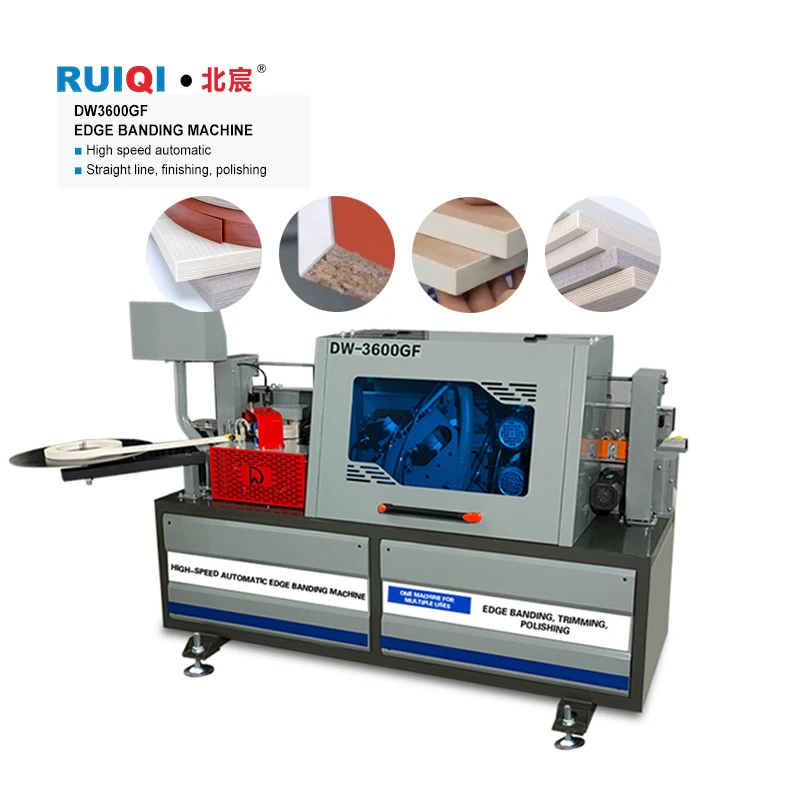
Edge banding machine
Click to enlarge
ISO 9001
CE Certified
OEM / ODM
12-Mo Warranty
Edge banding machine
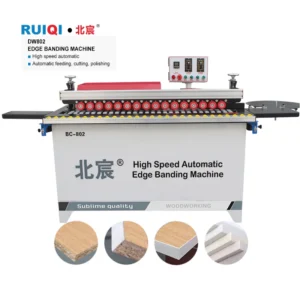
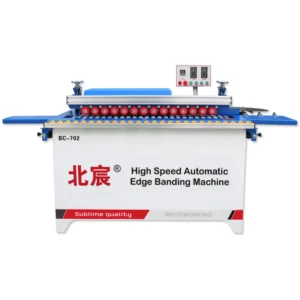
DW3600 Automatic Edge Banding Machine for MDF Board – Process Guide
<p><strong>DW-3600GF Automatic PVC Edge Banding Machine, 380V, 0–14 m/min Feed Speed, 0.3–3 mm Band Thickness</strong> — delivers a complete six-station edge banding sequence from gluing through polishing in a single pass, giving production managers predictable edge quality across MDF, plywood and particleboard substrates.</p> <ul> <li>Dual 800W trimming motors at 24000 r/min ensure clean cuts on straight PVC edges</li> <li>Edge band height coverage 0–50 mm accommodates standard and thick panel stock</li> <li>Air supply requirement 0.4–0.6 MPa with integrated vacuuming for dust-free operation</li> <li>Language and plug options customizable for target market commissioning</li> </ul> <p>Engineer-led configuration recommendation with formal quotation within 24 hours ensures the machine matches your substrate and throughput requirements.</p>
100+
Countries
MOQ 1
Unit
15-25 Days
Lead Time
380V
Automatic Feeding
DW-3600GF
Edge Banding Machine
Furniture Factory
MDF Panel
Process Application
- Full OEM/ODM support -- custom logo, voltage (110V-440V), multilingual panels
- ISO 9001 & CE certified, 5 national patents, 60 professional engineers
- 12-month warranty, remote technical support & spare parts service
- Professional export packaging, customs clearance support, on-time delivery
Integrated Process Sequence — The DW-3600GF completes gluing, trimming, scraping and polishing in one continuous pass, eliminating the visible glue lines and rework that plague batch edge banding on mixed substrates.
Technical Specifications
| Parameter | Value |
|---|---|
| Model | DW-3600GF |
| Product Type | Automatic PVC Edge Banding Machine |
| Voltage & Frequency | 380V three-phase four-wire (confirm 50Hz/60Hz for target market) |
| Total Power | 4.9 kW |
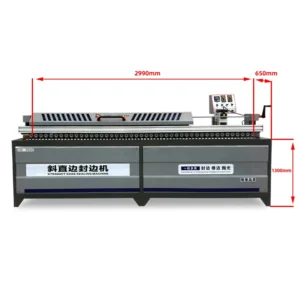
| Equipment Size | 2200×650×1250 mm |
| Total Weight | 320 kg |
| Edge Banding Type | Straight edge banding |
| Edge Band Height Range | 0–50 mm |
| Edge Band Thickness Range | 0.3–3 mm |
| Minimum Plate Length | 200 mm |
| Feed Speed | 0–14 m/min (source value — verify against manufacturer catalog) |
| Trimming Motor Power | 800W×2, 24000 r/min |
| Polishing Motor Power | 400W×2 |
| Air Supply Requirement | 0.4–0.6 MPa |
| Standard Functions | Gluing, trimming, front and rear trimming, scraping, polishing, vacuuming |
| Language Options | Chinese and English standard; other languages customizable |
| Plug Options | EU, USA, AU, UK available |
| Assembly State | Fully assembled, wooden box packed |
Application Suitability
| Application | Material or Output |
|---|---|
| Custom cabinet door and carcass edge banding | MDF and particleboard with 0.4–2 mm PVC edge band |
| Wardrobe and shelving panel finishing | Plywood and melamine-faced board with PVC strip |
| Small-batch bespoke furniture production | Solid wood panels with PVC edge banding up to 3 mm |
| Panel processing workshop straight-edge runs | Mixed MDF and particleboard batches at varying thicknesses |
Why Glue Lines Turn White on Particleboard and What the Automatic Edge Banding Machine Process Application Must Control
Substrate moisture and glue temperature must be matched before the first panel enters the feed.
I once spent three days at a custom cabinet factory where every particleboard panel came off the line with a chalky white glue line. The board had been stored in an unheated warehouse through winter, and the moisture content was well above what the adhesive could handle at standard temperature. Cranking up the glue pot without adjusting feed speed only made the band lift at the ends. Getting the automatic edge banding machine process application right means treating substrate condition as a variable, not a constant [NEED_CITE: substrate moisture content thresholds for hot-melt EVA adhesives in edge banding].
How the Six-Station Sequence Affects Edge Quality Downstream
Each station on the DW-3600GF performs a specific cut or finish that the next station depends on. The dual 800W trimming motors running at 24000 r/min remove excess band material flush with the panel face, and if that cut leaves chatter marks, the scraping stage cannot fully clean them. Production managers who inspect only the final polished edge often miss the fact that the defect originated two stations earlier in the automatic edge banding machine process application chain.
Substrate Density Changes the Rules for Feed Speed and Glue Open Time
Particleboard absorbs heat from the glue film faster than MDF because of its open pore structure, which shortens the effective open time available for the band to bond. On the DW-3600GF, dropping the feed speed by even a few metres per minute gives the adhesive more contact time under pressure, improving grab on porous substrates. Plywood, being denser, holds heat longer and can run at the higher end of the speed range without bond failure [NEED_CITE: adhesive open time variation across wood-based panel types].
Reading the Specs That Actually Matter for Edge Finish
The 0.3–3 mm band thickness range covers the PVC strips used in most cabinet and furniture production, from thin decorative bands to impact-resistant edges on worktops. Edge band height coverage of 0–50 mm allows the machine to handle both standard 18 mm board and thicker panels used in shelving or desk tops. Air supply at 0.4–0.6 MPa drives the pneumatic pressure rollers and trimming cylinders; insufficient pressure causes uneven bonding force, which shows up as intermittent adhesion failure rather than a continuous defect. The total power draw of 4.9 kW is modest for a six-station machine, meaning smaller workshops with limited electrical capacity can run the DW-3600GF without a dedicated transformer upgrade.
The Hidden Cost of Skipping the Voltage and Frequency Check
I have seen edge banders of this class arrive at a factory in South America only to sit idle for weeks because the local grid runs 60 Hz while the machine was wired for 50 Hz. The trimming motors spin faster, the glue pot overshoots its set temperature, and the control system throws faults that no one on site can diagnose. By the time the correct transformer is sourced and installed, the production schedule has slipped and the customer blames the machine rather than the specification gap [NEED_CITE: voltage and frequency standards by export market].
Why Sourcing the DW-3600GF Through This Channel
In-house manufacturing with patented cutting mechanisms means the trimming and scraping stations are built and tested under one roof, not assembled from sourced sub-modules with unknown tolerances. The full product family from entry-level to full-function allows a workshop to start with the DW-3600GF and add pre-milling or corner-rounding models later without retraining operators on a different control layout. Voltage and language customization is treated as a standard configuration step, confirmed in writing before production begins, so the machine that arrives matches the electrical schematic your electrician expects. A four-stage quality check covers incoming material through pre-shipment verification, with a factory test record generated on your specified panel and band combination. Engineer-led configuration recommendation is delivered as a formal quotation within 24 hours, reducing the back-and-forth that delays line commissioning.
Documentation & Verification
- CE declaration of conformity for the DW-3600GF edge banding unit
- Factory test record processed on your specified PVC band and panel material
- Electrical schematic confirming voltage, frequency and plug type for your market
- Operation and maintenance manual provided in the agreed operator language
- Spare parts list matching the six-station configuration shipped
Installation, Commissioning & Support
- Allow floor space exceeding 2200×650 mm for infeed and outfeed clearance around the DW-3600GF
- Confirm a dedicated 380V three-phase circuit rated above 4.9 kW before machine arrival
- Machine ships fully assembled; position and level on a flat concrete floor with anchor bolts
- First-run commissioning includes glue pot temperature mapping against your PVC band supplier spec
- Operator training covers feed speed adjustment across MDF, particleboard and plywood substrates
- Trimming cutters and polishing wheels listed as consumables with replacement intervals
What to Prepare Before Requesting a Quotation
Send the panel material types and thickness range you run most frequently, along with the PVC edge band brand and thickness you intend to use. Confirm your local voltage and frequency, and note the language your operators need on the control panel. If you have upstream panel saws or downstream boring machines, share their cycle times so the feed speed can be matched to your line throughput.
Frequently Asked Questions
Q: How do I verify edge banding tolerance on my specific panel and PVC band combination?
A: Request a factory test record where the DW-3600GF processes samples using your actual substrate and edge band material. Inspect the returned samples for glue line visibility, trimming flushness and scraping residue. Tolerance claims only matter when verified on the exact material combination you will run in production.
Q: What glue pot temperature should I set for different PVC band thicknesses?
A: Thinner PVC bands around 0.4 mm require lower glue temperature to prevent the heat from softening the band surface. Thicker bands up to 3 mm absorb more heat and need a higher pot setting to maintain adequate open time. Always cross-reference with your adhesive supplier data sheet and run test panels before committing to a production batch.
Q: How does feed speed affect edge finish on MDF versus particleboard?
A: MDF is denser and retains glue heat longer, allowing higher feed speeds without bond failure. Particleboard’s open structure draws heat away faster, so reducing feed speed improves adhesive grab. On the DW-3600GF, the 0–14 m/min range lets you dial in the optimal speed for each substrate.
Q: What panel sizes can this machine handle?
A: The DW-3600GF accepts edge band heights from 0 to 50 mm and a minimum plate length of 200 mm. Panel thickness and width ranges are not stated in the current source documentation — confirm these dimensions with the engineering team before ordering to ensure compatibility with your cutting output.
Q: How do I match the DW-3600GF throughput with my panel saw and boring machine?
A: Compare the feed speed range of 0–14 m/min against the cycle times of your upstream saw and downstream boring stations. The goal is to avoid bottlenecks where panels queue at one station while another sits idle. Your production layout and batch sizes determine the optimal feed speed setting.
Technical Specifications
| Parameter | Value |
|---|---|
| Product Name | DW3600 Automatic Edge Banding Machine for MDF Board – Process Guide |
| Category | Edge banding machine |
| Voltage Options | 110V / 220V / 380V / 440V (customizable) |
| Frequency | 50Hz / 60Hz (customizable) |
| Certification | ISO 9001, CE |
| MOQ | 1 Unit |
| Lead Time | 15-25 Working Days |
| Warranty | 12 Months |
| OEM / ODM | Available -- logo, color, panel language |
* Detailed technical specifications vary by model. Please contact us with your specific requirements for a complete datasheet.
Shipping & Export
-
Export Packaging
Heavy-duty wooden crate with foam padding and moisture protection
-
Shipping Methods
Sea freight (FCL/LCL), air freight, express -- we support all methods
-
Customs Support
Full documentation: CO, commercial invoice, packing list, HS code assistance
-
Port of Loading
Tianjin / Qingdao port, China -- 20 years export experience
OEM / ODM Services
-
Logo & Branding
Custom logo printing, color scheme, and nameplate engraving
-
Voltage Configuration
110V / 220V / 380V / 440V, 50Hz / 60Hz -- any region supported
-
Multilingual Panels
Control panels in English, Spanish, French, Arabic and more
-
Custom Specifications
Modified dimensions, accessories, or feature sets on request
Get a Quote
Request Product Inquiry
Fill in your details and we'll respond within 24 hours with pricing and availability.
Direct Contact
How It Works
-
1
Confirm requirements & budget
Tell us your factory scale and processing needs
-
2
Receive recommendation & quote
We match the right machine with full specs
-
3
Negotiate & place order
OEM terms, voltage, payment and delivery
-
4
Production & QC inspection
Multi-stage quality control by 60 engineers
-
5
Export packaging & shipment
Professional packing, customs clearance
-
6
After-sales support
12-month warranty, remote tech support
You May Also Like