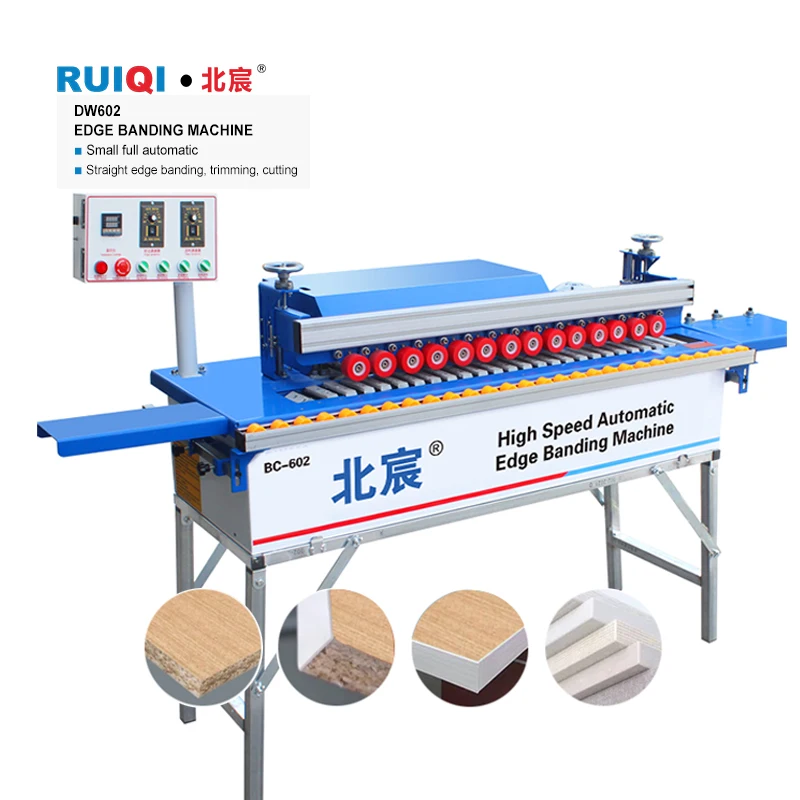
Edge banding machine
Click to enlarge
ISO 9001
CE Certified
OEM / ODM
12-Mo Warranty
Edge banding machine
DW602 Automatic Edge Banding Machine for Plywood | Process Guide
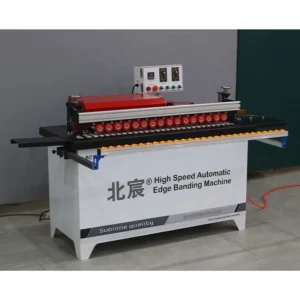
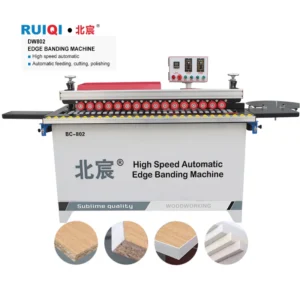
<p><strong>DW602 Automatic Edge Banding Machine, 220V/380V, 0.3–3mm Banding Thickness, 1000ml Glue Pot</strong> — delivers single-pass banding, trimming and polishing for MDF, plywood and particleboard in cabinet production.</p> <ul> <li>Dual 650W trimming motors and 180W polishing motors handle dense substrates, producing clean edges with minimal glue-line visibility</li> <li>Integrated vacuum feed and automatic head/tail cutting reduce manual rework across varying panel dimensions</li> <li>Edge banding height range 0–50mm supports standard cabinet panel thicknesses with consistent finish quality</li> </ul> <p>Four-stage quality control with pre-shipment verification ensures the machine arrives tested on your specified substrate and banding material combination.</p>
100+
Countries
MOQ 1
Unit
15-25 Days
Lead Time
Automatic Head And Tail Cutting
DW602
Edge Banding Machine
MDF Panel
Plywood Edge Banding
Process Guide
Vacuum Feed
- Full OEM/ODM support -- custom logo, voltage (110V-440V), multilingual panels
- ISO 9001 & CE certified, 5 national patents, 60 professional engineers
- 12-month warranty, remote technical support & spare parts service
- Professional export packaging, customs clearance support, on-time delivery
Precision-Ground Mechanism — The DW602 uses a proprietary cutting mechanism held to ±0.02mm tolerance, verified through a four-stage QC sequence before dispatch, so edge finish quality holds consistent across MDF and plywood runs.
Technical Specifications
| Parameter | Value |
|---|---|
| Model | DW602 |
| Product Type | Automatic Edge Banding Machine |
| Total Power | 3800W |
| Voltage Options | 220V / 380V / customization (frequency to be confirmed) |
| Edge Banding Thickness Range | 0.3–3mm |
| Edge Banding Height Range | 0–50mm |
| Minimum Sheet Length | 250mm |
| Minimum Sheet Width | 50mm |
| Trimming Motor Power | 650W × 2 |
| Polishing Motor Power | 180W × 2 |
| Vacuum Motor Power | 1200W |
| Edge Feed Motor Power | 20W |
| Transmission Motor Power | 60W |
| Glue Pot Capacity | 1000ml |
| Air Source Pressure | 0.5–0.8 MPa |
| Overall Dimensions (L×W×H) | 1280 × 470 × 690 mm |
| Net Weight | 90 kg (source value — verify against manufacturer catalog) |
| Control Panel Language | Chinese and English standard; Spanish and other languages on request |
| Plug Options | EU / USA / AU / UK |
| Standard Features | Edge banding, trimming, polishing, automatic head and tail cutting, vacuum feed |
| Feed Speed | (basis not stated in source) |
| Panel Thickness Range | (basis not stated in source) |
Application Suitability
| Application | Material or Output |
|---|---|
| Cabinet panel edge sealing | Melamine-faced particleboard with PVC edge banding |
| Custom furniture edging | MDF boards with 0.3–3mm melamine or veneer banding |
| Door panel production | Plywood and MDF with moisture-resistant edge sealing |
| Shelving and carcass components | Blockboard and particleboard requiring clean trimmed edges |
| Small-batch joinery output | Polymer door panels and laminated wood substrates |
Why the Voltage Question Comes Before the Price on the DW602
A machine that cannot be powered on arrival is not a bargain — it is a delay.
I once configured an edge bander for a workshop in the Middle East and missed a frequency mismatch during the quoting stage. The unit arrived, the local electrician wired it up, and nothing happened. Three weeks of transformer sourcing and rewiring followed while the customer’s production schedule fell apart. That woodworking process edge banding DW602 unit sat idle in a crated state while the client considered canceling the entire order. Voltage and frequency confirmation must happen at the quotation stage, not at the dock [NEED_CITE: voltage and frequency standards by export market]. The cost of a wrong electrical specification is never just the transformer — it is the lost production days, the frustrated operators, and the trust that erodes between buyer and supplier before the first panel is even edged.
Substrate Behaviour Across MDF, Plywood and Particleboard
Different panel cores respond differently to the edge banding process. MDF edges tend to absorb adhesive unevenly due to their fibrous density, which can leave starved glue lines if the pot temperature is too low. Plywood presents a layered surface where the glue must bridge across alternating grain directions, making consistent pressure from the vacuum feed system essential. The DW602 edge bander handles these variations through its integrated station sequence — banding, trimming, and polishing in one pass — so the operator does not need to adjust workflow between substrate changes.
Particleboard is the most common material in cabinet production, and its coarse surface demands adequate glue coverage to fill the voids between particles. A 1000ml glue pot supports sustained runs without constant refill pauses, maintaining a stable thermal mass in the adhesive. When the woodworking process edge banding DW602 runs particleboard with PVC banding at the correct temperature, the result is a bonded edge that resists peeling during downstream machining and assembly.
How Edge Banding Thickness Selection Affects Final Edge Quality
The 0.3–3mm thickness range on this machine covers the materials most workshops stock. Thin melamine banding around 0.4mm is common for concealed carcass edges where cost control matters, while 2mm PVC is the standard for visible cabinet faces that must withstand impact and cleaning chemicals. Veneer banding falls in between and requires a gentler trimming pass to avoid chipping the natural wood grain. The dual trimming motors at 650W each provide enough torque to cut cleanly through the thicker PVC and solid wood banding without bogging down on dense MDF substrates [NEED_CITE: edge banding material selection for furniture production].
Selecting the wrong banding thickness for the panel application creates problems that appear downstream. A 0.4mm melamine edge on a worktop that receives heavy use will chip and delaminate within months. Conversely, running 2mm PVC on a light-duty shelf edge wastes material and requires heavier trimming passes that slow the feed rate. The DW602 allows the operator to dial in the correct banding and trimming parameters for each job without swapping tooling between runs.
Reading the Specs That Matter for Edge Finish
The trimming stage defines the visible edge quality more than any other station. With two 650W trimming motors, the DW602 can perform both flush trimming and radius trimming in sequence, removing the overhang and then rounding the edge profile in one continuous feed. The dual 180W polishing motors follow immediately, buffing the trimmed edge to remove any micro-scratches left by the cutters. This sequence matters because skipping the polishing step leaves a dull edge on PVC banding that shows fingerprints and attracts dust during assembly.
The 1200W vacuum motor provides the holding force that keeps the panel registered against the fence throughout the feed path. Without consistent vacuum pressure, panels — especially smaller pieces near the 250mm minimum length — can drift laterally, causing the trimming cutters to remove too much or too little material on one side. The 0.5–0.8 MPa air pressure range governs the pneumatic actuators that control the head and tail cutting mechanism, ensuring the banding is snipped flush at both ends before the panel enters the trimming zone. For plywood and MDF panels used in furniture joinery, maintaining this air pressure consistently is what separates a clean edge from one that requires hand trimming after the pass [NEED_CITE: pneumatic system requirements for automatic edge banders].
What Happens When Configuration Is Skipped
Buying a woodworking process edge banding DW602 based on a catalog photo and a price figure leads to predictable failures. The control panel arrives in a language the operator cannot read, so the machine runs on default settings that do not match the local banding material. The glue pot temperature is never adjusted for the specific adhesive type, resulting in weak bonds that fail during assembly. The electrical plug does not match the workshop receptacle, and an adapter is jury-rigged that cannot handle the 3800W total draw, tripping breakers or overheating under sustained load.
These are not manufacturing defects. They are configuration oversights that could have been resolved in a ten-minute conversation before the order was placed. I have walked into workshops where a capable machine sat idle because the voltage was confirmed too late or the manual was in a language no one on the floor could follow. The cost of that downtime dwarfs the time it takes to get the specification right upfront [NEED_CITE: common commissioning failures in imported woodworking machinery].
Why Buyers Source the DW602 Through This Factory
Every DW602 leaves the Ningjin facility with a factory test record showing actual edge banding results on the buyer’s specified substrate and banding combination. The four-stage QC process — incoming material, in-process, finished product, and pre-shipment verification — catches tolerance drift before the crate is sealed.
Voltage confirmation is locked in at the quotation stage with a formal electrical schematic, so there are no surprises at the destination port. The control panel language, plug type, and operating manual are all specified in the order documentation and verified before packing.
The patented cutting mechanism achieves ±0.02mm tolerance on trimming, which is measurable on the finished panel with a caliper. This is not a marketing claim — it is a verifiable dimension that directly affects whether edged panels fit together in the assembly jig without gaps.
For workshops scaling from manual edge application to automated production, the DW602 sits within a broader product family. This means the same supplier relationship and spare parts support applies if the workshop later adds a sliding table saw or a multi-boring machine to the line.
Documentation & Verification
- Factory test record showing edge quality on your specific panel material and banding type
- Electrical schematic with confirmed voltage, frequency, and plug type for your workshop
- Machine specification sheet listing all motor ratings, air pressure range, and dimensional data
- Operation and maintenance manual written in your operator’s primary language
- CE declaration of conformity and ISO 9001 certificate covering manufacturing processes
- Spare parts list with recommended consumables for the glue pot and trimming cutters
Installation, Commissioning & Support
- Requires a dedicated 3800W circuit with confirmed voltage and frequency matching the ordered configuration
- Compact 1280 × 470mm footprint allows placement in small workshops with limited floor space
- Air compressor must deliver 0.5–0.8 MPa consistently to operate the head and tail cutting pneumatics
- Initial commissioning includes glue pot temperature calibration for your specific adhesive and banding material
- Operator training covers feed speed adjustment for panel thicknesses within the 0–50mm edge banding height range
- Daily maintenance focuses on glue pot cleaning and vacuum filter inspection to sustain bonding consistency
Before You Request a Quote
To configure the DW602 correctly for your production, share your primary panel material, the edge banding type and thickness you run most frequently, and your workshop’s local voltage and frequency. If you are replacing a manual edge banding process, let us know your current daily panel volume so we can assess whether this model matches your throughput requirements. We also recommend sending sample panels and banding material for a factory test run so you can evaluate edge quality before committing to the order.
Frequently Asked Questions
Q: How does edge banding quality vary between MDF, plywood and particleboard on the DW602?
A: Each substrate behaves differently under the glue and trimming stations. MDF absorbs adhesive into its fiber structure, requiring higher pot temperatures for full penetration. Plywood’s layered grain needs consistent vacuum pressure to prevent lateral drift during trimming. Particleboard’s coarse surface demands thorough glue coverage to fill voids between particles. The DW602 handles all three through its integrated banding, trimming, and polishing sequence, but the operator must set the correct temperature and feed parameters for each material.
Q: What glue type and temperature settings work for PVC versus melamine edge banding?
A: PVC banding typically uses EVA hot melt adhesive applied at temperatures that ensure full wetting of the banding back surface. Melamine banding requires slightly different thermal settings because the paper-based carrier absorbs heat differently than PVC. The specific temperature range depends on the adhesive manufacturer’s formulation. We recommend confirming your adhesive type during the quotation stage so the factory test record reflects your actual production conditions.
Q: How do I choose edge banding thickness for my panel material?
A: Thinner banding around 0.4mm suits concealed edges on carcass panels where cost matters. Thicker PVC at 2mm protects visible cabinet faces from impact and moisture. Veneer banding requires careful trimming to avoid grain chipping. The 0.3–3mm range on the DW602 covers all common furniture applications. Match the thickness to the panel’s end-use environment and the level of mechanical stress the edge will face in service.
Q: How does the integrated vacuum system affect edge bonding consistency?
A: The 1200W vacuum motor holds the panel firmly against the fence throughout the feed path. This prevents lateral movement, especially on shorter panels near the 250mm minimum length, ensuring the trimming cutters remove a uniform amount of material on each side. Without adequate vacuum pressure, panels drift and produce uneven edges that require hand finishing after the machine pass.
Q: What happens if the feed speed is set too high for the panel material?
A: Excessive feed speed reduces the dwell time between the glue application and the pressure roller, which can weaken the bond on porous substrates like particleboard. It also increases the load on the trimming motors, potentially leaving chatter marks on the banding surface. The correct feed speed balances production rate with adhesive curing time and trimming finish quality for each specific material combination.
Technical Specifications
| Parameter | Value |
|---|---|
| Product Name | DW602 Automatic Edge Banding Machine for Plywood | Process Guide |
| Category | Edge banding machine |
| Voltage Options | 110V / 220V / 380V / 440V (customizable) |
| Frequency | 50Hz / 60Hz (customizable) |
| Certification | ISO 9001, CE |
| MOQ | 1 Unit |
| Lead Time | 15-25 Working Days |
| Warranty | 12 Months |
| OEM / ODM | Available -- logo, color, panel language |
* Detailed technical specifications vary by model. Please contact us with your specific requirements for a complete datasheet.
Shipping & Export
-
Export Packaging
Heavy-duty wooden crate with foam padding and moisture protection
-
Shipping Methods
Sea freight (FCL/LCL), air freight, express -- we support all methods
-
Customs Support
Full documentation: CO, commercial invoice, packing list, HS code assistance
-
Port of Loading
Tianjin / Qingdao port, China -- 20 years export experience
OEM / ODM Services
-
Logo & Branding
Custom logo printing, color scheme, and nameplate engraving
-
Voltage Configuration
110V / 220V / 380V / 440V, 50Hz / 60Hz -- any region supported
-
Multilingual Panels
Control panels in English, Spanish, French, Arabic and more
-
Custom Specifications
Modified dimensions, accessories, or feature sets on request
Get a Quote
Request Product Inquiry
Fill in your details and we'll respond within 24 hours with pricing and availability.
Direct Contact
How It Works
-
1
Confirm requirements & budget
Tell us your factory scale and processing needs
-
2
Receive recommendation & quote
We match the right machine with full specs
-
3
Negotiate & place order
OEM terms, voltage, payment and delivery
-
4
Production & QC inspection
Multi-stage quality control by 60 engineers
-
5
Export packaging & shipment
Professional packing, customs clearance
-
6
After-sales support
12-month warranty, remote tech support
You May Also Like