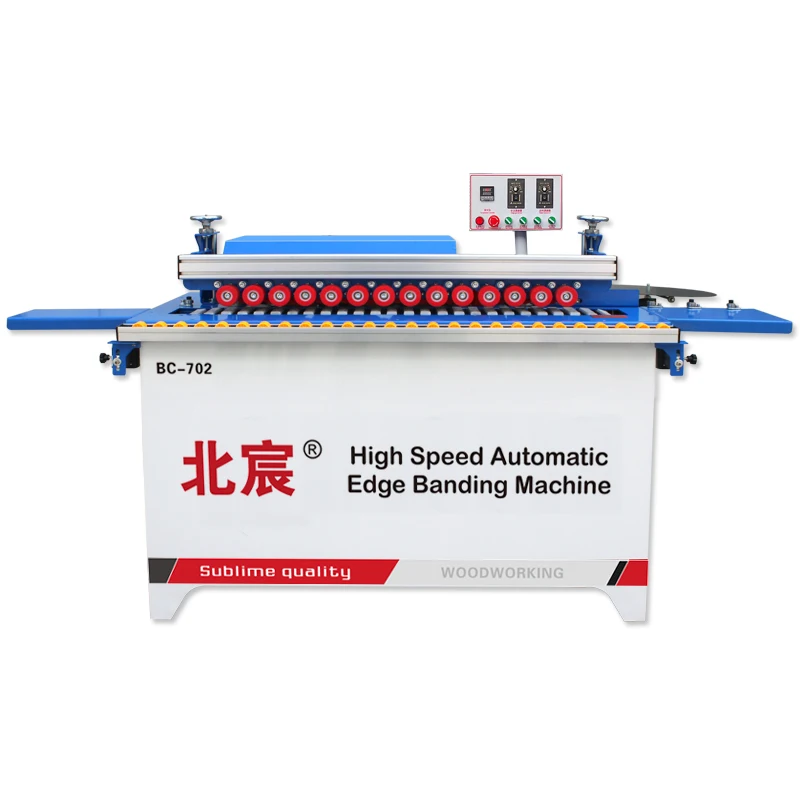
Edge banding machine
Click to enlarge
ISO 9001
CE Certified
OEM / ODM
12-Mo Warranty
Edge banding machine
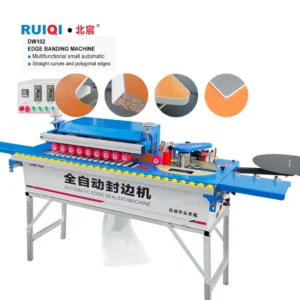
DW702 Automatic Edge Banding Machine for MDF and Plywood Panel
<p><strong>DW702 Automatic Edge Banding Machine, 3800W, 0.3-3MM Banding Thickness, 220V/380V</strong> — integrates gluing, trimming, and polishing in one pass for MDF, particleboard, and plywood panels.</p> <ul> <li>Dual 800W trimming motors deliver flush edge-to-panel transitions, reducing visible glue lines across varying substrate densities.</li> <li>Edge banding height 0-50MM with automatic head and tail cutting ensures consistent end-finish on panels as short as 25CM.</li> <li>1000ml glue pot supports continuous runs, minimizing refill stops during production shifts.</li> <li>Voltage and control panel language customizable to match your workshop's power supply and operator requirements.</li> </ul> <p>Engineer-led configuration with formal quotation within 24 hours, backed by four-stage QC and pre-shipment test records verifying trimming tolerance on your specific substrate.</p>
100+
Countries
MOQ 1
Unit
15-25 Days
Lead Time
Dual Trimming
DW702
Edge Banding Machine
Glue Application
MDF Cabinet
Plywood Panel
Vacuum System
- Full OEM/ODM support -- custom logo, voltage (110V-440V), multilingual panels
- ISO 9001 & CE certified, 5 national patents, 60 professional engineers
- 12-month warranty, remote technical support & spare parts service
- Professional export packaging, customs clearance support, on-time delivery
Precision-Ground Edge Finishing — Every DW702 rolling off the line carries a four-stage QC record showing verified flush trimming and polishing output before it leaves the factory floor.
Technical Specifications
| Parameter | Value |
|---|---|
| Model | DW702 |
| Product Type | Automatic Edge Banding Machine |
| Total Power | 3800W |
| Voltage | 220V/380V/customization |
| Trimming Power | 800W × 2 |
| Polishing Power | 180W × 2 |
| Vacuum Power | 1200W |
| Transmission Power | 140W |
| Edge Power | 20W |
| Glue Pot Capacity | 1000ml |
| Edge Banding Thickness Range | 0.3–3 mm |
| Edge Banding Height Range | 0–50 mm |
| Minimum Sheet Length | 25 cm |
| Minimum Sheet Width | 10 cm |
| Air Source Pressure | 0.4–0.8 MPa |
| Key Features | Edge banding, trimming, polishing, automatic head and tail cutting, vacuum hold-down |
| Control Language Options | Chinese, English; customizable to Spanish or other languages |
| Plug Options | EU, USA, AU, UK |
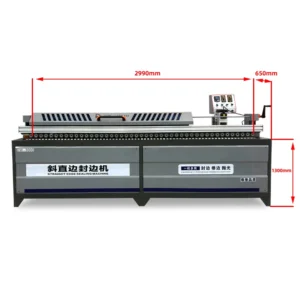
| Product Dimensions | 120 × 55 × 110 cm |
| Product Weight | 105 kg |
Application Suitability
| Application | Material or Output |
|---|---|
| Cabinet door and carcass production | MDF and particleboard with PVC or melamine banding |
| Plywood furniture panel finishing | Plywood panels with veneer or thin PVC edge banding |
| Polymer door edge sealing | Non-porous polymer substrates requiring consistent glue adhesion |
| Blockboard shelving and worktops | Blockboard with thicker banding up to 3 mm |
| Small-batch custom joinery | Mixed material runs on a single compact machine footprint |
Why the Substrate Pile Matters More Than the Spec Sheet
Edge banding adhesion fails on the shop floor, not in the showroom. A woodworking edge banding machine process application that looks flawless on MDF test samples can fall apart the moment a production manager switches to low-density particleboard without recalibrating glue temperature or pressure settings. I have watched three full production days evaporate on a Middle East cabinet project because the substrate changed without anyone updating the machine setup.
Visible glue lines, peeling banding mid-run, and inconsistent end cuts are symptoms, not root causes. The real failure happens upstream when machine configuration is locked before the actual material stack is identified. Glue behaviour on porous particleboard differs fundamentally from sealed MDF or non-porous polymer substrates, and each demands its own temperature curve, pressure adjustment, and feed pacing. [NEED_CITE: wood adhesive bonding behaviour across composite panel substrates]
Glue Application Behaviour Across Substrate Types
The DW702 runs a 1000 ml glue pot feeding hot melt adhesive through a controlled roller to the panel edge. On dense MDF, the glue film stays on the surface and bonds quickly under pressure. Particleboard absorbs adhesive differently, often starving the joint line if the pot temperature or roller gap is not adjusted for the material’s porosity. Polymer door profiles sit at the other extreme, rejecting adhesion entirely if the surface energy and glue temperature are not matched. Understanding this woodworking edge banding machine process application across substrates is what separates clean production runs from constant line stoppages.
Trimming and Polishing as a Single Continuous Pass
Two 800W trimming motors work sequentially to cut excess banding flush with the top and bottom panel faces. The polishing stage then uses dual 180W motors to buff the trimmed edge smooth. When these stations are correctly aligned, the panel exits the machine ready for assembly without secondary hand finishing. Misalignment or worn trimming cutters show up immediately as visible ridges or chipped edges, particularly on brittle melamine banding at the 0.3 mm end of the thickness range. [NEED_CITE: edge trimming quality standards for panel furniture components]
Reading the Specification Sheet for Production Impact
The 0.3–3 mm banding thickness range covers the three most common materials in cabinet and furniture work: thin PVC, standard melamine, and thicker veneer strips. Switching between these within a shift means the operator must adjust the pressure roller gap and trimming cutter depth, not just the glue temperature. The 0–50 mm banding height accommodates standard 18 mm board as well as thicker blockboard and polymer profiles. The 25 cm minimum sheet length and 10 cm minimum width allow small offcuts and narrow drawer sides to be edged, which matters for custom joinery shops processing mixed panel sizes rather than uniform cabinet runs.
The Cost of Skipping the Material Test Run
Specifying an automatic edge banding machine without running the actual production substrate through it leads to predictable consequences. Banding peels off during assembly, forcing rework and material waste. Trimming stations set for MDF leave chipped edges on particleboard, generating reject panels that never reach the packing bench. Operators spend shift time adjusting rather than producing, and the downtime compounds across every downstream station waiting for edged panels. These losses are difficult to trace back to a single configuration decision made at the ordering stage. [NEED_CITE: hidden costs of substrate-machine mismatch in panel furniture manufacturing]
What Backs This Machine Beyond the Brochure
In-house manufacturing with a patented cutting mechanism means the trimming stations on the DW702 are not generic sourced assemblies bolted onto a frame. The four-stage QC process runs incoming material inspection through to pre-shipment verification, so the edge finish on your test panels matches the machine that arrives at your dock. Voltage and frequency are confirmed against your local supply before production begins, eliminating the scenario where a machine arrives and cannot be powered. An engineer-led configuration recommendation with a formal quotation within 24 hours means the DW702 is matched to your actual substrate and banding material, not just quoted from a standard list. Factory visits are open, so you can watch your own material run through the machine before committing to the order.
Documentation & Verification
- CE declaration of conformity matching the DW702 configuration shipped
- Electrical schematic with confirmed voltage and plug type for your facility
- Factory test record on your specified panel material and banding thickness
- Operation manual in the agreed control panel language before dispatch
- Spare parts list covering trimming cutters, polishing wheels, and glue pot components
Installation, Commissioning & Support
- The 120 × 55 × 110 cm footprint fits standard workshop benches without special flooring
- Dedicated 3800W circuit required at the confirmed voltage with correct plug type
- Air supply line rated 0.4–0.8 MPa must be stable before first run
- Glue pot loaded and temperature calibrated to your specific banding material on commissioning
- Trimming and polishing stations aligned to your panel thickness during initial setup
- Chinese or English control panel standard, with Spanish or other languages configured before shipment
Before You Request a Quotation
Send a sample of the primary panel material you will be edging, along with the banding type and thickness you plan to run. Confirm your workshop voltage and frequency so the machine is built to match. Let us know the control panel language your operators read and whether you need a sample processing test on your material before order confirmation.
Frequently Asked Questions
Q: How does substrate type affect glue application and edge finish on the DW702?
A: MDF accepts hot melt glue evenly due to its dense sealed surface, while particleboard absorbs adhesive differently and may require higher pot temperature or adjusted roller pressure. Polymer substrates need specific surface energy matching. Each material change on the DW702 requires the operator to recalibrate glue temperature, pressure gap, and feed pacing to maintain clean bond lines without visible excess or starvation at the joint.
Q: What edge banding materials are compatible with the 0.3–3 mm thickness range?
A: The DW702 handles thin PVC at the 0.3 mm end, standard melamine strips in the mid-range, and thicker veneer banding up to 3 mm. Each material responds differently to trimming and polishing, with brittle melamine requiring sharper cutter geometry and veneer needing gentler polishing pressure. Operators switching between materials within a shift should adjust trimming depth and polishing speed accordingly.
Q: How does automatic head and tail cutting affect end-finish quality on short panels?
A: The automatic head and tail cutting function trims banding overhang at both panel ends as the sheet passes through, producing a consistent square finish without manual intervention. On the DW702, this is particularly relevant for panels near the 25 cm minimum length, where manual end trimming would be awkward and inconsistent. The result is uniform end-finish quality across both full-size sheets and small offcut pieces.
Q: What air supply conditions are needed for consistent trimming and polishing?
A: The DW702 requires a stable air source between 0.4 and 0.8 MPa to actuate pneumatic components in the trimming and polishing stations. Pressure drops below 0.4 MPa cause inconsistent cutter engagement, leaving untrimmed edges or partial cuts. Fluctuating supply leads to variable polishing pressure and uneven surface finish. A dedicated regulated line with a moisture trap at the machine inlet maintains consistent pneumatic performance across full production shifts.
Q: How does glue pot capacity translate to continuous run time before refill?
A: The 1000 ml glue pot on the DW702 holds enough hot melt adhesive for sustained edge banding runs on standard cabinet panels before requiring a top-up. Actual run time between refills depends on banding thickness, panel edge length per cycle, and glue application rate. Thicker 3 mm banding consumes more adhesive per linear meter than 0.3 mm PVC, so shops running heavier banding profiles will refill more frequently during a shift.
Technical Specifications
| Parameter | Value |
|---|---|
| Product Name | DW702 Automatic Edge Banding Machine for MDF and Plywood Panel |
| Category | Edge banding machine |
| Voltage Options | 110V / 220V / 380V / 440V (customizable) |
| Frequency | 50Hz / 60Hz (customizable) |
| Certification | ISO 9001, CE |
| MOQ | 1 Unit |
| Lead Time | 15-25 Working Days |
| Warranty | 12 Months |
| OEM / ODM | Available -- logo, color, panel language |
* Detailed technical specifications vary by model. Please contact us with your specific requirements for a complete datasheet.
Shipping & Export
-
Export Packaging
Heavy-duty wooden crate with foam padding and moisture protection
-
Shipping Methods
Sea freight (FCL/LCL), air freight, express -- we support all methods
-
Customs Support
Full documentation: CO, commercial invoice, packing list, HS code assistance
-
Port of Loading
Tianjin / Qingdao port, China -- 20 years export experience
OEM / ODM Services
-
Logo & Branding
Custom logo printing, color scheme, and nameplate engraving
-
Voltage Configuration
110V / 220V / 380V / 440V, 50Hz / 60Hz -- any region supported
-
Multilingual Panels
Control panels in English, Spanish, French, Arabic and more
-
Custom Specifications
Modified dimensions, accessories, or feature sets on request
Get a Quote
Request Product Inquiry
Fill in your details and we'll respond within 24 hours with pricing and availability.
Direct Contact
How It Works
-
1
Confirm requirements & budget
Tell us your factory scale and processing needs
-
2
Receive recommendation & quote
We match the right machine with full specs
-
3
Negotiate & place order
OEM terms, voltage, payment and delivery
-
4
Production & QC inspection
Multi-stage quality control by 60 engineers
-
5
Export packaging & shipment
Professional packing, customs clearance
-
6
After-sales support
12-month warranty, remote tech support
You May Also Like